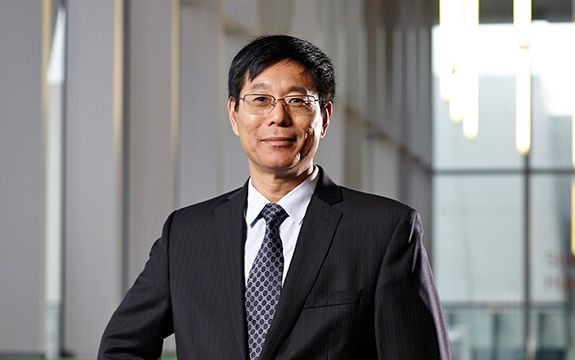
Professor Qing-Long Han is Pro Vice-Chancellor (Research Quality) and Distinguished Professor at Swinburne University of Technology, Australia. He has previously held academic and leadership roles at Griffith University and Central Queensland University. He is a globally recognized expert in control theory and engineering, particularly in networked and time-delay systems. Pro Vice-Chancellor (Research Quality), Swinburne University of Technology Distinguished Professor, Swinburne University of Technology Editor-in-Chief, IEEE/CAA Journal of Automatica Sinica President-Elect, Asian Control Association His research interests span Control Engineering, Networked Control Systems, Multi-Agent Systems, Smart Grids, Unmanned Surface Vehicles, Neural Networks, and Secure Control . He is deeply involved in resilient and secure control under cyber threats, optimization, and industrial metaverse applications. His work integrates control theory with AI, IoT, and industrial automation. The recent publications highlight a strong trend toward secure, resilient, and distributed control in cyber-physical systems, particularly under attacks (replay, falsification), communication constraints, and delays. There is a clear focus on real-world applications in autonomous vehicles, trains, drilling systems, and chiller networks, using advanced methods such as reinforcement learning, event-triggering, and neurodynamic optimization. Award highlights include: IEEE Dr.-Ing. Eugene Mittelmann Achievement Award (2024) Norbert Wiener Award (2021) M. A. Sargent Medal (2021) IEEE Andrew P. Sage Best Paper Award (2019, 2020, 2022) Highly Cited Researcher (Clarivate, multiple years) Professor Han actively supervises PhD students in cutting-edge control topics and leads major research grants from the Australian Research Council and National Natural Science Foundation of China. He is a Fellow of IEEE, IFAC, Engineers Australia (Honorary), and the Chinese Association of Automation. He also contributes to editorial leadership in top journals and professional societies. He is associated with research teams and editorial boards in control systems, automation, and intelligent systems, fostering international collaboration and innovation in engineering.