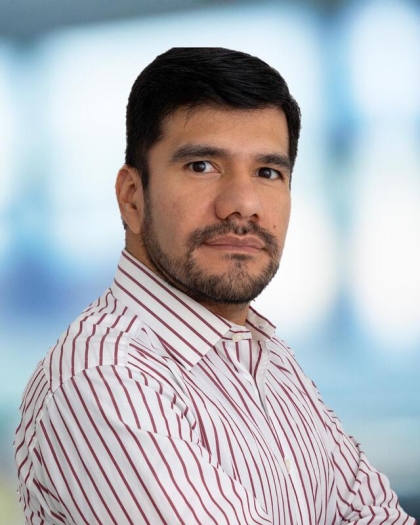
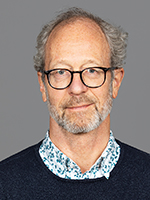
Hugo Jose Herrera de Leon is a Research Fellow at the Department of Geography, University of Bergen. His work focuses on socio-ecological resilience, system dynamics modeling, and policy planning for climate change adaptation. He is affiliated with the System Dynamics research group and has presented at major international conferences like the European Conference on Operational Research and the International System Dynamics Conference. His research explores bioeconomy transitions in Norwegian agriculture, resilience in farming systems, and participatory policy design. He has been funded by the Research Council of Norway (2021-2025) for projects investigating sustainable transitions in rural systems. Notable contributions include developing frameworks for assessing resilience through hybrid simulations and collaborative modeling approaches. Publications span topics like microworld simulations for policymaking, organizational impacts of group model-building, and system dynamics applications in food security. His doctoral thesis (2018) addressed public policy strategies for enhancing resilience in socio-ecological systems under climate change.
Habib Ullah is an Associate Professor in Data Science at the Norwegian University of Life Sciences (NMBU), Norway, where he conducts research at the intersection of computer vision and machine learning. He is affiliated with the Institute of Data Science under the Faculty of Science and Technology. He has previously held academic positions at COMSATS University Islamabad, Pakistan, and the University of Ha'il, Saudi Arabia, and served as a postdoctoral researcher at The Arctic University of Norway. Educational Background: PhD in Information and Communication Technology (Computer Vision), University of Trento, Italy (2011–2015) MSc in Electronics and Computer Engineering, Hanyang University, South Korea (2007–2009) BSc in Computer Systems Engineering, NWFP University of Engineering and Technology, Pakistan (2002–2006) Habib Ullah's research is primarily focused on computer vision and machine learning, with applications in aquaculture, agriculture, and human behavior analysis. He investigates underwater fish feeding sounds using audio classification, develops zero-shot learning models for recognizing unseen classes, and applies deep learning to detect stress in salmon via skin dot patterns. He also explores AI-driven controlled environment agriculture, leveraging sensors and automation for optimal crop growth. His work emphasizes practical AI solutions for real-world challenges in environmental and biological domains. The recent publications highlight a strong trend in leveraging deep learning for zero-shot and semi-supervised learning, particularly in computer vision tasks such as sea ice classification, crowd anomaly detection, and agricultural monitoring. His research spans remote sensing, biomedical signal processing, and human activity recognition, demonstrating interdisciplinary versatility. The keywords reflect a focus on robust feature representation, knowledge transfer, and model generalization. Scientific Awards and Funding: Industrial PhD grant 'Advancing Controlled Environment Agriculture AI' from The Research Council of Norway (Project number 354125, 2 million NOK, 2024) Team member (Coordinator-Participant) in the Battery Cell Assembly Twin (BatCAT) project funded by Horizon Europe (7 mEuro, 2023–2027) Development of an AI-Based Image Analysis System for Monitoring Plant Status (Funding: 1.8 mNOK, starting 2025) Habib Ullah actively supervises PhD projects and contributes to academic service through editorial and organizational roles. He has served as an Associate Editor for IEEE Access, Guest Editor for MDPI Remote Sensing, and Editor of the Springer book Machine Learning Techniques and Sensor Applications for Human Emotion, Activity Recognition, and Support (ML-SHEARS) . He has also been a Track Chair and Program Committee Member for several international conferences, reflecting his leadership in the academic community. His research is supported by significant grants and collaborative projects, indicating strong institutional and international engagement. He is involved in multiple research teams and projects, including the BatCAT project on battery manufacturing and AI applications in controlled environment agriculture with RIFT LABS AS. His lab work integrates deep learning, sensor fusion, and data analytics for environmental and biological monitoring systems.
Norwegian University of Science And TechnologyNorway
Nadia Shardt is an Associate Professor in the Department of Chemical Engineering at the Norwegian University of Science and Technology (NTNU). Her research focuses on interfacial thermodynamics, particularly in systems with nanoscale curvature, with applications spanning atmospheric science, biomedical cryopreservation, and industrial process optimization. She contributes to teaching courses such as TKP4580 - Chemical Engineering Specialization Project and KP3100 - Chemical Engineering . PhD in Chemical Engineering (University of Alberta, 2019) BSc in Chemical Engineering (University of Alberta, 2015) Postdoctoral researcher at ETH Zurich (2020-2022) Her work addresses fundamental challenges in phase behavior under curvature constraints, combining microfluidic experimentation , Gibbsian thermodynamic modeling , and machine learning techniques to study systems like CO 2 storage media, cloud microphysics, and food emulsions. Recent publications emphasize surface tension modeling for complex multi-component systems and cryoprotectant loading efficiency. Scientific awards include the ETH Postdoctoral Fellowship Natural Sciences and Engineering Research Council of Canada (NSERC) Postdoctoral Fellowship Outstanding Academic Fellows Programme 2024-2028
Hans Christopher Bernstein is a Professor at the Norwegian Fisheries College, UiT The Arctic University of Norway, and affiliated with the Arctic Centre for Sustainable Energy (ARC). His research focuses on biotechnology, microbial ecology, synthetic biology, and microalgal carbon capture and utilization. University: UiT The Arctic University of Norway School: Norwegian Fisheries College Research Group: Microalgae & Microbiomes Research Centers: Arctic Centre for Sustainable Energy (ARC) Bernstein’s work explores the intersection of biotechnology and microbial ecology, particularly in synthetic biology applications for carbon capture. His research includes modeling microbial processes, studying lipidome plasticity in Arctic diatoms, and developing engineered genetic circuits for microbial consortia. Key trends in his publications involve marine microbiome dynamics, cold seep ecosystems, and daylight-driven carbon exchange in structured microbial communities. Recent articles highlight advancements in microalgal biotechnology for industrial carbon capture, synthetic genetic circuits, and spatiotemporal metabolic network models. His work spans both theoretical modeling (e.g., neighbor-dependent interaction inference) and applied biotechnological solutions (e.g., EcoFABS fabricated ecosystems).
Norwegian University of Science And TechnologyNorway
Knut Tore Alfredsen is a Professor in the Department of Civil and Environmental Engineering at NTNU. His research focuses on cold climate hydrology, environmental impacts of hydropower, river ice dynamics, and water resource management. He leads projects like Trygg Elv (flood detection tools) and Hydro Connect (climate change mitigation in hydropower). He supervises numerous PhD and master’s students and teaches courses in hydrology, hydropower engineering, and environmental design. His work combines field measurements, data analysis, and advanced modelling, often using LiDAR and remote sensing technologies. Key projects include Sagelva research catchment studies and evaluations of environmental impacts from hydropeaking and reservoir operations. He is an active contributor to international conferences and collaborates with organizations like NVE and the IAHR. Education: Not explicitly stated in the provided text. Affiliations: HydroCen, Center for Renewable Energy (FME), NTNU’s Civil and Environmental Engineering Department. Grants: Involved in projects like HydroFlex (turbine development) and Klima 2050 (runoff estimation). Awards: None explicitly mentioned. Labs/Teams: Leads research groups in ecohydraulics, river modelling, and cold climate hydrology. Research Highlights: Focuses on ice-jam flood hazards, hydropeaking effects on fish, and sustainable hydropower practices. Recent work includes LiDAR-based river bathymetry and historical river development analysis using AI.
Norwegian University of Science and TechnologyNorway
Guangyu Cao is a Professor at the Department of Energy and Process Engineering, Norwegian University of Science and Technology (NTNU). He holds leadership roles in multiple international organizations, including the European standards working group CEN TC156 WG18, REHVA's technical committee, and the editorial board of the Journal of Building Engineering (Impact Factor 5.318). His research focuses on indoor airflow dynamics, ventilation systems in healthcare settings, and airborne disease transmission mitigation, with a strong emphasis on surgical environments and school buildings. Education: PhD in Energy Engineering (2009), Helsinki University of Technology Senior Researcher at VTT Technical Research Center (2009-2014) Research Interests: Hospital ventilation optimization, thermal comfort in clinical settings, airborne infection control, and sustainable building environmental quality. He combines experimental studies with mathematical modeling to evaluate ventilation strategies, particularly in operating rooms and isolation wards. Projects: EU Marie Curie DTN HumanIC (2024–2027) EU H2020 iclimabuilt (2021–2025) NFR POSIred (2020-2024) Labs/Teams: Collaborates with St. Olav's Hospital on indoor environment projects and leads teams in Cold Climate HVAC and Healthy Building Europe initiatives.
Katrine Eldegard is a Professor at the Norwegian University of Life Sciences (NMBU), Faculty of Environmental Sciences and Natural Resource Management (MINA), Department of Ecology and Natural Resource Management (INA). She leads BatLab Norway and contributes extensively to national and international conservation science policy. Institution: Norwegian University of Life Sciences School: Faculty of Environmental Sciences and Natural Resource Management Department: Department of Ecology and Natural Resource Management Position: Professor Her research centers on understanding how human activities and land use affect natural ecosystems and species across taxa and spatial scales. She specializes in the behavioral, population, and community-level responses of mammals, birds, and insects to anthropogenic pressures such as energy infrastructure, transport networks, and forestry. A major focus is on bat ecology and conservation, pollination dynamics, and biodiversity monitoring in boreal and agricultural landscapes. Her recent publications reveal strong trends in climate change impacts on bat morphology and distribution, pollinator-plant interactions under environmental change, and the ecological consequences of infrastructure development. These works integrate field ecology with advanced modeling and policy-relevant assessments. She has played leading roles in key scientific committees: Chair, Mammal Committee, Norwegian Red List for Species (2021) Chair, Mammal Committee, Norwegian Alien Species List (2023) Member, Norwegian Scientific Committee for Food and Environment (VKM), CITES Expert Panel Norway’s representative, UNEP/Eurobats Advisory Committee Eldegard has supervised numerous research projects and collaborated with government agencies and private partners on applied ecology. She teaches courses including NATF200 Vern og forvaltning av norsk natur and the upcoming NATF300 Conservation Science. Her work is supported by extensive fieldwork, interdisciplinary collaboration, and integration of ecological theory with practical conservation. She leads BatLab Norway, a research group dedicated to advancing knowledge on bat ecology, behavior, and conservation through innovative methods including telemetry, acoustic monitoring, and landscape analysis.
Norwegian University of Science and TechnologyNorway
Edgar Hertwich is a Professor of Industrial Ecology at the Department of Energy and Process Engineering, Faculty of Engineering, Norwegian University of Science and Technology (NTNU). He is on partial leave from NTNU, serving as a Senior Researcher at the International Institute for Applied Systems Analysis (IIASA) in Austria and as a partner in the environmental data company XIO Sustainability Analytics. His work bridges academic research and practical applications for climate mitigation. Current affiliations: NTNU (Professor), IIASA (Senior Researcher), XIO Sustainability Analytics (Partner) Previous roles: Professor at Yale University (2015-2019), Fellow at Yale (2019-2022), Professor at NTNU (2003-2015) Hertwich's research focuses on industrial ecology, examining material flows in economic systems to advance climate protection and sustainable development. His work spans machinery, buildings, urban form, and food supply systems, employing life cycle analysis, cross-flow analysis, and economic modeling. He contributes to global policy frameworks like the UN's Circular Economy Action Plan and EU Climate Council reports. Recent projects include CIRCOMOD (Circular Economy Modeling for Climate Mitigation) and RAINFOREST (knowledge co-production for biodiversity). He has been recognized with NTNU's Prize for Research and Artistic Activity (2023) for his contributions. Scientific Awards NTNU's Prize for Research and Artistic Activity (2023) Editorial Roles Environmental Science & Technology Journal of Industrial Ecology Journal of Economic Structures As a thought leader in industrial ecology, Hertwich connects technical insights to policy, emphasizing material efficiency and resource allocation. His work influences EU climate strategies and global environmental assessments.
Norwegian University of Science And TechnologyNorway
Hans Bihs is a Professor in the Department of Civil and Environmental Engineering, Faculty of Engineering. His research focuses on computational fluid dynamics (CFD), wave hydrodynamics, and wave-structure interaction using the open-source framework REEF3D. Key Research Areas: CFD simulations, wave modeling, floating body dynamics, ocean wave energy, aquaculture hydrodynamics, sediment transport, and high-performance computing. Projects: ERC Consolidator Grant PARTRES (2023-2028), EEA Grants Portugal SurfWave (2023), NFR KPN IPIRIS (2021-2025), EEA Baltic SolidShore (2021-2024), NTNU's MAPLE (2022-2025), and DigiCoast (2021-2024). Email: hans.bihs@ntnu.no His recent publications (2025-2020) analyze fluid-structure interaction, ship-induced waves, floating offshore wind turbines, submerged vegetation, and coastal structures using advanced CFD techniques. Topics include wave hydrodynamics, turbulence, and numerical modeling for marine and aquaculture systems.
Dieu Tien Bui is a Full Professor in the Department of Business and IT at the University of South-Eastern Norway (USN) School of Business. His research focuses on Geospatial Artificial Intelligence Machine Learning GIS and Remote Sensing Natural Hazard Modeling Environmental Problems (landslides, floods, soil salinity, biomass) . He has contributed to over 15 recent publications in journals like Science of the Total Environment , Remote Sensing , and Geomorphology , emphasizing hybrid AI models for landslide and flood susceptibility. His work spans Vietnam, India, China, and Iran with applications in climate change adaptation and disaster management. Scientific Awards: Global Highly Cited Researcher PhD Supervision: He has supervised 8 PhD students at institutions including USN, NTNU, and Vietnamese universities.
Norwegian University of Science and TechnologyNorway
Terje Andreas Eikemo is a Professor at the Department of Sociology and Political Science , Norwegian University of Science and Technology (NTNU) , and Head of the CHAIN research center . His work focuses on the intersection of social inequality , public health , and global policy , emphasizing how socioeconomic factors like education , income , and welfare systems influence mortality , chronic diseases , and mental health . He combines theories from sociology , epidemiology , and medicine to address health disparities across diverse contexts, including pandemics , climate change , and migration . 2009: Prize for Young Researchers in the Humanities 2010: SINTEF Prize for Outstanding Research 2014: NTNU Star Program Eikemo has published extensively in top journals like The Lancet and BMJ Open , with research themes spanning social determinants of health , policy interventions , and global health equity . His work includes GBD studies , European Social Survey analyses , and refugee health assessments. He serves as Editor-in-Chief of the Scandinavian Journal of Public Health and collaborates with international bodies like WHO and UNESCO .
Professor Inge Hoff is affiliated with the Norwegian University of Science and Technology (NTNU) in the Department of Civil and Environmental Engineering, where he has served since 2009. Prior to this, he held roles as senior researcher and research leader at SINTEF. Research Interests : Materials for road construction, frost protection, laboratory testing, pavement dimensioning, road rehabilitation, state development modeling, ground-penetrating radar surveys, and concrete/natural stone coverings. Students : Mentors active PhD fellows Lisa Hannasvik, Arman Hamidi, Clara Weber, and Shoiab Ahmad. Teaching : Coordinates courses like TBA4204/BYGT1102 Transport Infrastructure , BYGT2204 Road and Railway Construction , and BA8600 Pavement Structure Dimensioning . Recent publications highlight his expertise in granular material behavior, asphalt durability under climate stressors, and advanced structural assessment techniques. Collaborations with international researchers and presentations at major conferences (TRB, International Conference on Bituminous Mixtures) demonstrate his ongoing contributions to road engineering.
Norwegian University of Science And TechnologyNorway
Nicola Paltrinieri is a Professor of Risk Assessment at the Department of Mechanical and Industrial Engineering, NTNU (Norway), and an Adjunct Professor at the University of Bologna (Italy). His expertise spans risk assessment, hydrogen technologies, process safety, and data-driven safety management. He holds Chartered Engineer and Chartered Scientist certifications and has served on editorial boards for journals like Safety Science and Journal of Risk Research . Education: PhD in Environmental, Safety and Chemical Engineering (University of Bologna, 2012) Master’s in Chemical and Process Engineering (University of Bologna, 2008) Research Interests: Focuses on hydrogen infrastructure safety, Natech accident analysis, risk-based inspection strategies, and AI integration in safety systems. His work emphasizes sustainable energy transitions and mitigating risks in emerging technologies like hydrogen. Key Projects (2022-2026): H2Glass : Decarbonizing glass and aluminum sectors via hydrogen HyInHeat : Hydrogen technologies for industrial heating HYDROGENi : Norwegian research center for hydrogen/ammonia Awards: Onsager Fellowship (2016–2021) Frank Lees Medal (2012) for safety-related publications Grants & Leadership: Head of NTNU Energy Team Hydrogen, coordinator for EU-funded projects like SUSHy , and active in international risk committees (e.g., EFCE, ESRA). His work bridges academia and industry, with over 8 PhD examinations supervised. Labs/Teams: Leads the NTNU Energy Team Hydrogen and collaborates on initiatives like SH2IFT-2 for safe hydrogen fuel handling. His research group focuses on AI-driven risk analysis and hydrogen infrastructure resilience.
Ronny Scherer is Center Director and Professor at CEMO (Center for Educational Measurement) and Deputy Director at CREATE (Center for Research on Equality in Education) at the University of Oslo's Faculty of Educational Sciences. His work bridges educational measurement, assessment, and evaluation with a focus on research syntheses and complex sampling surveys. Dr. Scherer's research spans two interconnected domains: substantive areas including digital divides, equity and equality in education, and measurement of complex cognitive skills (such as complex problem solving, adaptability, computational thinking, and executive functioning); and methodological areas focusing on advanced meta-analytic techniques, multilevel structural equation modeling, and spatial analysis of complex survey data. His work frequently utilizes international large-scale assessment data from PISA, ICILS, TIMSS, PIRLS, PIAAC, and TALIS. His publication record demonstrates a clear trajectory toward increasingly sophisticated meta-analytic approaches, with recent work focusing on second-order meta-analyses, AI-assisted screening methods, and advanced techniques for handling complex survey data. His research consistently addresses critical educational challenges related to equity, digital literacy, and measurement of 21st century skills. Dr. Scherer has secured significant research funding for projects including ARISE (Academic resilience in mathematics and science among vulnerable students), DiDiRes (Digital inequalities in education), and ADAPT21 (Educational assessments of the 21st century: Measuring and understanding students' adaptability in complex problem solving situations). Co-director of CREATE (Centre for Research on Equality in Education) since 2023 Professor of Educational Assessment and Measurement at CEMO since 2019 Extensive experience with international large-scale assessments including ICILS, TALIS, and PIAAC As an educator, Dr. Scherer teaches advanced courses in measurement models, multilevel models, meta-analysis, and equity in education. He actively supervises graduate students interested in his research areas and has developed numerous workshops on structural equation modeling and meta-analytic methods for international audiences.
Rune Svarverud is a Professor at the Department of Culture, Religion, Asian and Middle Eastern Studies, Faculty of Arts, University of Oslo. His research spans two major periods in Chinese history: early Chinese philosophy (pre-Qin to Han dynasties) and modern China (post-Opium War cultural encounters). Key research areas include conceptual history, environmental history, political philosophy, and cross-cultural translation studies. Permanent employee since 2004 Head of Department since 2021 Former PhD committee member and research leader (2007-2014) Active in international collaborations with Fudan, Nanjing, Kansai, and Zhejiang Universities His academic work focuses on: History of concepts and textual analysis in Chinese thought Environmental history and terminology evolution in modern China Qing dynasty legal and political philosophy Translation of Western knowledge into Chinese Interactions between Chinese and Western modernity Individualism in 20th-century Chinese society Recent publications examine environmental terminology, cross-cultural scientific translation, and conceptual frameworks in Qing reform. His interdisciplinary approach connects philosophy, law, and environmental studies through historical analysis. Co-edited works on standard languages and cultural communication Contributor to ACTA ORIENTALIA and PNAS Recipient of multiple research grants for Transsustain project