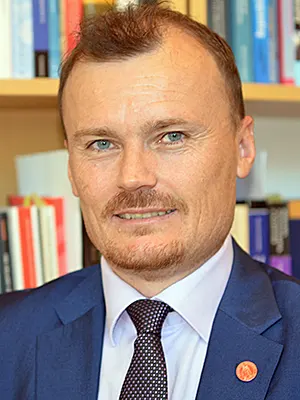
Oleksandr Kapranov is an Associate Professor of English at NLA University College's Teacher Education program. His work intersects discourse analysis, climate change communication, and English language teaching (ELT), with a focus on sustainable development education and intercultural communication. Research areas include political speeches (e.g., Keir Starmer, Rishi Sunak), corporate disclosures (Bank of England, Vedanta Resources), and media framing (Greenpeace branches, King Charles III). Key pedagogical interests: digital competence, beginner EFL training, and discourse markers in academic writing. His recent publications analyze climate change discourse through syntactic structures, metonymy, modality, and evidentiality, emphasizing institutional and political narratives. While no formal awards are listed, his work spans interdisciplinary collaborations with NGOs, governments, and universities.
Britt Kramvig is a Professor at the School of Business and Economics , part of the Faculty of Biosciences, Fisheries and Economics (BFE) at UiT The Arctic University of Norway. Her research intersects decolonization , Indigenous (Sámi) studies, and creative industries , with a focus on storytelling, archive decolonization, and Arctic land-seascapes. She coordinates PhD studies in Tourism and Northern Studies and teaches courses on qualitative methods, climate change impacts on tourism, and knowledge co-production. Research Interests: Kramvig explores the decolonial potential of Indigenous archives , creative industries as decolonial praxis , and Arctic environmental humanities . Her work emphasizes ontology over epistemology , art-science collaborations (e.g., Dark Ecology, BAT), and indigenous survivance in tourism and cultural policy. She actively disrupts appropriation processes in Arctic landscapes through pluriversal storytelling. Key Collaborations: Kramvig contributes to international projects like Surviving the Unthinkable and The New Sámi Renaissance , advocating for indigenous data sovereignty and decolonial research ethics . She leads interdisciplinary efforts to integrate Sámi epistemologies into environmental science and policymaking. Recent Publications: Her 2023-2025 works address Arctic decolonization , indigenous archival practices , and co-creation in tourism , often published in journals like Environmental Research Letters and GeoHumanities . Notable topics include counter-mapping , indigenous survivance , and collaborative listening in Arctic soundscapes. Academic Affiliations: Member of the Norwegian Scientific Academy for Polar Research and the Indigenous Voices research group at UiT. She participates in the OKTA - Sami Art and Friction-Filled Communities on Festivals project.
Øyvind Gjerstad is an Associate Professor of French Linguistics in the Department of Foreign Languages at the University of Bergen. His academic work focuses on the intersection of language, narrative, and climate change discourse, with particular emphasis on comparative analyses between French and Norwegian contexts. As a core member of the LINGCLIM research group (Language, Climate and Lifestyle), he contributes to interdisciplinary investigations of how linguistic structures shape public understanding of environmental issues. Gjerstad's research interests center on linguistic polyphony, narrative analysis, and discourse structures as applied to climate communication. His work examines how narratives about climate change are constructed linguistically, how different voices are represented in climate discourse, and how narrative frameworks influence public perception and willingness to act. He has developed methodological approaches that combine narrative analysis with polyphonic theory to reveal complex storylines in climate-related texts, particularly focusing on how negation, reported speech, and rhetorical devices function in climate communication. His publication record demonstrates consistent scholarly output examining climate narratives across various text genres including political documents, media coverage, and public surveys. Recent work has increasingly focused on the combination of narrative and polyphonic analysis ('polynarrativity') to uncover intersecting storylines in climate discourse. His research spans both descriptive analyses of existing narratives and explorations of how normative narratives might be constructed to motivate climate action. Gjerstad has supervised graduate students, including Taran Marie Hoel Stabell's Master's thesis on French temporal prepositions. His research has been supported by funding from the Research Council of Norway (projects 220654 and 301103), indicating sustained institutional support for his work on climate discourse analysis. He actively participates in academic conferences across Europe, presenting his findings to both linguistics and climate studies audiences. As part of the LINGCLIM research group, Gjerstad collaborates closely with Kjersti Fløttum and other colleagues on projects examining how language shapes climate perceptions and actions. His work bridges theoretical linguistics with practical applications in climate communication, contributing to interdisciplinary efforts to understand and address the climate crisis through the lens of language and narrative.
Rune Svarverud is a Professor at the Department of Culture, Religion, Asian and Middle Eastern Studies, Faculty of Arts, University of Oslo. His research spans two major periods in Chinese history: early Chinese philosophy (pre-Qin to Han dynasties) and modern China (post-Opium War cultural encounters). Key research areas include conceptual history, environmental history, political philosophy, and cross-cultural translation studies. Permanent employee since 2004 Head of Department since 2021 Former PhD committee member and research leader (2007-2014) Active in international collaborations with Fudan, Nanjing, Kansai, and Zhejiang Universities His academic work focuses on: History of concepts and textual analysis in Chinese thought Environmental history and terminology evolution in modern China Qing dynasty legal and political philosophy Translation of Western knowledge into Chinese Interactions between Chinese and Western modernity Individualism in 20th-century Chinese society Recent publications examine environmental terminology, cross-cultural scientific translation, and conceptual frameworks in Qing reform. His interdisciplinary approach connects philosophy, law, and environmental studies through historical analysis. Co-edited works on standard languages and cultural communication Contributor to ACTA ORIENTALIA and PNAS Recipient of multiple research grants for Transsustain project
Knut Axel Jacobsen is a Professor of the Study of Religion at the University of Bergen's Department of Archaeology, History, Cultural Studies and Religion. His work focuses on Hinduism, Yoga, Sāṃkhya philosophy, and religious pluralism in South Asia. He has extensively researched Hindu diaspora communities in Europe, pilgrimage traditions, and the intersection of religion with digital technologies. Research Interests: Jacobsen’s research explores core themes such as Sāṃkhya-Yoga philosophy, Hindu ritual practices (e.g., pilgrimage, procession rituals), and the adaptation of South Asian religions in transnational contexts. His recent work analyzes ethical responses to ecological crises through Sāṃkhya frameworks and investigates the digital transformation of religious practices. Publications Trends: His articles from 2024–2025 highlight interdisciplinary approaches, combining philosophy with environmental ethics, digital religion, and historical studies of religious figures like Kapila. He consistently addresses themes of religious pluralism, diaspora identity formation, and the material culture of South Asian traditions. Academic Contributions: Jacobsen has authored monographs on Hindu pilgrimage (e.g., Pilgrimage in the Hindu Tradition ) and Sāṃkhya-Yoga in modern contexts. He co-edited volumes like Brill’s Encyclopedia of Sikhism and Young Sikhs in a Global World , showcasing his role in shaping scholarly discourse on South Asian religions. Labs/Teams: While no specific lab is mentioned, his collaborations in edited volumes and international conferences reflect his engagement with academic networks in religious studies, digital humanities, and diaspora research.
Norwegian University of Science and TechnologyNorway
Marius Korsnes is an Associate Professor at the Department of Interdisciplinary Cultural Studies, Faculty of Humanities, Norwegian University of Science and Technology (NTNU). He leads the ERC-funded 'MidWay' project on sufficiency in meat and milk consumption in China and co-leads the NFR INTPART project 'Sociomaterial Transformations in Norway and East Asia (SoMaT)'. He is actively involved in the MEATigation, COJUST, and GreenBlack projects, and previously led research in the FME NTRANS center on deep decarbonization. His work bridges energy, sustainability, and socio-cultural transitions with a strong focus on Norway and China. BA in International Studies, University of Oslo (2009) BA in History, University of Oslo (2011) M.Phil. in Culture, Environment and Sustainability, University of Oslo (2012) PhD in Technology, Innovation and Culture, NTNU (2015) His research centers on sustainability transitions , energy use , renewable energy systems , consumer practices , and sufficiency , particularly in the context of China and Norway. He explores how socio-material practices shape energy and food systems, with attention to justice, inclusion, and policy implications. His work integrates Technology, Innovation and Society (TIS) perspectives and public engagement. His recent publications (2022–2025) reflect a strong trend in energy citizenship , meat and dairy consumption , prosumerism , and sufficiency . These articles analyze low-income energy practices, policy injustices, and cultural dynamics in food and energy transitions. The research is interdisciplinary, combining social science, environmental studies, and policy analysis. ERC Starting Grant (MidWay project) Member, Academy for Young Researchers (AYF) NTNU Star Program Korsnes has advised Master’s students and contributes to transdisciplinary research, including using improvisational theatre for collaborative research. He has been involved in major research centers like FME ZEN and FME CenSES, and his work emphasizes public engagement and societal impact. His projects often involve international collaboration, especially between Norway and East Asia.
Kristian Stokke is a Professor at the Department of Sociology and Human Geography , University of Oslo. His research focuses on Political Geography , Democratization , and Social Movements in South and Southeast Asia, particularly Myanmar, Indonesia, Sri Lanka, and Nepal. He is affiliated with the Center for South Asian Democracy (CSAD) and has led comparative studies on citizenship politics in Indonesia and Myanmar. Academic Interests : Democratization, Autocracy, Social Movements, Citizenship, Civil War, Peacebuilding Teaching : SGO2400 - Political Geography, HGO4401 - Democratization and Civil Society, SOSGEO4801 - Social Movements His recent publications analyze autocratization resistance in Tunisia and Myanmar, hybrid regime dynamics , and transformative citizenship frameworks . He has contributed to key debates in Political Geography , Democratization , and Development Studies . Scientific Awards : 2015 Progress in Human Geography Best Paper Prize 2013 Progress in Human Geography Essay Prize Stokke's work emphasizes contextual democracy , peacebuilding in post-conflict societies, and civil society's role in global development. He has published extensively in Palgrave Macmillan , Routledge , and Political Geography journal.
Karen O'Brien is a Professor in the Department of Sociology and Human Geography at the University of Oslo, where she has been a full-time faculty member since 2005. She is internationally recognized for her work on the human and social dimensions of global environmental change, with a focus on climate change, adaptation, and transformative pathways to sustainability. She currently serves as co-chair of the IPBES transformative change assessment and has contributed to major scientific assessments including the IPCC Fifth Assessment Report. Her educational background includes a BA in International Relations from the College of William and Mary (1985), an MS in Environmental Studies from the University of Wisconsin-Madison (1990), and a PhD in Geography from Pennsylvania State University (1995). She completed a postdoc at the North American Commission for Environmental Cooperation in 1996 and was a Senior Research Fellow at CICERO from 1997 to 2005. Karen O'Brien's research centers on integrative and transdisciplinary approaches to sustainability, emphasizing the role of beliefs, values, and worldviews in driving social and systems change. She is a leading proponent of quantum social science as a framework for understanding and scaling transformative change. Her recent scholarly output explores youth activism, climate education, and the philosophical underpinnings of transformation in the Anthropocene. Her publications reveal a strong thematic focus on transformation, adaptation, and the intersection of climate change with social theory. Articles consistently engage with interdisciplinary frameworks, action research, and innovative methodologies such as SenseMaker, reflecting her commitment to bridging science, policy, and societal action. BBVA Foundation's Frontiers of Knowledge Award for Climate Change (2021) Member of Academia Europaea (2022) University of Oslo Student Parliament's Teaching Award (2015) Burtoni Prize for Adaptation Research (2011) AAG Meridian Book Award (2008) Shared in the 2007 Nobel Peace Prize as part of the IPCC Karen O'Brien has supervised numerous PhD and Master’s students, though specific names are not listed in the provided text. She has led significant research projects such as the AdaptationCONNECTS project and co-founded cCHANGE, an organization dedicated to sustainability transformations. Her advisory roles include membership on the Science Committees of Future Earth and Our Common Future in a Changing Climate, as well as leadership in the transition to global sustainability research initiatives. She has no reported grants listed, but her involvement in large-scale international assessments implies substantial funding support. She is affiliated with key research platforms including the Department of Sociology and Human Geography at the University of Oslo, where she has served on the Board, and the Research Center for Socially Inclusive Energy Transition (Include). Her work is deeply collaborative, involving networks such as IPBES, IPCC, and Future Earth, and she frequently publishes with interdisciplinary teams across Europe and North America.
Norwegian University of Science and TechnologyNorway
Halvard Buhaug is a Professor II in Political Science at the Norwegian University of Science and Technology (NTNU) and a Researcher I at the Peace Research Institute Oslo (PRIO). His work focuses on the security implications of climate change, including food security, economic shocks, forced migration, and natural disasters. Affiliations: NTNU (Political Science), PRIO (Researcher I) Research Areas: Climate-conflict nexus, environmental security, migration dynamics, peace research Expertise: Quantitative conflict analysis, climate risk modeling, policy-relevant research Buhaug's recent publications analyze climate-induced displacement, conflict risk projections, and the limitations of climate migration models. His interdisciplinary work bridges climate science, political geography, and security studies. Methodologically, Buhaug employs statistical modeling, geospatial analysis, and comparative case studies. He contributes to policy debates through accessible publications in outlets like The Conversation and Political Violence @ A Glance .
Victoria Edgar is an Associate Professor at the University of Agder's School of Business and Law. She holds a PhD in Accounting from Queen's University Belfast and has 3.5 years of experience at that institution prior to joining UiA. Her professional background includes work in the UK public sector at the Northern Ireland Statistics and Research Agency. Her research focuses on: Public Private Partnerships (PPPs) financing models Corporate communication strategies in financial reporting Accounting narratives in public and private sectors Comparative analysis of international financial disclosures Her publications primarily examine financial communication during crises, climate change accounting in government reports, and shareholder accountability mechanisms. Recent work explores pandemic-related profit warnings and climate adaptation in public sector financial reporting. Teaching responsibilities include: International Financial Reporting (from Autumn 2023) Financial Accounting 5 (2019-2022) Management Accounting 2 (2020-Present) Business Administration for IT Students (2021)
Ove Daniel Jakobsen is a distinguished academic at Nord University's School of Business specializing in ecological economics and sustainability. He serves as a board member at the Center for Sami and Indigenous Studies and holds leadership positions including Deputy Chairman of NaKUHel Academy. His scholarly work bridges economics, environmental science, and social philosophy, challenging conventional growth paradigms with transformative frameworks for sustainable development. Dr. Jakobsen's educational background includes: Dr. Economics from the Norwegian School of Economics (NHH) in 1989 Cand. Philol. from the University of Bergen (UiB) with a philosophy major in 1991 Master of Science in Economics and Administration from the Norwegian School of Economics in 1987 His research focuses on ecological economics as a paradigm shift from traditional economic thinking. He explores circular economy models, ecopreneurship, and dialogue-based approaches to social change, emphasizing the interconnectedness of nature, culture, and health. His scholarship challenges the growth imperative of mainstream economics, advocating for systems that prioritize ecological integrity and social wellbeing. Dr. Jakobsen's recent work examines utopian thinking as a practical methodology for community development and investigates the spiritual dimensions of sustainable business practices. His publications reveal a consistent focus on transforming economic systems through ecological principles, with growing emphasis on community-based solutions and the integration of indigenous knowledge systems. His research demonstrates a progression from theoretical foundations toward practical implementation, with increasing attention to participatory methods and alternative economic indicators that measure wellbeing rather than mere output. The nature-culture-health interplay represents a central theme in his scholarship, recognizing these as interconnected systems rather than separate domains. Dr. Jakobsen actively contributes to public discourse through his board memberships with organizations including Cultura Bank, Public Health Alliance Nordland, and the Norwegian Non-Fiction Writers and Translators Association. His work with the Utopia Workshop methodology provides communities with practical tools for envisioning sustainable futures through collaborative processes. His educational initiatives include developing ecological economics curriculum for Bodø Upper Secondary School and leading the ERASMUS+ 'Applied Ecopreneurship Methodologies' project (2017-2019), demonstrating his commitment to translating academic research into practical applications that benefit communities and students.
Manjana Milkoreit is a Research Fellow at the University of Oslo's Department of Sociology and Human Geography, part of the Faculty of Social Sciences. She holds a Ph.D. in Global Governance from the University of Waterloo (Canada) and a Master of Public Policy from Harvard Kennedy School. Previously, she was an Assistant Professor at Purdue University and a Postdoctoral Researcher at Arizona State University’s Wrigley Institute. Her work focuses on global environmental governance, climate policy, and the role of cognition in decision-making. She coordinates governance research for the Global Tipping Points Report and leads projects like the Imagination and Climate Futures Initiative. Academic interests include science-policy interfaces, social tipping points, and future-oriented sustainability governance. Education: Ph.D. in Global Governance (University of Waterloo), MPP (Harvard Kennedy School). Key Positions: Affiliate at Norwegian Institute of International Affairs (NUPI), Sustainability Scholar at Arizona State’s Global Futures Lab. Research Themes: Climate change governance, cognitive approaches to policy, Earth system resilience, and anticipatory governance frameworks. Projects & Teams: Co-leads the RESULTS project on sustainability transformations and the Democrisis initiative exploring democracy and climate crisis intersections. Engages in interdisciplinary collaborations linking academia, policymakers, and civil society through tools like serious gaming and scenario planning. Grants & Collaboration: Funds include projects on governance innovation for tipping points and participatory climate action frameworks. Her work emphasizes bridging cognitive science with environmental policy to address complex global challenges.
Knut Bjørn Stokke is an Associate Professor in the Department of Urban and Regional Planning at the Norwegian University of Life Sciences (NMBU). His work bridges research, teaching, and supervision with a focus on landscape, environmental, and regional planning. His research interests include municipal and regional landscape planning, coastal and waterway planning, climate adaptation, protected areas, and local community development. He emphasizes the integration of environmental considerations, cultural heritage, and outdoor life into planning processes, particularly in peripheral and coastal regions. The recent publications highlight a consistent focus on climate change adaptation, European environmental policy implementation, landscape resource management, and the socio-political dimensions of planning. His work often involves multi-institutional collaboration and addresses real-world governance challenges in Norway. He is actively involved in several major research projects funded by the Research Council of Norway, including RUVIVAL (cultural heritage in urban development), WINDGOV (wind power and cabin planning), MAREA (nature accounting in the Oslofjord), and LANDTIME (time perspectives in planning and visitor management). Stokke teaches courses such as LAA360/361 Regional Landscape Planning and Local Community Development and APL240/241 Environment and Planning. He supervises multiple master's students and is committed to fostering synergies between research and education. No scientific awards or email addresses were mentioned in the provided text.
Hallvard Moe is a Professor in Media Studies at the Department of Information and Media Studies , University of Bergen (UiB) , Norway. He is a leading researcher in media and democracy, public service media, and digital media use, leading the Media Use Group and the ERC-funded PREPARE project. He actively teaches and supervises students in media-related fields. His research focuses on the democratic role of media, particularly how public service media adapt to digital platforms, the impact of algorithms and datafication, and citizens’ news use during crises like the pandemic and climate change. He has extensively studied Nordic media systems, social media in political campaigns, and media policy across Europe. The 15 most recent publications highlight a consistent research trajectory centered on public connection, media trust, and digital transformation. Key themes include crisis news consumption, algorithmic perception, media welfare state critique, and evolving citizen roles in datafied societies. Methodologically, he employs qualitative and mixed methods, including diaries and cross-national comparisons. ERC Consolidator Grant (2022) for the PREPARE project Member of the Norwegian Broadcasting Council Member of the Media Diversity Committee (2015–2017) He supervises master’s and PhD students and leads multiple research projects funded by the Research Council of Norway and the European Research Council. He is a frequent contributor to public discourse through lectures, reports, and media appearances, including the Reuters Institute Digital News Report. He is affiliated with research groups such as the Bergen Media Use Research Group and MediaFutures: Research Center for Responsible Media Technology & Innovation , where he contributes to interdisciplinary work on responsible media innovation.
Gentian Zyberi is Professor of International Law and Human Rights at the Norwegian Centre for Human Rights, Faculty of Law, University of Oslo, where he serves as Head of Department (2025-2027). He holds significant international appointments including Member of the Permanent Court of Arbitration (2016-2028), Member of the Scientific Committee of the European Union Agency for Fundamental Rights (2023-2028), and President of the Albanian branch of the International Law Association (2014-present). His educational background includes: Bachelor of Laws (LL.B, 2000) from Tirana University School of Law, Albania Master of Laws (LL.M, 2002) from Utrecht University School of Law, Netherlands Doctor of Laws (PhD, 2008) in International Law from Utrecht University School of Law, Netherlands Professor Zyberi's research focuses on the role of international courts and tribunals in developing human rights, international humanitarian law, and international criminal law. His work explores the protection of community interests in international law, the operationalization of the Responsibility to Protect doctrine, and transitional justice processes with special focus on the Balkan region. His interdisciplinary approach bridges legal theory with practical application in conflict resolution and human rights protection. His extensive publication record demonstrates consistent engagement with core themes in international law. Recent works show increasing focus on the intersection of human rights and humanitarian law, the evolving role of international courts, and the practical implementation of international law at domestic levels. His scholarship addresses contemporary challenges including the impact of politics on human rights bodies, the application of international law in specific national contexts like Albania, and emerging issues related to conscientious objection and interim measures in human rights protection. Professor Zyberi has held several prestigious appointments that reflect recognition of his expertise: Member of the Permanent Court of Arbitration (2016-2028) Member of the UN Human Rights Committee (2019-2022) Member of the Scientific Committee of the EU Agency for Fundamental Rights (2023-2028) His professional experience combines academic work with practical application of international law. He served for eight years (2004-2012) with the defense at the International Criminal Tribunal for the former Yugoslavia (ICTY), acted as legal advisor for the Albanian team in Kosovo's independence declaration case before the ICJ (2009), and participated in the Albanian legal team for the ICJ advisory opinion on climate change (2024). He has advised multiple states and NGOs on international law matters and has contributed to numerous research projects including Erasmus+ Global Mobility with the University of Prishtina and NORHED II project "Partnership for Peace." Professor Zyberi is actively involved in several research groups including the Climate Law Expert Group, International Law and International Governance Research Group, and groups focused on Global Challenges to Human Rights and Human Rights in Armed Conflicts. His leadership extends to editorial roles for the Nordic Journal of Human Rights and co-editing significant publications in international law.