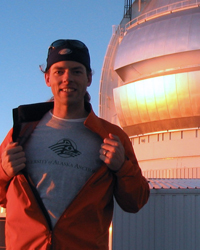
John R. Thorstensen is a Professor of Physics and Astronomy at Dartmouth College since 1980. He serves as Director of the MDM Observatory (since 2007) and President of the MDM Observatory Corporation. His research focuses on observational studies of cataclysmic binary stars and X-ray binaries. He developed the widely-used astronomical planning software JSkyCalc and its predecessors. Education: B.A. in Physics from Haverford College (1974), Ph.D. in Astronomy from University of California, Berkeley (1980). Research emphasizes cataclysmic variable stars' orbital dynamics and population studies. Maintains a comprehensive catalog of cataclysmic variables using multi-source data (ASASSN, ZTF, Gaia). Collaborates internationally through the MDM Observatory consortium. Formerly led ground-based parallax studies before Gaia satellite data rendered this obsolete. Award-winning contributions to astronomical software and observational astronomy methodologies. Actively involved in observational campaigns at Kitt Peak, Arizona. Encourages queries from astronomers about unpublished orbital period data.
Professor Christian Knigge serves as Professor of Astrophysics at the University of Southampton and is a core member of the Southampton Theory Astrophysics and Gravity (STAG) Research Centre within the Institute for Life Sciences. His research program investigates accretion phenomena across diverse cosmic scales, from stellar-mass compact objects to supermassive black holes. Knigge's primary research focuses on accretion phenomena and associated outflows, cataclysmic variables, close binaries, globular clusters, and active galactic nuclei. He examines the physical mechanisms driving accretion disk instabilities, outflow generation, and explosive events in binary systems, with particular emphasis on white dwarf and black hole accretors. His work integrates observational data with theoretical modeling to unravel the complex physics of these high-energy environments. Recent publications (2024-2025) reveal a strong emphasis on multi-wavelength observational campaigns, especially leveraging JWST capabilities, alongside theoretical code development. Key research threads include characterizing disk winds in active galactic nuclei, identifying quasi-periodic oscillations in white dwarf systems, classifying optical outbursts in cataclysmic variables, and developing computational tools like the SIROCCO radiative transfer code. These studies demonstrate his leadership in connecting observational signatures with fundamental accretion physics across different astrophysical regimes. Supervision: Currently guides six PhD students in Physics (Austen George William Wallis, Cordelia Brown, Brian Luff, Zackery Alexander Irving, Arianna Clarissa Albayati, Pornisara Nuchvanichakul) Grants: Leads STFC-funded projects including 'Line-Driven Disk Winds in Active Galactic Nuclei', 'C Knigge - Astrophysics at Southampton', and previously held a Leverhulme Trust Research Fellowship for 'The Universal Nature of Accreting Compact Objects' As an integral member of the STAG Research Centre, Knigge collaborates within a multidisciplinary team investigating gravity-dominated systems, contributing to Southampton's prominence in theoretical and observational astrophysics through both individual research initiatives and institutional consolidation grants.
Dr. Steven Parsons is a Lecturer in Astrophysics and an Ernest Rutherford Fellow at the University of Sheffield's School of Mathematical and Physical Sciences. His research focuses on white dwarf stars and their binary systems, particularly eclipsing binaries that provide precise measurements of stellar properties. As part of the astronomy group, he contributes to understanding stellar evolution, binary star interactions, and the progenitors of Type Ia supernovae. Dr. Parsons received his academic training at: MPhys in Physics with Astrophysics at the University of Kent (2008) PhD at the University of Warwick under Professor Tom Marsh Dr. Parsons specializes in the study of white dwarfs - the incredibly dense remnants of dead stars that have masses similar to the Sun but are only Earth-sized. His research particularly focuses on white dwarfs in binary systems, especially those that eclipse, allowing precise measurements of their properties. He uses telescopes worldwide to investigate these systems to better understand stellar structure, composition, and evolution. A key aspect of his work involves searching for progenitors of Type Ia supernovae in our Galaxy to determine how these white dwarfs gain mass to reach the Chandrasekhar limit and explode, which has implications for cosmological distance measurements. Dr. Parsons' publication record demonstrates a consistent focus on white dwarf binary systems, with particular emphasis on eclipsing binaries that allow precise mass and radius measurements. His work spans observational studies using ground-based and space telescopes, theoretical modeling of binary evolution, and large-scale surveys to identify and characterize white dwarf systems. Recent work shows increasing involvement with major astronomical surveys like Gaia and TESS, expanding the scope of his research to larger stellar populations and connecting observational data with theoretical models of stellar evolution. Dr. Parsons has received several prestigious fellowships supporting his research: ESO/Comite Mixto Post Doctoral fellowship at Universidad de Valparaiso FONDECYT Post Doctoral fellowship Leverhulme Early Career Fellowship STFC Ernest Rutherford Fellowship As an active researcher in the astronomy group at Sheffield, Dr. Parsons collaborates extensively with international teams on white dwarf research. His work with the HiPERCAM project demonstrates his involvement in cutting-edge instrumentation for high-speed astronomy. While specific student advisement details aren't provided, his role as Astronomy L2 Year Tutor indicates significant involvement in undergraduate education and mentorship. His research connects with broader efforts to understand stellar evolution and the role of binary systems in shaping the final stages of stellar life. Dr. Parsons is a key contributor to the 'white dwarf binary pathways survey' which systematically investigates the evolution of white dwarf binary systems. His work connects observational astronomy with theoretical models of binary star evolution, particularly focusing on post-common envelope binaries and systems that may lead to Type Ia supernovae. The team utilizes data from major observatories worldwide and space-based missions to build comprehensive understanding of these stellar systems, with implications for fundamental astrophysics and cosmology.
Professor Stuart Littlefair is a Professor of Astrophysics at the University of Sheffield's School of Mathematical and Physical Sciences. His research focuses on Interacting binary stars , Brown dwarfs and low-mass stars , Star formation , and High time resolution astrophysics . He contributes to projects like the Gravitational-wave Optical Transient Observer (GOTO), which detects transient astrophysical events. His work bridges observational astronomy and theoretical modeling, emphasizing multi-messenger astronomy and gravitational wave source identification. Research interests include studying accretion processes in compact binaries, AGN variability, and transient phenomena like gamma-ray bursts. Recent publications highlight his involvement in analyzing high-cadence optical/X-ray data (e.g., NGC 4395 AGN variability studies) and discovering peculiar systems such as inflated brown dwarfs in eclipsing binaries. He collaborates internationally, serving on committees like the ESO Observing Programmes Committee and the LSST:UK Board. Teaching activities include PHY241 Observational Astronomy . Professional roles include leading the Astrophysics Research Cluster and contributing to departmental administration (e.g., Head of Second Year Astrophysics). His work supports the University of Sheffield's astronomy infrastructure, including the GOTO telescope array.
Dacheng Lin is a Research Professor in the Department of Physics at Northeastern University (NU), where he has held this position since December 2020. Previously, he served as a Research Scientist at the University of New Hampshire (UNH) from 2014 to 2017, later becoming a Research Assistant Professor with a joint appointment in the Department of Physics and the Space Science Center within the Institute for the Study of Earth, Oceans, and Space. His academic journey includes a PhD in Physics from the Massachusetts Institute of Technology (2009) and an undergraduate degree from the University of Science and Technology of China. Dr. Lin specializes in high-energy astrophysics, focusing on black hole candidates, neutron star accretion processes, tidal disruption events, and X-ray astronomy. His research leverages multiwavelength observations and advanced spectroscopic techniques to study phenomena such as ultraluminous X-ray sources, magnetar-powered transients, and stellar disruption dynamics. Notable contributions include identifying intermediate-mass black hole candidates in dwarf galaxies and analyzing prolonged tidal disruption events. His work integrates cutting-edge telescopes like Chandra and XMM-Newton, emphasizing transient event detection and source classification. While no formal awards are listed, his research has garnered attention, including a feature in Northeastern’s news for discovering high-energy signals from billions of light years away. Dr. Lin’s advising and grant activities remain unspecified in the provided texts, though his prior roles at UNH suggest involvement in collaborative research teams and observational projects. Dr. Lin’s affiliations and research reflect a deep engagement with extragalactic phenomena and compact object astrophysics, contributing to our understanding of accretion physics and high-energy transients in the universe.
Abigail Polin is a theoretical and computational astrophysicist and Professor of Physics and Astronomy at Purdue University. Her research focuses on astrophysical transients, particularly Type Ia supernovae and stellar explosions. She utilizes hydrodynamical simulations and radiative transport calculations to bridge theory with observational data. Polin holds a PhD from UC Berkeley (2020), where she worked under Peter Nugent and Dan Kasen, and previously served as a postdoctoral fellow at Carnegie Observatories and Caltech. Her work has been recognized with the NERSC Early Career Award (2025) for modeling sub-Chandrasekhar mass Type Ia supernovae. Polin's research spans observational astronomy, numerical modeling, and instrument design, including proposals for CubeSat missions like UVIa to study ultraviolet signatures of supernovae. She collaborates extensively with international teams on projects like the Carnegie Supernova Project-II and Zwicky Transient Facility surveys. Key research themes include: Explosion mechanisms for calcium-rich transients and Iax/Ia supernovae Stellar progenitor systems and detonation processes Anisotropy studies in supernova remnants Multi-wavelength observations using JWST and ground-based facilities Her recent work emphasizes late-time NIR spectroscopy, forbidden line emission analysis, and the connection between theoretical models and observational data from transient surveys. Polin actively participates in transient classification efforts like POISE and contributes to both observational campaigns and numerical simulation frameworks.
Inés Pastor-Marazuela is a Rubicon Research Fellow at the Jodrell Bank Centre for Astrophysics, University of Manchester, UK. She specializes in radio astronomy with a focus on Fast Radio Bursts (FRBs) and neutron star research. PhD in Astrophysics from University of Amsterdam (2022) Master's in Physics from Université Paul Sabatier (2018) Her research explores: FRB origins and emission mechanisms Neutron star connections to transients Radio transient detection techniques Multi-wavelength follow-up observations Galactic and extragalactic magnetic fields Statistical analysis of burst populations Recent work involves MeerKAT and Apertif telescope observations, with publications on FRB galactic localization, neutron star bursts, and transient discovery methodologies. Scientific awards: Rubicon Research Fellowship recipient Active in transient detection algorithms and international collaborations like MeerTRAP. No student advisory roles mentioned.
Lorne A. Nelson is a Professor of Physics at Bishop's University, where he joined as an Assistant Professor in 1988 and was promoted to full Professor in 1998. He has served as Chair of the Physics Department during two separate terms (1996-1998 & 1999-2001). His research focuses on the theoretical aspects of stellar evolution, particularly in binary systems containing compact objects such as white dwarfs, neutron stars, and black holes. Nelson received his Ph.D. from Queen's University in 1984. He subsequently held a postdoctoral fellowship at MIT's Center for Space Research, where he conducted pioneering work on brown dwarfs. From 1986-1988, he was a research fellow at CITA (Canadian Institute of Theoretical Astrophysics). Professor Nelson's research interests center on interacting binary stars, Type Ia supernovae, millisecond pulsars, and brown dwarfs. His work provides insights into the formation and evolution of binary systems, with applications to understanding dark matter, testing general relativity, and explaining exotic astronomical phenomena. He employs population synthesis and stellar evolution techniques to develop self-consistent models of binary evolution that can be tested against observational data from instruments like HST, Chandra, and Keck. Analysis of Nelson's publication record reveals a consistent focus on binary stellar evolution across four decades. His work demonstrates progression from foundational studies of brown dwarfs and very low-mass stars to sophisticated modeling of binary millisecond pulsars, cataclysmic variables, and Type Ia supernova progenitors. A recurring theme is the development of theoretical frameworks that connect stellar evolution with observable phenomena, particularly through population synthesis techniques that bridge theoretical predictions with observational constraints. Canada Research Chair in Astrophysics (2002) William & Nancy Turner (Chancellor's) Teaching Award (1996) Invited Contributor to Nature's News & Views (1995) Reinhardt Fellowship from CITA (1999) Invited Review Speaker at multiple international conferences Professor Nelson has advised numerous graduate students who have gone on to successful careers in academia and industry, including Kirk Buckley (NSERC PDF at Berkeley), Chris Burns (Assistant Professor at Swarthmore), and Drew MacCannell (PhD student at UCSD). His research has been supported by significant grants including the Canada Foundation for Innovation, NSERC, and the Ministère de la Recherche, de la Science et de la Technologie of Quebec. Nelson collaborates extensively with researchers at MIT, UCSB, Northwestern, and other institutions worldwide. Nelson leads the Bishop's University Interacting Binary Evolution Server, a valuable resource for the international astrophysics community that provides evolutionary tracks for low-mass interacting binaries. He also co-developed the Elix2 Beowulf cluster in collaboration with the Université de Sherbrooke, creating a high-performance computing environment for theoretical astrophysics research. His team produces detailed animations of binary evolution that serve both research and educational purposes.
Professor Diego Altamirano is a faculty member at the University of Southampton, affiliated with the Department of Physics and Astronomy within the Faculty of Physical Sciences and Engineering. His research focuses on high-energy astrophysics, particularly X-ray binaries, black holes, and accreting compact objects. He leads or co-leads multiple research projects funded by the Royal Society and STFC, including studies of black hole X-ray binaries and accretion processes. His work utilizes advanced facilities like NICER, JWST, and XMM-Newton. Professor Altamirano has supervised numerous PhD students in areas such as astrophysics and physics. He holds a Royal Society University Research Fellowship and has published extensively in journals like Monthly Notices of the Royal Astronomical Society and The Astrophysical Journal. His research group collaborates with institutions globally, contributing to cutting-edge studies of accretion disk dynamics and compact object behavior.
Sebastian Heinz serves as an Adjunct Professor in the Department of Physics at the University of Wisconsin-Madison. His research focuses on high-energy astrophysical phenomena, including active galactic nuclei (AGN), black hole jets, and X-ray transients. He employs numerical simulations and observational data to investigate AGN-jet interactions, galaxy cluster dynamics, and interstellar dust properties. Key research interests include the morphology and environmental impacts of AGN jets, the role of AGN feedback in galaxy evolution, and the application of X-ray dust tomography to map galactic structures. His work spans topics from gamma-ray bursts to the thermal regulation of galaxy clusters. Recent studies highlight trends in jet dynamics, AGN environmental interactions, and dust-scattering echoes from X-ray transients. These investigations aim to uncover fundamental processes in astrophysical systems, such as energy transfer mechanisms and the evolution of cosmic structures. No scientific awards or grants are explicitly mentioned in the provided materials. Dr. Heinz’s contributions include collaborations on missions like the X-ray Surveyor and analyses of data from instruments such as NICER and Chandra.
David Kaplan is an Associate Professor of Physics at the University of Wisconsin-Milwaukee (UWM) and holds a Visiting Professor position at the University of Wisconsin-Madison. His primary research focuses on multi-wavelength observations of neutron stars, including isolated thermally emitting neutron stars and magnetars, as well as radio transient detection using facilities like the Murchison Widefield Array (MWA) and the Australia Square Kilometre Array Pathfinder (ASKAP). He currently chairs the MWA Transient Science Team and serves as a peer reviewer for journals such as the Astrophysical Journal and Astronomy & Astrophysics . Education: PhD in Astrophysics from California Institute of Technology (2004) Pappalardo Fellow at MIT Kavli Institute (2004-2007) Hubble Postdoctoral Fellow at MIT Kavli Institute and KITP (2007-2010) His research interests span astrophysical transients, pulsar astronomy, and the development of radio instrumentation. He is particularly known for studies of neutron star systems and the application of widefield radio surveys to discover new astrophysical phenomena. His work with the MWA has expanded our understanding of low-frequency radio sources, including contributions to space debris detection and polarization surveys. Kaplan’s research bridges observational astronomy with theoretical astrophysics, leveraging large-scale observational facilities to explore extreme astrophysical environments. While no formal student advisement is listed, his involvement in major observational projects suggests an active role in training graduate students and postdocs through collaborative research teams. His grants and funding are tied to his roles in leading large-scale telescope initiatives like the MWA. Kaplan leads the Murchison Widefield Array Transient Science Team, fostering interdisciplinary collaboration in radio astronomy. His website ( http://www.gravity.phys.uwm.edu/~kaplan/ ) provides further details on his research activities and publications.
Professor Tony Bird is a member of the astronomy group within the School of Physics and Astronomy at the University of Southampton. He currently serves as Deputy Head of School (Education) and previously held roles as Director of Programmes for Physics and Astronomy. His research focuses on instrumentation and data analysis for high-energy astrophysics, particularly through his role as a co-investigator on the ESA's INTEGRAL mission's IBIS telescope. He leads the compilation of its all-sky survey catalogues and explores applications of astronomical technology in medical imaging and security systems. Research Projects: - Developed novel instrumental techniques for coded-aperture imaging. - Led Knowledge Transfer Partnerships with Symetrica for security tech. - Co-led SPRINT programs advancing space technology innovation. - Active in next-generation space telescope design initiatives. Teaching: Teaches Medical Physics and Applied Nuclear Physics courses, and oversees mission design components of the Tenerife Field Trip for astronomy students. Supervises multiple PhD students in physics and related fields. Labs/Teams: Part of the Southampton Theory Astrophysics and Gravity (STAG) Research Centre and collaborates with interdisciplinary teams on detector development and data analysis challenges.
Donald Terndrup is an Associate Professor of Astronomy at The Ohio State University, specializing in observational astronomy with a focus on stellar populations, quasar winds, and galactic evolution. He joined the faculty in 1990 and has contributed extensively to studies of quasar outflows and their impact on galaxy formation. His research bridges stellar astrophysics and extragalactic phenomena, particularly examining angular momentum evolution in stars and the structure of the Galactic bulge. Education: Ph.D. in Astronomy & Astrophysics from UC Santa Cruz (1986), A.B. in Physics and Astronomy from UC Berkeley (1981). He served as Program Director in the Division of Astronomical Sciences at the National Science Foundation (2008–2012), emphasizing his leadership in astronomical research policy. Courses taught include Astronomy 3350 (Methods of Astronomical Observation) and Astronomy 1221 (Astronomy Data Analysis). Research Interests: Terndrup’s work centers on quasar winds and feedback mechanisms, using multi-wavelength observations and spectral synthesis techniques. He investigates how outflows from active galactic nuclei influence galaxy evolution, with recent focus on iron low-ionization broad absorption-line (FeLoBAL) quasars. His studies employ advanced tools like SimBAL simulations to model outflow dynamics and energetics. Articles Trends: His publications (2020–2024) emphasize quasar outflow physics, including geometric modeling, spectral variability analysis, and connections between accretion processes and radiation-driven winds. Collaborations span institutions worldwide, addressing topics like γ-ray novae and stellar rotation in the Kepler field. Grants & Advising: Funded by NSF grants such as the Collaborative Research on BAL quasar spectral synthesis (2020). Advises graduate students on AGN feedback projects and undergraduate research through initiatives like 'Quasar Outflows for Undergraduates and Everyone.' Labs/Teams: Active in collaborative projects such as the 4MOST-Gaia Quasar Survey and Dragonfly Galaxy studies, focusing on high-redshift galaxy mergers and radio jet interactions.
Simone Scaringi is an Assistant Professor in the Department of Physics and Astronomy at Texas Tech University. His research focuses on accretion disk physics across cosmic scales and the application of machine learning to astrophysical data analysis, particularly through the BlackGEM telescope project. Education: Ph.D., Astrophysics, University of Southampton (2010) M.Phil., Astrophysics, University of Southampton (2007) B.Sc., Mathematics with Astronomy, University of Southampton (2005) Research Interests: Dr. Scaringi investigates universal accretion processes in systems ranging from young stellar objects to supermassive black holes. He develops machine learning algorithms to analyze data from projects like BlackGEM, aiming to classify transient events and reduce subjective bias in classification. His work bridges observational astronomy with computational techniques. Awards: Alexander von Humboldt Fellowship (2014) FWO Pegasus Marie Curie Fellowship (2012) Labs/Teams: Involved with the BlackGEM telescope array project, focusing on optical transient detection and data fusion techniques using deep learning and convolutional neural networks.
Travis Rector is a Professor in the Department of Physics & Astronomy at the University of Alaska, Anchorage. His academic profile demonstrates a dual focus on astrophysical research and astronomy education, with particular emphasis on observational techniques and visualization methods. He maintains an active presence in both research and teaching, with recent publications spanning from 2011-2016 and teaching responsibilities in multiple astronomy courses. Ph.D. in Astrophysics, University of Colorado, 1998 M.S. in Astrophysics, University of Colorado, 1995 B.S. in Physics, Trinity University, 1992 Rector's research spans two primary domains: observational astrophysics and astronomy education. In astrophysics, he investigates blazars (BL Lac objects), cataclysmic variables, young stellar objects in star-forming regions, and recurrent novae in M31. His work often employs multiwavelength observational techniques to study these phenomena. In astronomy education research, he focuses on student learning through authentic research experiences, particularly using robotic telescope networks for asteroid observation projects and developing tools like OrbitMaster for visualizing solar system dynamics. His research in imagery and visualization of research data bridges both domains, creating effective ways to present complex astronomical concepts. Analysis of Rector's publication record reveals a strong interdisciplinary approach that combines observational astronomy with educational innovation. His work on recurrent novae in M31 represents a significant contribution to extragalactic variable star research, while his educational publications demonstrate a decade-long commitment to improving astronomy education through authentic research experiences. The recurring theme across his work is the application of observational techniques to both astrophysical research and educational contexts. Rector teaches multiple astronomy courses including Solar System Astronomy (ASTR A103), Stars, Galaxies, and Cosmology (ASTR A104), Astrobiology (ASTR A365), and Basic Physics I (PHYS A123). His educational research focuses particularly on how non-science majors benefit from authentic research experiences, with assessment data spanning over a decade. Dr. Rector is actively involved with the RBSE Nova Search Team, contributing to the creation of a uniform catalog of novae in M31. His work with robotic telescope networks for student research projects indicates involvement with observational facilities that support both research and educational objectives.