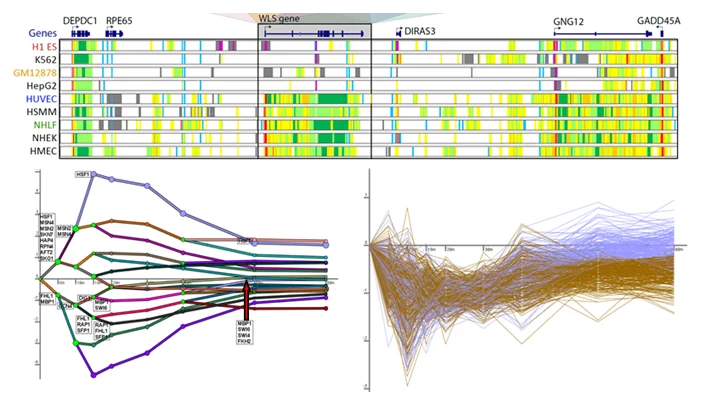
Jason Ernst is a Professor of Biological Chemistry and Computational Medicine at the University of California, Los Angeles (UCLA), where he leads a computational biology lab focused on epigenomics, regulatory genomics, and non-coding genome interpretation. His work spans multiple departments and institutes including the David Geffen School of Medicine, Computer Science Department, Computational Medicine Department, Interdepartmental Bioinformatics Program, Institute for Quantitative and Computational Biosciences, Broad Stem Cell Research Center, Jonsson Comprehensive Cancer Center, and Molecular Biology Institute. Dr. Ernst received his BS in Computer Science and Mathematics from the University of Maryland, College Park (2002), his PhD in Machine Learning from Carnegie Mellon University (2008), and completed postdoctoral training in Computational Biology at MIT (2011). His research interests center on developing computational methods to analyze chromatin states, DNA methylation patterns, and regulatory elements across diverse cell types and species. His recent publications reveal a strong focus on epigenomic data integration, with particular emphasis on chromatin state annotation, cross-species methylation analysis, and the functional interpretation of non-coding genomic regions. His lab has developed influential computational frameworks like ChromHMM for chromatin-state discovery, which has been widely adopted in the field. Current research directions include investigating regulatory elements in autism, developing methods for cross-species methylation imputation, and exploring the relationship between epigenetic patterns and life-history traits across mammals. Dr. Ernst actively mentors graduate students, with recent PhD defenses including work on autism genomics. His lab collaborates extensively across UCLA and with researchers worldwide, particularly in the fields of epigenetics, computational genomics, and disease mechanisms. His research is supported by multiple NIH grants and institutional resources, enabling the development of cutting-edge computational approaches to analyze large-scale genomic datasets. Dr. Ernst's lab maintains strong connections with both computational and experimental research groups, facilitating the translation of computational findings into biological insights.