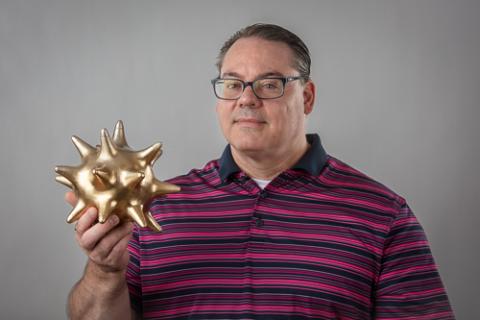
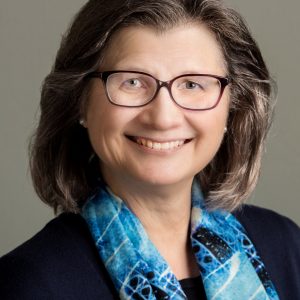
Gary A. Baker is an Associate Professor in the Department of Chemistry at the University of Missouri (Columbia), part of the College of Arts and Science. He holds a BS from SUNY Oswego (1995) and a PhD from SUNY Buffalo (2001). His research focuses on sustainable nanoscience, deep eutectic solvents, and nanomaterials for environmental and biomedical applications. Notable honors include the PECASE (2008), Cottrell Scholar Award (2015), and MU Graduate Faculty Mentor Award (2024). Research interests include light-driven nanochemistry, nanoparticle-based bioimaging, and waste valorization aligned with UN Sustainable Development Goals. His lab develops eco-friendly materials for water purification, sensors, and drug delivery. Collaborative work includes the Women in Training for Science (WITS) outreach program. Over 340 publications span topics like ionic liquid applications, nanoparticle synthesis, and environmental remediation. Key recent work involves programmable nanoclays, eutectogels, and piezoelectric ionic liquid studies. Awards highlight mentorship and innovation in nanoscience and sustainable chemistry.
Dr. Youngchan Kim is a Lecturer in Quantum Biology at the University of Surrey , serving as Director of the Quantum Biology Doctoral Training Centre (QB-DTC). He is affiliated with multiple departments including the School of Biosciences, Advanced Technology Institute, and Quantum Sciences Group. PhD in Physics (2011), Korea Advanced Institute of Science and Technology MSc in Physics (2008), KAIST BSc in Physics (2006), Chung-Ang University Graduate Certificate in Learning and Teaching (2022), Advance HE His research focuses on quantum phenomena in biological systems at physiological temperatures, particularly using femtosecond optical spectroscopy and genetically engineered fluorescent proteins to explore evolutionary adaptations and develop quantum-bio-inspired technologies like room-temperature single-photon sources. The 15 most recent publications span quantum biology, biophotonics, and optical spectroscopy, with particular emphasis on quantum coherence in biological systems , terahertz birefringence , fluorescent protein dynamics , and biomedical imaging innovations . These works demonstrate his interdisciplinary approach bridging physics, biology, and medical applications. As QB-DTC Director, he leads transdisciplinary initiatives fostering collaboration between quantum physics and biosciences. His technical expertise includes time-correlated single-photon counting , common-path interferometry , and ultrafast fluorescence depolarization techniques.
Privatdozent Dr. Andreas Faust is a leading researcher at the European Institute for Molecular Imaging (EIMI) at the University of Münster, where he heads the Chemical Targeting Lab. His work focuses on developing innovative imaging agents for medical diagnostics, particularly in radiopharmaceutical chemistry and molecular imaging. He maintains strong affiliations with the Department of Nuclear Medicine at the University Hospital Münster and participates in the "Cells in Motion" excellence cluster, contributing to cutting-edge research at the intersection of chemistry, medicine, and imaging technology. Dr. Faust completed his chemistry studies at the University of Münster, earning his Diploma in 1999, followed by his doctoral degree (Dr. rer. nat.) in 2003 with research on artificial caffeine receptors. His academic journey continued with positions at the Department of Organic Chemistry and the Department of Nuclear Medicine before becoming head of the chemistry group at EIMI in 2011. Dr. Faust's research centers on organic and medicinal chemistry with specialization in radiopharmaceutical chemistry . His team develops novel tracers for diagnostic molecular imaging using positron emission tomography (PET), single-photon emission computed tomography (SPECT), optical imaging, and photoacoustic imaging. A significant portion of his work focuses on creating specific ligands for the alarmins S100A8/S100A9 and bacteria-specific tracers based on complex carbohydrates or siderophores. His research has important applications in inflammation imaging, infection diagnostics, and cancer theranostics, with emphasis on improving metabolic stability and target specificity of imaging agents. His publication record demonstrates consistent contributions to molecular imaging, with recent work emphasizing bacteria-specific PET tracers, inflammation imaging targeting S100 proteins, and novel optical imaging probes. The research shows a clear trajectory toward developing clinically applicable imaging agents with improved specificity and metabolic stability, particularly in the areas of infection diagnostics and inflammation monitoring. 2017: Best Poster Award at Symposium "Molecular Imaging Agents in Medicine," Groningen 2009: Young Investigator Award at Deutscher Röntgenkongress, Berlin 2005: Best Scientific Poster Award at 4th Annual Meeting of the Society of Molecular Imaging, Köln Dr. Faust leads multiple significant research projects, including as Coordinator of a project on immune cell distribution imaging (2019-2024) and as Principal Investigator for CRC-project A03 "Targeting of S100A8/A9 for imaging of inflammatory disorders" and research on vascular graft infections (both 2021-2024). His Chemical Targeting Lab comprises a multidisciplinary team working at the intersection of chemistry, microbiology, and medical imaging, securing substantial funding from the Innovative Medicines Initiative and DFG Collaborative Research Centre. The Chemical Targeting Lab maintains state-of-the-art facilities for chemical synthesis, radiochemistry, and biological testing. The lab collaborates extensively with microbiologists, clinicians, and imaging specialists to translate basic research into clinical applications. Current research directions include optimizing bacterial imaging probes for clinical diagnostics and developing new inflammation-specific tracers for early disease detection, with particular focus on S100A9-targeted imaging and siderophore-based bacterial detection systems.
Ulrich B. Wiesner is the Spencer T. Olin Professor of Engineering at Cornell University since 2008, with a career spanning over two decades in polymer-inorganic hybrid nanomaterials. His work bridges materials science, chemistry, and biomedical engineering, focusing on block copolymer self-assembly for multifunctional materials. Education: Diploma in Chemistry (University of Mainz, 1988), Ph.D. in Physical Chemistry (University of Mainz & MPI-P, 1991) Research Interests center on combining soft polymeric materials with inorganic/solid-state chemistry to create hierarchical hybrid materials. Key areas include: Energy conversion and storage via mesoporous oxides/non-oxides Clean water technologies through advanced materials Nanomedicine applications in cancer therapy and bioimaging Development of C-dots: ultrasmall fluorescent silica nanoparticles Structure-directing agents from dendron architectures His article trends reveal a focus on asymmetric porous structures (2024-2025), 3D-printed quantum materials (2024), and biomedical applications of C-dots for super-resolution microscopy and targeted drug delivery (2023-2025). Scientific Awards include: National Academy of Inventors Fellow (2024) "Ambassadeur pour la Chimie Française" (2019) Arthur K. Doolittle Award (2016) ACS PMSE Fellow (2015) NSF Creativity Award (2008) Cornell Teaching Excellence Award (2005) IBM Faculty Partnership Award (2001) Carl Duisberg Memorial Award (1999) As co-director of the MSKCC-Cornell Center for Translation of Cancer Nanomedicine (2015-present), he leads interdisciplinary teams developing clinical nanoparticle probes. His work has produced >250 peer-reviewed publications and numerous patents, with recent breakthroughs in antibody fragment-nanoparticle therapeutics for gastric cancer eradication.
Barbara Smith is an Associate Professor at Arizona State University’s School of Biological and Health Systems Engineering. She joined ASU in January 2015 and leads the Smith Laboratory, focusing on photoacoustic imaging technologies and multiomic biomarker discovery for women’s health and mental illness applications. Her work bridges biomedical engineering and clinical diagnostics, with recent publications and patents advancing early-stage detection and point-of-care analysis. Postdoctoral Research Fellow, Harvard University Ph.D. in Biomedical Engineering, Colorado State University B.Sc. in Industrial Engineering, Michigan State University The Smith Laboratory specializes in developing novel photoacoustic and ultrasound imaging systems to study single-cell behavior and neural networks, aiming to improve cancer diagnosis and monitoring of mental health conditions. Collaborations with clinics have enabled patient sample analysis for multiomic biomarker identification. Scientific Awards: Centennial Professorship Award Arizona Biomedical Research Consortium Early Stage Investigator Award Women and Philanthropy Award National Science Foundation ICorps Award Her lab has submitted seven patents, and she has taught courses in bioengineering product design and directed research for advanced degree candidates. Barbara Smith’s research aligns with expertise in bioimaging, neuroimaging, and biotechnology.
Sandeep Kumar Mishra, PhD, is an Associate Research Scientist in the Department of Radiology & Biomedical Imaging at Yale School of Medicine, where he holds a primary appointment in the Magnetic Resonance Research Center within the Division of Bioimaging Sciences. He completed his doctoral training at Pondicherry University (2017) and finished post-doctoral research at Yale in 2024 before transitioning to his current research-intensive faculty role. Education: PhD, Pondicherry University – 2017 Post-doctoral Associate, Yale University – 2024 Research Focus: Mishra’s work integrates multinuclear magnetic resonance spectroscopy, responsive paramagnetic probes, and nano-constructs to quantify the tumor microenvironment. Major themes include in-vivo mapping of interstitial pH and sodium gradients in gliomas, development of Fe(II)/Co(II)/Ni(II)-DOTA tetraglycinate complexes for simultaneous pH–temperature sensing, and engineering dual-modal nano-agents that couple MR angiography with therapeutic delivery (chemo-photothermal, cryo-ablation, MMP inhibition). Publication Trends: Across 28 peer-reviewed articles (2016-2025) he demonstrates a sustained trajectory in cancer imaging, moving from theranostic nanoparticles toward sophisticated spectroscopic imaging of tumor acid–base and ionic homeostasis, with increasing translational orientation involving rodent glioma and hepatocellular carcinoma models. Collaborations & Affiliations: He is embedded in Yale’s inter-disciplinary MR research ecosystem, collaborating recurrently with faculty in Radiology, Biomedical Engineering, and the Magnetic Resonance Research Center (D. Coman, F. Hyder, P. Herman, J. Verhagen, J. Santana, A. Shewarega). Contact: sandeepkmishra11@gmail.com | Magnetic Resonance Research Center, 300 Cedar Street, New Haven, CT 06519, USA
Professor Brant Gibson is a Deputy Dean of Research and Innovation and holds the rank of Professor in the School of Science at RMIT University. His research focuses on quantum technologies, particularly diamond-based systems including nitrogen-vacancy (NV) centers, fluorescent nanoprobes, and hybrid materials for sensing applications. He leads projects in quantum magnetometry, photonics, and biomedical imaging, with an emphasis on translating lab-based innovations into practical devices for fields like medical diagnostics and environmental monitoring. Brant’s work spans condensed matter physics, nanotechnology, and optical engineering, with notable contributions to diamond-doped optical fibers, quantum sensor development, and the application of nanodiamonds in biophotonics. His research integrates experimental physics with computational modeling to optimize material properties and sensor performance. He is actively involved in student supervision, offering guidance for Masters and PhD candidates in quantum engineering, materials science, and interdisciplinary applications. Current projects include quantum tensor gradiometry for navigation, bioimaging with near-infrared emitters, and silk-diamond composites for wound monitoring. Brant’s academic contributions are further reflected in over 150 peer-reviewed publications and collaborations across academia and industry. His work bridges fundamental research with real-world applications, emphasizing Australia’s role in global quantum technology advancements.
Jennifer Chen is an Associate Professor in the Department of Chemistry at York University's Faculty of Science. She leads a research group focused on designing nanomaterials for optical sensing, biomedical diagnostics, and solar energy conversion , with an emphasis on plasmonic nanostructures and hybrid materials. Research spans analytical, inorganic, and physical chemistry Eligible supervisor for Physics and Astronomy graduate students Key funding: CFI, NSERC, Ontario Research Fund Her work bridges fundamental studies of materials interfaces with applications in healthcare and sustainability. Recent publications explore charge transfer mechanisms and DNA-nanoparticle interactions for biosensing. 2022: J. Mater. Chem. A on Mn-doped quantum dots 2020: Analyst and ACS Appl. Nano Mater. on DNA-based sensing 2018: JPCC on interfacial charge dynamics 2013: JACS on plasmonic microRNA detection Major awards include the Canadian Society for Chemistry Fred Beamish Award (2019), Nano Ontario Early-Career Award (2018), and Top 40 Under 40 Analytical Scientist (2018). Her group has trained 15+ graduate students, including PhD graduates Brian and Anthony.
Kejun Huang is an Assistant Professor in the Department of Computer and Information Science and Engineering at the University of Florida's Herbert Wertheim College of Engineering. His primary research area is Machine Learning, with additional interests in algorithms, computer vision, and data science. He received his Ph.D. in Electrical Engineering from the University of Minnesota in 2016. His research focuses on machine learning, signal processing, optimization, and statistics. Recent work tackles unsupervised learning challenges and AI-powered medical research through NIH-funded projects. Dr. Huang's publications demonstrate consistent focus on optimization techniques for tensor decomposition, dictionary learning identifiability, and nonnegative matrix factorization. Key themes include algorithmic efficiency and theoretical guarantees in machine learning models.
Alisa Piekny, PhD, is a Professor of Biology and Associate Dean of Research and Infrastructure at Concordia University's School of Health. Her research focuses on cytoskeleton regulation during cell division, migration, and polarity, particularly in cancer cells. She employs human cell cultures, iPSCs, and collaborative drug discovery approaches to advance anti-cancer therapies and nanotechnology-based diagnostic tools. Education: PhD (University of Calgary), Post-Doc (IMP Vienna and University of Chicago). Research interests include anillin protein dynamics, microtubule-actomyosin interactions, and nanoparticle-cell interactions. Her work bridges cell biology with translational medicine, emphasizing cytokinesis mechanisms and their hijacking in cancer. Recent publications highlight innovations in drug delivery systems, fluorescent nanoparticle imaging, and molecular tools for live-cell cytokinesis analysis. Collaborations span nanotechnology, cancer biology, and developmental biology, yielding insights into cell fate regulation and therapeutic targeting. Her research has been recognized through interdisciplinary projects at the interface of biology and materials science, with a focus on practical medical applications.
David A. Tirrell serves as Provost and holds the Ross McCollum-William H. Corcoran Professorship in Chemistry and Chemical Engineering at the California Institute of Technology. He earned his B.S. (1974) from MIT, M.S. (1976) and Ph.D. (1978) from the University of Massachusetts at Amherst, and received an honorary doctorate (D.h.c.) from Eindhoven Technical University. Chair, Division of Chemistry and Chemical Engineering (1999-2009) Director, Beckman Institute (2012-2018) Provost (2017-present) His research focuses on macromolecular chemistry and genetic code reengineering to incorporate non-canonical amino acids into proteins. This work enables novel approaches to biomaterials design , proteomic analysis , and protein evolution with applications in tissue regeneration and molecular imaging . Recent publications highlight 3D-printable cellular composites , engineered bacterial films , and non-canonical amino acid applications in medical contexts. Scientific recognitions include election to: American Academy of Arts and Sciences American Philosophical Society All three branches of U.S. National Academies (Sciences, Engineering, and Medicine) As principal investigator of the Tirrell Lab , he has mentored numerous students and researchers like Sophie Miller, Hanwei Liu, and Grace Wang, whose work spans synthetic biology , genetic code modification , and advanced proteomic techniques .
Yunpeng Ye serves as an Associate Research Scientist within the Department of Radiology and Biomedical Imaging at Yale School of Medicine. His primary appointment is in Radiology & Biomedical Imaging, with additional affiliation with the Bioimaging Sciences PET Core. Dr. Ye earned his PhD from Peking Union Medical College in 1993, establishing a foundation for his career in medical imaging research. His research focuses on advanced imaging techniques, particularly in the field of Positron Emission Tomography (PET) and biomedical imaging. As part of the Bioimaging Sciences PET Core, he contributes to the development and application of cutting-edge imaging technologies for medical diagnosis and research. His work bridges clinical applications with technical innovation in medical imaging systems. While specific publications were not detailed in the available information, his institutional affiliations suggest expertise in quantitative imaging analysis, radiotracer development, and clinical applications of PET technology across various medical specialties. Dr. Ye's position within the Radiology department places him at the intersection of clinical medicine and technological innovation, contributing to Yale's imaging research infrastructure through the PET Core facility.
Jan Ellenberg is a Senior Scientist and Head of the Cell Biology and Biophysics Unit at the European Molecular Biology Laboratory (EMBL) since 2006 and 2010, respectively. He also serves as EMBL Delegate to the Euro-BioImaging Interim Board since 2014 and has coordinated multiple EMBL units and pan-European imaging infrastructure projects. PhD in biochemistry (1998, NIH & Freie Universität Berlin) Diploma in biology (1994, Universität Hamburg) His research focuses on cell biology , nuclear and chromosome dynamics , and advanced microscopy technologies . Key areas include mitosis/meiosis , nuclear pore complex organization , and super-resolution/light-sheet microscopy development. Scientific awards include the Allen Distinguished Investigator (2017), ERC Advanced Investigator (2016), and Walter Flemming Medal (2004). His publications (>130) frequently appear in top journals like Nature, Science, and Cell. 2017 Allen Distinguished Investigator 2016 ERC Advanced Investigator 2016 Honorary Doctor of Philosophy at Åbo Akademi University 2006 EMBO Member
Maryellen L. Giger, Ph.D. is the A.N. Pritzker Distinguished Service Professor of Radiology, Committee on Medical Physics, and the College at the University of Chicago. She serves as Vice-Chair of Radiology (Basic Science Research) and was the immediate past Director of the CAMPEP-accredited Graduate Programs in Medical Physics/Chair of the Committee on Medical Physics. Her career spans over 30 years of pioneering research in computer-aided diagnosis, machine learning, and deep learning applications in medical imaging. Dr. Giger's research focuses on computational image-based analyses for cancer risk assessment, diagnosis, prognosis, and response to therapy, particularly in breast cancer, lung cancer, prostate cancer, lupus, bone diseases, and more recently, COVID-19. Her work has evolved from developing computer-aided diagnosis systems to utilizing 'virtual biopsies' in imaging genomics association studies for discovery. She has made significant contributions to quantitative imaging, radiomics, and AI applications in medical imaging, with emphasis on translating research into clinical practice. Her publication record shows a clear trajectory from foundational work in computer vision for medical imaging to cutting-edge AI and deep learning applications. The recent publications demonstrate her leadership in large-scale collaborative efforts like the Medical Imaging and Data Resource Center (MIDRC), focus on health equity through AI analysis, and expansion into diverse applications including gynecological imaging, lung cancer screening, and trauma assessment. Her work consistently bridges technical innovation with clinical relevance. Dr. Giger has received numerous prestigious honors including membership in the National Academy of Engineering, the William D. Coolidge Gold Medal (the highest award from AAPM), and being named one of the 50 most impactful medical physicists in the last 50 years. She is a Fellow of multiple professional societies including AAPM, AIMBE, SPIE, SBMR, and IEEE. Her 2019 TIME magazine recognition for QuantX, the first FDA-cleared machine-learning-driven system for cancer diagnosis, highlights her translational impact. As an educator and mentor, Dr. Giger has guided over 100 graduate students, residents, and medical students throughout her career. She has secured substantial research funding including NIH R01 grants and serves as contact PI for the NIH NIBIB-funded & ARPA-H-funded Medical Imaging and Data Resource Center (MIDRC). Her leadership extends to former presidencies of the American Association of Physicists in Medicine and SPIE, and she was the inaugural Editor-in-Chief of the SPIE Journal of Medical Imaging. Dr. Giger co-founded Quantitative Insights, Inc. through the University of Chicago's New Venture Challenge, which developed QuantX - the first FDA-cleared AI system for cancer diagnosis. She leads the Medical Imaging and Data Resource Center (MIDRC), a critical resource for AI development in medical imaging that received the 2023 DataWorks Prize. Her research laboratory bridges engineering, physics, and clinical medicine to develop and validate quantitative imaging biomarkers and AI tools for precision medicine.
Lu Wei is an Assistant Professor of Chemistry at the California Institute of Technology and an Investigator at the Heritage Medical Research Institute. She holds a B.S. from Nanjing University (2010) and a Ph.D. from Columbia University (2015), joining Caltech in 2018. Research Areas: Optical spectroscopy, Biophysics, Bio-imaging, Chemical probe development Education: B.S. Nanjing University (2010), Ph.D. Columbia (2015) Research Interests include next-generation optical imaging techniques based on nonlinear vibrational spectroscopy for live-cell dynamics. Her work spans super-resolution label-free imaging , quantitative polyQ aggregate analysis in Huntington’s disease, Raman-guided pharmacometabolomics for melanoma, and environmental sensing in subcellular systems. Recent Publications highlight trends in vibrational thermometry (2025), high-speed bond-selective imaging (2025), and photochromic Raman microscopy (2023), with applications from single-molecule to cellular biology . 2024 Margaret Oakley Dayhoff Award 2023 NSF CAREER Award 2022 Sloan Research Fellowship 2021 Scialog Fellow Students : 5 Ph.D. graduates (Dr. Jiajun Du, Dr. Kun Miao, Dr. Xiaotian Bi, Dr. Li-En Lin, Dr. Dongkwan Lee) and current advisees including Adrian, RJ, Phil, Yulu, Berea, and Kwan. The lab has received grants from the Chan Zuckerberg Initiative, NSF, Curci Foundation, and Eli Lilly. Labs & Collaborations : The Wei Lab at Caltech collaborates with Karthikeyan (metabolic imaging) and Mazmanian Labs (microbiome studies). They host interdisciplinary teams in physical chemistry and chemical biology.