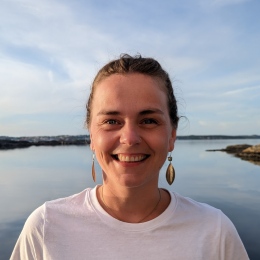
Sara Blichnerمشاهده پروفایل
پژوهشگر ارشد
Sara Blichner is a Postdoctoral Fellow at Stockholm University's Department of Environmental Sciences, focusing on critical atmospheric processes that influence climate. Her research primarily centers on aerosol-cloud-climate interactions, with particular emphasis on biogenic volatile organic compounds (BVOCs) and their role in climate feedback mechanisms. Working within the atmospheric science research group at Stockholm University, she contributes to advancing our understanding of how natural processes affect climate systems. Dr. Blichner's research interests span atmospheric aerosol dynamics, new particle formation processes, and Earth System Model evaluation. She investigates how biogenic emissions from forests influence cloud formation and climate, with significant work on boreal and tropical forest ecosystems. Her research addresses fundamental questions about pre-industrial aerosol conditions, current climate impacts, and future climate projections under changing emission scenarios. She employs both observational data and sophisticated modeling approaches to understand complex atmospheric processes that remain among the largest uncertainties in climate prediction. Analysis of her publication record reveals a strong focus on process-based evaluation of climate models, particularly examining aerosol-cloud interactions in forested regions. Her work demonstrates how observational constraints can reduce uncertainty in Earth System Models, with significant contributions to understanding BVOC-climate feedbacks. Her research spans multiple disciplines including atmospheric physics, climate science, and environmental chemistry, with particular emphasis on nanoparticle growth mechanisms and their climate relevance. While no specific scientific awards are mentioned in the available information, her publications in high-impact journals including Nature Communications, Science Advances, and Reviews of Modern Physics indicate significant contributions to her field. Her research appears to be supported by collaborative projects involving multiple institutions and field measurement campaigns, particularly in boreal forest regions. Dr. Blichner's work contributes to critical climate science questions at the intersection of atmospheric chemistry and climate modeling, with implications for understanding both historical climate conditions and future climate projections as anthropogenic emissions change.