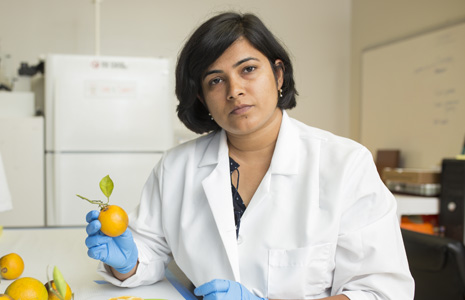
Professor Jayashree Arcot is a distinguished academic in the School of Chemical Engineering at the University of New South Wales (UNSW), where she serves as a Professor in Food Science and Nutrition within the Food and Health group. She holds the position of Undergraduate Food Science Program Director and Advisor, demonstrating her leadership in academic program development and student mentorship. Professor Arcot's research spans the critical intersection of food science and nutritional health, with particular emphasis on food and nutrient security. Her work encompasses food chemistry, nutrient analysis, and the bioaccessibility and bioavailability of micronutrients. She has developed expertise in stable isotopic techniques and 3D cell culture methods to investigate micronutrients (vitamins and minerals) and bioactives in foods. Her research extends to practical applications including nutrient recovery from food manufacturing waste streams, utilization of agricultural wastes for biodegradable packaging materials, and extraction of nutrients using membrane technology. Analysis of Professor Arcot's recent publications reveals a strong focus on food security challenges, micronutrient bioavailability, and innovative food technologies. Her work spans from fundamental research on nutrient interactions (particularly iron, zinc, and carotenoids) to applied research on plant-based alternatives, sustainable food systems, and public health nutrition interventions. A significant portion of her recent work addresses micronutrient malnutrition in the Asia Pacific region through food-based approaches. Excellence in Postgraduate Research Supervision Award (2013) Australia-India Senior Visiting Fellowship (2012-2013) Professor Arcot has supervised numerous PhD students, honors, and Master's students in Food Science, Food Chemistry, and Nutrition. Her research has attracted significant funding, including her role as Director of the ARC Training Centre for Advanced Technologies in Food Manufacture (2013-2018). She has initiated multiple industry-funded projects and collaborates extensively with researchers across disciplines including cancer cell biologists. Her laboratory work integrates advanced analytical techniques with biological models, particularly utilizing Caco-2 cell cultures and 3D organoids to study nutrient bioavailability. She leads collaborative research teams focused on sustainable food systems, including projects in Papua New Guinea, Indonesia, and the Democratic Republic of Congo aimed at improving food and nutrition security through local crop utilization and food fortification strategies.