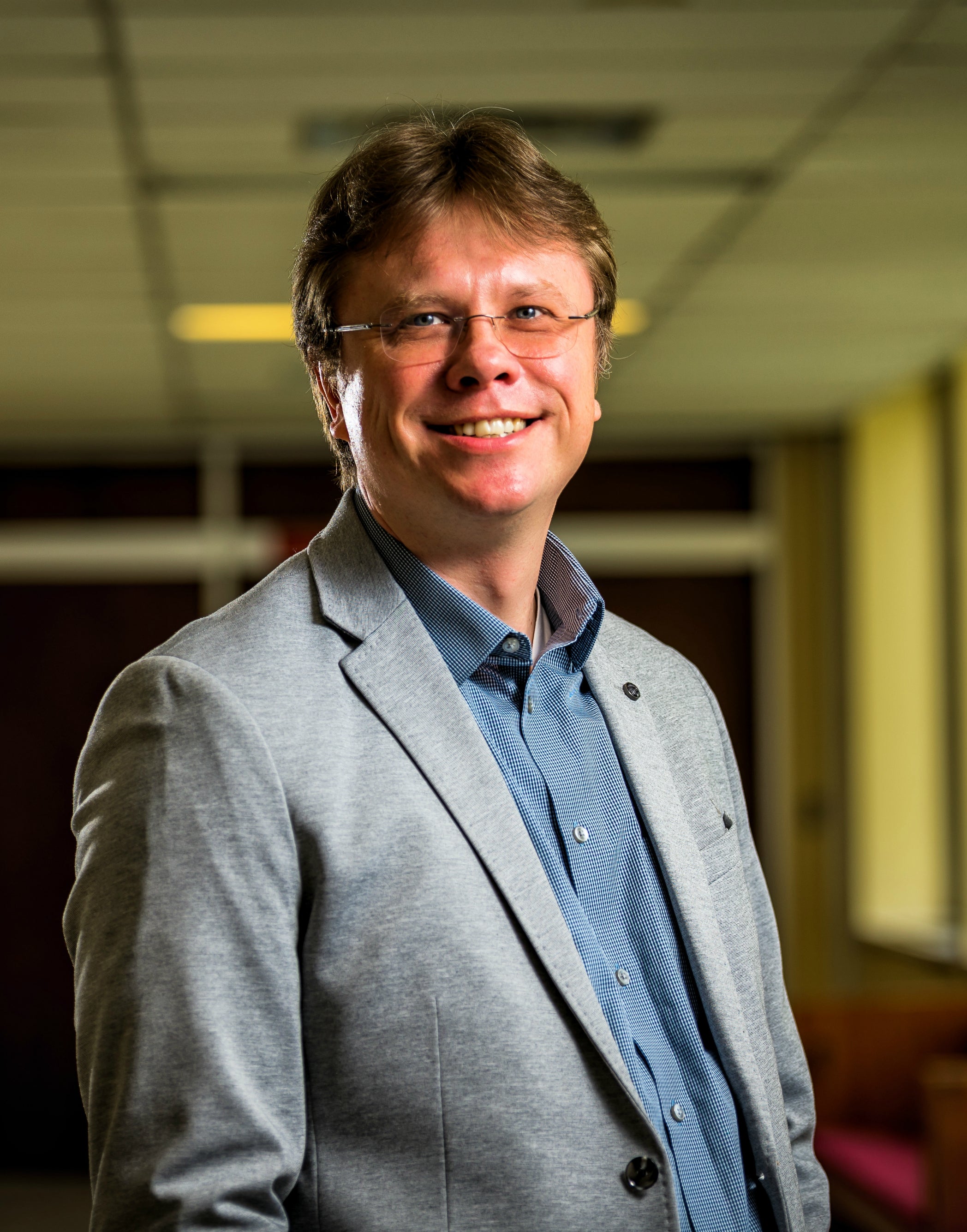
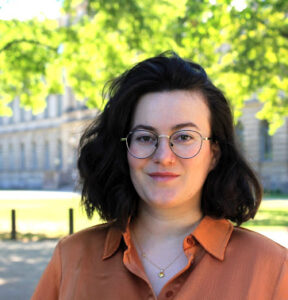
Prof. Dr. Helen Engemann is a Junior Professor at the Department of English, School of Humanities, University of Mannheim. Her research focuses on multilingualism, language acquisition, and cognitive aspects of bilingualism. She is affiliated with the Research Team JP Multilingualism and is a member of the Deutsche Gesellschaft für Sprachwissenschaft (DGfS), European Second Language Association (EUROSLA), and International Association for the Study of Child Language (IASCL). Her work investigates how language structures influence cognitive processes, particularly in bilingual children and heritage speakers. Key topics include motion event constructions, crosslinguistic influence, and syntactic packaging in multilingual environments. Recent studies explore language change mechanisms in Italian heritage speakers and the impact of typological factors on memory and event encoding. Publications span prestigious journals like Linguistic Approaches to Bilingualism , Journal of Child Language , and Bilingualism: Language and Cognition . Her research bridges linguistics, psychology, and education, addressing both theoretical and applied questions in multilingual development.
Janet van Hell is Professor of Psychology and Linguistics at Pennsylvania State University , where she also serves as Co-Director of the Social, Life, and Engineering Sciences Imaging Center (SLEIC) and Co-Director of the Center for Language Science . She leads the Bilingualism and Language Development (BiLD) Lab , investigating neurocognitive aspects of bilingual language use. Education: Ph.D., University of Amsterdam, 1998 Research Interests: Her work centers on bilingualism , second language acquisition , and the neurocognitive mechanisms underlying language development. Using EEG/ERP , behavioral, and linguistic techniques, her lab explores cross-language interaction, code-switching, and foreign-accented speech comprehension. The ‘brain bus’ , a mobile EEG lab, extends her research into schools and public outreach. Publications Overview: Her recent publications span bilingual phonetics , syntax processing , memory consolidation , and executive control , with a focus on EEG/ERP methodologies and experimental behavioral paradigms . Studies often involve heritage speakers , child bilinguals , and late L2 learners . Advising & Collaborations: Advises numerous PhD students and postdocs, many co-authoring papers (marked with *). Collaborates across Psychology, Linguistics, and Neuroscience departments. Leads outreach via the ‘brain bus’ for public engagement in science. Labs & Centers: BiLD Lab – Bilingualism and Language Development Lab SLEIC – Co-Director, Social, Life, and Engineering Sciences Imaging Center Center for Language Science – Co-Director
Edna Andrews is the Nancy & Jeffrey Marcus Distinguished Professor of Slavic and Eurasian Studies and Professor of Linguistics and Cultural Anthropology at Duke University. She serves as Director of the Program in Linguistics, Director of Undergraduate Studies in the Linguistics Program, and Director of FOCUS, Duke's signature first-year seminar program. Her interdisciplinary work bridges Slavic studies, linguistics, anthropology, and cognitive neuroscience. Dr. Andrews earned her Ph.D. from Indiana University at Bloomington in 1984 and holds an honorary doctorate from St. Petersburg State University (Russia). Her academic journey has evolved from traditional Slavic linguistics to pioneering work at the intersection of language and brain sciences, reflecting her commitment to interdisciplinary scholarship. Professor Andrews' research focuses on cognitive neuroscience and multilingualism, semiotics (particularly Peircean and Lotmanian theories), and the neural basis of language processing. Her work examines how the brain processes multiple languages, the relationship between music and language cognition, and the semiotic foundations of linguistic structures. She has pioneered longitudinal fMRI studies of second language acquisition, challenging traditional linguistic models that often overlook the multilingual reality of most humans. Her research program has produced significant insights into how multilingualism affects brain structure and function, with implications for education, cognitive aging, and language rehabilitation. Andrews' work uniquely integrates theoretical linguistics with empirical neuroscience, creating a more comprehensive understanding of human language as situated within cultural and biological contexts. University Scholar/Teacher Award (2013) Richard Lublin Teaching Award Through her leadership of the Slavic & Eurasian Language Resource Center and numerous federally-funded grants from the U.S. Department of Education, Professor Andrews has secured significant research funding to advance understanding of language acquisition and multilingualism. Her collaborative approach brings together linguists, neuroscientists, anthropologists, and educators to tackle complex questions about language and the brain. Professor Andrews leads research teams through the Duke Institute for Brain Sciences and has developed innovative programs like Duke Intense Global (DIG), which combines intensive language training with neuroscience research. Her work with the Bass Connections in Brain & Society Research Team fosters interdisciplinary collaboration among students and faculty across multiple departments.
Maria Gindidis is an Associate Professor at the School of Curriculum, Teaching & Inclusive Education at Monash University . Her work focuses on Teacher Education in marginalized and culturally diverse contexts, contributing to UN Sustainable Development Goals on Quality Education ( SDG 4 ) and Reduced Inequalities ( SDG 10 ). Current roles include Chief Examiner and Coordinator of first and fourth-year core units in the Bachelor of Education with Honours program. State Coordinator of the Bilingual Schools Project Acting Assistant Principal, eastern region secondary school Coordinator of bilingual programs in 15 Victorian schools Research Interests center on Neuroscience and Learning , particularly the bilingual brain, and the intersection of Community Languages with teacher training. Her PhD explored marginalised teachers' lived experiences in community schools using phenomenology. Recent projects examine digital literacy, transmedia storytelling, and equity in teacher coaching. Article Trends include autoethnographic methodologies, critical explorations of cultural conformity in diaspora communities, and integrative approaches to arts and language education during crises. Publications emphasize pedagogical innovation, digital-physical learning intersections, and systemic challenges in community language programs. Scientific Awards : Australian Linguistics Society Michael Clyne Award (2014) Monash Students Association Outstanding Teacher of the Year (2016) Teaching Excellence Award (2019) Grants and Collaborations include a 2019 national parent survey grant on immigrant language maintenance and leadership research in marginalized communities. International collaborations span professional learning programs in Zhejiang, China. Media engagements address language education innovation and aged-care language labs for preschoolers.
Suzanne Flynn is a Professor of Foreign Languages and Linguistics at the Massachusetts Institute of Technology (MIT), affiliated with the Department of Linguistics and Philosophy. Her research focuses on Second Language Acquisition (SLA), Syntax, Semantics, and the intersection of Universal Grammar with language learning mechanisms. She has contributed significantly to theories such as the Cumulative-Enhancement Model for multilingualism and the Parameter-Setting Model in SLA. Education: Not explicitly mentioned, but her academic roles and publications suggest advanced degrees in Linguistics. Affiliations: MIT Linguistics and Philosophy Department, involvement in academic societies and conferences. Her work explores syntactic and semantic factors in SLA, including free relative clauses, third language acquisition, and the role of cognitive constraints in language learning. Key contributions include co-editing volumes on SLA theories and co-authoring foundational texts like Theoretical Second Language Acquisition (2006). She has also published extensively in journals such as Behavior and Brain Sciences and International Journal of Multilingualism . Research Themes: Universal Grammar, syntactic parameters, comparative language acquisition (children vs. adults). Though no specific awards are listed, her impactful publications and academic leadership reflect scholarly recognition. Her advising and grants are not detailed here, but she has supervised collaborative projects with colleagues like B. Lust and G. Martohardjono. She is involved in the MIT Linguistics community, contributing to pedagogical innovation and theoretical discourse in language studies.
Dr. Nina Maadad is a Senior Lecturer in the School of Education at the University of Adelaide, affiliated with the Faculty of Arts, Business, Law and Economics. She holds a strong focus on global educational challenges, particularly refugee education, multiculturalism, and academic mobility. Her research spans multiple countries including Australia, Indonesia, Lebanon, Turkey, and Sweden. Key research interests include refugee integration, language acquisition in diverse contexts, and policy analysis in cross-cultural education systems. Dr. Maadad’s work often addresses the interplay between education systems and societal structures, with recent emphases on online learning dynamics post-2020 and multilevel factors affecting student outcomes in secular vs. religious schools. Her publications from 2020-2025 consistently analyze refugee education across geopolitical contexts, emphasizing systemic barriers faced by displaced populations. This includes studies on child marriage dynamics among refugee girls, comparative education policies for Arabic-speaking refugees, and the role of first language attrition in multilingual settings. No specific scientific awards or grants are explicitly mentioned in the provided materials, though her extensive publication record indicates significant academic contribution. Advising activities are not detailed here, but her research often collaborates with international teams addressing global educational inequities.
Kanstantsin Tsedryk is an Associate Professor at the University of Waterloo's Department of French Studies, specializing in second language acquisition and French language didactics. He has extensive experience in developing internet-based French language resources and teaching full-time since 2008. Education: BA from Minsk State Linguistic University (2003), MA in French Studies from Western University (2004), PhD in French Studies from Western University (2014) His research focuses on grammatical structure acquisition in second languages, French pedagogy, and computer-assisted language learning. He has contributed to virtual French grammar presentations and interactive exercises, including co-founding one of the best French grammar websites. Publications highlight his work on clitic pronouns in French L2 acquisition, sociolinguistic variation, and online course development. While no explicit scientific awards are mentioned, his contributions to French grammar education and digital pedagogy are significant. He has taught full-time at the University of Waterloo, with expertise in virtual presentations (Flash/PDF) and self-correcting grammar exercises. His pedagogical innovations include diagrammatic grammar explanations and syntactic transformations for language learners.
Marten van Schijndel is an Assistant Professor of Computational Linguistics at Cornell University, affiliated with the Cognitive Science Program and the Department of Linguistics within the College of Arts and Sciences. His research focuses on incremental language processing, comparing human linguistic behavior with computational models like neural networks. He organizes the Computational Psycholinguistic Discussions (C.Psyd) and collaborates with the Cornell Computational Linguistics Lab (CLab) and Cornell NLP Group. Van Schijndel’s work bridges computational modeling and psycholinguistics, probing how humans and models process language incrementally, particularly through methodologies like fMRI and behavioral experiments. His research interests include computational modeling of language processing, neural network representations, and the interplay between syntax, semantics, and discourse. Notably, he investigates ungrounded learning in neural models, exploring what linguistic aspects emerge from statistical patterns alone. Recent contributions include studies on semantic change quantification, phonotactic effects in context, and discourse predictability in Hindi word order. Van Schijndel teaches courses such as Computational Linguistics II and leads seminars on natural language processing. He actively advises students like John R. Starr, Ashlyn Winship, and Zander Lynch, whose work spans experimental paradigms for semantic spaces, implicit arguments in sentence processing, and semantic role localization. His recent activities include co-organizing workshops on event representation (PEER 2025) and presenting at the University of Rochester on event construction from language. Media highlights include research on tracking anti-immigrant hate speech and semantic evolution in French texts.
Pedro Guijarro Fuentes is a Professor in the Department of Spanish, Modern and Classical Philology at the University of the Balearic Islands since 2013, with prior teaching appointments at Utrecht University (Netherlands, 1992-1995), University of Salford (UK, 1995-1998), and University of Plymouth (UK, 1998-2013). He holds a degree in Hispanic Philology from the University of Granada (1991) and a PhD in Philosophy and Letters from the University of Salford (UK, 1999). His research spans applied Spanish linguistics, sociolinguistics, psycholinguistics, and bilingualism, with current projects examining spatial prepositions, object marking, word order, and tense/aspect phenomena among Spanish language learners. His scholarly output includes numerous publications in top journals such as Language Learning , Bilingualism: Language and Cognition , Cognition , and Studies in Second Language Acquisition , with over 100 conference presentations worldwide. Research funding has been secured from the British Academy, Arts and Humanities Research Council, Deutsche Forschungsgemeinschaft, Spanish Ministry of Economy and Competitiveness, and European Commission (Horizon2020). Principal Researcher: Bilingualism and Acquisition of Spanish (BASLA) Member: Applied Linguistics (REGAL) research group Organizer: Romance Turn 2014 International Conference Teaching includes Spanish Psycholinguistics, Morphosyntax Acquisition in First and Second Languages, and final degree projects across Spanish Language and Literature and Education programs. His current tutoring hours are Wednesdays 14:00-15:00 in room CD10 - Ramon Llull.
Professor Binhua Wang is Chair and Professor of Interpreting and Translation Studies at the Centre for Translation and Interpreting Studies, School of Languages, Cultures and Societies, University of Leeds, where he has been a faculty member since 2017. He previously held academic positions at Hong Kong Polytechnic University and Guangdong University of Foreign Studies, where he served as Associate Professor and Head of Department. He is an elected member of the European Academy of Sciences and Arts and a Fellow of the Chartered Institute of Linguists. His educational background includes a PhD in Interpreting and Translation Studies and a Certificate of Training in Public Administration from Oxford University. He also holds a Training for Trainers Certificate from the European Commission’s DG Interpretation. Professor Wang’s research focuses on interpreting and translation studies with interdisciplinary extensions into digital humanities, human-AI interactions, and cross-cultural studies of Chinese literature and culture. He has published extensively in top-tier SSCI/A&HCI/CSSCI journals and with leading publishers such as Routledge, Springer, and John Benjamins. His recent work explores metaverse interpreting, AI-assisted translation, and the sociocultural dimensions of interpreting norms. His recent publications reveal a strong trend toward digital transformation in translation and interpreting, with increasing emphasis on technology integration, cognitive processes, and interdisciplinary methodologies. Keywords across his articles highlight core themes in translation theory, discourse analysis, and digital scholarship, with subfields ranging from AI-augmented interpretation to historical translation movements and cognitive load in simultaneous interpreting. Elected Member, European Academy of Sciences and Arts Fellow, Chartered Institute of Linguists First Prize, China Ministry of Education Research Award (2024) AHC Partnership Award for Academic Supervision (2022) National-level Excellence Course Tutor (2007) Member, National-level Teaching Team (2010) Professor Wang actively supervises PhD candidates and has co-supervised multiple graduates who have published in top journals such as Meta , Perspectives , and The Translator . He has served as external examiner at institutions including UCL, SOAS, Durham, and Beijing Foreign Studies University. He leads major funded projects, including a UK government-funded initiative on computational linguistics and an EU-funded platform for conference interpreter training. His research has been supported by the Hong Kong Research Grants Council and China’s Ministry of Education. He is deeply involved in academic service, serving as Co-Editor of Interpreting and Society , Associate Editor of Frontiers in Psychology , and Founding Editor-in-Chief of the International Journal of Chinese and English Translation & Interpreting . He sits on the editorial boards of numerous international journals and book series, and regularly acts as a reviewer for top publishers and academic rankings.
Dr. Dorota Gaskins is a Lecturer in Applied Linguistics at King’s College London’s School of Education, Communication & Society since 2023. Previously, she held a Leverhulme Early Career Fellowship (2020–2023) focusing on metaphor acquisition in young children. With 18 years of teaching experience in TESOL and 14 years as a language examiner, her expertise bridges research and pedagogy. Her research focuses on bilingual first language acquisition (ages 1–10), metaphor development, child-directed speech effects, and methodologies for studying young language learners. She actively contributes to the Cognition, Learning, and Communities Lab and the Language, Discourse & Communication Research Centre. Dr. Gaskins teaches BA and MA courses in linguistics and supervises students in areas like bilingual acquisition, usage-based linguistics, and figurative language. Her recent work explores metaphor production in bilingual children and cross-linguistic code-switching patterns, emphasizing practical implications for multilingual education.
Verónica E Valdez is a tenured Professor in the Department of Education, Culture & Society at the University of Utah. Her work centers on critical language education, Latinx schooling equity, and culturally sustaining pedagogy, with a focus on dual language bilingual education (DLBE), raciolinguistic ideologies, and teacher practices that challenge systemic inequities. A first-generation U.S. born Latina with deep ties to border communities, her research bridges family/community contexts with macro-level policy analysis. PhD in Curriculum & Instruction (Multilingual Studies) from the University of Texas at Austin Master of Science in Psychology from Emporia State University Bachelor of Arts in Psychology from Southwestern University Her research explores four interrelated strands: 1) Language learning in school and community contexts, 2) Educational language policy at macro/micro levels, 3) Latinx educational inequities, and 4) Teacher education for multicultural justice. Recent work highlights tensions between 50:50 vs 90:10 DLBE models and the marginalization of heritage language families. Key trends in her scholarship include raciolinguistic analysis of teacher practices, translanguaging in adult refugee education, and critical examinations of neoliberalism in language policy. Awards recognize her leadership in bilingual education research and mentorship of emerging scholars. She serves on national AERA and AAAL committees and directs the APEX project, a 5-year federal grant building ESL educator capacity in Utah.
Taiga Brahm is a Professor at the University of Tübingen , holding the Chair of Economic Education and Business Didactics since 2016. She serves as Dean of the Faculty of Business, Economics and Social Sciences (since September 2024) and has held prior administrative roles including Dean of Studies (2019-2024). Education: Business Education studies at Johannes Gutenberg University Mainz and Ghent University Doctorate (2006-2010) at the University of St. Gallen Research assistant at University of Kaiserslautern Research Focus: Learner competency development during school-to-university transitions Promoting interdisciplinary competencies in business education (financial literacy, entrepreneurial skills) Gender gap analysis in economic literacy Design of digital learning environments and instructional videos Teacher professionalism and bilingual education frameworks Technology integration in higher education Publication Trends: Her recent work examines gender disparities in economic literacy, digital media’s role in education, teacher development for instructional video creation, and factors supporting student engagement in higher education. She collaborates extensively on interdisciplinary projects analyzing learning environments. Current Affiliation: Leads the Economics Business Didactics team and contributes to faculty governance in both the Faculty of Business and Economics and broader Faculty of Economics and Social Sciences.
Rachel Mayberry's Academic Profile Rachel I. Mayberry is a Professor in the Department of Linguistics at the University of California San Diego (UCSD), where she holds affiliations with the Center for Research on Language, Cognitive Science Program, and the Center for Academic Research and Training in Anthropogeny (CARTA). She holds a Ph.D. from McGill University, M.Sc. from Washington University, and B.A. from Drake University. Her work focuses on the critical period for language acquisition through sign language and deafness studies. Her research integrates psycholinguistic and neuroimaging methods to explore how delayed language exposure impacts syntactic processing, brain development, and reading proficiency in deaf individuals. Key areas include neurolinguistic processing differences between early and late first-language learners of ASL, the role of modality in syntactic comprehension, and the relationship between gesture and language development. Mayberry teaches courses such as Sign Language and Its Culture (Lign 7), Child Language Acquisition (Lign 171), and Biology and Environment in Language Acquisition (Lign 282). She has received grants from NIH, the Kavli Foundation, and the National Science Foundation. Her work has been published in high-impact journals like Developmental Science , Proceedings of the National Academy of Sciences , and Brain and Language . Notable contributions include demonstrating that critical period effects are stronger for first-language acquisition than second-language learning, and revealing how early language deprivation alters neural language pathways in adulthood. Her lab collaborates with institutions like the Salk Institute and UCSD's Neuroscience Program to bridge cognitive science and linguistics.
Dr. Leonarda Prela is a doctoral researcher at the Chair of Language and Cognition (Alexander von Humboldt-Professorship) within the Department of English and American Studies at Friedrich-Alexander-Universität Erlangen-Nürnberg (FAU). Her research investigates the interplay between cognitive abilities and linguistic performance in adult bilingual speakers of Greek and English, focusing on factors influencing first and second language acquisition. Research Focus : Relationship between L1 and L2 in bilinguals Cognitive predictors of language attainment Role of education and input quality/quantity Recent Publications Analyzed : 2024 study on age effects in heritage vs. late L2 learners 2022 investigation of aptitude-experience interactions in Greek-English bilinguals Contact: leonarda.prela@fau.de