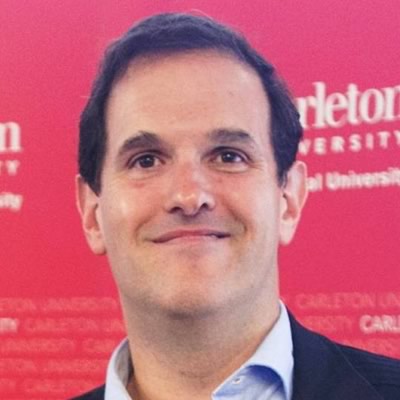
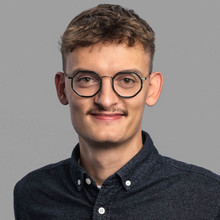
Dr. Gabriel Wainer is a Professor in the Department of Systems and Computer Engineering at Carleton University's Faculty of Engineering and Design. He leads the Advanced Real-Time Simulation Lab and specializes in modeling and simulation methodologies, particularly focusing on discrete event systems, real-time modeling, cellular automata, and DEVS formalism. Research Interests: Discrete event systems, DEVS formalism, cellular automata, real-time simulation, IoT applications, and parallel/distributed simulation Affiliation: Carleton University Recent publications highlight his work in advanced simulation frameworks, energy-efficient 5G systems using deep reinforcement learning, and pandemic modeling with cellular automata. His lab develops tools like PROMETHEUS and Devsmap for standardized DEVS model representation, while also exploring applications in wireless communication, building energy systems, and behavioral epidemiology.
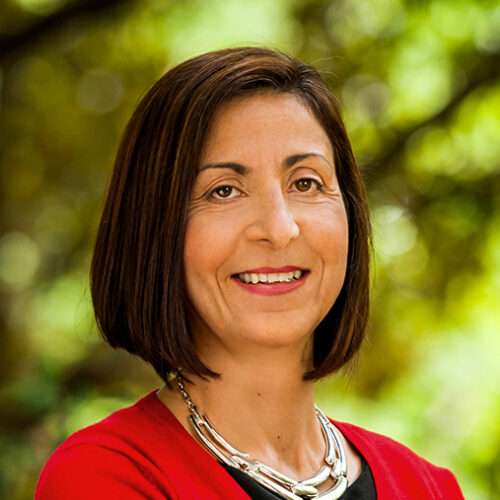
Elena Karahanna is a Professor at the Terry College of Business , University of Georgia. Her research spans Artificial Intelligence , Health Information Technology , and the social and algorithmic implications of digital platforms . PhD in MIS, University of Minnesota (1993) MBA in Business Administration, Lehigh University (1988) BS in Computer Science, Lehigh University (1986) Her work examines how conversational agents and social bots reshape e-commerce and social media, the algorithmic coordination in organizations, and the integration of IT in healthcare systems . She has contributed to foundational theories like the Needs-Affordances-Features (NAF) framework for social media analysis. Recent publications highlight her focus on digital governance (e.g., firm-sponsored online communities), chatbot applications in public health (e.g., pandemic response), and privacy concerns in online social networks. Her research often bridges information systems and marketing (e.g., hyper-privacy and dark web insights). Scientific Awards Terry College of Business Service Award, 2024 INFORMS Information Systems Society President's Service Award, 2023 MIS Quarterly Best Paper Award, 2022 AIS Leo Award for Exceptional Lifetime Contributions, 2020 AIS Fellow, 2012 Karahanna has served as Senior Editor for MIS Quarterly , Information Systems Research , and Journal of AIS . She co-founded the Doctoral Student Corner (2014) and the Senior Scholar Consortium (2004), emphasizing her leadership in academic mentorship. She has taught courses on theory development and business intelligence , and her international teaching includes stints in Hong Kong, Cyprus, Singapore, and Australia .
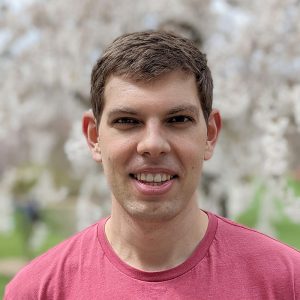
Tina Eliassi-Rad is Professor and the Inaugural Joseph E. Aoun Chair at Khoury College of Computer Sciences, Northeastern University in Boston. She serves as Core Faculty at the Network Science Institute and holds External Faculty positions at both the Santa Fe Institute and Vermont Complex Systems Institute. Additionally, she maintains Affiliated Faculty status across six Northeastern University institutes including the NULab for Digital Humanities and Computational Social Science, Global Resilience Institute, Cybersecurity and Privacy Institute, Institute for Experiential AI, and Internet Democracy Initiative. Her research spans: Data Mining & Machine Learning Network Science & Complex Systems Artificial Intelligence & Society She leads two major research initiatives: Trustworthy Network Science , which addresses explainability, transparency, stability, and robustness in network science ML algorithms; and Just Machine Learning , which examines broader complex systems where ML operates to understand and mitigate risks. Her work bridges theoretical foundations with societal applications. Dr. Eliassi-Rad's publication record demonstrates consistent focus on applying network science to critical societal challenges. Her recent research examines pandemic mobility patterns and cybersecurity threats using network-based approaches that combine epidemiological modeling with network analysis techniques. She actively mentors doctoral students through her RADLAB research group, currently advising PhD candidates Wan He (Network Science) and David Liu (Computer Science), along with PhD students Zohair Shafi and Samantha Dies (Computer Science). Her research has secured funding from prestigious organizations including the National Science Foundation, Department of Defense, Defense Advanced Research Projects Agency, Army Research Lab, and others. As leader of RADLAB, she directs research at the intersection of data science, network analysis, and societal impact, with particular emphasis on ensuring that technical advances in AI and network science serve societal needs responsibly and equitably.
Gedas Bertasius is an Assistant Professor in the Department of Computer Science at the University of North Carolina at Chapel Hill. Previously, he served as a postdoctoral researcher at Meta AI (Facebook AI) and earned his PhD in Computer Science from the University of Pennsylvania. His academic journey began with a bachelor’s degree in Computer Science from Dartmouth College. Dr. Bertasius specializes in computer vision and machine learning with specific interests in: Video understanding First-person vision (egocentric vision) Human behavior modeling Multimodal deep learning Transfer learning Computer vision for sports analytics Video+robotics integration His research produces practical frameworks like Video ReCap for hierarchical captioning of long videos, SiLVR for language-based video reasoning, and BASKET for fine-grained skill estimation. He focuses on developing models that can process videos across multiple temporal granularities while maintaining computational efficiency. Key research themes in his work include: Recursive video processing architectures Space-time attention mechanisms Generative video modeling LLM integration with vision systems 3D-aware representation learning Continual learning for video QA He has received notable recognition, including: CVPR 2024 Egocentric Vision (EgoVis) Distinguished Paper Award CVPR 2020 Best Paper Award Nomination First Place at CVPR 2025 Multi-Discipline Lecture Understanding Workshop Dr. Bertasius collaborates with prominent researchers like Mohit Bansal and Lorenzo Torresani . His recent publications demonstrate expertise in advancing video-language models, with applications in semantic alignment, temporal grounding, and cross-modal reasoning. For detailed information about his research, publications, and ongoing projects, please visit his official website .
Dr. Ronita Bardhan is Associate Professor of Sustainable Built Environment at the University of Cambridge , where she leads the Cambridge Sustainable Design Group and serves as Director of Research & Deputy Head of the Department of Architecture . She holds courtesy roles at Cambridge Public Health and the Department of Computer Science and Technology , and is a Fellow at Selwyn College . Education: BArch, MCP, MA, PhD (Urban Engineering) Her research intersects built environment , climate change , and public health , focusing on data-driven strategies for precision prevention of health and energy burdens. She pioneers algorithmic approaches to identify decarbonisation potential in buildings and urban areas, with a particular emphasis on gender-inclusive climate adaptation in the Global South. The 15 most recent articles span topics such as urban cooling with tree canopies , heatwave impacts on social systems , and machine learning applications for building energy efficiency . Her work addresses climate justice , hybrid workspace design , and thermal comfort in low-income housing . Awards: Top 50 Finalist Women in Engineering, UK 2024 Exceptional Woman of Excellence, Women Economic Forum Felicitated by Ministry of Health, Maharashtra, India She advises World Bank and ADB on affordable housing and climate resilience, and chairs the Research Ethics Committee at the Department of Architecture. Her lab, the Sustainable Design Group , develops solutions for health and low-carbon potential in built environments.
Riccardo Raheli is a Full Professor at the University of Parma , Department of Engineering and Architecture, with a career spanning over three decades in Information and Communication Technologies (ICT). He has served as Chair of the Councils for Telecommunications and Communication Engineering programs, and as representative of the University of Parma in CNIT and its Members' Assembly. Education: Laurea in Electronic Engineering (University of Pisa, 1983), M.Sc. in Electrical and Computer Engineering (University of Massachusetts, 1986), Postgraduate Diploma (Scuola Superiore Sant'Anna, 1987) Key Roles: President of Degree Councils (2002-2018), CNIT Committee Member (2000-2005), Editorial Board member for IEEE Transactions, Springer and MDPI journals His research bridges telecommunications , digital signal processing , and healthcare applications , producing extensive international publications and industrial patents. He has co-authored monographs including Detection Algorithms for Wireless Communications (Wiley, 2004) and LDPC Coded Modulations (Springer, 2009). Recent article trends show interdisciplinary work in automotive stress monitoring (IoT/Matlab-based systems), video processing for healthcare (neonatal seizures, respiratory monitoring), and acoustic field control (microphone virtualization, personal sound zones). His work spans machine learning applications in automotive systems, stochastic acoustic modeling , and power-line communications . Scientific Leadership : Co-Chair for IEEE conferences (ICC 2010, GLOBECOM 2011, ISPLC 2020) Editorial roles in 7+ international journals Grants & Collaborations : Led industrial patents in communications systems Coordinated CNIT Technical Reports series (2025) He teaches Wireless Communications and Digital Signals Laboratory , emphasizing Matlab/Simulink proficiency. His laboratory sessions focus on practical implementation of signal processing algorithms, requiring full software installation on personal devices.
Can Güler is an Assistant Professor in the Department of Lifelong Learning and Adult Education at the Faculty of Education, Anadolu University, Turkey. Previously, from 2002 to 2023, he served as a Lecturer in the Department of Distance Education at the Faculty of Open Education, Anadolu University. His academic career spans over two decades with continuous contributions to open and distance education systems. His educational background includes: Bachelor's degree in Computer and Instructional Technologies Education, Anadolu University (2002) Master's degree in Distance Education, Institute of Social Sciences, Anadolu University (2007) Ph.D. in Distance Education, Institute of Social Sciences, Anadolu University (2022) Güler's research centers on open and distance learning methodologies, educational technology integration, and instructional material development. He specializes in video-based learning systems, interactive media design, and gamification strategies for enhancing learner engagement. His work addresses practical challenges in digital content creation and accessibility for diverse learner demographics, particularly adult populations. Analysis of his publication trajectory reveals consistent innovation in multimedia applications for distance education, with recent emphasis on generative AI awareness among educators and interactive video transformation techniques. His research frequently employs design-based methodologies and institutional case studies from Anadolu University's open education infrastructure. Scientific Awards: None mentioned in available sources. Advising and Grants: No information provided regarding student supervision or research funding in current documentation.
Prof. Dr. Wolfgang Nejdl is a Professor at the Institute for Data Science within the Faculty of Electrical Engineering and Computer Science at Leibniz University Hannover. He serves as Executive Director of the L3S Research Centre and Leibniz Forschungszentrum Inclusive Citizenship. Web Science Information Retrieval Artificial Intelligence Deep Learning His recent research focuses on AI applications in medicine , multimodal data fusion , and ethical AI systems . Projects include CAIMed (AI in Causal Medicine) and DAISEC (AI & Cybersecurity). His publications span conferences like AAMAS, WWW, and SIGIR. Notable awards include membership in the National Academy of Science and Engineering (acatech) . Former students hold positions at institutions like Stanford, TU Dresden, and ETH Zürich. Current projects involve climate resilience AI , federated learning for healthcare , and quantum-inspired data science .
Florian Zettelmeyer is the Nancy L. Ertle Professor of Marketing at Northwestern University's Kellogg School of Management and Faculty Director of the Program on Data Analytics at Kellogg. He also serves as a senior science leader at Amazon, leading the Advertising Economics organization. His research focuses on marketing analytics, digital advertising, and the economic implications of artificial intelligence in business. PhD in Management Science from MIT (1996) Vordiplom in Business Engineering from University of Karlsruhe (1992) MS in Economics from University of Warwick (1991) Professor Zettelmeyer specializes in analyzing how analytics and AI transform firms, with notable work on advertising measurement, pricing strategies, and consumer decision-making in automotive markets. His publications span journals like Marketing Science, Management Science, and American Economic Review, emphasizing empirical validation through field experiments. He has received prestigious awards including the John D.C. Little Award (twice), Sales SIG Excellence in Research Award, and multiple teaching honors such as the Sidney J. Levy Teaching Award and L. G. Lavengood Outstanding Professor of the Year Award. His research frequently appears in top-tier journals and working paper series.
Iris Bohnet is the Albert Pratt Professor of Business and Government at Harvard Kennedy School and co-director of the Women and Public Policy Program. She serves as faculty director of the social sciences at Harvard Radcliffe Institute and has held significant leadership roles including academic dean of Harvard Kennedy School for six years and faculty chair of the World Economic Forum's executive program for Young Global Leaders for over a decade. Albert Pratt Professor of Business and Government, Harvard Kennedy School Co-Director, Women and Public Policy Program Faculty Director of Social Sciences, Harvard Radcliffe Institute Special Advisor to UN Secretary-General on Gender Equality Acceleration Plan Member, Gender Equality Advisory Council of the G7 Faculty Co-Chair, World Economic Forum's Young Global Leaders program Bohnet earned her Ph.D. in Economics from the University of Zurich in 1997 and joined Harvard Kennedy School as an assistant professor in 1998, becoming a full professor in 2006. Her research focuses on behavioral economics, combining insights from economics and psychology to improve decision-making in organizations and society, with particular emphasis on gender equality and cross-cultural perspectives. She pioneered experimental research in the Middle East and developed tools to measure behavior and beliefs across different global contexts. Her publications reveal a consistent focus on embedding fairness into organizational structures rather than relying on individual-level diversity training. Recent work emphasizes data-driven design for workplace equity, behavioral interventions to disrupt bias in hiring and performance evaluations, and creating organizational norms that support gender equality. Her research spans multiple disciplines including economics, psychology, management, and public policy, with practical applications for governments and corporations worldwide. Shortlisted for FT and McKinsey Business Book of the Year Award (2016) Financial Times Best Business Book of 2016 Named Most Influential Academics in Government by apolitical Named Most Influential People in Gender Policy by apolitical Recipient of multiple honorary degrees Bohnet advises governments and companies globally, serving on numerous boards including the Graduate Institute of International Studies in Geneva and advisory boards for institutions like the Vienna University of Economics. She directs the Harvard Decision Science Laboratory and has developed evidence-based frameworks that have influenced policy and organizational practices worldwide, particularly through her books 'What Works: Gender Equality by Design' and 'Make Work Fair'.
SangHyung Ahn is a Lecturer at the School of Civil Engineering , University of Queensland (UQ), since 2017. He joined UQ as a postdoctoral research fellow in 2015 after earning his PhD in Civil Engineering (Construction Engineering and Management) from Purdue University, USA. Prior to his academic career, he worked as an assistant manager at Hyundai Engineering and Construction Co., Ltd. (2003-2007) and holds an MBA in international business from Hanyang University and a B.Sc in Civil Engineering from Korea University. Research Focus: Construction process modelling with virtual reality, decision support systems for construction, automation of data-driven simulation modelling, sensor-based operations analysis, and integration of Building Information Modelling (BIM). Teaching: Coordinates undergraduate courses Introduction to Project Management (CIVL3510) and Construction Engineering Management (CIVL4522) . Research Trends: His recent publications highlight interdisciplinary work in transportation engineering, structural design, and AI-driven simulation tools. Key themes include application of machine learning to car-following models, drone-based vehicle identification, and optimization of public transport systems using agent-based simulations. Supervision: Available for supervision, with completed supervision of PhD and Master’s theses on topics such as BIM-LCA integration, pedestrian trajectory analysis, and AI-driven driving behavior models.
John Harry Evans is the III Katz Alumni Professor of Accounting at the Department of Accounting, Katz School of Business, University of Pittsburgh. His research focuses on economic perspectives of accounting phenomena, analytical models of incentives, experimental studies in managerial and tax reporting, and empirical investigations of healthcare incentives. He teaches courses in Financial Accounting, Financial Statement Analysis, Managerial Accounting, and Strategic Cost Management. Research spans incentive design, corporate governance, healthcare accounting, and empirical methodologies. Recent publications address CEO turnover, physician compensation, tax reporting ethics, and organizational incentive structures. Awarded multiple honors including the Outstanding Management Accounting Paper Award (2012), Provost Award for Excellence in Mentoring (2011), and multiple Best Paper Awards across journals. Active in professional service as a financial consultant to the Department of Defense and expert witness in legal cases. Designed financial analysis training programs for healthcare managers at University of Pittsburgh Physicians and Highmark Insurance Company.
Hannu Saarijärvi is a Professor in the Faculty of Management and Business at Tampere University, specializing in Marketing. His research bridges consumer behavior, retail innovation, and data-driven health studies. Based in Tampere University's City Centre Campus, he explores transformative retailing and societal impacts of consumer data. University: Tampere University School: Faculty of Management and Business Department: Business Studies Email: hannu.saarijarvi@tuni.fi His research focuses on consumer behavior in omnichannel and second-hand retailing, data analytics using loyalty card datasets, and health research linking maternal experiences to dietary patterns. Recent studies examine sustainable diets , alcohol consumption dynamics , and food waste reduction . Key article trends highlight loyalty card data applications in health informatics , retail transformation , and sustainability . Collaborative studies with Finnish institutions analyze population-level consumption behaviors, legislative impacts, and digital service innovations. Professor Saarijärvi's work emphasizes value co-creation , customer experience , and strategic digitalization in retail contexts, with practical implications for public health and business models.
Mitchell L. Stevens is a Professor at Stanford University’s Graduate School of Education and holds a courtesy appointment in the Department of Sociology. He co-directs the Stanford Center on Longevity and leads the Pathways Network and Futures Project on Education and Learning for Longer Lives . His research bridges organizational sociology and educational innovation, focusing on equity in academic pathways, data-driven institutional practices, and the sociology of higher education. Education: PhD in Sociology (Northwestern University, 1996); BA in Sociology (Macalester College, 1988). Stevens’ scholarly work examines alternative schooling , educational policy , gendered academic decision-making , and lifelong learning . His recent publications analyze the intersection of machine learning and enrollment trends , merit rituals in admissions , and the marketization of higher education . He employs mixed methods, including large-scale data analysis and comparative-historical frameworks. Stevens mentors doctoral students and postdoctoral researchers, with advisees including Daniela Ganelin, Philip Hernandez, Hansol Lee, Léon Marbach, Melanie Shimano, Joao M. Souto-Maior, Bernardo Mackenna, and Katie Spoon. His lab, the Pathways Network , develops analytics tools to enhance educational equity and institutional practices. Current teaching includes courses on Higher Education , Stanford’s Historical Context , and Organizational Analysis .
Dr. Hannes Petrowsky is a Senior Research Associate at the Chair of Business Psychology, Social Psychology & Experimental Methods at Leuphana University of Lüneburg. He earned his M.Sc. in Management & Marketing (2017-2019) and completed his Ph.D. on first-offer effects in negotiations (2020-2023). Academic Affiliation: Institute for Management & Organization (IMO) Location: Universitätsallee 1, C6.419, Lüneburg Contact: hannes.petrowsky@leuphana.de | +49.4131.677-1437 His research spans negotiation psychology , consumer behavior , and the impact of digital technologies (e.g., big data, machine learning, AI, VR). He investigates anchoring effects, price-ending strategies, and socially innovative transformations through inclusive working environments. Key Trends in Recent Publications: Analysis of concession patterns in negotiations using behavioral economics principles Development of immersive VR frameworks for skill acquisition Behavioral science-driven interventions for climate change mitigation Meta-analyses of negotiation dynamics across 25-26 million real-world transactions Exploration of technology adoption in public health contexts Dr. Petrowsky contributes to projects like the Digital Transformation Lab and MEHRCE (circular economy initiatives). His work bridges experimental psychology with digital innovation and sustainable entrepreneurship .