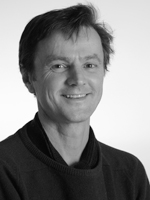
Professor Adil Rasheed is affiliated with the Department of Engineering Cybernetics at the Faculty of Information Technology and Electrical Engineering , Norwegian University of Science and Technology (NTNU). His work focuses on integrating data-driven methods with physics-based modeling to create reliable hybrid systems for high-stakes applications. Research Interests : Bigdata Cybernetics, Hybrid Analytics / Modeling, Artificial Intelligence, Reduced Order Modeling, Computational Fluid Dynamics, Wind Energy, Autonomous Vessels, and Safe Reinforcement Learning. Digital Twin Applications : Professor Rasheed leads projects in Digital Twin technology for wind energy and smart greenhouses. His work includes autonomous marine navigation, federated learning for Industrial IoT, and predictive maintenance in offshore wind turbines using integrated data-driven models. Collaborative Efforts : He collaborates with industry partners on digital twin syncing for autonomous vessels, thermal zoning algorithms for building control, and anomaly detection in multivariate time series. His publications highlight the use of transformers, federated transfer learning, and corrective source terms in hybrid modeling.
Ajit Jha is an Associate Professor at the Department of Engineering Sciences , University of Agder , Norway, with research expertise in photonic sensing, robotics, machine learning, and sensor fusion. His work bridges theoretical advancements with real-world applications in autonomous systems, industrial automation, and biomedical imaging. Research Areas: Photonic sensing, Robotics, Machine Learning, Computer Vision, Sensor Fusion, Mechatronics Recent Publications demonstrate innovative applications of deep learning to thermal imaging (gesture recognition), reinforcement learning for drone landing, and sensor fusion techniques for autonomous navigation. His interdisciplinary approach combines photonics, radar systems, and AI to solve complex engineering problems.
Georgios Kavallieratos is an Associate Professor at the University of Oslo's Institute of Transport Economics, specializing in the Section for Autonomous Systems and Sensor Technologies. His research focuses on cybersecurity in maritime systems, cyber-physical systems, and risk management. He actively contributes to the DESSI project on energy system security infrastructure. His research interests include maritime cybersecurity, cyber-physical system security, and the intersection of safety and security in autonomous systems. His work addresses threats to navigation systems, smart farming, and satellite communications, with a focus on developing risk assessment frameworks and robust cybersecurity controls. Recent publications emphasize maritime cybersecurity trends, integrated navigation system protection, and threat analysis in emerging technologies like Dairy Farming 4.0. He co-authored foundational papers on cyberattack defenses for autonomous ships and cybersecurity requirements for Shipping 4.0. Current projects involve enhancing societal awareness of cybersecurity risks and improving incident response strategies for critical infrastructure. His work bridges theoretical cybersecurity principles with practical applications in transportation and industrial systems.
Jo Herstad is an Associate Professor in the Department of Information Systems Design at the University of Oslo , where she has worked since 2002. With a background in industry at Ericsson (1990-2003), Herstad bridges technical expertise with academic rigor. She teaches courses including: IN1030 - Introduction to Design, Use, Interaction (since 2017) IN2000 - Software Engineering with Project Work IN5480 - Interaction with AI and Autonomous Systems Research Focus: Her work explores Human-Computer Interaction through: Universal Design principles in digital environments Human-Robot Interaction for domestic applications Inclusive Technology across diverse populations Participatory Design methodologies Privacy Dynamics in smart homes Multimodal Systems for elderly care Key Publications (2017-2024) examine motion profiling in robotics, equitable digital feedback, and socio-technical systems. Her supervision includes 15+ master's theses on topics ranging from chatbot ethics to universal design in education. Current projects focus on: Artificial Intelligence and Sensor Technology Multimodal Elderly Care Systems (MECS) Podcast Accessibility (PUD) RHYME: Music Technology for All
Ørjan Grøttem Martinsen is a Professor of Electronics at the Department of Physics, Faculty of Mathematics and Natural Sciences, University of Oslo. He also holds a temporary research position at the Medical Technology Business Area of Oslo University Hospital. With over three decades of experience, he has established himself as a leading expert in bioimpedance research and applications. Education: High-voltage engineer degree (1983) Cand. scient. in electronics/measurement technology (1990) Dr. scient. with thesis on skin's electrical properties (1995) Professor Martinsen's research centers on bioimpedance—the passive electrical properties of biological tissues that vary with anatomy and physiology. His work spans diverse applications including medical diagnostics (skin cancer detection), food quality assessment (fresh vs. thawed fish), skin condition monitoring (moisture levels), and stress level evaluation. His research bridges physics, engineering, and medical applications, creating practical diagnostic tools from fundamental electrical principles. He has pioneered methods to characterize tissue properties through impedance measurements, with particular focus on electrodermal activity and skin impedance. His recent publications (2022-2025) demonstrate a strong interdisciplinary approach combining bioimpedance with machine learning, robotics, and advanced signal processing. The work spans from fundamental biophysics (GABA detection, tissue characterization) to practical applications (dental anxiety assessment, ADHD treatment evaluation). Key trends include integration of AI with bioimpedance measurements, development of novel sensor systems, and expansion into new application areas like optogenetics and micro-robotics. Awards and Recognition: IEEE Senior Member (2006) CLABIO Award (2012) Fellow at Institute of Physics (FInstP) (2015) Dr. Honoris Causa, Tallinn University of Technology (2018) UiO Innovation Award (2019) Member of Norwegian Academy of Technical Sciences (2021) Professor Martinsen has served as Editor-in-Chief of the Journal of Electrical Bioimpedance since 2010 and was President of the International Society for Electrical Bioimpedance (2010-2016). His research has attracted significant funding, enabling collaborations across engineering, medical, and biological disciplines. He has supervised numerous students and researchers in the Bioimpedance Group at UiO, fostering a strong research environment that bridges theoretical and applied work. His work is conducted primarily through the Oslo Bioimpedance Group and Sensorama SmartSense research teams, which focus on developing innovative measurement techniques and applications of bioimpedance technology. These groups maintain strong collaborations with medical institutions and industry partners to translate research findings into practical healthcare solutions.
Dr. Aida Akbarzadeh is a Postdoctoral Researcher at NTNU's Department of Information Security and Communication Technology, specializing in cybersecurity for critical infrastructure and cyber-physical systems. She holds a Ph.D. in Information Security and Communication Technology and leads research in the Critical Infrastructure Security and Resilience (CISaR) group. Her research focuses on developing advanced threat models for industrial control systems and maritime autonomous systems. Recent projects include vulnerability analysis of power grid substations and navigation systems. Publications demonstrate consistent focus on cybersecurity frameworks for critical infrastructure, with emerging applications in maritime autonomous systems and evolving threat landscapes. Her work integrates practical testing environments through dedicated cybersecurity testbeds.
Annette Stahl is a Professor at the Department of Engineering Cybernetics, NTNU, and an Onsager Fellow. She leads the Robot Vision Group and oversees the AILARON project, funded by the Research Council of Norway. Her expertise spans robotic vision, control theory, and autonomous systems. She holds a PhD in Applied Mathematics (Computer Vision) from Heidelberg University. Her research focuses on underwater robotics, autonomous vehicles, and aquaculture monitoring, with applications in fish health analysis and marine environmental sensing. Stahl has supervised numerous PhD and master’s students, including projects on autonomous ships (SFI AutoShip), underwater SLAM (AROS), and plankton identification. She collaborates with industry partners like Zebop AS and SINTEF Ocean. Notable projects include the robotic microplankton sniffer-dog and AI-driven fish welfare monitoring. Her work is published in top journals/conferences like IEEE Access and MIC Journal. She actively contributes to datasets like the VAROS Synthetic Underwater Data Set.
Dinsha Vinod is a Postdoctoral Researcher at the University of Agder, affiliated with the Department of Engineering Sciences. His research focuses on control systems, fog computing, and autonomous robotics, with a particular emphasis on integrating artificial intelligence and event-triggered control mechanisms. He has contributed to advancements in fog-cloud platforms for mobile robotics applications, model predictive control (MPC), and robust control design. Education details are not explicitly provided in the text, but his work spans academic and industrial collaborations. He is part of the Robotics and Automation research group at UiA. Key research areas include: Event-based control strategies for LPV systems Fog computing autoscaling with service guarantees MPC applications in mobile robotics Integration of AI inference into control systems Publications since 2017 reflect a trajectory from aerospace control systems to fog computing and robotics. Recent work emphasizes real-time systems and autonomous decision-making frameworks.
Thor I. Fossen is a Professor of Guidance, Navigation, and Control at the Norwegian University of Science and Technology (NTNU), Department of Engineering Cybernetics. He holds a PhD in Engineering Cybernetics and an MSc in Marine Technology. His research focuses on marine craft hydrodynamics, autonomous systems, inertial navigation, and cybersecurity of control systems. He is an IEEE Fellow and has authored influential textbooks such as the Handbook of Marine Craft Hydrodynamics and Motion Control . **Education**: PhD Eng. Cybernetics, MSc Marine Technology. **Research Interests**: Development of guidance, navigation, and control (GNC) systems for marine and aerial vehicles; cybersecurity for autonomous systems; inertial navigation algorithms; and robotics. Notable contributions include the Marine Systems Simulator (MSS), a widely used MATLAB/Simulink toolbox for vehicle control design. **Recent Trends in Publications**: Focus on autonomous surface/underwater vehicles, adaptive guidance laws, cyber-resilient navigation, and sensor fusion techniques. His work bridges theory and practice, with experimental validations on real systems. **Awards**: Automatica Prize Paper Award (2002), Arch T. Colwell Merit Paper Award (2008), IEEE Fellow (2020+). **Grants & Labs**: Co-founder of Marine Cybernetics AS and ScoutDI AS. Lead developer of MSS software. Active in collaborative projects involving dynamic positioning, wave filters, and cyber-physical systems security.
Roger Skjetne is a Professor in Marine Control Engineering at the Norwegian University of Science and Technology (NTNU), affiliated with the Department of Marine Technology under the Faculty of Engineering. His research focuses on autonomous ships, dynamic positioning systems, energy and power management for hybrid-electric vessels, Arctic stationkeeping, and ice management systems. He leads the SFI Autoship research center, which aims to advance autonomous ship technology for safe and sustainable operations in Arctic and maritime environments. Key projects include DigitalSeaIce (multiscale sea ice observation), ENDURE (safety solutions for autonomous ships), and ZEVS (zero-emission passenger vessel systems). His work integrates control systems, robotics, and environmental monitoring to address challenges in marine autonomy and energy efficiency. Skjetne’s research has produced over 150 publications since 2020, with a focus on hybrid control barrier functions, energy optimization, and autonomous navigation. He collaborates with industry partners to translate academic findings into practical maritime solutions.
Edmund Førland Brekke is a Full Professor at NTNU's Department of Engineering Cybernetics, specializing in autonomous maritime systems. He leads major projects like Autosea, Autosit, Autosight, and SFI Autoship. His research focuses on estimation theory, target tracking, SLAM, and collision avoidance for autonomous ships. He has held roles including Project Manager for key initiatives and was a Research Fellow at NUS's Acoustic Research Lab. Brekke teaches courses on sensor fusion and nonlinear state estimation. PhD: NTNU (2010), MSc: NTNU (2005) Research interests include sensor fusion, maritime navigation, and autonomous system safety. He supervises over 20 PhD students in topics like radar tracking, SLAM, and digital twins. His publications span collision avoidance algorithms, multi-sensor integration, and autonomous vessel control. He co-founded Zeabuz and collaborates on projects like Autoferry and AutoBarge. Recent work emphasizes maritime target tracking, scenario-based collision risk assessment, and sensor fusion for autonomous ferries. His contributions advance autonomous vessel autonomy and regulatory compliance with COLREGs.
Slawomir Wojniusz is an Associate Professor at Oslo Metropolitan University's Faculty of Health Sciences, Department of Rehabilitation Science and Health Technology. His research focuses on physiotherapy interventions for sexual health issues, particularly provoked vestibulodynia, integrating somatocognitive therapy and digital pedagogy during clinical placements. Affiliation: OsloMet - Faculty of Health Sciences Academic Roles: Associate Professor in Physiotherapy Research Interests: His work spans sexual pain management, digital transformation in higher education, and musculoskeletal health. He leads feasibility studies like ProLoVe for vestibulodynia treatment and explores electrodermal activity asymmetry in behavioral neuroscience. Publication Trends: Recent articles emphasize hybrid learning in physiotherapy education, somatocognitive therapy for pelvic pain, and biomedical research on electrodermal responses. Subfields include clinical trial design, patient-centered care, and technology integration in teaching. Laboratory & Collaborations: Wojniusz collaborates with researchers like Mette Bøymo Kaarbø and Gro Killi Haugstad on projects addressing women's health and digital pedagogy.
Pawan Sharma is an Associate Professor at the Department of Electrical Engineering, Faculty of Engineering Science and Technology, UiT The Arctic University of Norway (Narvik Campus). He is affiliated with the Electromechanical Systems research group and the ARC research center. His research focuses on: Power system dynamics and control Distributed generation integration Microgrid optimization Smart grid technologies Reactive power control Electric vehicle-grid interaction Key research trends observed in his publications include: Hybrid microgrid control frameworks Cyber-physical co-simulation for grid applications Machine learning approaches for power optimization Integration of renewable energy sources Advanced converter control techniques Voltage stability and reactive power management He serves on the editorial boards of: International Transactions on Electrical Energy Systems Designs (MDPI) Electrical Engineering (Springer) Teaching responsibilities: Master's course: Power System Fundamentals (10 credits) Special PhD course: Distributed Energy Resources Integration (10 ECTS) Distributed Generation & Microgrids: Role and Concepts (5 credits) Research projects include: Cooperative Isolated Renewable Energy Systems (rural reliability) Hybrid Renewable Energy Micro Grid development Smart Solar PV Control Technology in Arctic regions arcICE, Arctic Energy, nICE initiatives
Ingrid Bouwer Utne is a Professor in the Department of Marine Technology at the Norwegian University of Science and Technology (NTNU). Her research focuses on risk assessment, autonomy, safety, and maintenance management of marine and maritime systems. She leads the Risk Group at NTNU and has been a main supervisor for numerous PhD students in areas like autonomous systems safety and risk modeling. She is actively involved in research projects such as the ERC AdG BREACH (Risk-Based Rationality in Autonomous Systems), SFI Autoship (Center for Autonomous Ships), and SAFEGUARD (Intelligent autonomous systems for safeguarding ocean infrastructure). Her work emphasizes risk-based control systems, online risk monitoring, and human-autonomy collaboration in maritime operations. Key publications include 'Risk and Interdependencies in Critical Infrastructures' (Springer) and 'Online Probabilistic Risk Assessment of Complex Marine Systems' (Springer). She has advised over 20 PhD students and contributed to industry-funded projects like UNLOCK and ORCAS, focusing on safer autonomous systems design and verification.
Gudmund Grov is an Associate Professor in Digital Security at the Department of Informatics, Faculty of Mathematics and Natural Sciences, University of Oslo. His research focuses on cybersecurity, with emphasis on anomaly detection, explainable AI, and security modeling. He is actively contributing to advancements in autonomous cyber defense and machine learning applications in security operations. His research interests span Digital Security , Network Anomaly Detection , Explainable AI (XAI) , Machine Learning for Cyber Defense , Security Modeling , and Risk Modeling in Enterprise Architecture . His work integrates formal reasoning with practical modeling to enhance system security and interpretability. The recent publications reflect a strong trend towards intelligent and interpretable cybersecurity systems, combining deep learning with formal methods to detect and explain network threats. His work bridges the gap between theoretical modeling and real-world security applications, particularly in autonomous defense and labeled dataset generation for APTs. No scientific awards were mentioned in the provided text. Gudmund Grov collaborates extensively with researchers in cybersecurity and formal methods. While specific grants and advising roles are not detailed, his co-authorship on multiple projects indicates active research supervision and collaboration. He is involved in developing frameworks for labeled data generation, contextual anomaly detection, and explainable alerts in SOC environments. There is no explicit information about labs or research teams, but his work suggests involvement in cybersecurity research groups at the University of Oslo focusing on AI-driven security and formal verification.


/georgkav/georg.jpg)