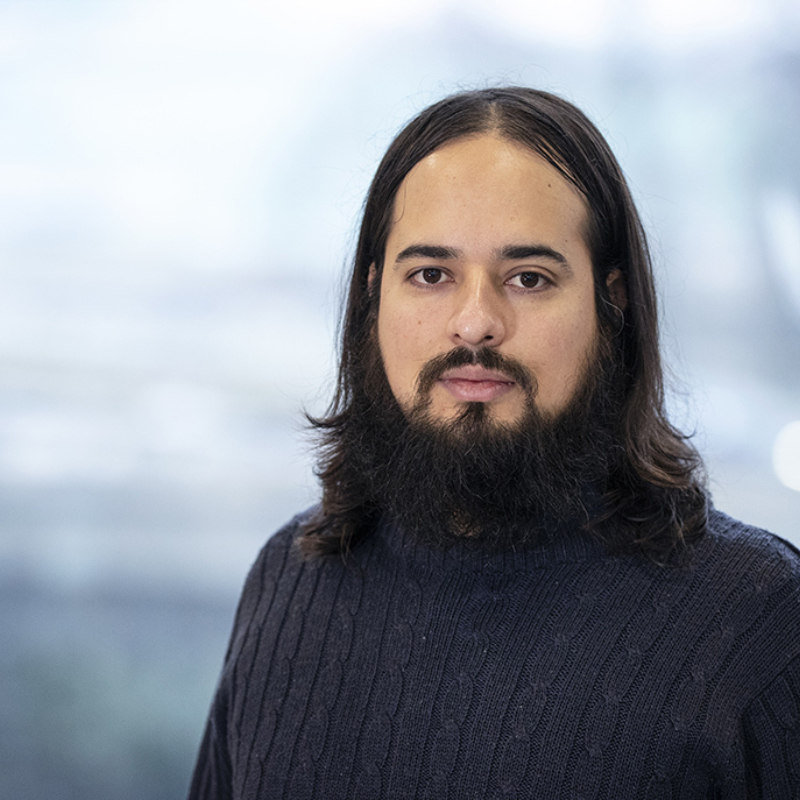
Idelfonso Nogueira is an Associate Professor at the Department of Chemical Process Technology, Norwegian University of Science and Technology (NTNU). His research focuses on integrating artificial intelligence, advanced control, and system optimization to address challenges in Industry 4.0/5.0. Key research areas include AI-driven product/process development, interpretable machine learning for process systems, multi-scale system integration, and adaptive digital twins. He collaborates extensively with global universities, institutes, and industries to advance sustainable industrial solutions. His work emphasizes digitalization, hybrid modeling, and optimization frameworks, as seen in publications on pressure swing adsorption, fragrance engineering, and CO2 capture systems. He also promotes innovative teaching methods, including augmented reality for chemical engineering education. Recent publications highlight advancements in digital twin frameworks, machine learning for crystallization processes, and optimal control strategies. His research bridges theoretical models with practical applications, ensuring robustness and reliability in industrial contexts.
Bjarte Hannisdal is an Associate Professor in the Department of Geosciences at the University of Bergen, Norway, and affiliated with the Bjerknes Centre for Climate Research. He plays a key leadership role in iEarth, a national Centre of Excellence in geoscience education, serving as the iEarth Education Chair and Head of Focus Area 1, which aims to develop innovative frameworks for higher education in geosciences. Department of Geosciences, University of Bergen Bjerknes Centre for Climate Research iEarth – Centre of Excellence in Geoscience Education His research lies at the intersection of geobiology, paleontology, and Earth system science, with a strong focus on quantitative methods. He investigates Earth system evolution, causality in dynamical systems, and the co-evolution of life and the planet using advanced statistical and information-theoretic approaches applied to geological and fossil records. His work spans microbial ecology in deep-sea sediments, paleoclimatology through isotope analysis, and the detection of causal interactions in deep time. Hannisdal has made significant contributions through a high-impact publication record, with articles in top journals such as Science , Nature Geoscience , PNAS , and Physical Review E . His recent publications highlight trends in applying machine learning and information theory to geoscience problems, including microbial responses to oxygen, causality detection in incomplete records, and the calibration of geochemical proxies. These works reflect a strong interdisciplinary trend, integrating biology, physics, and computational methods into Earth sciences. He is actively involved in higher education, having developed and taught courses such as GEOV114 (Introduction to Geobiology) and GEOV302 (Data Analysis in Geosciences), and contributes to others like GEOV344 and BIO318. His educational research explores student-centered learning and computational skill development. He has supervised doctoral research, including Dario Blumenschein’s project on educational change. His work is supported by funding from the Research Council of Norway, Trond Mohn Foundation, and EU Horizon 2020. Hannisdal collaborates widely across institutions and disciplines, as evidenced by his co-authorship with researchers from Norway, the US, Germany, and others.
Mina Mirhosseini is a Research Fellow at the Faculty of Logistics, Molde University College, Norway. She holds a PhD in Computer Science from Shahid Beheshti University of Tehran, Iran, and has prior academic experience as a faculty member and lecturer in Iran and as a remote teaching assistant at the University of Hertfordshire, UK. Her primary research interests include Optimization Methods, Metaheuristics, Heuristics, Linear Integer Programming, Parallel Processing, Machine Learning, Artificial Intelligence, and Logistics. She has made significant contributions to solving complex computational problems such as the n-similarity problem and Mixed Integer Linear Programming (MILP) models using hybrid and parallel algorithms, particularly in the context of high-level synthesis and wireless sensor networks. The analysis of her recent publications reveals a strong focus on developing and applying advanced optimization techniques, especially quantum-inspired gravitational search algorithms and parallel genetic algorithms, to real-world engineering and computational challenges. Her work consistently emphasizes performance improvement, scalability, and load balancing in distributed and heterogeneous computing environments. Mina Mirhosseini has an extensive publication record in high-impact journals such as IEEE Transactions on Parallel and Distributed Systems, Journal of Parallel and Distributed Computing, Journal of Supercomputing, and Computers and Electrical Engineering. Her research has been published across a range of venues, reflecting interdisciplinary work at the intersection of computer science, electrical engineering, and applied optimization. She has actively contributed to the academic community through roles such as program committee member and executive committee member for conferences on fuzzy systems, swarm intelligence, and evolutionary computation. Her academic journey includes teaching and research roles in Iran, demonstrating a sustained commitment to higher education and scientific inquiry. Mina Mirhosseini is part of the research group focused on Planning, Optimization and Decision Support at Molde University College. Her current work continues to advance the state-of-the-art in parallel and metaheuristic optimization methods, with applications in logistics, synthesis, and sensor network design.
Morten Brun is an Associate Professor at the Department of Mathematics, University of Bergen. His research spans computational topology, persistent homology, and applications in biology and data science. Email: morten.brun@uib.no Research Interests: He specializes in topological data analysis, focusing on sparse nerves, relative persistent homology, and computational geometry. His work applies topological methods to biological problems, including drug resistance modeling in tuberculosis and immune profiling in multiple sclerosis. Recent Publications: His 2025 work includes hypercubic modeling of tuberculosis drug resistance and high-dimensional immune profiling post-stem cell transplantation. Earlier articles explore computational topology techniques (2017-2024) and interdisciplinary applications in toxicology and systems biology.
Nikolas Olson Aksamit is an Associate Professor in the Department of Mathematics and Statistics at UiT The Arctic University of Norway, where he conducts interdisciplinary research at the intersection of applied mathematics and environmental science. His work focuses on understanding coherent structures in fluid flows relevant to the coupling between the cryosphere, atmosphere, and hydrosphere. His research interests include applied mathematics, nonlinear dynamical systems, fluid dynamics, Lagrangian coherent structures, snow science, and climate dynamics. He develops mathematical tools to analyze complex environmental systems, particularly in polar and alpine regions, with applications to sea ice, blowing snow, and ocean turbulence. His work bridges theoretical modeling with field observations and data analysis. The recent articles reflect a strong trend in using Lagrangian methods and nonlinear dynamics to study geophysical flows. Key themes include the detection of coherent structures in turbulent flows, sea ice dynamics, climate modeling, and the application of machine learning to oceanographic data. His publications span high-impact journals in fluid mechanics, geophysics, and environmental science, often in collaboration with leading experts in dynamical systems and climate science. He is a member of the research group Changing Arctic and contributes to the project Development of nonlinear dynamics-based techniques for sea ice diagnosis . While no formal students or awards are listed, his active publication record indicates a vibrant research program. His work has implications for climate prediction, polar monitoring, and environmental engineering.
Ove Edvard Hatlevik is a Professor at the Faculty of Education and International Studies , Department of Primary and Secondary Teacher Education at Oslo Metropolitan University. His research focuses on Teacher Professional Digital Competence , ICT integration in education , Psychometrics , and Critical Health Literacy . He leads the Teacher Education for a Future in Flux (TEFF Academy) and Teacher Education Panel Study (TEPS) projects, while previously managing initiatives such as Developing ICT in Teacher Education (DiCTE) and Literacies for Health and Life Skills . Email : ove-edvard.hatlevik@oslomet.no Office : Pilestredet 42, Oslo (Q6007) His recent publications explore: AI applications in thesis categorization (2025) Gender differences in early childhood education outcomes (2025) Job satisfaction dynamics in teaching (2024) Digital distraction management in teacher training (2024) Professional digital competence in technology-rich classrooms (2024) Systematic reviews on digital competence dimensions (2023) Key thematic areas include: Algorithmic thinking in mathematics education Long-term impacts of ECEC quality Digital divide in adult education Assessment of critical health literacy ICT access barriers in education centers Psychometric properties of educational tools
Juha Vierinen is a Professor in Space Physics at the Department of Physics and Technology, UiT The Arctic University of Norway. His research focuses on experimental space physics, specializing in radar and radio remote sensing techniques applied to space plasma dynamics, atmospheric physics, space debris characterization, and planetary science. Develops advanced radar systems for ionospheric and mesospheric studies Works with EISCAT, EISCAT_3D, and GNSS networks Investigates Kelvin-Helmholtz Instabilities, GNSS scintillation, and space debris mapping Recent research includes interferometric imaging of ionospheric structures and machine learning applications in ionogram analysis. He collaborates with international institutions on projects like UNICube, QBDebris, and CASCADE. Based in Tromsø, Norway, he operates from Forskningsparken 1 A220. His publications span topics like solar eclipse effects on ionospheric density, smartphone-based space weather mapping, and multi-static meteor radar turbulence studies. Current work emphasizes volumetric radar analysis and fine-scale plasma irregularity characterization using novel imaging techniques.
David Landa Marban is a Researcher at NORCE Research AS, affiliated with the Energy and Technology division. His primary focus is on mathematical modeling and simulation of subsurface processes, including applications in CO2 storage (CCS), microbial enhanced oil recovery (MEOR), and microbially induced calcite precipitation (MICP). He has expertise in scientific computing, software development for multi-phase flow and reactive transport, and numerical simulations at pore, core, and field scales. Education: PhD in Applied Mathematics from the University of Bergen (2019), followed by a postdoctoral position at NORCE (2019-2021). Current role as a Research Scientist since 2022. Research interests emphasize computational geosciences, with projects such as MuPSI (multiscale pressure-stress impacts on CO2 storage) and CSSR (sustainable subsurface resources). He develops open-source tools like pyopmspe11 and contributes to frameworks like OPM Flow for reservoir simulation and history matching. Key contributions include modeling pressure interference in CO2 storage, machine-learned near-well models, and data-driven predictions for CO2 EOR. His work bridges lab-scale experiments with field-scale applications, addressing challenges in subsurface energy systems and leakage remediation.
Adam Palmquist is a Professor at Nord University, leading the HABIT research group focused on human-centered AI, behavior analytics, and technology design. He holds a PhD in Applied Information Technology for Learning and specializes in gamification, learning analytics, VR games, and organizational learning dynamics. His work bridges academia and industry, addressing real-world challenges through cross-disciplinary collaboration. Education: PhD in Applied Information Technology for Learning. Research Interests: Palmquist’s research explores gamification’s role in lifelong learning, AI integration in education, and VR game development. He investigates how generative AI, learning analytics, and game mechanics enhance engagement and motivation. His studies on group processes in workplace learning highlight frameworks for effective organizational learning systems. Current Projects: GOAL: Uses gamification to train leadership in crisis scenarios, funded by the University of Borås. ETUS: Enhances game research via eye-tracking and analytics, funded by Nord University. BiP: Studies remote-first VR game development methodologies, funded by Erasmus+. Scientific Affiliations: Member of the University of Gothenburg’s research team, steering committee for the Design Society’s Data Informed Design group, and the Swedish Game Researcher Council. Grants & Advising: Active in Nordic and international collaborations, including the Norwegian Centre for Excellence in IT Education (EXCITED). Supervises Izabella Jedel’s PhD on gamification in higher education. Labs/Teams: Heads HABIT, which integrates experts from Journalism, Games, Business, and Social Work to develop innovative tech solutions.
Haakon Fossen is a Professor at the University of Bergen, affiliated with the Department of Natural History and the University Museum of Bergen. His research focuses on structural geology, tectonics, and the evolution of rift basins, particularly in the North Sea region. He is part of the Geodynamics and Basin Studies research group. His work integrates field observations, seismic data analysis, and microstructural studies to understand orogenic processes, fault mechanics, and basin formation. Key research areas include the Caledonian orogen collapse, Jurassic North Sea rifting, and the interplay between structural inheritance and rift development. Fossen has authored a textbook on Plate Tectonics and collaborates internationally on projects involving deformation band analysis, fault permeability, and seismic interpretation. His contributions span both academic studies and applied geoscience, including work with industry partners like Aker BP ASA and Equinor. Recent research highlights include studies on gravity tectonics in the North Sea, quartz texture analysis for orogenic collapse insights, and structural evolution of Paleozoic basins. Fossen’s methodologies combine advanced techniques like EBSD and machine learning with traditional geologic analysis, emphasizing interdisciplinary approaches to tectonic problems. He has advised numerous collaborative projects and contributed to major international conferences such as the 85th EAGE Annual Conference. His affiliations include roles in both academic and museum settings, reflecting a commitment to both research and public science outreach.
Elena Celledoni is a Professor of Mathematics at the Department of Mathematical Sciences, Norwegian University of Science and Technology (NTNU), where she has been employed since 2004. She leads the research group on differential equations and numerical analysis. Her academic background includes a Master’s degree (1993) and Ph.D. (1997) in mathematics from the Universities of Trieste and Padua, Italy, respectively. She has held postdoctoral positions at the University of Cambridge (UK), the Mathematical Sciences Research Institute (MSRI, Berkeley, CA), and NTNU. Her research focuses on numerical analysis, particularly structure-preserving algorithms for differential equations and geometric numerical integration. Recent work includes applications of neural networks in computational mechanics and data-driven modeling. She has co-authored over 100 peer-reviewed articles in journals such as Journal of Computational Physics , SIAM Journal on Scientific Computing , and Physica D . Her research interests span computational methods for dynamical systems, machine learning integration with numerical analysis, and geometric algorithms for shape analysis. She actively collaborates with international researchers, including contributions to conferences like NeurIPS and workshops on theoretical aspects of computational dynamics. Elena is a member of the editorial boards of Journal of Computational Dynamics and has organized workshops on structure-preserving integrators. Her work emphasizes preserving geometric properties in numerical methods, with applications in fluid dynamics, mechanical systems, and image processing.
Christian Fredrik Sætre is an Associate Professor at the Department of Engineering Cybernetics, Norwegian University of Science and Technology (NTNU). His work focuses on control engineering, robotics, and machine learning, particularly in nonlinear control systems and underactuated dynamical systems. Current courses: AIST1001 Automation, Introduction and IELET2101 Control Theory 2 Previous courses: TTK4195 Modeling and Control of Robots Research interests: Control engineering, robotics, motion planning, machine learning, and computer vision Competencies: Artificial intelligence, automation, control theory, cybernetics, dynamical systems, robotics His recent publications (2019–2023) explore orbital stabilization techniques for underactuated mechanical systems, with applications in robotics and automation. Key themes include Floquet theory, transverse coordinates, and robust control approaches. Contact: christian.f.satre@ntnu.no | Office: Elektro D/B2, D435, Gløshaugen
Pedro Lind is a Professor at Oslo Metropolitan University's Faculty of Technology, Art and Design, where he serves in the Department of Information Technology with a focus on Artificial Intelligence. His academic appointments include active participation in research groups for Applied Artificial Intelligence and Mathematical Modeling. Dr. Lind's research spans interdisciplinary domains including: Biomedical AI applications (EEG classification, ECG analysis, eye tracking) Stochastic processes and complex systems modeling Trustworthy machine learning for security/privacy Physics-inspired computational methods Renewable energy statistics and modeling His recent publications demonstrate strong focus on developing novel AI methodologies for medical diagnostics (2024-2025), particularly using generative models and interpretable AI approaches for physiological data analysis. He leads significant research initiatives including the AI-Mind project developing diagnostic tools for dementia. Additional projects include international technology transfer collaborations with Czech Republic institutions. Dr. Lind maintains active research teams and labs focused on computational neuroscience and applied AI.
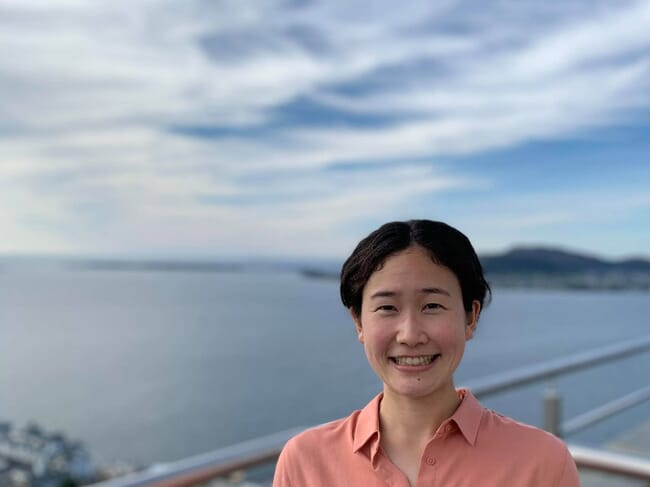
Kana Banno is a PhD Research Fellow at the Department of Biological Sciences Ålesund, Faculty of Natural Sciences at the Norwegian University of Science and Technology (NTNU). Her research focuses on salmon aquaculture, with particular emphasis on fish behavior and welfare in commercial sea cages. She utilizes advanced technologies including underwater cameras, ROVs, echosounders, and sonars for aquaculture monitoring. Banno earned her PhD in Biology from NTNU in 2025, following an MSc in Biology with a focus on aquaculture and genetics from UiT The Arctic University of Norway in 2019. Her educational background includes: PhD in Biology, NTNU (2025) MSc in Biology (Aquaculture & Genetics), UiT The Arctic University of Norway (2019) Banno's research interests center around understanding fish behavior as an indicator of welfare and health in aquaculture settings. She investigates how environmental factors affect the distribution and behavior of Atlantic salmon in commercial sea cages. Her work bridges biology and engineering through the integration of technology for monitoring purposes. She has particular expertise in using computer vision and artificial intelligence to identify growth-stunted salmon and monitor wild fish interactions around aquaculture sites. Her research contributes to developing more sustainable and welfare-conscious aquaculture practices. Analysis of her publication record reveals a strong focus on technological applications in aquaculture monitoring, with particular emphasis on computer vision, sonar technology, and multi-sensor integration. Her work spans both practical applications for the aquaculture industry and fundamental research on fish behavior. The publications show a progression from molecular genetics (her master's work on salmon lice) to more applied technological solutions for monitoring fish welfare in commercial settings. Her notable achievements include: Featured in 'Women in aquaculture' series by The Fish Site (2021) Research on AI for wild fish monitoring highlighted by Norwegian SciTech News (2021) Banno teaches BIA3003 Introduction to scientific method (2024 Autumn) and has been actively involved in the InnoSEA project (Innovations for Sustainable sEabased Aquaculture). Her fieldwork involves regular visits to salmon farms approximately 1.5 hours from her base, where she monitors salmon behavior using underwater cameras and remotely operated vehicles. She collaborates extensively with researchers from multiple countries including Argentina, China, Germany, Japan, and Norway. She maintains strong connections with the aquaculture industry, having previously worked at FRD Japan, a land-based RAS facility producing rainbow trout, where she gained practical experience in fish farming operations before transitioning to research.
Hugo Lewi Hammer er professor ved Oslo Metropolitan University, tilhørende Faculty of Technology, Art and Design og Department of Information Technology – Mathematical Modeling . Hans forskning fokuserer på forbedring av pålitelighet og transparens i maskinlæring, forsterkende læring og dyb læringsmodeller gjennom metodikk innen modelltolkning, usikkerhetskvantifisering, robust statistikk og kausal inferens. Hans nylige arbeid inkluderer: AI-drevet optimering i assistert reproduksjonsteknologi (embryoutvalg og sædcelleanalyse) Medisinsk bildebehandling (polypdeteksjon, meibomkertutgang) Neural nettverkstolkning og usikkerhetsmodellering i EEG-analyse Biomekanisk prediksjon av muskelutmatting Hans publikasjoner viser mangfoldige anvendelser av AI i medisin og teknologi, med spesialvekt på: Explainable AI (XAI) i diagnostikk og behandling Usikkerhetskvantifisering i dyb læring Automatisering av medisinske prosedyrer (ICSI, embryoanalyse) Stokastisk simulering og kausal inferens Hammer er engasjert i forskningsgruppene Applied Artificial Intelligence og Mathematical Modeling og har publisert over 130 vitenskapelige artikler og 7 forskningsrapporter.