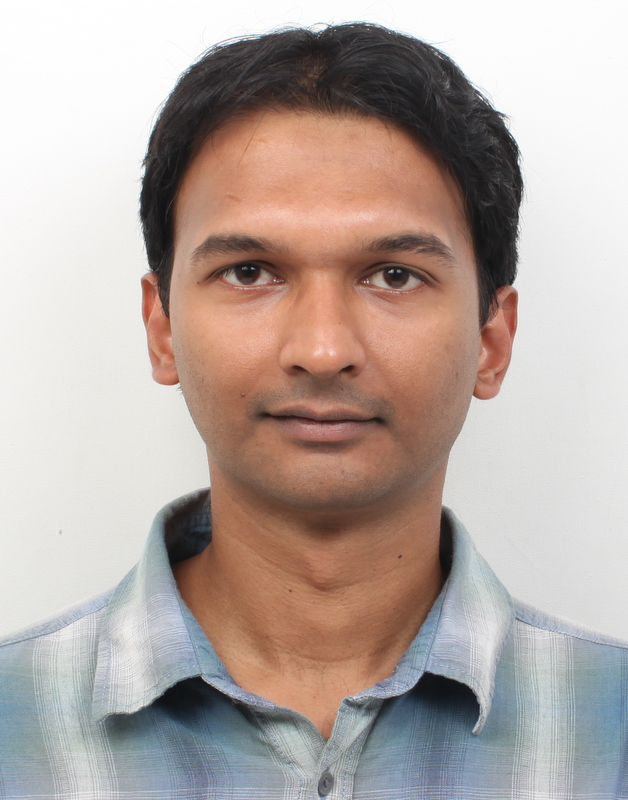
Shivaram Kalyanakrishnan is an Associate Professor at the Department of Computer Science and Engineering , Indian Institute of Technology Bombay , specialising in Artificial Intelligence and Machine Learning . His research spans sequential decision making , multiagent learning , multi-armed bandits , and humanoid robotics , with applications in robot soccer , computer games , and online advertising . He teaches advanced courses like CS 747: Foundations of Intelligent and Learning Agents and CS 748: Advances in Intelligent and Learning Agents , focusing on end-to-end system design and theoretical analysis. His scientific awards include the Best Student Paper Award at RoboCup International Symposium 2006 and nomination for Best Student Paper Award at AAMAS 2007 . His work on reinforcement learning and policy iteration has been published in leading venues such as IJCAI , ICML , and COLT , with recent contributions to railway scheduling and bandit algorithms. While no explicit list of advisees is provided, his research projects and publications suggest mentorship of students in collaborative efforts. Contact : shivaram@cse.iitb.ac.in .
Prof. Dr. Sakibe Nalan BÜYÜKKANTARCIOĞLU is a Professor at Çankaya University, Faculty of Arts and Sciences, Department of Translation and Interpreting Studies (English). She previously served as Professor (2007–2019), Associate Professor (2000–2007), and Assistant Professor (1997–2000) at Hacettepe University, Department of English Linguistics. PhD in English Linguistics (Hacettepe University, 1991) MA in English Language Teaching (Middle East Technical University, 1985) BA in English Teaching (Istanbul University, 1978) Her research spans Linguistics, Cognitive Linguistics, Discourse Analysis, Psycholinguistics, Sociolinguistics, Translation Studies , with a focus on figurative language, interjections, political discourse, and endangered languages. She received the European Language Award (2011) and has supervised numerous PhD and MA theses, including work on Turkish idioms, gender representation, and language awareness. A prolific editor and conference participant, she has contributed to interdisciplinary projects and publications on Turkish sociolinguistics.
Adriana Kovashka is an Associate Professor at the University of Pittsburgh , affiliated with the School of Computing and Information and serving as Department Chair . Her academic journey began with BA degrees in Computer Science and Media Studies from Pomona College (2008) and a PhD in Computer Science from The University of Texas at Austin (2014). Joined Pitt’s faculty in January 2015 NSF CAREER awardee (2021) Google Faculty Research Award recipient Dr. Kovashka’s research spans Computer Vision , Machine Learning , and Natural Language Processing , focusing on visual rhetoric, weak multimodal supervision, and domain adaptation. She pioneered techniques for analyzing political imagery, developing robust object detection frameworks, and exploring the intersection of visual and textual persuasion through large-scale annotated datasets. Her recent work emphasizes geographic diversity in vision-language systems, audio-visual fusion for domain generalization, and shape-texture bias mitigation in CNNs. Key publications include groundbreaking studies on symbolic reasoning, multimodal dialogue systems, and ethical AI applications in education. Scientific honors include: NSF CRII Award (2016) NSF CAREER Award (2021) Pitt CRDF Award (2016, 2018) Best Paper at ECV Workshop (2021) Google Faculty Research Award (2016, 2018) Dr. Kovashka actively mentors students in multimodal learning projects and collaborates with interdisciplinary teams on NSF-funded initiatives. She co-organizes workshops like the first CVPR workshop on advertisement understanding and leads research groups exploring human-AI co-learning systems.
Blase Ur is an Associate Professor of Computer Science at the University of Chicago, leading the UChicago SUPERgroup (Security, Usability, & Privacy Education & Research group). His research focuses on data-driven methods to improve online security, privacy, and usability of complex systems. He holds a PhD from Carnegie Mellon University and an AB from Harvard University. Education: PhD in Societal Computing, Carnegie Mellon University (2016) AB in Computer Science, Harvard University Research Interests: Blase's work spans computer security, privacy, HCI, and ethical AI. He develops tools like password meters, privacy transparency systems, and IoT security solutions. His SUPERgroup emphasizes interdisciplinary collaboration, with projects addressing data-driven decision-making and usability challenges in AI and IoT. Articles Trends: Recent work includes studies on ad transparency systems, user perceptions of privacy in AI, and barriers to passwordless authentication. Research often combines empirical user studies with technical implementations to bridge gaps between security mechanisms and user needs. Awards: NSF CAREER Award (2021) Quantrell Award for Teaching (2021) SIGCHI Outstanding Dissertation Award (2018) Advising & Grants: Advisor to PhD students like Kevin Bryson. Secured grants from NSF, Mozilla, and Meta. Active in outreach to broaden CS participation, including K-12 programs. Labs & Teams: Co-director of the SUPERgroup and affiliated with the Systems Group and CERES Center for Unstoppable Computing at UChicago.
Andrew Stephen is the L’Oréal Professor of Marketing and Deputy Dean for Faculty and Research at Saïd Business School, University of Oxford. He leads the Marketing faculty and directs the Oxford Future of Marketing Initiative, focusing on emerging technologies like AI and data-driven strategies in marketing, media, and advertising. His research explores digital marketing, consumer behavior, and the impact of new technologies, earning him recognition as a top global marketing scholar. His academic contributions span leading journals such as the Journal of Consumer Research and Harvard Business Review. He serves as editor of the Journal of Consumer Research, co-editor of the International Journal of Research in Marketing, and actively engages with industry through councils like the Mobile Marketing Association’s Brand Safety Council. Teaching responsibilities include marketing curriculum oversight and courses across MBA, Executive MBA, and DPhil programs, focusing on digital transformation, marketing analytics, and the future of marketing. His work bridges academic rigor with industry relevance, addressing challenges in tech-enabled marketing and global brand strategies. Awards: Top marketing academic in the UK (AMA), featured in Poets & Quants’ top 40 under 40, multiple research excellence awards. Labs/Initiatives: Oxford Future of Marketing Initiative, fostering collaborations with leading companies to tackle industry challenges. Grants/Advising: Extensive industry partnerships and academic grants not explicitly detailed in the text.
Claire Célérier is an Associate Professor of Finance at the Rotman School of Management, University of Toronto, where she holds the Canada Research Chair in Household Finance. Her academic career spans prestigious institutions including the University of Toronto (where she advanced from Assistant to Associate Professor between 2016-2022) and the University of Zurich (2014-2016). She maintains an affiliation with the People's History Lab and actively contributes to academic discourse through conference organization including 'Race, Equity and Public Policy' (2023) and 'Banks, States and the People' (2024). Dr. Célérier's research explores how finance can benefit households through multiple lenses including behavioral economics, asset pricing, and financial history. Her work investigates innovation in finance, diversity and inclusion impacts, and historical perspectives on financial systems. She has developed significant expertise in household finance, banking, and the intersection of finance with social issues, particularly racial disparities in financial markets as demonstrated in her award-winning research on the Freedman's Savings Bank. Her scholarly output shows a clear trajectory from foundational work on security design and investor behavior toward increasingly socially relevant research on financial inclusion, racial equity, and household financial decision-making. Recent publications demonstrate her growing focus on historical contexts of financial systems and their contemporary implications, particularly regarding marginalized communities. Canada Research Chair in Household Finance (2024) Bank of Canada Governor's Award (2022) University of Toronto Top 5% Merit Award (2021) Petro Canada Young Innovators Award Program (2021) Multiple Rotman School of Management Teaching Awards (2019-2021) Ieke van den Burg Prize for Research on Systemic Risk (2015) Dr. Célérier has successfully secured substantial research funding including Insight Development Grants (CAD 54,500), Connaught Research Grant (CAD 10,000), and the Marianne and Marcus Wallenberg Foundation Grant (EUR 400,000). She mentors several PhD students including Andrada Bilan (2020), Alexey Vasilenko (2023), and Purnoor Tak (Expected 2026), and has supervised numerous master's theses at both University of Toronto and University of Zurich. Her service contributions include Rotman School of Management MBA program committee, executive committee, seminar coordination, and faculty recruiting committee.
Anna S. Mattila is the Marriott Professor of Lodging Management and serves as Professor-in-Charge of the Graduate Program at the School of Hospitality Management, Pennsylvania State University. Her research spans social media, service recovery, servicescape, prosocial behaviors, cross-cultural studies, and wellness in hospitality contexts. Education : B.S. and Ph.D. from Cornell University, M.B.A. from University of Hartford Mattila's work examines how emotions, cultural norms, and technological innovations like AI influence consumer decisions in hospitality. Her studies cover topics from robotic service interactions to sustainable food marketing and moral psychology in tourism. She has published extensively in journals such as International Journal of Hospitality Management and Journal of Consumer Marketing . Her recent articles focus on AI integration in hospitality, consumer trust in virtual influencers, upcycled food adoption, and the psychological effects of servicescape design. Key themes include ethical consumption, digital transformation, and cross-cultural consumer behavior. Advising : Supervised Anqi Luo's dissertation on service recovery in 2022 Mattila's office is located in 224 Mateer Building, University Park, PA. She contributes to advancing hospitality research through methodological consulting and the Penn State Biomarker Core Laboratory.
David Stillwell serves as Professor of Computational Social Science at Cambridge Judge Business School and Academic Director of The Psychometrics Centre, University of Cambridge. His research leverages big data to understand human psychology and behavior, with significant contributions in personality prediction from digital footprints and personalized advertising applications. His educational background includes: BSc in Psychology from the University of Nottingham (2007) MSc in Research Methods from the University of Nottingham (2008) PhD in Decision Making from the University of Nottingham (2012) Dr. Stillwell's research centers on computational social science and psychometrics, pioneering the myPersonality Facebook application that collected data from over 6 million users. His work demonstrates computers can predict personality as accurately as spouses, reveals psychological targeting's advertising effectiveness, and establishes links between personality-matched spending and life satisfaction. He also explores linguistic honesty markers through profanity analysis and personality-based dating patterns. His recent publications (2019-2025) reveal a strong trajectory toward AI evaluation using psychometric frameworks, particularly in medical and general-purpose AI assessment. Key themes include fairness metrics in language models, crisis emotional responses through social media, and computational personality recognition - demonstrating consistent innovation at the psychology-technology intersection. He has received significant recognition: Top 10 most influential papers of 2013 by Altmetric Nieman Journalism Lab highlight of 2013 Named in 'top 30 thinkers under 30' by Pacific Standard Magazine Dr. Stillwell maintains active industry engagement through consultancy with Barclays, Hilton, and Ubisoft on projects spanning computer-adaptive testing systems to interactive experiences like Predictive World for Watch Dogs 2. His policy impact is substantial, with citations by the European Data Protection Supervisor, World Bank, and multiple national governments, leading to speaking engagements at the European Parliament and Bank of England. As Academic Director of The Psychometrics Centre, he leads a global hub for advancing psychological assessment through innovative methods including Concerto open-source software, collaborating with organizations ranging from the European Commission to major corporations on psychometric applications in people analytics and digital behavior.
Dean Eckles is an Associate Professor of Marketing at MIT Sloan School of Management and serves as an Associate Director of the MIT Institute for Data, Systems, and Society (IDSS). He is also affiliated with the MIT Schwarzman College of Computing through the Institute for Data, Systems & Society and its Statistics and Data Science Center. Additionally, he leads the analytics research area at the Initiative on the Digital Economy and organizes the annual Conference on Digital Experimentation (CODE@MIT). His educational background includes a BA in philosophy, BS and MS in cognitive science, MS in statistics, and PhD in communication, all from Stanford University. Prior to joining MIT, Eckles worked as a scientist at Facebook, where he contributed to areas including News Feed, messaging, advertising, tools for randomized experiments, and survey methods. He previously held research positions at Nokia and Yahoo. Eckles's research primarily focuses on social influence mediated by interactive technologies, examining how communication technologies mediate, amplify, and direct social influence. His work spans multiple specific areas including social interactions, contagion, and interventions in networks; experimental design and inference in networks; and methods for causal inference. His research often combines social science with advanced statistical methods. His notable publications include research on long ties in social networks and their relationship to economic prosperity, how network structure affects social contagions, and algorithmic transparency in social media platforms. His work has appeared in prestigious journals including PNAS and Nature Human Behaviour, and he has provided expert testimony before the US Senate on algorithmic ranking. Long ties, disruptive life events and economic prosperity (PNAS) Long ties accelerate noisy threshold-based contagions (Nature Human Behaviour) Algorithmic transparency and assessing effects of algorithmic ranking (Senate testimony) Eckles actively shares his research through social media platforms including Bluesky, Twitter, and Mastodon, as well as through his blog and contributions to the Gelman et al. blog. His work bridges academic research with practical applications in technology and policy.
Dr Luke Garrod is a Senior Lecturer in Economics at Loughborough University's Loughborough Business School. He holds a PhD, MPhil, and BA from the University of East Anglia. His research focuses on industrial organization, competition policy, consumer policy, and behavioral economics, with a particular emphasis on modeling firm incentives in imperfectly competitive markets. He received the International Journal of Industrial Organization Best Theoretical Paper Award 2019 for his work on collusion mechanisms. His book on hub-and-spoke cartels provides critical insights into antitrust enforcement strategies. Teaching responsibilities include Principles of Microeconomics (ECA002) and Industrial Economics (ECC005). He serves as an Associate Editor for the International Journal of the Economics of Business and contributes to economic consultancy through his role at Economic Insight. His research has explored topics such as cartel damages quantification, digital market regulation, and the interplay between consumer protection and competition policies. Key awards include the 2019 Best Theoretical Paper Award, reflecting his contributions to advancing antitrust and competition policy frameworks. His work bridges theoretical economic modeling with practical regulatory applications, addressing emerging challenges in global competition dynamics and digital economy policies.
Dr. Yaron Meron is a Lecturer and researcher in design at the University of Sydney's School of Architecture, Design and Planning. He holds a PhD (RMIT, Melbourne) and two Master's degrees (RMIT, Central St Martins). His work bridges academic research and professional practice, focusing on graphic and communication design, socially engaged design, AI integration, and responsible design thinking. Meron’s research explores interdisciplinary challenges, design collaboration, and the societal impact of emerging technologies like AI. He coordinates the Civic & Social Design Research Group. Educations: PhD in Design (RMIT University, Melbourne) MA in Design (RMIT University, Melbourne) MA in Communication Design (Central Saint Martins, London) Research Interests: Graphic design as an interdisciplinary practice Artificial intelligence in design education and practice Media literacy and defamiliarisation techniques Socially engaged design methodologies Design briefs and stakeholder relationships Articles & Trends: Recent publications emphasize AI's role in design education, speculative urban futures, and critical design approaches to media literacy. His work frequently intersects with pedagogy, ethics, and technology’s societal implications. Labs/Teams: Coordinator of the Civic & Social Design Research Group, fostering collaborative projects on responsible design and interdisciplinary innovation.
Janna Parker is a professor in the Department of Marketing at James Madison University, specializing in digital marketing, retailing, and nonprofit marketing. With a career transition from political campaigns, she focuses on social media's role in personal and professional branding. Her research examines work-personal social media boundaries, employer governance policies, and volunteerism in nonprofit contexts. Education: Bachelor's in History (California State University Sacramento), Master's (Cameron University), Doctorate (Louisiana Tech) Teaching Interests: Digital marketing education, social media strategy, nonprofit marketing Her scholarly work spans social media governance, volunteer engagement, and retail dynamics, with recent emphasis on digital marketing pedagogy and cancel culture implications. Parker has contributed to academic journals through empirical studies and conceptual commentaries. Key article trends include: Digital marketing education evolution (2024) Social media governance in corporate and nonprofit contexts (2024) Online teaching satisfaction in higher education (2022) Volunteer brand community dynamics (2020) Consumer behavior frameworks (2019) Her media appearances include expert commentary on holiday retail strategies and social media research, reflecting practical applications of her academic work.
Andrea Korda, PhD (University of California, Santa Barbara), is an Associate Professor of Fine Arts & Humanities and Associate Dean (Research) at the Augustana Campus of the University of Alberta. Her academic career bridges art history, material culture studies, and pedagogical innovation. Educations: BA in Fine Arts, Queen's University MA in Art History, Concordia University PhD in Art History, University of California, Santa Barbara Research Focus: Dr. Korda specializes in 19th-century visual and material culture, with a focus on education's visual dimensions, children's literature, and community-engaged projects like the award-winning Crafting Communities initiative. She co-curated the virtual exhibition Photographies (Bruce Peel Special Collections) and explores hands-on learning through historical crafts. Teaching: Courses include modern art history (AUART 220), photography theory (AUART 225), and special topics in visual culture (AUART 382). She emphasizes experiential learning and digital humanities integration, as seen in her work with the Getty Museum Challenge and OER projects. Collaborations: Leads interdisciplinary teams on projects like Crafting Communities , blending scholarship with public engagement. Her research bridges historical methodologies with contemporary pedagogical practices, fostering connections between academia and communities.
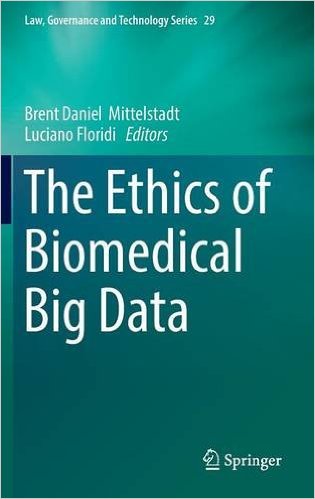
Professor Brent Mittelstadt is a leading academic in data ethics and AI governance at the University of Oxford's Oxford Internet Institute (OII), serving as Professor of Data Ethics and Policy and Director of Research. He coordinates the Governance of Emerging Technologies (GET) programme, focusing on ethics, law, and technology interplay. His work bridges academic research with policy impact, contributing frameworks like 'counterfactual explanations' and fairness metrics ('Conditional Demographic Disparity') used globally. He leads high-profile projects such as Trustworthiness Auditing for AI and A Right to Reasonable Inferences in Advertising and Financial Services. Research interests span AI ethics, medical ethics, technology governance, and non-discrimination law. He has pioneered ethical frameworks addressing algorithmic bias, GDPR compliance, and AI accountability. His work has influenced policy bodies like the UK Information Commissioner’s Office and the European Commission, and is implemented by tech giants such as Google and Microsoft. Awarded O2RB Excellence in Impact Awards (2018, 2021) and PLSC Best Paper (2019) Funded by Wellcome Trust, Sloan Foundation, and others Advisory roles for NHSx, GSK Consumer Healthcare, and regulatory bodies Recent work focuses on AI regulation (EU AI Act), generative AI ethics, and healthcare AI governance. He co-leads the OxonFair toolkit for algorithmic fairness and investigates societal impacts of deepfake proliferation and large language models.
Dr Alvin Tan is a Lecturer in the School of Advertising, Marketing & PR at Queensland University of Technology (QUT). His research focuses on SME internationalisation, export readiness, and managerial decision-making in cross-border contexts. He holds a PhD in International Business from the University of Queensland (2012) and has over a decade of academic experience, including roles in teaching units like AMB110 Internationalisation. Education: Doctor of Philosophy (International Business), University of Queensland (2012) Bachelor of Business (Honours), Queensland University of Technology Bachelor of Commerce (International Business), University of Tasmania Research Interests: Small-medium enterprise internationalisation drivers, export decision rigidity, managerial commitment in export strategies, and inward internationalisation dynamics. His work emphasizes the pre-internationalisation phase and has contributed to frameworks like the export readiness index. Awards: QUT Vice Chancellor's Performance Award for Teaching Excellence (2008) Accredited Senior Fellow of the Higher Education Academy (SFHEA) Teaching and Supervision: Specializes in global business strategy, international marketing, and supervises postgraduate students on SME internationalisation topics.