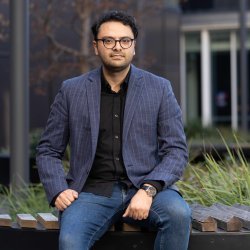
Dr Ehsan Nabavi is a Senior Lecturer in Technology and Society at the College of Asia and the Pacific (CPAS), Australian National University (ANU). He leads ANU’s Responsible Innovation Lab, focusing on responsible computing, modeling, and AI ethics. His interdisciplinary work bridges technical and social sciences, particularly addressing wicked problems in sustainability and water governance. Current Affiliation: ANU (CPAS), since 2020 Former Roles: Research Fellow at ANU School of Cybernetics (2018–2020), Harvard Kennedy School (2016–2017) Visiting Positions: SOAS University of London, University of Bonn (ZEF) His research spans responsible AI , transdisciplinary modeling , and socio-technical systems , as reflected in his publications across journals like Nature Humanities and Social Sciences Communications , IEEE Transactions on Technology and Society , and Water Alternatives . His recent articles emphasize ethical AI deployment, human-water systems, and integrating social aspects into modeling. Labs: Responsible Innovation Lab (ANU) Future Work: Developing frameworks for responsible AI in sustainability and policy contexts
Gavin Schwarz is a Professor and Head of School at the School of Management and Governance within the UNSW Business School . He specializes in organizational change , organizational failure and inertia , and the dynamics of virtual teams , with a focus on how organizations fail during change processes and how to develop applied strategies for change management . His work spans diverse sectors including healthcare, technology, and education, with publications in leading journals such as Academy of Management Learning and Education and Administrative Science Quarterly . Education : PhD in Management (University of Queensland), MPhil (Hons) in Management (University of Auckland), BA in Management and English (University of Auckland). Grants : 2020 Brock University grant for "University communication in times of COVID-19" , 2020 UNSW Medicine grant for "Translation and change: Embedding effective change management in health" , and earlier Australian Research Council and Gordon J. Samuels Fellowship awards. His research explores the development of knowledge in organizational theories , with an emphasis on collective responses to change , HR management during crises , and technology strategy . He has contributed to understanding organizational communication , team innovation , and structural inertia . His 15 most recent publications cover topics from AI’s role in organizational change to pandemic-driven research adaptation, with keywords spanning management science , behavioral economics , and digital transformation . Scientific Awards 2021-2023 : Outstanding Reviewer Awards (Academy of Management Review) 2017-2020 : Best Reviewer Awards (Journal of Organizational Behavior) 2019, 2013, 2011 : Best Paper Finalist/Awardee (Academy of Management divisions) 2007, 2006 : Editorial Board Excellence (Academy of Management Journal) and Gordon J. Samuels Fellowship As an active supervisor in organizational change and HR development , his work supports healthcare innovation and digital transformation. He serves as Editor-in-Chief for the Journal of Applied Behavioral Science and is on the editorial boards of Academy of Management Review , Journal of Management , and Journal of Organizational Behavior . Contact: g.schwarz@unsw.edu.au
Thomas Pepinsky holds the prestigious Walter F. LaFeber Professorship of Government and Public Policy at Cornell University, where he is a faculty member in the Department of Government within the College of Arts and Sciences. He additionally serves as a Nonresident Senior Fellow at the Brookings Institution, bridging academic research with policy engagement. His academic career, which began at Cornell in 2008 after earning his Ph.D. from Yale University, has established him as a leading scholar in comparative politics with deep regional expertise in Southeast Asia. Professor Pepinsky's research examines the complex interactions between political and economic systems globally, with particular attention to democratic backsliding in Southeast Asia and Europe, the evolution of social categories like ethnicity in the Malay world, and methodological approaches to social science explanation. His work consistently connects theoretical political science with empirical analysis of real-world political phenomena, often employing innovative methodological frameworks to understand complex political dynamics across different contexts. His scholarly output demonstrates a clear trajectory from foundational work on Southeast Asian politics to increasingly comparative analyses examining democratic erosion, electoral behavior during political transitions, historical persistence of political attitudes, and the intersection of social categories with political economy. Recent publications reveal growing attention to contemporary crises including refugee flows, pandemic politics, and the challenges to democratic institutions worldwide. Among his significant professional activities, Dr. Pepinsky serves as editor of the Journal of East Asian Studies and is a co-founder and Executive Board member of the Southeast Asia Research Group (SEAREG). He also contributes to the Association for Analytical Learning about Islam and Muslim Societies (AALIMS) and the International Political Economy Society (IPES), reflecting his interdisciplinary approach. At Cornell, he actively participates in the Southeast Asia Program (SEAP) and teaches courses including Introduction to Comparative Government and Politics, Southeast Asian Politics at both undergraduate and graduate levels, and independent study opportunities. His international scholarly engagement is evident through visiting appointments at institutions including Amsterdam, the Australian National University, Freiburg, Griffith University, the Hertie School, and the National University of Singapore.
Thomas Le Goff is an Assistant Professor of Law & Technology at Télécom Paris – Institut Polytechnique de Paris, affiliated with the Interdisciplinary Institute of Innovation (i3) and the Digital, Organization and Society (DTOS) research team. His work bridges legal frameworks and technological advancements, focusing on AI regulation, environmental sustainability, data protection, and cybersecurity. Education: PhD in Private Law, Université Paris Cité Master’s in Law, Université Paris Cité LLM, University of Exeter (UK) Licence and Magistère, Université de Rennes 1 His research explores the intersection of AI and sustainability, emphasizing how legal principles can guide environmentally responsible technology. Key themes include the AI Act’s implications, data center energy demands, and regulatory strategies for balancing digital growth with net-zero targets. His work has been presented at international forums like BILETA and contributes to EU think tanks such as CERRE. Recent publications address AI’s environmental footprint, nuclear energy’s role in powering AI, and legal frameworks for sustainable digital infrastructure. Collaborations with institutions like the Center on Regulation in Europe (CERRE) highlight his focus on comparative analyses of global regulatory practices.
Joel Townsend is an Associate Professor at Monash University's Faculty of Law and serves as Director of Monash Law Clinics, a community legal centre providing experiential education to law students while delivering legal assistance across multiple practice areas including social security, NDIS appeals, tenancy, and migration law. Education: Currently pursuing PhD at Monash University focusing on merits review in Australian public law Townsend's research centers on Administrative Law and Public Law , with specialized expertise in merits review mechanisms , social security law (particularly the Robodebt scheme), disability law (NDIS) , migration law , and tenancy law reform . As an Accredited Specialist in Administrative Law and co-Chair of the Law Institute of Victoria's Administrative Law Advisory Committee, his work directly influences policy development and legal practice through extensive public advocacy and law reform submissions. His scholarly output reveals a critical examination of administrative review systems across diverse contexts, consistently analyzing how automated decision-making impacts government accountability and access to justice. Recent publications demonstrate growing focus on the intersection of technology, public administration, and legal redress mechanisms. Scientific Awards: Vice-Chancellor's Award for Industry and Community Education Programs (Community) (2022) Townsend supervises law students in clinical placements at Monash Law Clinics while leading significant policy initiatives, including a 2023 expert report on third-party merits review for the EPBC Act commissioned by Lock the Gate Alliance Limited. His grant activities extend to Senate committee consultations on automated decision-making and submissions to Victoria's Administrative Reform Review. As Director of Monash Law Clinics, Townsend oversees a multidisciplinary team handling high-impact public interest litigation and community legal services, maintaining strong connections with organizations including Flemington Kensington Community Legal Centre (where he previously served as Board Chair) and Inner Melbourne Community Legal.
Dr Mukarrum Ahmed is a Lecturer in Business Law at the School of Law, University of Lancaster, and a barrister of Lincoln's Inn. He is a recognized expert in private international law and commercial law, with significant contributions cited by courts including the High Court of England and Wales and the European Court of Justice. His educational background includes: FHEA - PGCAP from Lancaster University PhD in Law from the University of Aberdeen Barrister qualification from Lincoln's Inn LLM from City, University of London LLB (Hons) from the University of London Dr Ahmed's research focuses on private international law (conflict of laws) , with particular emphasis on international commercial litigation and arbitration. His work explores the intersection of EU law, international legal theory, and comparative law, with recurrent themes including post-Brexit legal developments, party autonomy, methodological pluralism, and the global governance function of private international law. He approaches legal questions from theoretical, pragmatic, and comparative perspectives, contributing significantly to understanding how legal systems interact across borders. His scholarly work has been cited by prestigious courts including the High Court of England and Wales in the Etihad Airways v Flöther case and the European Court of Justice in Maersk A/S v Allianz Seguros cases. His publications reveal a consistent focus on jurisdictional issues, choice of court agreements, and the evolving landscape of private international law in the post-Brexit era, demonstrating both theoretical depth and practical relevance to international commercial disputes. Dr Ahmed has received several notable honors: University of Aberdeen's Principal's Excellence Award (2015) Fully Funded Doctoral Scholarship in Private International Law of the EU from University of Aberdeen STIP Foundation Scholarship from The Hague Academy of International Law Nomination for the Inner Temple Book Prize As an academic supervisor, Dr Ahmed oversees PhD and Master's students including Denis Carey and Shu Li, while also convening key courses such as Private International Law (LLB), International Commercial Litigation (LLM), and International Commercial Arbitration (LLM). He serves as Director of PG Recruitment and Admissions and Cluster Lead for Law, Business and the Economy in the Centre for Law and Society. His external roles include being an External Examiner at York Law School, Associate Member of research centers at Aberdeen and Stirling Universities, and Editor for prominent publications in private international law. Dr Ahmed is actively involved in the Centre for Law and Society, contributing to research clusters focused on Law, Business and the Economy. His scholarly activities span editorial work for Commentaries on Private International Law and Conflictoflaws.net, peer review for major academic publishers, and participation in international conferences addressing contemporary challenges in private international law.
Christian Igel is a Professor at the Department of Computer Science, University of Copenhagen, and serves as director of the SCIENCE AI Centre . He is also a co-lead of the Pioneer Centre for Artificial Intelligence in Denmark. His academic journey includes a Doctoral degree from Bielefeld University (2002) and a Habilitation degree from Ruhr-University Bochum (2010). Igel is a Juniorprofessor (2002–2010) and has held editorial roles at journals like KI - Künstliche Intelligenz and Artificial Intelligence Journal . Doctoral degree: Faculty of Technology, Bielefeld University, Germany (2002) Habilitation degree: Department of Electrical Engineering and Information Sciences, Ruhr-University Bochum, Germany (2010) His research spans Machine Learning , focusing on Support Vector Machines , Evolution Strategies , Reinforcement Learning , Deep Neural Networks , and PAC-Bayesian Analysis . He applies these methods to Environmental Monitoring , Medical Diagnostics , and Climate Research . Recent publications highlight work on adversarial machine learning , environmentally sustainable AI , and tree resource mapping using deep learning. His scientific awards include being a ELLIS Fellow . Igel’s software tools like Shark , woody , and Multi-Planar UNet are widely used in research and industry. Notable grants and collaborations involve projects with European Lab for Learning and Intelligent Systems (ELLIS) , SCIENCE AI Centre , and international teams in Denmark , Germany , and France . His lab leadership emphasizes open-source frameworks and reproducible research. Editorial Roles: German Journal on Artificial Intelligence , Evolutionary Computation Journal , Artificial Intelligence Journal Software Projects: Shark , woody , Multi-Planar UNet , U-Time Collaborations: SCIENCE AI Centre , Pioneer Centre for Artificial Intelligence , European Lab for Learning and Intelligent Systems
Chelsey R. Carter is an Assistant Professor of Public Health in the Department of Social and Behavioral Sciences at Yale School of Public Health with a secondary appointment in the Department of Anthropology. A Black feminist anthropologist of medicine, public health, and race from St. Louis, Missouri, Dr. Carter's interdisciplinary work bridges public health, anthropology, and critical race studies to address health inequities, particularly focusing on neurodegenerative diseases like ALS in Black communities. Dr. Carter received her BA in Anthropology from Emory University (2012), followed by an MPH and PhD from Washington University in St. Louis (2021), and completed a Presidential Postdoctoral Fellowship at Princeton University (2022). Her educational background reflects her commitment to both anthropological theory and public health practice. Her research examines the relationship between social determinants of health (particularly anti-Black racism, socioeconomic status, and gender) and neurodegenerative diseases such as amyotrophic lateral sclerosis (ALS) and motor neuron diseases. Dr. Carter employs ethnographic research and qualitative methodologies to investigate how embodied inequality impacts diagnosis, treatment, and engagement in clinical trials for Black individuals with ALS. She also leads research on precision medicine and genomic research in Black communities through The Black Genome Project and studies caregiving among persons impacted by ALS. Her scholarship has been funded by the National Science Foundation, the Andrew Mellon Foundation, and the Wenner Gren Foundation. Analysis of Dr. Carter's recent publication trends reveals a strong focus on health equity, particularly examining how systemic racism manifests in medical settings and contributes to health disparities. Her work spans multiple domains including neurodegenerative diseases, HIV/AIDS care, genomics, and mental health, with consistent attention to intersectional approaches that consider race, gender, and socioeconomic status. A notable pattern in her scholarship is the use of qualitative and mixed methods to center the lived experiences of marginalized communities, challenging dominant biomedical paradigms through a Black feminist lens. Principal's Development Fund Visiting Scholar (2024) Distinguished Teaching Award from Yale School of Public Health (2023) Funding from the National Science Foundation Support from the Andrew Mellon Foundation Wenner Gren Foundation grant Dr. Carter actively mentors students and has developed innovative teaching approaches, including her course 'Biomedical Justice: Public Health Critiques and Praxis,' which encourages students to bring their full selves into the classroom. Her research has been supported by significant grants that enable community-engaged work addressing health disparities. She emphasizes the importance of community partnerships in her research, ensuring that academic work serves and is accountable to the communities being studied. Dr. Carter is Founder and Director of The LEITH (Lived Experiences Igniting Transformations in Health) Lab, which addresses Black invisibility and misdiagnosis for rare neurodegenerative and genetic diseases. The lab brings together persons and caregivers impacted by rare diseases, researchers, clinical providers, educators, students, and activists to develop more humanizing and critical approaches in the rare neurodegenerative field. The LEITH Lab's vision centers on advancing anti-racist research, fostering awareness through education, creating palliative networks for support, and developing a pipeline of health equity scholars.
Jamie Morgenstern is an Associate Professor at the Paul G. Allen School of Computer Science & Engineering , University of Washington . She was previously an assistant professor at Georgia Tech and a Warren Center Fellow at University of Pennsylvania . Expertise: Ethics & Fairness, Human-Centered AI, Machine Learning Education: PhD in Computer Science from Carnegie Mellon University (2015) Her research examines the social impact of machine learning and ensuring ML models do not exacerbate societal inequalities. She investigates robustness to human-generated training data, fairness in clustering and active learning, and algorithmic equity in recommendation systems. Recent publications focus on interactive ML systems , fairness constraints , and privacy-preserving methods across conferences like NeurIPS, ICML, and AIES. Key subfields include multimodal learning , membership inference attacks , and data equity . Scientific Awards: NSF Career award for "Strategic and Equity Considerations in ML" Simons collaboration project Simons Award for Graduate Students in Theoretical Computer Science (2014-2016) NSF GFRP fellowship Microsoft Research Graduate Women's Scholarship Spotlight presentation at NeurIPS 2015 Mentoring: She advises current PhD students Rachel Hong , Jie (Claire) Zhang , and Yuanyuan (Chloe) Yang . Former advisees include Daniel Jiang (MS), Bhuvesh Kumar (PhD), and Angel (Alex) Cabrera (BS). Grants: Funded by NSF Career award and Simons collaboration projects. Previously supported by Simons, NSF, and Microsoft Research fellowships. Labs & Collaborations: Collaborates with researchers like Michael Kearns , Aaron Roth , and Avrim Blum . Affiliated with the Allen School's Artificial Intelligence research group.
Maria Cherba is an Assistant Professor in Communication at the Faculty of Arts, University of Ottawa. Her work bridges health communication, telemedicine, and Indigenous health equity. Ph.D. in Communication from Université de Montréal (2020) Research Interests span: Cultural and Health Telemedicine and Digital Health Patient Experience and Interpersonal Communication Indigenous Health Advocacy Organizational Communication in Healthcare Psychosocial Support Systems Publication Trends focus on telemedicine implementation, Indigenous health representation in policy, patient-physician interactions in chronic care, and pandemic impacts on end-of-life preferences. Her methodological emphasis lies in qualitative interaction analysis.
Professor Jill Atkins is a Professor of Accounting at Cardiff Business School, Cardiff University, with a distinguished career spanning accounting and finance. She also serves as a Visiting Professor at the University of the Witwatersrand in South Africa. As a leading academic in sustainable accounting, she has published over 50 journal articles and several influential books, establishing herself as a thought leader in the field of extinction accounting and biodiversity finance. Professor Atkins holds a BA Hons (First Class) in European Economics with a Licence ès Sciences Economiques from the University of Nantes, an MSc in Corporate and International Finance from the University of Durham, and a PhD in Finance from the University of Manchester. She is Series Editor for the de Gruyter Studies in Corporate Governance and has authored the leading international textbook "Corporate Governance and Accountability," now in its 5th edition. Professor Atkins' research focuses on three interconnected areas that have significantly contributed to sustainability accounting literature. Her work on private social and environmental reporting (SER) has evolved into "private integrated reporting," where institutional investor engagement processes increasingly integrate social, environmental, and financial issues. She has pioneered the development of "extinction accounting," creating a framework that has inspired extensive international academic research and influenced investment institutions' pollinator engagement strategies. Her third major contribution involves exploring the historical roots of environmental and ecological accounting, connecting accounting history with sustainability research across various historical periods from Victorian water pollution accounting to 18th century nature diaries. Analysis of Professor Atkins' recent publications reveals a clear trajectory toward increasingly specialized and urgent environmental accounting. Her work has evolved from general sustainability reporting to highly focused extinction accounting frameworks, with growing attention to historical precedents and cross-cultural applications. The publications demonstrate a sophisticated integration of critical accounting theory with practical applications in biodiversity conservation, showing how accounting mechanisms can serve as tools for species protection and environmental preservation. Her research increasingly incorporates interdisciplinary perspectives, drawing from ecology, history, art, and philosophy to develop comprehensive approaches to extinction governance. Professor Atkins has received significant recognition within the ESG investment industry and governance circles as a thought leader, regularly invited to give keynotes at international practitioner and academic events. She has led influential projects including a Nuffield Foundation-funded study on private SER and has developed innovative frameworks such as the extinction governance model that brings together accounting practices with governance mechanisms aimed at preventing species extinctions. Professor Atkins supervises doctoral candidates in extinction accounting, extinction governance, ESG investment, accounting for biodiversity, and corporate governance (qualitative research). She has established collaborative networks with leading practitioners in responsible investment, sustainability ratings, financial analysis, and reporting framework providers, including the Capitals Coalition, Moody's, Vigeo Eiris, AXA, and the WWF.
Prof. Dr. Johanna Rahner serves as Professor of Dogmatics, History of Dogma and Ecumenical Theology at the Catholic Theological Faculty of the Eberhard Karls University of Tübingen since 2014. She also holds the position of Director of the Institute for Ecumenical and Interreligious Research at the same institution. Her research interests span a wide range of theological topics including: Biblical Hermeneutics for Systematic Theology (especially Christology), Ecumenical theology and its ecclesiological problem areas, the relationship between religion, culture, educational processes, politics and society, interaction of contemporary culture with worship and theology of the sacraments, theoretical foundations of dialogue between world religions in a globalized world, relationship between reason and faith, theology and philosophy, theology and natural sciences, patchwork religiosity and subjective religious pluralism, and religiosity of children and adolescents with special consideration of youth and cult literature and pop music. Prof. Rahner's publications demonstrate a consistent focus on contemporary challenges facing the Catholic Church, ecumenical dialogue, and the intersection of theology with modern culture. Her work frequently addresses the Second Vatican Council's implications for contemporary theology, the relationship between science and faith, and the practical application of theological concepts in interreligious contexts. She has made significant contributions to understanding eschatology, ecclesiology, and the practical application of theological concepts in interreligious contexts. Wissenschaftlicher Beirat des Kuratoriums zur Vorbereitung des Reformationsjubiläums 2017 Ökumenischer Arbeitskreis evangelischer und katholischer Theologen Editorial-Board der Ökumenischen Rundschau Wissenschaftlicher Beirat der Europäischen Melanchthonakademie, Bretten Societas oecumenica AG der deutschsprachigen katholischen Dogmatiker und Fundamentaltheologen Europäische Gesellschaft für Katholische Theologie. Deutsche Sektion e.V. AGENDA – Forum katholischer Theologinnen e.V. Prof. Rahner has been involved in several significant research projects including Moralische Urteilsfindung im säkularen Diskurs als Herausforderung für die christlichen Konfessionen, Intergenerationelle LehrerInnen-Ausbildung, Theorie und Praxis des interreligiösen Lernens, Kirche und Bildungsregime in Lateinamerika, Reformationsgedenken und Ökumene, and Grundfragen theologischer Anthropologie in Auseinandersetzung mit aktuellen naturwissenschaftlichen Modellen. She leads the Institute for Ecumenical and Interreligious Research, which serves as a hub for scholarly research on contemporary challenges in interfaith relations and ecumenical theology.
Ingrid Jeacle is a Professor of Accounting and Popular Culture at the University of Edinburgh Business School. With a PhD from the University of Limerick and a Master of Arts from Trinity College Dublin, she bridges interdisciplinary research with traditional accounting scholarship. A founding member of the Culture, Accounting & Society (CAS) Research Network, she explores how accounting practices permeate everyday life and popular culture. PhD, Accounting, University of Limerick (1999) MA, Economics and Business Studies, Trinity College Dublin (1989) Her research focuses on the intersection of accounting and popular culture, examining phenomena like calorie labeling, online reviews, and historical compensation systems. She employs methodologies such as netnography and actor-network theory to analyze how accountability systems shape societal norms. Recent publications include studies on cinematic portrayals of accountants (2024), calorie accounting in the UK food sector (2023), and historical valuations of human life in slavery abolition (2023). These works reflect her commitment to expanding accounting scholarship into cultural and social domains. AAAJ Hall of Fame Award (2019) Emerald Literati Highly Commended Awards (2015, 2017) Jeacle maintains leadership roles in editorial boards, including as Associate Editor for Accounting, Auditing & Accountability Journal and Financial Accountability & Management . She has served as Visiting Professor at South East Technological University (2022-2023) and guest-edited special issues across major journals.
John Byrne is a Distinguished Professor of Energy and Climate Policy and Director of the Center for Energy and Environmental Policy (CEEP) at the University of Delaware's Biden School of Public Policy. His academic career spans over three decades with significant contributions to global climate policy through roles in the IPCC, World Council for Renewable Energy, and Seoul International Energy Advisory Council. He pioneered the Sustainable Energy Utility (SEU) model and led the first SEU implementation in Delaware, recognized internationally for its innovative financing mechanisms. His research focuses on energy transitions, environmental justice, and renewable energy integration. Notable achievements include co-founding the International Solar Cities Initiative, advising China’s State Environmental Protection Agency, and conceiving the SEU's AA+-rated bond program. Byrne has held visiting positions at Lawrence Berkeley National Laboratory and Seoul National University, where he contributed to South Korea’s greenhouse gas abatement strategy. Byrne’s publications include 19 books and 170+ articles, with influential works like Rethinking Environmentalism (MIT Press) and Green Energy Economies . He serves as Co-Editor-in-Chief of WIREs Energy and Environment and editor of the Energy and Environmental Policy book series since 1983. His work is funded by major institutions including the World Bank, UNDP, and U.S. Department of Energy. Key recognitions include the 2007 Nobel Peace Prize (shared via IPCC contributions) and Fulbright Senior Lecturer Award. Byrne’s current efforts focus on advancing solar energy policies, sustainable urban development, and bridging environmental justice with climate resilience.
Ke Yang serves as Assistant Professor in the Department of Computer Science at the University of Texas at San Antonio (UTSA), College of Sciences. He founded and leads the Cohort for AI REsponsibility (CAREAI) initiative, while also holding core faculty positions in UTSA's School of Data Science and MATRIX (AI Consortium for Human Well-being). Education: Ph.D. from New York University (supervised by Prof. Julia Stoyanovich) Research Focus: Dr. Yang's work centers on AI trustworthiness and responsibility , with specialized expertise in algorithmic fairness, data ethics, and human-centered data science. His research addresses critical challenges including Large Language Model hallucinations, explainable AI frameworks, and algorithmic accountability mechanisms. He actively develops open-source tools like Ranking Facts and FairDAGs to implement these principles in practical systems. Publication Trends: Recent work (2020-2025) demonstrates evolving focus from foundational fairness in ranking systems toward generative AI safety and medical applications. His publications show strong theoretical grounding combined with real-world implementation, particularly in privacy policy analysis and medical question-answering systems using causal inference techniques. Scientific Recognition: Pearl Brownstein Doctoral Research Award (NYU Tandon School of Engineering) CDS Postdoctoral Fellowship (University of Massachusetts) Professional Development: Dr. Yang has secured significant research funding including the CDS Postdoctoral Fellowship at UMass. His graduate work at NYU and Drexel University was fully supported by research assistantships, demonstrating consistent funding acquisition throughout his career. He actively contributes to academic community building through conference tutorials and educational initiatives. Research Ecosystem: He directs CAREAI at UTSA while collaborating across institutional boundaries through MATRIX and the School of Data Science. Previously, he contributed to the Data systems Research for Exploration, Analytics, and Modeling (DREAM) lab and Center for Data Science at UMass Amherst, maintaining continuity in his responsible AI research trajectory.