معرفی
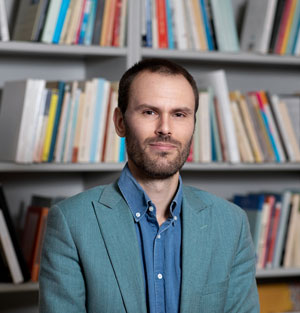
Professor Thomas Weitin is a leading scholar at Darmstadt University of Technology's Institute of Linguistics and Literary Studies, where he heads the German Studies - Digital Literary Studies department. As Director of the LitLab, he bridges traditional literary scholarship with cutting-edge computational and cognitive science methodologies. His work positions him at the forefront of the digital humanities movement in Germany.
Weitin's research focuses on the intersection of digital literary studies and cognitive science, particularly examining how humans process literary texts through methods like eye-tracking, EEG, and physiological measurements. His 'Reading at Scale' project analyzes 19th-century German novellas to explore the middle ground between close reading and distant reading approaches. Weitin argues against the simplistic 'close vs. distant reading' dichotomy, advocating instead for methodologically appropriate scale selection based on specific research questions.
Analysis of Weitin's recent publications reveals a strong interdisciplinary approach combining literary theory, cognitive neuroscience, and data science. His work increasingly incorporates empirical methods to study reading processes, moving beyond purely textual analysis to investigate the physiological and cognitive dimensions of literary reception. This represents a significant methodological shift in literary studies toward evidence-based approaches to understanding how literature affects readers.
Weitin maintains significant leadership roles including membership on the Editorial Board of Frontiers in Human Neuroscience, Senior Editorship of Open Library of Humanities, and Executive Board membership of the Digital Humanities Cooperation between TU Darmstadt and the University of Konstanz. He serves as a reviewer for major funding organizations including the German Research Foundation (DFG) and the Science Council.
At the LitLab, Weitin oversees research infrastructure including eye-tracking equipment (both stationary and mobile glasses), EEG amplifiers, and physiological measurement devices for pulse, heart activity, and skin conductance. This sophisticated laboratory enables multimodal studies of reading that combine textual analysis with direct measurement of reader responses, representing a novel approach to literary scholarship.