معرفی
Sara Haravifard is the William M. Fairbank Associate Professor of Physics at Duke University, with additional appointments in the Department of Mechanical Engineering & Materials Science and previously in Electrical and Computer Engineering. She is also an Associate of the Duke Initiative for Science & Society.
Education:
- B.S. from McMaster University (Canada), 2003
- M.S. from McMaster University (Canada), 2005
- Ph.D. from McMaster University (Canada), 2010
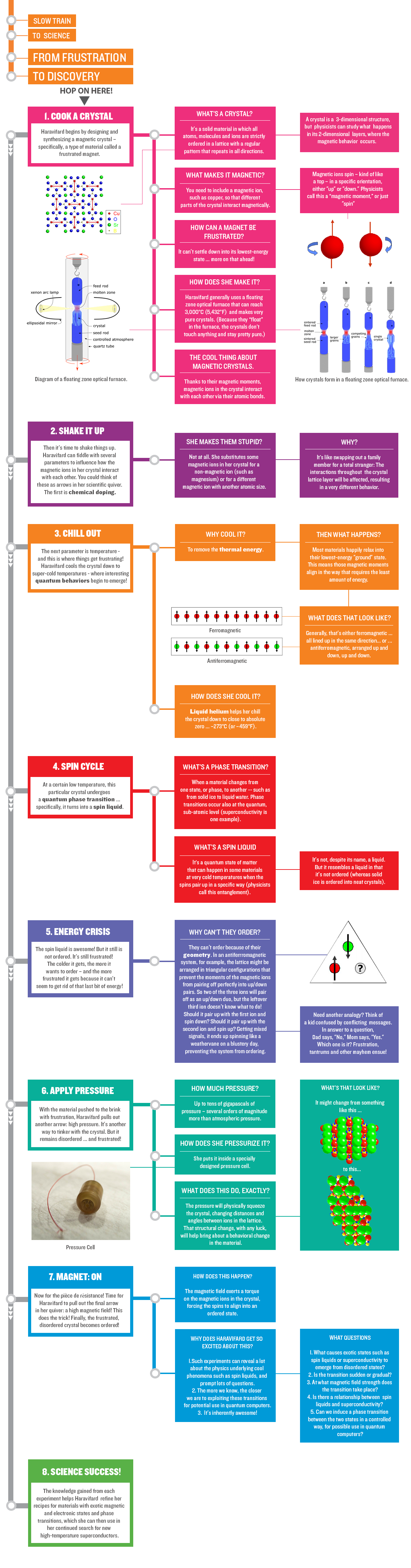
Professor Haravifard's research focuses on exploring novel collective phenomena in quantum materials using neutron and x-ray scattering techniques. She investigates quantum critical phenomena under extreme conditions of ultra-low temperature, high magnetic field, and high pressure. Her work also encompasses Materials by Design, involving synthesis, single crystal growth, and characterization of correlated electron systems, quantum magnets, topological systems, metal-organic frameworks, and high-temperature superconductors. The Haravifard Lab at Duke is equipped with state-of-the-art sample synthesis and crystal growth capabilities including Optical Floating Zone Image furnace, Chemical Vapor Transport, Flux, Hydrothermal, and Bridgman techniques.
Her research group leverages existing knowledge of materials to tailor new compounds with desired characteristics, probing their static and dynamic properties through x-ray and neutron scattering studies at national facilities like Oak Ridge National Laboratory, Argonne National Laboratory, National Institute of Standards and Technology, and the National High Magnet Field laboratory. Recent publications show a strong focus on quantum spin liquids, topological magnons, quantum supersolids, and breathing pyrochlore compounds, indicating active research at the forefront of condensed matter physics.
Awards:
- Ralph E. Powe Junior Faculty Enhancement Award (ORAU, 2017)
Professor Haravifard teaches courses including PHYSICS 670: Experimental Methods in Condensed Matter Physics, PHYSICS 516: Quantum Materials: Introduction to Solid State Physics, and various research independent study courses. She actively collaborates with theorists to explain fundamental physics in exotic quantum materials and mentors students in her lab, which is equipped with advanced characterization tools including TGA/DSC, Powder X-ray diffractrometer, Laue Xray back-scattering, SQUID (7 Tesla/He-3 system), and PPMS DynaCool (14 Tesla / Dilution Fridge) systems.