معرفی
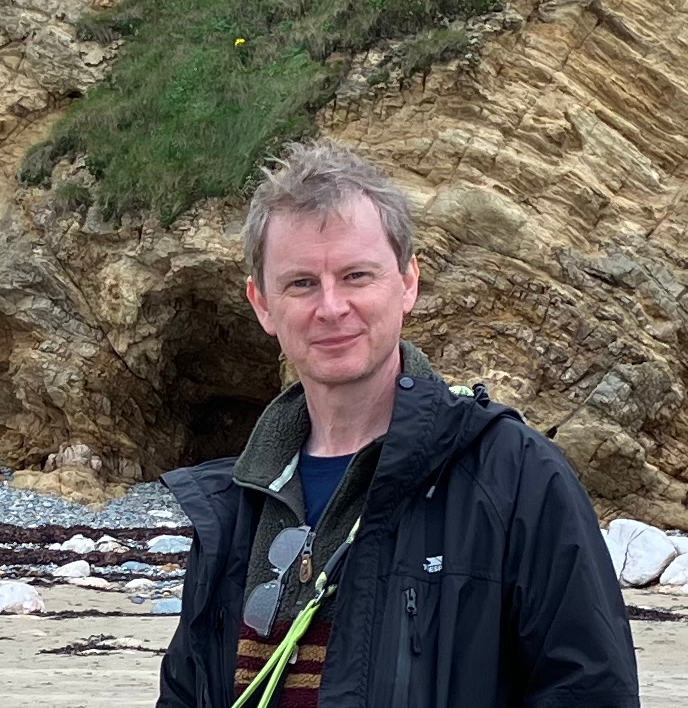
Professor Peter Duck holds the position of Professor of Applied Mathematics at the University of Manchester's Applied Mathematics Department. His research focuses on fluid mechanics, mathematical finance, and continuum mechanics, with contributions to boundary layer dynamics, renewable energy systems, and stochastic modeling. He has authored over 60 peer-reviewed articles and co-organized the IUTAM Symposium on Nonlinear Instability and Transition in Three-Dimensional Boundary Layers (2012). Duck leads the Continuum Mechanics and Industrial and Applied Mathematics research groups, and is affiliated with the UMARI research institute. His work aligns with UN Sustainable Development Goals, particularly in advancing sustainable energy solutions.
Research interests span fluid dynamics (boundary layer instabilities, ciliary flow modeling), financial engineering (hedge fund strategies, regime switching models), and energy systems (wind/solar power valuation, storage optimization). Notable contributions include developing PDE-based frameworks for stochastic storage systems and advancing eigensolution techniques for compressible boundary layers. Duck has supervised 17 research students and received the 2012 Best Student Paper Award for collaborative work on methodologies and technologies.
His publications demonstrate interdisciplinary innovation, blending mathematical rigor with practical applications in energy, finance, and fluid dynamics. Current projects include optimal trading strategies for electricity markets and modeling mass transport in biological fluid systems. Duck is a member of the Digital Futures research beacon, emphasizing computational advancements in applied sciences.
Awards:
- Best Student Paper Award: Methodologies and Technologies (2012)
Research Infrastructure: Active in UMARI (University of Manchester Advanced Research Institute) and collaborates internationally on fluid dynamics and energy systems. His work integrates theoretical models with computational tools, addressing real-world challenges in energy storage, turbulence control, and financial risk management.