معرفی
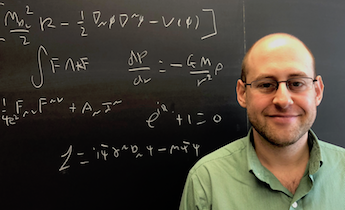
Niels Martens is an Assistant Professor in the History and Philosophy of Science department at Utrecht University's Faculty of Science. He specializes in the philosophy of physics with a focus on astronomy and cosmology, particularly examining dark matter, dark energy, and black holes through philosophical and metaphysical lenses. Martens leads the Collaborations Focus Group of the Next Generation Event Horizon Telescope (ngEHT) Collaboration and serves as Principal Investigator for the COSMO-MASTER ERC Project, which investigates dark energy, black holes, inflation, and spin-2 gravity. Previously, he was a Marie Curie Fellow at Utrecht University and a Postdoctoral Researcher within the German-Austrian research unit 'Epistemology of the Large Hadron Collider' at the University of Bonn.
Martens' research interests center on the intersection of philosophy of physics, metaphysics, and scientific methodology as applied to modern astronomy and cosmology. His work critically examines the spacetime-matter distinction in cosmological contexts, particularly regarding dark matter and modified gravity theories. He investigates whether these approaches are mutually exclusive or if hybrid theories can bridge the divide, challenging conventional wisdom in the field. His research also explores dimensional magnitudes in physics, questioning whether physical quantities like mass require absolute values beyond mere ratios, and examining scaling symmetries in physical theories. Martens has developed arguments for absolutism about mass in Newtonian gravity while exploring Machian and Humean alternatives.
His publication record reveals a strong focus on the philosophical foundations of cosmology and astrophysics, with particular attention to dark matter realism, the epistemology of large scientific collaborations, and the conceptual foundations of physical magnitudes. Martens' work demonstrates an increasing emphasis on interdisciplinary approaches, particularly integrating humanities perspectives into large-scale astrophysics projects like the ngEHT. His recent publications show a sophisticated engagement with both theoretical physics concepts and the practical challenges of conducting cutting-edge observational astronomy in the era of 'Big Science.'
Martens has received significant recognition for his work, most notably an ERC Starting Grant for his COSMO-MASTER project. His contributions to the field extend beyond traditional academic publications to include science communication through media appearances, podcasts, and public lectures. He has been featured in Spektrum der Wissenschaft, Nature Human Behaviour, and The Conversation, discussing topics ranging from black holes potentially composed of dark energy to the importance of including humanities in large STEM collaborations.
In terms of teaching and supervision, Martens is actively involved in Utrecht's Master's programs, offering numerous thesis projects in philosophy of astronomy and cosmology. He teaches courses including 'Philosophy of Astronomy & Cosmology' and 'Philosophy of Space and Time' as part of the History and Philosophy of Science program. He has also delivered guest lectures on 'Open Science for Physicists,' focusing on the changing landscape of scientific collaboration in the 21st century. Martens maintains an active research group, the Utrecht Philosophy of Astronomy & Cosmology (UPAC) Research Group, which organizes weekly colloquia and supports postdoctoral, PhD, and visiting fellowship applications.
Martens is deeply embedded in multiple international research networks, including the Gravitational Constant Network (St. Andrews-Bonn), the COSMOS History & Philosophy of Cosmology Network, and Harvard's Black Hole Initiative. His work with the ngEHT represents a pioneering effort to integrate humanities and social science perspectives into large-scale astrophysics collaborations, with his team's white paper establishing the first-ever inclusion of humanities contributions in the Key Science Goals of a major astrophysics project.