معرفی
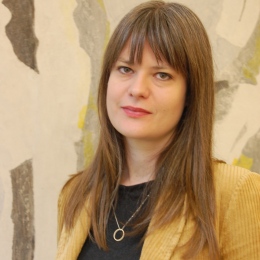
Natalia Volvach is a Researcher in the Department of Human Geography at Stockholm University, Sweden. Her work focuses on the intersection of semiotic landscapes, critical sociolinguistics, and linguistic ethnography, with particular attention to language and power dynamics in politically charged contexts.
Dr. Volvach earned her Ph.D. at the Centre for Research on Bilingualism in Stockholm University in 2023. Her dissertation, "From Words to Voids: Absencing and Haunting in Crimean Semiotic Landscapes," was distinguished by the Stockholm University Association's prize in 2023 (the Faculty of Humanities).
Her research examines how language and semiotic practices shape and are shaped by political contexts, particularly in relation to Ukraine, Crimea, and the experiences of displaced Ukrainians in Sweden. She employs linguistic ethnography to investigate how people navigate spaces of conflict, dispossession, and displacement through language and semiotic practices. Her work often focuses on the concept of "absence" as an active element in semiotic landscapes, exploring how what is not said or displayed carries significant political meaning.
Dr. Volvach's publications reveal a consistent focus on the relationship between language, power, and space, particularly in contexts of conflict and occupation. Her recent work examines Ukrainian experiences in the wake of Russia's invasion, exploring vulnerability, linguistic citizenship, and the performative aspects of absence in semiotic landscapes.
Scientific Awards:
- Stockholm University Association's prize in 2023 (the Faculty of Humanities) for her dissertation
Dr. Volvach held a Junior Research Fellowship within Ukraine in European Dialogue program at the Institute for Human Sciences in Vienna, Austria (Sept-Dec 2023). Currently, she is working on her postdoctoral project "Ukrainian Voices in Sweden," which investigates the lived experiences of language among Ukrainians who fled to Sweden following Russia's full-scale invasion on February 24, 2022. This project is generously funded by the Anna Ahlströms och Ellen Terserus stiftelse.
She is an active member of the "Network Language and Power" research group at Stockholm University, which focuses on how language and power dynamics have become increasingly relevant due to the rise of populism and increasing societal polarization.