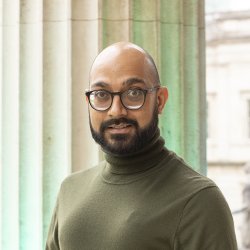
معرفی
Mohit Dalwadi is an Academic Faculty member at the Mathematical Institute, University of Oxford, specializing in fluid mechanics and mathematical biology. His work bridges theoretical mathematics with biological applications, focusing on active matter, bacterial signaling, and synthetic systems. He holds a DPhil from Oxford and maintains active research collaborations across disciplines.
Education:
- MMath, University of Oxford (Lincoln College)
- DPhil, University of Oxford (Mathematical Institute)
His research integrates Active matter dynamics, Biological signalling networks, and Fluid-structure interactions using singular perturbation theory. Key methodologies include homogenization for multiscale biological systems and asymptotic analysis of fluid phenomena, with applications ranging from biofilm modeling to industrial filter design.
Analysis of his 12 publications (2015-2024) reveals consistent focus on fluid-biological interfaces: particle dynamics in Jeffery's equations, bacterial quorum sensing in flow environments, and morphogen pattern formation. His work demonstrates mastery of asymptotic techniques to extract universal principles from complex nonlinear systems.
Scientific awards and recognitions include:
- Contributed Talk Award, SMB Annual Conference 2021
- Departmental Teaching Award, Mathematical Institute, University of Oxford
- Exceptional Performance Bonus, School of Life Sciences, University of Nottingham
- G-Research Prize in Quantitative Methods, Mathematical Institute, University of Oxford
- EPSRC Doctoral Training Grant, Mathematical Institute, University of Oxford
- Senior Scholarship x2, Lincoln College, University of Oxford
- Lord Crewe Scholarship x2, Lincoln College, University of Oxford
Supported by EPSRC funding during doctoral studies, Dalwadi later received performance recognition at Nottingham before returning to Oxford. Current research is sustained through institutional affiliations rather than listed external grants, with teaching excellence formally acknowledged in 2019. He collaborates within Oxford's Mathematical Biology group on decontamination modeling and active matter systems, leveraging the university's industrial mathematics networks for real-world impact.