معرفی
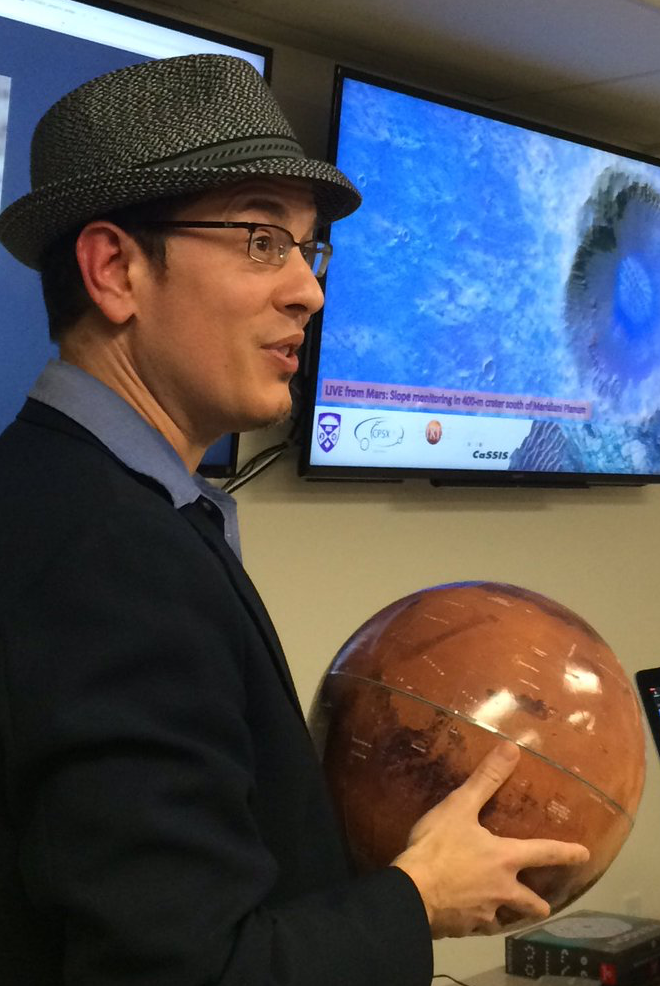
Dr. Livio Tornabene is a Research Scientist at SETI Institute and Western University, and an Adjunct Professor at Western University. He specializes in planetary missions, particularly focusing on Mars surface processes, impact cratering, and aqueous alteration using high-resolution imaging and remote sensing techniques. He is a science team member for the HiRISE instrument on the Mars Reconnaissance Orbiter (MRO) and Co-Investigator on the CaSSIS instrument on the ExoMars Trace Gas Orbiter, as well as the Pancam on the Rosalind Franklin rover.
Education: Ph.D. (2007) in Earth and Planetary Sciences from the University of Tennessee, M.S. (2001) in Geological Sciences from the University of South Florida, and B.S. (1996) in Geology from the University of Florida.
Research interests include analyzing planetary surfaces through multispectral imaging, digital terrain models, and compositional studies. He investigates Martian craters for subsurface lithology exposure, layered ejecta deposits, and the role of impact events in planetary evolution. His work also involves developing data products for CaSSIS and improving atmospheric correction techniques for surface signal analysis.
Scientific awards include NASA Group Achievement Awards (2011, 2006, 2005, 2004), the Charles Lindbergh Fellowship (2010), and the Prose Award (2015). His recent publications focus on Martian surface features, ExoMars landing site analysis, and impact-induced hydrothermal systems.
He has led mission training for over 20 personnel and contributed to rover mission planning (e.g., Schrödinger Basin lunar sample return). His work integrates field studies (e.g., Haughton Impact Structure) with orbital data to understand planetary processes.