معرفی
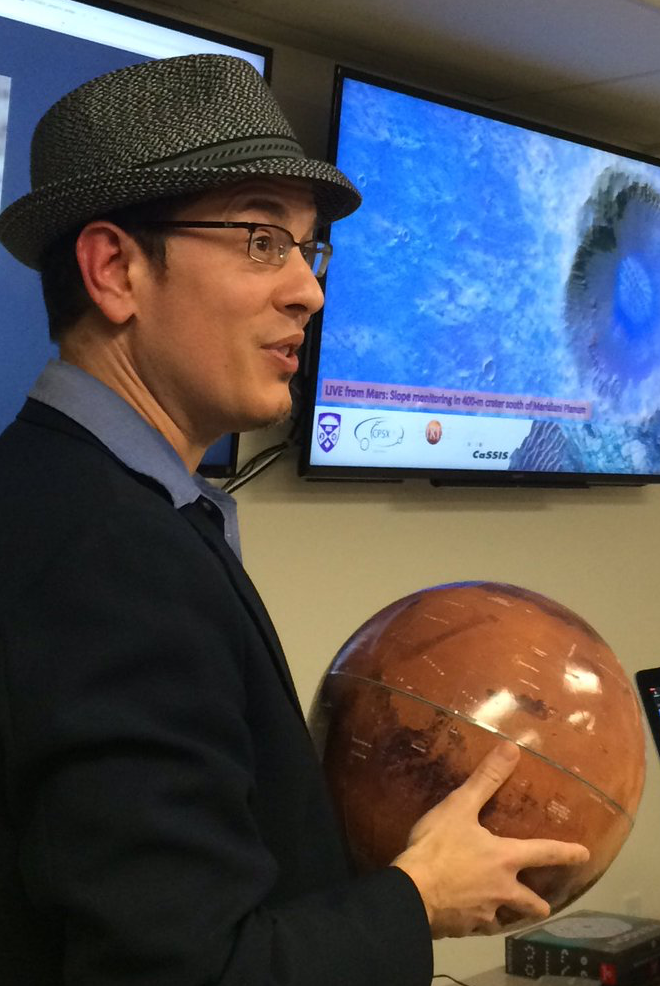
Dr. Gordon Osinski is a Professor in the Department of Earth Sciences at Western University, specializing in planetary geology, astrobiology, and economic geology. His research integrates fieldwork, remote sensing, and laboratory analyses to study impact craters, particularly their role in planetary evolution and astrobiological potential. He has conducted fieldwork on six continents, with significant work in the Canadian Arctic. Dr. Osinski leads the Canadian Lunar Rover Mission, Canada's first lunar rover mission, and is part of NASA's Artemis III geology team for the Moon landing. He is also a Co-Investigator on the ExoMars mission's PanCam instrument. His academic role includes teaching graduate courses on planetary science and impact cratering. He oversees labs in the Biological and Geological Sciences Building and is affiliated with the Centre for Planetary Science and Exploration (CPSX).
Research Interests: Planetary geology focuses on impact crater processes, Mars and Moon exploration, and hydrothermal systems. Astrobiology studies microbial life in impact environments. Economic geology examines Sudbury impact-related mineralization. He collaborates globally, training astronauts in field geology and advising on mission science planning.
Dr. Osinski's teaching includes Earth Sciences 2232G and advanced planetary science seminars. He actively mentors graduate students and postdoctoral fellows in impact cratering, planetary materials, and field geology. His lab locations include WSC 12, 14, 18, 26, 27, and 30. Current research projects include analyzing Martian gully formation, lunar basins, and biosignature preservation in impact hydrothermal systems.
His work bridges academia and space exploration, with direct involvement in mission design (e.g., Artemis III) and sample analysis strategies. He emphasizes using Earth analogs to interpret extraterrestrial geology, fostering international collaboration in planetary science.