معرفی
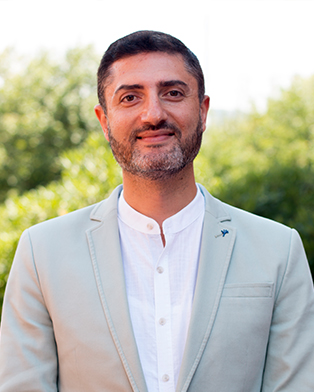
Associate Professor Ibrahim Salkini is a Syrian Islamic-law scholar who has held faculty positions at Damascus University, Jinan University (Lebanon) and, since 2021, Gaziantep University, Faculty of Theology, where he chairs the Arabic Language and Rhetoric division of the Department of Fundamental Islamic Sciences. Promoted to full Professor at Jinan University in 2024, he teaches and publishes extensively in Islamic jurisprudence, political fiqh, refugee studies and Arabic rhetoric.
Education:
- Ph.D. Islamic Law, Damascus University, 2009
- M.A. Islamic History, Ouzai University College (Lebanon), 2003
- B.A. Theology, Imam Muhammad Ibn Saud Islamic University (Saudi Arabia), 1998
Research Interests:
Dr. Salkini’s work integrates classical usûl al-fiqh with contemporary legal and social questions. He explores the theological-juridical foundations of political authority, the rights of forced migrants under Islamic law, and the role of Arabic rhetoric in Qurʾānic interpretation. His recent projects include comparative constitutionalism and the development of fiqh curricula for Syrian safe-zone schools.
Publications Profile:
Across 20 authored books and 14 refereed articles since 2004, his output addresses four converging arenas: legal theory (usûl al-fiqh), political jurisprudence, refugee & migration law, and Qurʾānic studies. The temporal spread (2004-2025) and multilingual dispersion (Arabic, Turkish) reveal sustained engagement with both classical commentary and urgent regional issues such as Syrian displacement and governance in conflict zones.
Outreach & Grants:
- Designer of Arabic-language curricula for northern Syrian safe-zone schools (MoNE & Diyanet, 2021-)
- Trainer of imams and preachers in Euphrates-Shield regions (Diyanet, 2016-)
- Member, Scientific Committee for Northern Syria Textbook Project (2021-)
Labs & Teams:
He coordinates the Arabic Rhetoric circle within Gaziantep University’s Theology Faculty, supervising MA theses and hosting annual workshops on “Fiqh of Migration” in collaboration with Syrian academic associations.