معرفی
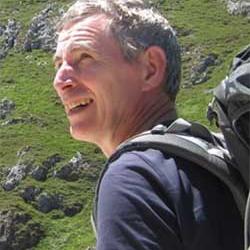
Professor Howard Griffiths serves as Professor of Plant Ecology in the Department of Plant Sciences at the University of Cambridge's School of Biological Sciences, where he leads the Physiological Ecology research group and holds a Fellowship at Clare College since 2002. He delivers 25-30 lectures annually in the Natural Sciences Tripos and directs an eight-day field course to Portugal.
His educational background includes a BSc in Botany (First Class Honours) and PhD in Botany from the University of Dundee (1972-1983), followed by a Personal Chair at Newcastle University (1983-2000) before joining Cambridge.
Griffiths' research investigates plant molecular, physiological and environmental processes regulating CO2 sequestration and productivity, with emphasis on carbon concentrating mechanisms (CCM) including C4 photosynthesis, Crassulacean Acid Metabolism (CAM), and algal pyrenoid systems. His work employs stable isotope methodologies to evaluate photosynthetic efficiency and translate findings into crop resilience applications for food security.
Recent publications demonstrate expertise in Rubisco optimization, algal carbon concentration mechanisms, and bryophyte ecosystem monitoring, revealing evolutionary patterns in CCM across plant lineages and practical pathways for sustainable agriculture.
His scientific recognition includes:
- Fellow of the Royal Society of Biology (2014)
- Fellow of the Linnaean Society (2015)
Griffiths has chaired the Departmental Graduate Education Committee (2018-2021), co-chaired the Cambridge Global Food Security Initiative, and advised the Vice Chancellor on Indian strategic partnerships. His grant leadership spans NERC-funded projects and international collaborations including expeditions to Trinidad, Venezuela, and Panama.
He directs the Physiological Ecology Group conducting field and laboratory research on photosynthetic adaptation, with ongoing projects in tropical cloud forest monitoring and crop engineering for water use efficiency.