معرفی
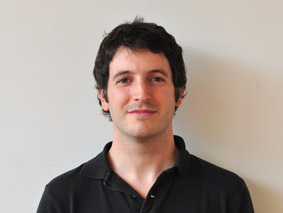
Ferran Feixas Gerones is a Ramón y Cajal Researcher at the Department of Chemistry, University of Girona, and a key member of the Institute of Computational Chemistry and Catalysis (IQCC). He is co-Principal Investigator of the CompBioLab research group and part of the Theoretical Chemistry of Biosystems (TCBioSys) group, where he leads projects on molecular recognition, biomolecular dynamics, and computational drug design.
His research focuses on advancing computational methods in chemistry, particularly through enhanced sampling molecular dynamics simulations. He applies these techniques to understand enzyme catalysis, protein folding, and biomolecular recognition processes. His work bridges theoretical chemistry and practical applications in drug discovery and biocatalyst design.
Ferran Feixas has led significant research projects funded by national and European programs, including a Ramón y Cajal grant, a Marie Curie Individual Fellowship, and projects under Spain’s Challenges and TED calls. These efforts aim to develop integrated simulation strategies that account for molecular dynamics to enable step-by-step reconstruction of biochemical and biomolecular recognition events.
Scientific Awards and Fellowships:
- Ramón y Cajal Fellowship (RYC2020-029552-I)
- Marie Curie Individual Fellowship
- Beatriu de Pinós Postdoctoral Fellowship
As a project leader and co-PI, Dr. Feixas mentors students and early-career researchers within CompBioLab. His group collaborates on enzyme engineering and rational drug design, supported by grants such as RTI2018-101032-J-I00 and TED2021-130173B-C42. These grants enable the development of advanced computational protocols for simulating complex biomolecular systems.
Dr. Feixas is embedded in a strong research infrastructure, working within the Institute of Computational Chemistry and Catalysis (IQCC), a leading center for theoretical and computational chemistry in Spain. His team leverages high-performance computing to explore conformational dynamics and its role in catalysis and molecular recognition.