معرفی
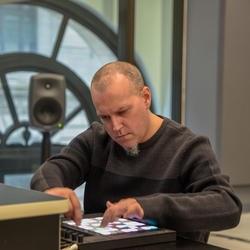
Fernando Lopez-Lezcano is a Lecturer at Stanford University's Center for Computer Research in Music and Acoustics (CCRMA) where he has been working since 1993. His work combines music composition, electronic engineering, and programming with a focus on spatial audio and sound diffusion technologies. He was the Edgar Varese Guest Professor at TU Berlin during the Summer of 2008 and is the 2014 winner of Stanford's Marsh O'Neill Award for Exceptional and Enduring Support of Stanford University's Research Enterprise.
Lopez-Lezcano's research interests center on computer music, spatial audio technologies, and sound diffusion systems. He has pioneered work in High Order Ambisonics (HOA), developing novel decoders and reverberation architectures for immersive sound environments. His work on the SpHEAR Project has created innovative 3D-printed soundfield microphone arrays, while his development of the GRAIL (Giant Radial Array for Immersive Listening) has revolutionized concert speaker arrays for HDLAs (High Density Loudspeaker Arrays). He has also created numerous open-source tools and software environments for spatial sound composition and diffusion.
His recent creative output demonstrates a consistent exploration of 3D sound spatialization, modular synthesis, and interdisciplinary collaborations. Across his compositions, he frequently integrates custom-built hardware like his modular synthesizers (including the famous 'El Dinosaurio' built in 1980-81) with sophisticated software environments written in SuperCollider. His work often bridges acoustic and electronic sound sources, creating rich spatial experiences that explore the relationship between technology and artistic expression.
Among his notable achievements is the 2014 Marsh O'Neill Award, recognizing his exceptional support of Stanford's research enterprise. This prestigious award was inspired by Marsh O'Neill, Associate Director of the W.W. Hansen Laboratories, and honors outstanding staff members who support faculty research activities.
Lopez-Lezcano has mentored numerous students in the development of musical instruments and performance systems, most notably the 'Ensemble AnaLocos' (Analógicos Locos or 'Crazy Analogs') which created the 'Noise Toaster' synthesizers. He has also developed important infrastructure for CCRMA including 'Planet CCRMA,' a collection of open-source audio software for Linux. His teaching includes the 'Sound in Space' course (Music 222), which covers historical background, techniques, and theory on the use of space in music composition and diffusion.
He directs the CCRMA Stage concerts and has been instrumental in developing CCRMA's spatial audio infrastructure, including the GRAIL system used in Bing Concert Hall. His work with the SpHEAR Project has advanced 3D sound recording techniques, while his collaborations with performers like Michiko Theurer (violin) and Chris Chafe (celletto) have produced innovative interdisciplinary performances.