معرفی
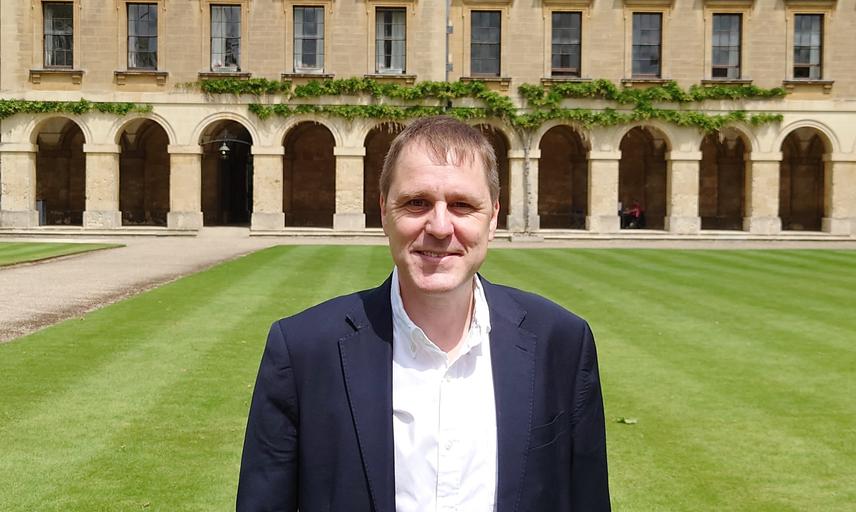
Dr. Emrys Evans is a Research Fellow in the Department of Chemistry within the Faculty of Science and Engineering at Swansea University. He leads research on radical energy and spin control in organic electronics as a Royal Society University Research Fellow. His work bridges chemistry, physics, and materials science to develop next-generation optoelectronic devices based on organic radical materials.
Dr. Evans completed his MChem in 2012 and DPhil in 2016 at the University of Oxford under Professor Christiane Timmel, focusing on photo and spin physics of light-induced radical pairs related to animal magnetoreception. He then worked with Professor Sir Richard Friend at the Cavendish Laboratory, University of Cambridge as a Research Associate (2016-2019) and Leverhulme Trust Early Career Fellow (2019-2020), researching organic semiconductors and radical materials for optoelectronics in collaboration with Professor Feng Li at Jilin University.
- Specializes in spectroscopy, spin physics, optoelectronics, and spintronics
- Focuses on radical materials with unpaired electrons for novel electronic and magnetic properties
- Research explores luminescence, magnetism, and spin properties in organic radical materials
- Develops applications for organic electronics and molecular-based technologies
His recent publications demonstrate a clear trajectory toward developing practical applications of organic radical materials, particularly in light-emitting devices. The research shows increasing sophistication in controlling spin states and energy transfer processes, with multiple high-impact papers in Nature family journals and Advanced Materials. A significant portion of his work focuses on overcoming efficiency limitations in organic light-emitting diodes through novel radical-based approaches that exploit doublet emission states.
Scientific Awards:
- Dillwyn Medal for STEMM from the Learned Society of Wales (2021) - recognizing early career research excellence in optoelectronics
- Swansea University Research & Innovation Rising Star award (2022)
Dr. Evans currently supervises multiple PhD students on projects related to spin dynamics, organic quantum devices, and radical-based optoelectronics, often in collaboration with other faculty members. His research is supported by significant funding including an EPSRC New Investigator Award (2022-2025), a Royal Society University Research Fellowship (2020-2025), and a Leverhulme Early Career Fellowship (2019-2022). His work represents a unique interdisciplinary approach that combines molecular chemistry with quantum physics to develop next-generation electronic materials.