معرفی
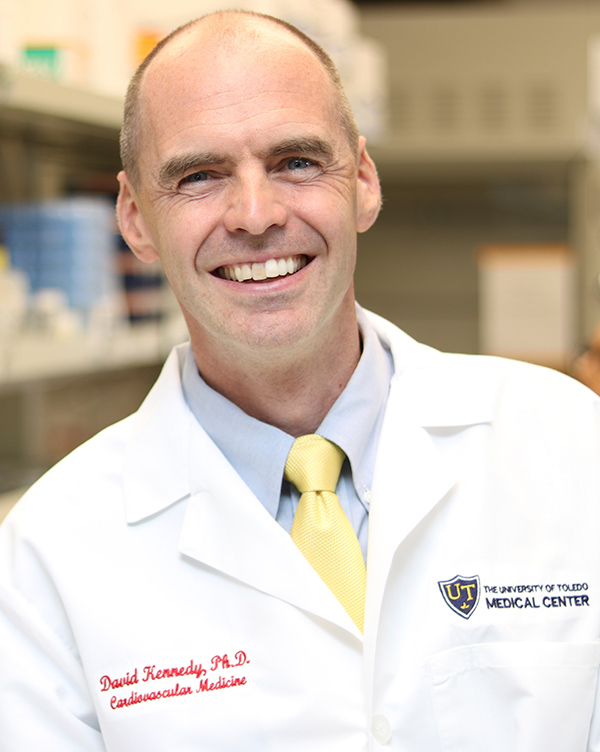
David Kennedy, Ph.D., is a tenured Professor of Medicine at the University of Toledo College of Medicine and Life Sciences. He serves as Co-Director of the Women & Philanthropy Genetic Analysis Center and leads the Kennedy Research Lab, which focuses on the pathogenesis of cardio-renal syndromes and environmental health impacts on the Great Lakes region. His work spans molecular mechanisms of cardiotonic steroids (CTS) and Na/K-ATPase signaling in heart failure, hypertension, and chronic kidney disease, alongside environmental risk mitigation for freshwater toxins.
- Education: B.S. in Biology (John Carroll University, 1995), M.S. in Biological Sciences (Medical College of Ohio, 2001), Ph.D. in Biomedical Sciences (Medical University of Ohio, 2006)
- Postgraduate Training: David & Lindsay Morgenthaler Endowed Fellowship (Cleveland Clinic, 2007-2010), University of Toledo (2006-2007)
- Academic Appointments: Assistant Professor (2015-2020), Associate Professor (2020-2025), Professor (2025-present)
Research interests include:
- CTS-Na/K-ATPase axis in cardio-renal fibrosis
- Environmental stressors in the land-water-food nexus
- Systems genetics of salt-sensitive hypertension
- Microcystin toxicity in pulmonary and hepatic systems
- Computational lipidomics for disease stratification
- Novel diagnostics for acute kidney injury
His recent publications focus on oxylipin biomarkers, microcystin-induced inflammation, and multi-organ fibrosis. Kennedy has received numerous awards, including the American Heart Association Fellowships, Cleveland Clinic Morgenthaler Endowed Fellowship, and Dean’s Awards for Research and Advising Excellence. His lab employs high-content phenotyping, mass spectrometry, and translational models to address unmet clinical needs.