معرفی
Clark A. Lindgren is a Professor and holds the Patricia A. Johnson Professorship of Neuroscience at Grinnell College. He is affiliated with the Department of Biology, Department of Biological Chemistry, and the Neuroscience program. His research focuses on the chemical synapse, particularly the neuromuscular junction, where neurons communicate with neighboring cells.
Dr. Lindgren earned his B.S. in Physics from Wheaton College, followed by M.S. and Ph.D. degrees in Physiology from the University of Wisconsin-Madison. He completed postdoctoral training in Neurobiology at Duke University.
Dr. Lindgren's research primarily investigates synaptic transmission and plasticity at the neuromuscular junction. His laboratory studies how presynaptic cells regulate neurotransmitter release and how synapses maintain stability through processes like presynaptic homeostatic potentiation (PHP). A key focus of his recent work has been exploring the role of hydrogen ions (protons) as potential mediators in PHP, challenging long-standing mysteries in neuroscience that have persisted for over four decades.
Analysis of Dr. Lindgren's recent publications reveals a consistent focus on synaptic mechanisms at the neuromuscular junction across multiple model organisms (mouse, lizard, frog, Drosophila). His work spans multiple disciplines including neurophysiology, neuropharmacology, and molecular neuroscience, with particular emphasis on the roles of nitric oxide, endocannabinoids, and prostaglandins in modulating synaptic transmission. His research demonstrates an evolution from studying basic neurotransmitter release mechanisms to investigating complex synaptic homeostasis processes involving multiple cell types (the "tripartite synapse" including nerve, muscle, and glial cells).
Dr. Lindgren holds the distinguished Patricia A. Johnson Professorship of Neuroscience, reflecting his significant contributions to the field.
Over 90 undergraduate students have worked in Dr. Lindgren's laboratory since 1990, contributing to numerous publications where student researchers are denoted with asterisks. His mentoring has provided extensive research opportunities for undergraduates, with students contributing to all aspects of experimental design, execution, and publication. His laboratory has received support for undergraduate research training, though specific grant details are not provided in the available text.
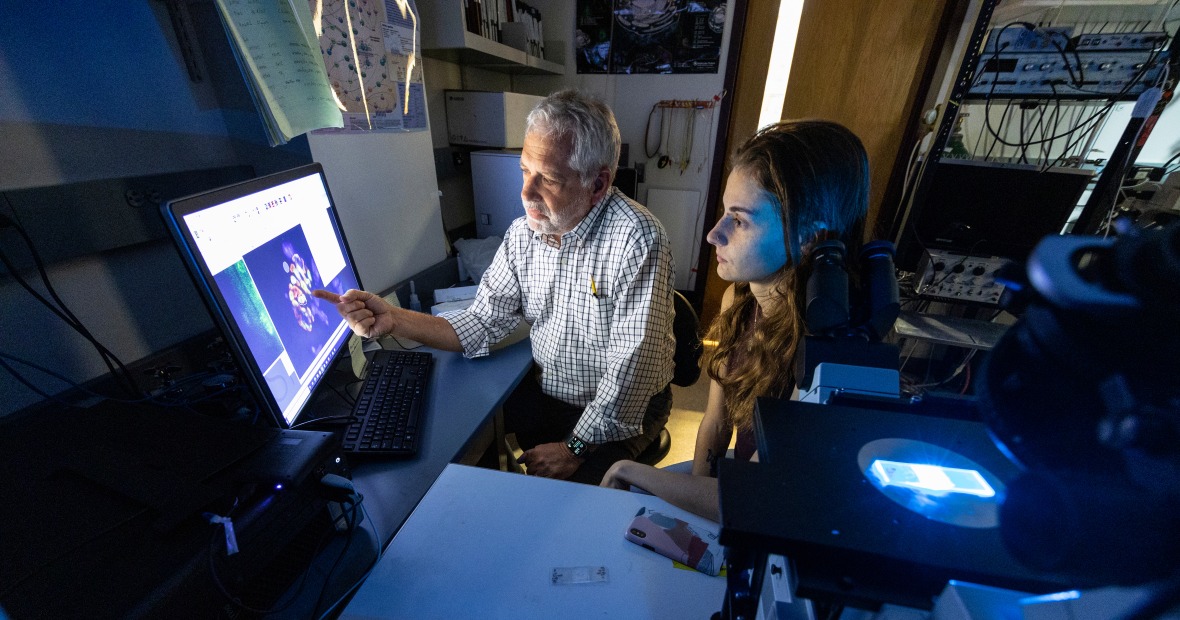
Dr. Lindgren's laboratory employs a range of techniques including electrophysiology, confocal microscopy, immunofluorescence, computational modeling, and molecular approaches to study synaptic function. Current projects focus on measuring pH in the synaptic cleft, exploring the morphology of synapses at the neuromuscular junction, computationally simulating pH responses, and investigating PHP mechanisms in the presence of postsynaptic action potentials.