معرفی
Christoph Emanuel Düllmann is a Professor in the SHE Chemistry department at GSI Helmholtzzentrum für Schwerionenforschung GmbH, with strong affiliations to Johannes Gutenberg University Mainz. He leads groundbreaking research on superheavy elements and transactinide chemistry, utilizing advanced facilities like TASCA (TransActinide Separator and Chemistry Apparatus) and UNILAC accelerator.
His research focuses on the chemical and physical properties of the heaviest elements in the periodic table, particularly elements 112-118. Düllmann's work combines nuclear physics with cutting-edge chemical separation techniques to study single atoms of these extremely rare and short-lived elements. His research group investigates adsorption behavior, gas-phase chemistry, and relativistic effects that significantly influence the chemical properties of superheavy elements.
His publication record shows a clear trend toward increasingly sophisticated chemical investigations of elements at the limits of the periodic table, with recent work focusing on nihonium (element 113), flerovium (element 114), and moscovium (element 115). These studies reveal how relativistic effects modify expected periodic trends, providing crucial tests for theoretical models of chemical behavior in the superheavy element region.
Düllmann mentors PhD students including Katharina Hermainski, who attended the 2025 Lindau Nobel Laureate meeting, and Dominik Dietzel. His research is supported by major grants from German research foundations and international collaborations focused on expanding the periodic table and understanding nuclear stability at its extremes.
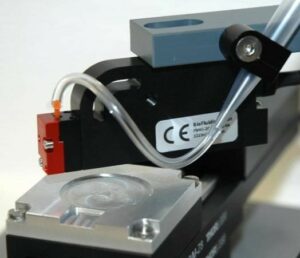
He leads experimental efforts at the TASCA facility, where his team develops specialized equipment like the Recoil Transfer Chamber to interface physical separators with chemical analysis systems. Current work focuses on preparing for element 119 and 120 synthesis campaigns, pushing the boundaries of the periodic table further than ever before.