معرفی
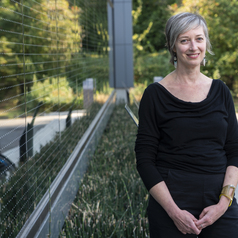
Christina E. Hoicka is an Associate Professor in the Department of Geography and Civil Engineering at the University of Victoria, where she holds the prestigious Canada Research Chair in Urban Planning for Climate Change. She leads the Re-imagining Social Energy Transitions (ReSET) CoLaboratory, which focuses on understanding the emergence of clusters of low-carbon and renewable energy innovations and energy citizenship. Her interdisciplinary work bridges geography, civil engineering, and urban planning to address critical challenges in energy transitions and climate change.
Dr. Hoicka's educational background includes:
- PhD in Geography from the University of Waterloo
- MES (Master of Environmental Studies) with a focus on ecological economics from York University
- B.Eng (Bachelor of Engineering) from McGill University
Her research expertise centers on energy geography, justice in low-carbon energy transitions, socio-technical and complex systems approaches to the diffusion of low-carbon innovations, renewable energy development, and sustainable cities. Dr. Hoicka employs radical, place-based, justice and complex systems approaches in her research, with particular attention to the benefits and participation of urban, rural, and Indigenous communities in renewable energy transformations. She is especially interested in how renewable energy technologies emerge in communities and how these transitions can be structured to ensure equitable outcomes for diverse populations, including examining the complementarity of different renewable energy sources and governance models for community energy projects.
Dr. Hoicka's publication record demonstrates a consistent focus on renewable energy communities, energy justice, and the socio-political dimensions of energy transitions. Her highly cited 2020 paper 'Renewable energy communities under the 2019 European Clean Energy Package–Governance model for the energy clusters of the future?' has established her as a leading scholar in this area. A notable trend in her recent work is the increasing attention to Indigenous perspectives and participation in energy transitions, as well as the integration of equity, diversity, and inclusion considerations in climate and energy policy and philanthropy.
Dr. Hoicka's primary scientific recognition is her appointment as a Canada Research Chair in Urban Planning for Climate Change, which is a highly competitive and prestigious award recognizing exceptional researchers in Canada.
- Canada Research Chair in Urban Planning for Climate Change
As the founder and leader of the Re-imagining Social Energy Transitions (ReSET) CoLaboratory, Dr. Hoicka mentors graduate students and collaborates with researchers across multiple disciplines. She is also the co-founder and inaugural Chair of Women & Inclusivity in Sustainable Energy Research (WISER) Network, which works to advance gender equity and inclusion in sustainable energy research. Her research has been supported by various funding agencies that recognize the importance of interdisciplinary approaches to energy transitions and climate change mitigation.
The ReSET Colaboratory, which Dr. Hoicka leads, brings together researchers, community partners, and practitioners to explore innovative approaches to energy transitions. The lab focuses on applying radical, place-based, justice and complex systems approaches to understand how renewable energy innovations emerge and diffuse in different contexts. The lab's work emphasizes the importance of local knowledge and community participation in creating sustainable and equitable energy futures, with particular attention to the needs and perspectives of Indigenous communities.