معرفی
Carole Lamonier is a Professor at the University of Lille, working within the Department of Heterogeneous Catalysis at the Solid State Catalysis and Chemistry Unit (UCCS - UMR CNRS 8181). She leads research in the CEMOP group (Catalysis for Energy and Synthesis of Platform Molecules), focusing on catalyst development for petroleum fraction treatment.
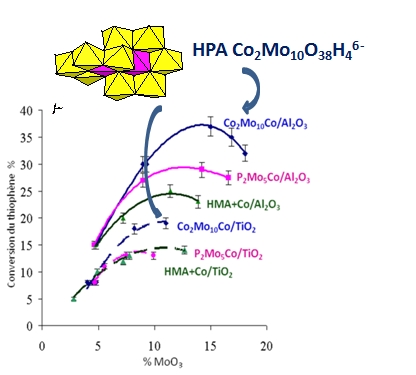
Her research expertise spans heterogeneous catalysis with specialization in hydrotreatment processes including hydrodesulfurization, hydrocracking, and hydrodemetallation. She is renowned for her work on heteropolyanions (HPAs) and mixed-valent HPAs for catalyst preparation, particularly the synthesis of metallic salts (Nickel and Cobalt) of HPAs for Co(Ni)-Mo, Ni-W, and Ni-Mo-V catalyst systems. Her research demonstrates that the proximity of Co-Mo species in HPA salts directly correlates with catalytic performance regardless of support material.
Analysis of her recent publications reveals a strong focus on advanced characterization techniques (HAADF, QEXAFS), hierarchical catalyst structures, oxidative desulfurization methods, and the development of novel catalyst supports including Moroccan phosphates and Argentinean bentonite. Her work bridges fundamental understanding of active phase genesis with practical applications in petroleum refining and environmental protection.
Scientific Recognition:
- Habilitation à Diriger les Recherches (HDR) awarded in 2007
- Eight significant patents covering innovative catalyst preparation methods using heteropolyanions
- Over 60 publications since 2008 in high-impact journals including Applied Catalysis B, Journal of Materials Chemistry A, and ACS Catalysis
Prof. Lamonier has supervised multiple PhD students and served on numerous thesis committees. Her research has been supported by international programs including Volubilis (2006-2009), Ecos-Sud (2008-2010), and ANR-funded 'NG2M' program. She actively collaborates with research institutions in Morocco and Argentina, reflecting her commitment to global scientific cooperation in catalysis research.