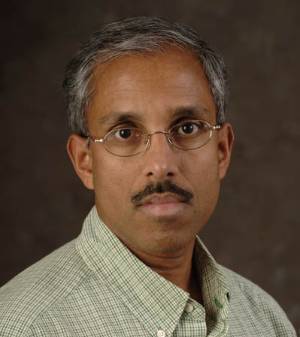
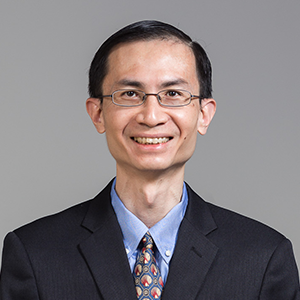
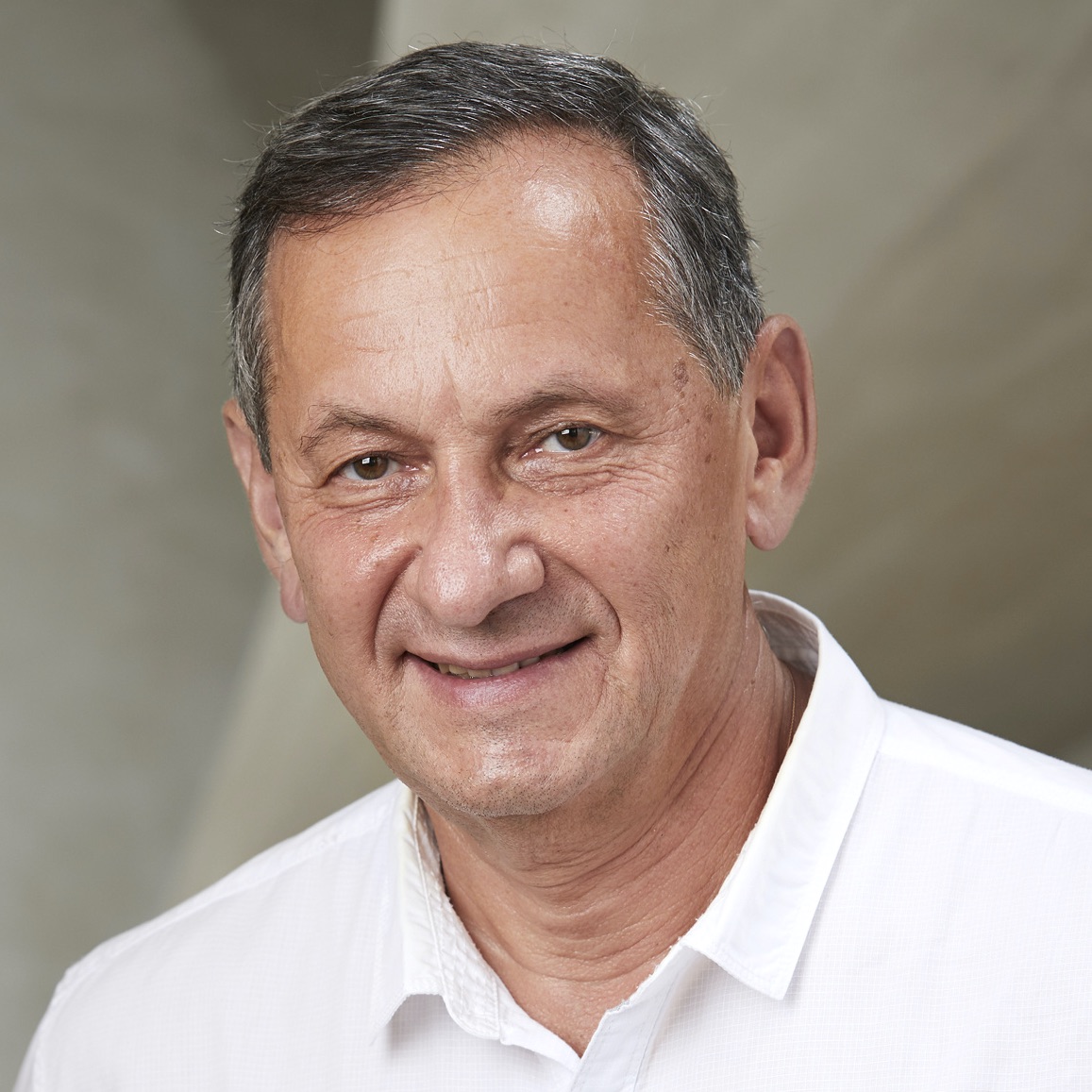
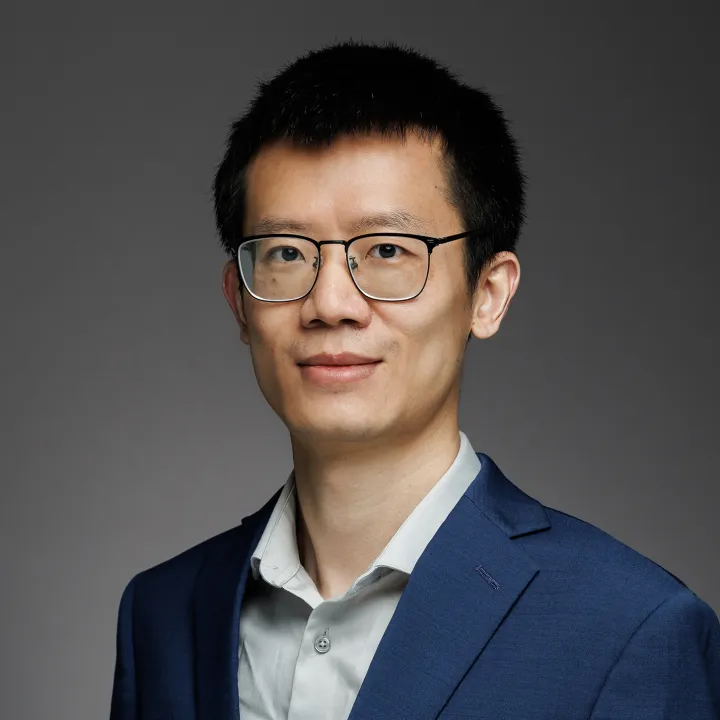
Dr. Venkat Bhethanabotla is a Professor and Director of the Materials Science and Engineering Program at the University of South Florida's College of Engineering. He holds a B.S. from Osmania University and a Ph.D. from Penn State University, both in Chemical Engineering. His research focuses on chemical/biological sensors, plasmonics, and catalysis, with emphasis on point-of-care biosensors, photocatalytic CO₂ conversion, and acoustic wave applications. Research highlights include development of SAW-based biosensors for protein biomarkers, plasmonic-enhanced fluorescence systems, and silica-supported perovskite catalysts for CO₂ conversion. He has pioneered techniques combining acoustic streaming with plasmonic effects for improved sensor performance. His work spans materials synthesis, computational modeling (DFT), and biomedical applications. Awards: Fellowships from AAAS, AIMBE, and AIChE Labs/Teams: Bhethanabotla Group (focusing on sensors, catalysis, and plasmonics) Over 150 publications span journals like IEEE Sensors, ChemSusChem, and ACS Applied Materials. Active in editorial roles (Associate Editor, IEEE Sensors Journal). Current projects include acoustic manipulation of lipid vesicles, electro-plasmonic neural stimulation, and additive manufacturing of optical interconnects.
Bruce Dick is a Professor in the Department of Anesthesiology & Pain Medicine at the University of Alberta's Faculty of Medicine & Dentistry. He maintains dual clinical roles at the Pediatric Chronic Pain Clinic (Stollery Children's Hospital) and the Multidisciplinary Pain Centre (University of Alberta Hospital), integrating research with direct patient care. Education: Ph.D. in Clinical Psychology (Dalhousie University, Pediatric Pain Research Laboratory) Clinical training at Royal National Hospital for Rheumatic Diseases (Bath, UK) and IWK Health Centre (Halifax, NS) AHFMR Postdoctoral Fellowship (University of Calgary/Alberta Children's Hospital) Dr. Dick's research examines chronic pain's impact across the lifespan with particular focus on cognitive function , disability , sleep disturbances , and social stigmatization . His work bridges pediatric pain management with innovative distance treatment programs and population-level interventions. Key themes include psychosocial pain modulation in adolescents, virtual care adaptation during crises, and cancer pain self-management systems. Analysis of his 2020-2022 publications reveals dominant trends in pandemic-responsive pain care delivery, caregiver-focused interventions, and adolescent social dynamics. His work spans pediatric psychology , digital health implementation , and pain epidemiology with strong emphasis on real-world clinical translation. Scientific Awards: AHFMR Postdoctoral Fellow As a registered clinical psychologist, Dr. Dick directs multiple research streams including the Chronic Pain Network initiatives and Teens Taking Charge cancer pain program. His grant portfolio supports telehealth innovation and longitudinal studies of pain's social impact, while mentoring focuses on training the next generation of pain researchers through clinical rotations and co-authorship opportunities. Dr. Dick leads collaborative teams across the Stollery Children's Hospital Pediatric Chronic Pain Clinic and University of Alberta Multidisciplinary Pain Centre , with active partnerships in the Canadian Pain Society and international pain research consortia. Current projects emphasize scalable digital interventions and neurocognitive pain mechanisms using MEG technology.
Dr. GOH Khim Yong is an Associate Professor and Head of the Department of Information Systems and Analytics at the National University of Singapore (NUS School of Computing). He holds a Ph.D. in Business Administration (University of Chicago), M.Sc. and B.Sc. in Computer & Information Sciences (NUS). His research focuses on digital media marketing, social/mobile platforms, AI pricing strategies, and econometric methods. He advises major firms like Alibaba, Lazada, and Johnson & Johnson across industries such as e-commerce, healthcare, and retailing. Educations: Ph.D., Business Administration, University of Chicago (2005) M.Sc., Computer & Information Sciences, NUS (1998) B.Sc., Computer & Information Sciences, NUS (1997, First-Class Honours) His research explores digital transformation, AI-driven pricing, live-streaming commerce, and consumer behavior in platform ecosystems. Notable projects include studying AI pricing agents' impact on e-commerce sales and analyzing live-streaming dynamics' socio-economic effects. He has published in top journals like Management Science and Information Systems Research , and his work frequently addresses practical industry challenges. Recipient of prestigious awards including the International Conference on Information Systems Best Paper Award (2022) and AIS Distinguished Member (2021). He teaches courses in econometrics and data analytics across NUS and the University of Chicago. His former Ph.D. students hold faculty positions at institutions like Tsinghua University and the Chinese University of Hong Kong (Shenzhen).
Mark Heinrich is an Associate Professor in the Department of Computer Science at the University of Central Florida (UCF), where he also serves as Undergraduate Coordinator for CS and IT, and Senior Design Coordinator. He previously held roles at Cornell University and has industry experience co-founding companies like Phanfare and Flashbase. His research focuses on parallel computer architecture, heterogeneous systems, cache coherence protocols, and multiprocessor simulation. Heinrich holds a Ph.D. in Electrical Engineering from Stanford University (1998) under John Hennessy, and a B.S. in Electrical Engineering and Computer Science from Duke University (1991). Research Interests His work spans parallel architectures, active memory systems, scalable cache coherence protocols, and hardware/software co-design. Recent efforts include innovations in persistent memory technologies and multiprocessor simulation methodologies. Teaching In Spring 2020, he taught CS Senior Design I and II courses (COP 4934/4935), with office hours focused on senior design and undergraduate coordination. Professional Background Associate Professor at UCF since 2003 Past roles: Director of UCF's School of Computer Science (2005), Associate Director of EECS (2005-2007) Co-founder of the Cornell Computer Systems Laboratory Contributed to the FLASH multiprocessor architecture and its simulation tools Labs & Projects He has been involved in projects like Active Memory Clusters and architectural support for multiprocessor systems. His work often bridges theoretical computer architecture with practical hardware implementations.
Dr. Vladimir Vlassov is a full Professor in Computer Systems at the Division of Software and Computer Systems (SCS) , Department of Computer Science (CS) , School of Electrical Engineering and Computer Science (EECS) , KTH Royal Institute of Technology , Stockholm, Sweden. He leads the AVA project in ALEC2, an AI-powered system for mental health care. He is a member of the Distributed Computing research group (DC@KTH) . Education & Roles: Holds a PhD and is a member of ACM and IEEE. Previously visited MIT (1998) and UMass Amherst (2004). Teaches courses on Data Mining , Distributed Systems , and Concurrent Programming . Research Interests: Focus on scalable AI, Cloud computing, distributed systems, and NLP for mental health. Projects include ExtremeEarth (Copernicus data analytics) and EMJD-DC (distributed computing PhD program). Grants & Projects: Principal Investigator in ALEC2 (adaptive mental health care) and ExtremeEarth (EU H2020). Led EU projects like ENCORE (manycore systems) and PaPP (embedded systems). Labs & Teams: Directs the Distributed Computing group, contributing to Hopsworks (machine learning feature store) and Maggy (hyperparameter optimization).
William D. Bishop is the Director of Admissions for the Faculty of Engineering at the University of Waterloo and an Associate Professor, Teaching Stream in the Department of Electrical and Computer Engineering. He leads the Engineering Admissions Team and teaches courses in engineering design, digital design, and embedded systems. His research focuses on engineering education, configurable computing, and multimedia processing. Education: Ph.D. in Electrical and Computer Engineering (2003), University of Waterloo M.A.Sc. in Electrical Engineering (1996), University of Waterloo B.A.Sc. in Computer Engineering/Management Science (1994), University of Waterloo Research Interests: Engineering education methodologies and outcomes Field-programmable gate arrays (FPGAs) for general-purpose computing Image processing and multimedia system optimization Hardware/software co-design for embedded systems Awards: Unsung Hero Award (2024) James A. Field Teaching Excellence Award (2006, 2011) Ontario Volunteer Service Award (2019) Teaching & Service: Teaches ECE 124, ECE 224, and ECE 327 Oversees admissions for all undergraduate engineering programs Professional memberships: PEO, OSPE, CEEA, IEEE Industrial Experience: Co-op at Atlantis Aerospace (1992-1993): Developed flight simulation engines Co-op at Motorola Corporation (1991-1992): Ported software to OS/2 platform
Prof. Alexander Mathys is an Associate Professor at the Department of Health Sciences and Technology, ETH Zurich, and Deputy Head of the Institute of Food, Nutrition, and Health. His research focuses on sustainable food processing, with a systems-oriented approach to optimize food value chains and address environmental, economic, and social impacts. Key areas include microalgae and insect-based protein sources, bioconversion of food waste, and novel preservation technologies. Education: PhD in Food Processing (2008), Tenured Professor (2022). Affiliations: Singapore-ETH Centre, Bezos Centre for Sustainable Protein (NUS). Research Interests: Sustainable food systems, bioeconomy principles, multi-indicator sustainability assessments. Innovations include urban farming concepts, microalgae cultivation for nutrition, and mechanical/biotechnological food processing techniques. Awards: IAFoST Fellow (2024), ETH Zurich Dandelion Award (2022), IFT International Food Security Award (2020), Young Researcher (Nobel Laureates Meeting, 2010). Grants & Advising: Over 200 publications (140 peer-reviewed articles), 13 patents, and extensive international collaborations. Leads the Sustainable Food Processing group at ETH Zurich. Labs/Teams: Directs interdisciplinary research teams exploring novel protein sources, food waste valorization, and scalable bioprocessing technologies.
Linghao Song is an Assistant Professor in the Department of Electrical & Computer Engineering at Yale University. His research focuses on accelerator architecture design, FPGA-based acceleration systems, and ReRAM-based computing. He is affiliated with the School of Engineering & Applied Science and holds expertise in sparse matrix processing, high-level synthesis, and task-parallel programming frameworks. Education: Ph.D. and M.S. from Duke University and University of Pittsburgh, respectively, with a B.S.E. from Shanghai Jiao Tong University. Research Interests: Song's work spans FPGA-accelerated computing, resistive memory (ReRAM) architectures for deep learning and graph processing, and high-performance sparse matrix operations. His recent projects include the TAPA framework for FPGA programming, ReFloat for iterative linear solvers, and the Sextans/Serpens accelerators for sparse matrix computations. Key Contributions: Over 20 peer-reviewed publications on topics like ReRAM-based accelerators (e.g., GraphR, PipeLayer), FPGA optimization frameworks (TAPA, RapidStream), and novel hardware designs for neural networks and graph analytics. His work emphasizes energy efficiency, scalability, and cross-domain applicability of hardware accelerators. Awards: Recipient of the Duke ECE Outstanding Dissertation Award (2021), EDAA Outstanding Dissertation Award (2020), and National Scholarship of China (2012). Labs/Teams: Leads research in FPGA acceleration and memory-based computing, collaborating on projects involving HBM integration, resistive memory architectures, and task-parallel dataflow frameworks.
Professor Javid Taheri is a leading academic at Karlstad University (2019–present), previously serving as Associate Professor (2015–2019) and Senior Lecturer (2015). His research focuses on cloud computing, edge computing, distributed systems, and AI-driven networking. He holds a Ph.D. in Information Technologies from The University of Sydney (2007) and an M.Sc./B.Sc. in Electrical Engineering from Sharif University of Technology (2000/1998). Research interests include cloud-edge continuum systems , resource optimization , 5G/6G networking , and AI for IoT . Notable contributions include frameworks like PerfSim (microservice performance simulation) and MultiScaler (auto-scaling for cloud applications). Publications highlight innovations in edge computing optimization, security for distributed systems, and machine learning for resource management. He has co-authored over 150 papers across top venues like IEEE Transactions and ACM conferences. Academic leadership includes roles as conference chair (IC2E 2023) and editorial work for journals on cloud and edge computing.
Dr. Andrew Binns is an Associate Professor in the School of Engineering at the University of Guelph and a Principal Investigator at the G360 Institute for Groundwater Research. He holds a PhD from Queen’s University (2012), followed by a postdoctoral fellowship in Integrative Biology at the University of Guelph and a tenure as Assistant Professor at the University of Western Ontario. His research focuses on water resources engineering and environmental hydraulics, emphasizing river resilience, urban flood mitigation, and watershed hydrology. Key research interests include fluvial hydraulics, urban flood prevention, and the sustainability of surface water systems. He investigates technologies like backwater valves and foundation drainage systems to reduce basement flooding risks. His work also explores watershed hydraulic processes, climate impacts, and stormwater management infrastructure efficacy. Grants & Awards: NSERC Discovery Grant (2020-2025), NSERC Collaborative Research & Development Grant with ICLR (2017-2021), MOECC COA Grant (2020-2023), and OMAFRA-UofG Partnership Grant (2018-2021). Lab Capabilities: Includes a Teledyne RDI StreamPro ADCP, Nortek Vectrino probe, river basin flume, backwater valve model, and foundation drainage system model. Professional Roles: Associate Editor for Journal of Flood Risk Management and Hydrotechnical Division Committee Member of the Canadian Society for Civil Engineering. His research aims to enhance urban resiliency, improve flood prediction, and sustain water resources through experimental and numerical methods.
Lynne Grewe serves as a Professor in the Department of Computer Science at California State University, East Bay, where she maintains active research and teaching responsibilities with current office hours and contact information. Her work bridges theoretical computer science with real-world applications across healthcare, education, and emergency response domains. Her research portfolio centers on three interconnected thrusts: Medical Technology : Development of computer vision systems for stroke detection through facial pattern analysis (StrokeChange), infrared-based disease monitoring, and assistive navigation tools for the visually impaired (Seeing Eye Drone) Educational Innovation : Creation of multimodal systems like ULearn that detect student frustration using deep learning, alongside community college partnerships to broaden participation in computing Sensor Fusion Applications : Integration of multi-modal data for disaster response, infrastructure monitoring, and mobile health platforms using advanced machine learning techniques Publication analysis reveals consistent evolution toward real-time, deployable systems—particularly mobile health applications and educational tools—while maintaining foundational work in sensor fusion. Her 2020-2024 output shows increasing emphasis on healthcare applications (40% of recent work) and educational technology (25%), often combining computer vision with mobile platforms. Grewe demonstrates significant commitment to educational equity through the Faculty in Residence program, collaborating with community colleges to prepare underrepresented students for computing careers. Her Google partnership and focus on practical applications indicate strong industry engagement, though specific grant details aren't documented in source materials. Current projects suggest ongoing expansion into in-situ health monitoring and AI-driven educational support systems.
Dr. Bas Vriens is an Assistant Professor at Queen's University, Department of Geological Sciences and Geological Engineering, within the Faculty of Arts and Science. He leads the NFRF-Exploration Project and holds cross-appointments at the Beaty Water Research Centre. His research focuses on metal contaminants in mine wastes and the Great Lakes basin, integrating environmental geochemistry, hydrology, and engineering to quantify anthropogenic pollutant impacts. Education : Ph.D. in Environmental System Sciences (2015), ETH Zurich M.E.Sci. in Environmental Geochemistry (2011), Utrecht University B.Sc. in Chemical Engineering (2009), Avans Hogeschool Breda Research Interests : He investigates metal mobilization from mine wastes and emerging contaminants in wastewater. His work integrates interdisciplinary methods, including geochemical modeling, geospatial statistics, and field monitoring. Key areas include: Mine waste management and metal recovery Trace metal biogeochemistry in aquatic systems Wastewater effluent and biosolids management Advising & Grants : Current advisees span MSc to postdoctoral researchers (e.g., Nathan Beckner-Stetson, Mehran Mahdian). He supervises projects on surface water quality, watershed modeling, and industrial waste analysis. Labs & Teams : His research group collaborates with industry and government partners, focusing on lab-scale experiments, field studies, and computational modeling. Active projects include the Great Lakes trace metal budget and mine waste-rock weathering dynamics.
Prof. Dr.-Ing. habil. Konrad Koch is a Professor at the Technical University of Munich (TUM), leading the working group on energy-efficient wastewater treatment since 2012. He holds the Chair of Urban Water Management within the TUM School of Engineering and Design. His career includes a habilitation in 2018 and appointment as an Extraordinary Professor (Apl.-Prof.) in 2023. He previously worked at the Bavarian State Research Center for Agriculture and earned his PhD from TUM in 2010. Education: PhD (Dr.-Ing.), Technical University of Munich (2010) Diploma in Waste Management and Contaminated Sites, TU Dresden (2007) Research at TU Hamburg-Harburg (2006–2007) Research focuses on sustainable use of organic waste streams, anaerobic digestion, wastewater treatment innovation, and energy recovery. Key areas include biological methanation, CO₂ utilization, and process optimization for resource efficiency. Koch actively bridges lab-scale to full-scale applications, emphasizing practical implementation in urban wastewater systems. Publications highlight advancements in biogas potential testing standardization, microbial methanation, and co-digestion strategies. His work addresses challenges like nitrogen oxide emissions and substrate selection for anaerobic processes. Lab affiliation: Chair of Urban Water Management, TUM. Collaborates with interdisciplinary teams on projects like ENCOVER, CANDO, and the Urban Water-Energy-Food Nexus. Editor for Bioresource Technology and Environmental Technology & Innovation .
Steve Muylle is a Full Professor of Digital Strategy and Business Marketing at Vlerick Business School and Ghent University, and serves as Associate Dean Digital Learning. His expertise spans digital transformation, B2B marketing, and leveraging technologies like AI, blockchain, and IoT. He holds a Doctor in Business Engineering from Solvay Management School and has held visiting roles at SMU’s Cox School of Business and Vanderbilt University’s Owen Graduate School. Education: PhD in Business Engineering (Solvay Management School) Visiting Doctoral Researcher (Owen Graduate School of Management, Vanderbilt University) Research Interests: Digital strategy, B2B customer experience, AI-driven marketing, and digital innovation frameworks. His work emphasizes actionable insights for executives in sectors like energy, healthcare, and finance. Recent trends in his publications focus on agentic marketing, VR in education, and competitive digital innovation. Impact: Designs executive programs like the Digital Strategy Open Programme and the Executive Master Class in B2B Marketing/Sales. Recognized for contributions to digital learning and open banking strategies. Board member at multiple firms.
Gregory S. Springer is a Professor in the Department of Earth and Environmental Geosciences at Ohio University's College of Arts and Sciences. He has served in multiple leadership roles, including Department Chair (2016–2020), Faculty Senator (2023–24), and Leadership Fellow in the Mid-American Conference Academic Leadership Development Program (2023–24). His research is centered on karst systems, paleoclimate, and geomorphic responses to environmental change. Education: Ph.D. in Earth Resources, Colorado State University, 2002 M.S. in Geology, West Virginia University, 1994 B.S. in Geology, West Virginia University, 1991 Dr. Springer’s research lies at the intersection of geomorphology, hydrology, and paleoenvironmental science. His primary focus is on cave systems in the Appalachian region, where he uses speleothems, sediments, and geomorphic features to reconstruct past climates, flood events, and human impacts such as Native American land use. His work combines field-based observations with geochemical and sedimentological analyses to understand long-term landscape evolution. He teaches courses including Introduction to Geology, Natural Disasters, and Stream Geomorphology, both in-person and online. The 15 most recent publications reflect a sustained focus on karst processes, paleoflood hydrology, and paleoclimate reconstruction. These works span disciplines such as hydrology, sedimentology, and climate science, with recurring themes including speleothem isotope records, cave scallop hydraulics, and human-induced environmental change. His research often involves interdisciplinary collaboration and student participation, particularly in Appalachian cave systems. Scientific Awards and Honors: Fellow, National Speleological Society Leadership Fellow, Mid-American Conference Academic Leadership Development Program (2023–24) Dr. Springer has advised over 15 Master’s students, many of whom have pursued careers in environmental consulting, government agencies (e.g., EPA, USGS), and energy sectors. His research has been supported through institutional and collaborative grants, though specific grant titles are not listed. He actively engages in scientific outreach through public talks, media coverage, and open-access dissemination of research. He is a member of the Geological Society of America, American Geophysical Union, and the West Virginia Association for Cave Studies. His research projects often involve field teams working in cave systems across West Virginia, with a focus on Buckeye Creek and Culverson Creek cave systems. These teams include students and collaborators conducting hydrological monitoring, sediment sampling, and geomorphic mapping.