Robert Kaufman is a Professor of Comparative Literature at the University of California, Berkeley. He holds a B.A. (1979), J.D. (1982), and Ph.D. (1995) from UC Berkeley. Prior to academia, he practiced labor and employment law. His career includes positions at McGill University, Stanford University (where he was an Assistant Professor of English and affiliated with German Studies and Modern Thought & Literature), and visiting roles at the University of Chicago and UC Berkeley. He has held fellowships including Stanford Humanities Center, Hellman Family, and Institute of International Studies. He co-chairs Berkeley's Program in Critical Theory. His research focuses on 20th-21st century American poetry, Latin American poetry, Romantic-era poetics, Frankfurt School Critical Theory, and aesthetic philosophy. Key projects include Negative Romanticism: Adornian Aesthetics in Keats, Shelley, and Modern Poetry , and studies on César Vallejo, Paul Celan, and Robert Duncan. His work bridges Marxist theory, lyric form, and sociopolitical critique. Kaufman's essays analyze Adorno's influence on modern poetry, the ethics of lyric form, and intersections between poetry and democracy. His recent work engages postmodernism's aftermath and contemporary political crises. He frequently collaborates on translation projects and public humanities initiatives, including events on Paul Celan's centenary.
Matthew Potolsky is Professor of English at the University of Utah, specializing in nineteenth-century literature and literary theory. His career spans from 1998 Lecturer at Harvard University to current University Professorship. He earned a BA in Comparative Literature and Philosophy (1990), followed by MA and PhD in Comparative Literature (1992, 1997) from UC Irvine. Chair of English Department (2013-2016) University Professor (2014-2016) Research focuses on Decadence , Mimesis , Finance-Aesthetics intersections , and Government Secrecy . His work traces connections between financialization and decadent aesthetics, revealing how economic cycles influence artistic production. Key themes include: Decadent anti-realist literary movements Finance capital's cultural impact Decadent counterpublic formations Victorian aesthetic education debates Sublime aesthetics in national security Cosmopolitanism in literary communities Recent publications analyze: Decadent style as financialization rhetoric Reintroduction of verisimilitude theory Decadent responses to financial crises Mimetic labor in artistic production Decadent cosmopolitan counterpublics Historical parallels between financialization and literary decadence
Ramsey McGlazer is an Associate Professor specializing in twentieth-century European and Latin American literature, film, and critical theory. His research engages with poetry, politics-aesthetics intersections, critical carceral studies, and feminist/queer/psychoanalytic frameworks. He holds a Ph.D. in Comparative Literature and Critical Theory from UC Berkeley (2015) and previously taught at the University of St Andrews and Brown University’s Pembroke Center. McGlazer’s work interrogates modernist critiques of progress, radical psychiatry movements, and the interplay between aesthetic practices and institutional critique. His acclaimed monograph Old Schools: Modernism, Education, and the Critique of Progress (2020) won the American Association for Italian Studies First Book Prize. Current projects include The Clinic and its Double , exploring mid-century radical psychiatry and avant-garde art. He serves as Senior Editor of Critical Times and Coeditor of Italian Culture , and has translated key works like Rita Segato’s The War Against Women . McGlazer’s writing appears in venues such as Los Angeles Review of Books and n+1 . Research interests span Surrealist provocations, Brazilian artist Lygia Clark’s propositions, and transnational feminist solidarities. His scholarship bridges literary analysis with critical engagements in carceral studies, postcolonial theory, and decolonial thought.
Chi-Ming Yang is a Professor of English at the University of Pennsylvania's School of Arts & Sciences, where she has established herself as a leading scholar in literary and visual culture studies with a focus on race, empire, and East-West cultural exchanges. Her interdisciplinary approach bridges British, American, Asian, and Latin American studies while examining historical periods from the early modern era through the 18th century to contemporary contexts. Educational Background: Ph.D. in English from Cornell University B.A. in Comparative Literature from Stanford University with emphases in Spanish, Chinese, and English Professor Yang's research interrogates the intersections of race, visual culture, and imperial histories through multiple disciplinary lenses. Her work explores how objects, images, and texts function within global networks of power and representation, with particular attention to transpacific and transatlantic connections. She has developed significant expertise in chinoiserie, material culture, and the visual dimensions of racial formation across historical periods. Her recent publications demonstrate a growing interest in ecological perspectives on race and empire, particularly evident in her 2021 article 'The Song of the Rice Bird,' which innovatively examines plantation slavery through avian migration patterns. Her scholarship consistently bridges historical analysis with contemporary concerns about representation, power, and cultural exchange. Professional Recognition: 2022 Best Advisor Award in English, Sponsored by the English Undergraduate Advisory Board Professor Yang maintains an active advising role, having chaired doctoral dissertations including Jacob Myers' 'Noxious Life: Figuring Vermin in the Natural Histories of the Anglophone Caribbean' (2025) and Cassidy Holahan's 'Dramatizing the Novel: Transmedial Exchange in the Long Eighteenth Century' (2023). She regularly participates in departmental workshops and events, including the 2024 conversation with Sharon Holland exploring Black feminist perspectives on animal life in relation to Octavia E. Butler's work. Her teaching portfolio reflects her interdisciplinary approach, with recent courses including 'Science Fictions of Octavia E. Butler,' 'Orientalisms,' '18th-Century British Poetry,' and 'Arts of Abolition and Liberation,' demonstrating her commitment to connecting historical scholarship with contemporary social justice concerns.
Roland Greene is the Mark Pigott KBE Professor and Anthony P. Meier Family Professor of the Humanities at Stanford University, holding dual appointments in the Department of English and the Department of Comparative Literature. He serves as Director of the Stanford Humanities Center and co-chair of the Renaissances and Poetics Workshop research groups. Educated at Brown University (A.B., 1979) and Princeton University (Ph.D., 1985), his academic career includes prior roles at Harvard and Oregon universities. His research focuses on Renaissance literatures of England, Latin Europe, and the transatlantic world, with expertise in poetry and poetics from the Renaissance to the present. Major works include Five Words: Critical Semantics in the Age of Shakespeare and Cervantes (2013) and editing the Princeton Encyclopedia of Poetry and Poetics (2012). Recent lectures address topics like Juan Caramuel’s Metametrica , Baroque aesthetics, and digital humanities challenges. Greene has advised over 50 Ph.D. students, many of whom hold academic positions globally. Awards include American Academy of Arts and Sciences membership and leadership roles like MLA President (2015–2016). His work engages with interdisciplinary themes such as colonial baroque, digital humanities, and global literary history.
Rosa Andujar is a Senior Lecturer in Liberal Arts at King's College London, where she is affiliated with both the Department of Liberal Arts and the Department of Classics within the Faculty of Arts & Humanities. She serves as Editor of the American Journal of Philology and holds positions on the editorial boards of Brazilian journals Nuntius Antiquus and PhaoS - Revista de Estudos Clássicos. Dr. Andujar was elected to the Program Committee of the Society for Classical Studies for a three-year term (2022-2025), serving as Vice President for Program and Chair from 2023-2025. Her research focuses on two complementary areas: Ancient Greek tragedy, particularly the tragic chorus and its performance capabilities Global receptions of Greek drama, with special emphasis on Latin America and the Caribbean Dr. Andujar's work examines how engagements with Graeco-Roman antiquity intersect with questions of gender, race, class, and national identity. She has particular expertise in Cuban adaptations of Greek tragedy and Latinx receptions of classical drama, exploring how these cultural encounters create new narratives that challenge traditional understandings of classical reception. Her research has been recognized with prestigious awards including the 2020 London Hellenic Prize for 'The Greek Trilogy of Luis Alfaro' and the 2022 AJP Best Article Prize. She has secured significant research funding from the Loeb Classical Library Foundation, British Academy, A. G. Leventis Foundation, Harvard Center for Hellenic Studies, Andrew W. Mellon Foundation, and Fundación BBVA. Dr. Andujar's current research projects include 'The Cambridge Companion to Classics and Race' (edited volume), 'La Puerta Electra/The Electra Door' (critical bilingual anthology of Cuban rewritings), and 'Tragedy and Revolución' (monograph on Greek drama in Caribbean cultural history), supported by recent fellowships from the Loeb Classical Library Foundation and British Academy. She is actively involved in academic service as Editor of the American Journal of Philology, co-editor of the 'Classics and the Postcolonial' book series for Routledge, and Advisory Board member of 'Hesperides: Classics in the Luso-Hispanic World.' Her external examining work for the University of Birmingham (2018-2023) demonstrates her commitment to academic standards across institutions.
Professor Ben Bollig holds the position of Professor of Latin American Literature and Film at the University of Oxford's Faculty of Medieval and Modern Languages. He is also a Fellow and Tutor in Spanish at St Catherine's College, and an Associate Lecturer at St John's College. His research focuses on contemporary Latin American literature and film, with a specialization in Argentine poetry and its cinematic adaptations. He has authored or edited numerous books, including Moving Verses and The Poetry-Film Nexus in Latin America , and serves as editor of the Journal of Latin American Cultural Studies . Teaching responsibilities include the entire Spanish course for first-year students and Latin American literature and film options for upper years. He supervises MPhil/DPhil students in Latin American cultural studies, particularly Southern Cone literature and film. His work explores intersections of poetry, film, translation, and postcolonial theory, with a focus on Argentina's cultural production. He has published widely on topics such as poetic adaptation, political literature, and cultural activism. Key contributions include co-editing Latin American Cultural Studies: A Reader and producing translated volumes of Cristian Aliaga's work. His research themes span comparative literature, postcolonial studies, environmental humanities, and global cultural dynamics. He is actively engaged in academic leadership roles within his field, maintaining a strong international profile in cultural studies and literary criticism.
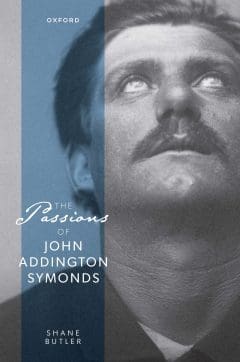
Shane Butler is the Nancy H. and Robert E. Hall Professor in the Humanities and Professor of Classics at Johns Hopkins University, where he also directs the Classics Research Lab and serves as Director of Graduate Studies. He holds a PhD from Columbia University (2000) and has taught at the University of Bristol, UCLA, and the University of Pennsylvania. His research spans Latin literature, classical reception, sensation studies, aesthetics, queer theory, and media history, focusing on the interplay between embodiment and art. Education: PhD in Classics from Columbia University (2000). Prior to Hopkins, he held faculty positions at the University of Bristol, UCLA, and UPenn. He has been a residential fellow at the American Academy in Rome, Villa I Tatti, the Getty Villa, and the MPIWG Berlin. Research focuses on Latin literature from antiquity to early modernity, classical reception theory, and the sensory dimensions of ancient aesthetics. Notable works include The Passions of John Addington Symonds (2022), The Ancient Phonograph (2015), and Sound and the Ancient Senses (2019). He co-edits the Classical Philology special issue on 'Philology Transfigured' and directs the John Addington Symonds Project. Awards include fellowships at leading institutions and editorial roles, including Associate Editor of the I Tatti Renaissance Library. His recent work explores queer philology and the intersection of sound studies with ancient literature.
Vicente Cervera Salinas is a Professor of Spanish Literature at the University of Murcia, affiliated with the Faculty of Arts and Humanities and the Department of Spanish Literature, Literary Theory and Comparative Literature. He has been a full professor since 2004 and specializes in Latin American literature, intertextuality, and literary theory. His research interests include: Spanish and Latin American Literature Comparative Literature and Intertextuality Poetry and the Essay as Literary Genres Classical Mythology and its Modern Reinterpretations Aesthetic Criticism and Cultural Memory Philosophical Dimensions in Literature His scholarly and creative work reflects deep engagement with figures like Jorge Luis Borges, Dante Alighieri, and George Santayana. His publications span poetry, critical essays, and editorial projects, often exploring the intersections between literature, philosophy, and cultural identity. The themes across his recent articles reveal a consistent focus on myth, authorship, and transatlantic literary traditions, particularly in Hispanic contexts. He has received recognition including the Second Prize in the America Poetry Prize (1993). He co-directs the journal Cartaphilus: Revista de investigación y crítica estética and has directed the Humanities Classroom at the University of Murcia. He served as president of the Association of Hispanic American Literary Studies (2014–2018). He has supervised at least one doctoral thesis and has been a visiting professor at institutions in Havana, San José (Costa Rica), Buenos Aires, and Vienna. His academic leadership includes editing multi-volume works on literary figures and movements, contributing significantly to the study of Hispanic intellectual and aesthetic traditions. He leads the research group Plural Scriptures: Intertextuality and Interdisciplinarity , continuing to influence both literary scholarship and creative writing in Spain and Latin America.
Lady Rojas Benavente is an Associate Professor in the Department of Classics, Modern Languages and Linguistics at Concordia University, where she has been teaching since her appointment as Assistant Professor in 1996, with promotion to Associate Professor in May 2003. Prior to joining Concordia, she served as an Assistant Professor at the University of Ottawa and as a lecturer at the Faculty of Education at The University of Western Ontario, where she taught second language methodology, French and Spanish. Dr. Rojas Benavente received her PhD in Hispanic Literature from the University Laval in 1991, following an MA in Spanish Literatures (Cum Laude, 1985) and BA in History and Spanish (1983), both from the University of Ottawa. She also holds a Diploma qualifying as a Secondary School teacher specializing in Spanish Language and Literature, Psychology and Philosophy from the National Pedagogic University of Women in Lima, Peru (Cum Laude, 1968). Her research focuses on Critical Feminism in Peruvian & Latin-American Women Writers, with special emphasis on contemporary Peruvian and Mexican narrative, drama, poetry and essay. Her work encompasses Cultural Studies and Literary and Critical Theories, Latin American History, Post-colonialism, Human Rights, Women Studies, Feminist Theories, Gender Issues, Latin America Black History, Indigenous and Minorities Studies, and Comparative Studies in Education. She has published nine books (two poetry collections and seven critical interpretations) and over 50 refereed papers in Latin American Women's literary work, particularly focusing on Peruvian and Mexican authors. Dr. Rojas Benavente's scholarly output demonstrates consistent engagement with themes of gender, ethnicity, and power structures in Latin American literature. Her recent publications explore the works of contemporary Peruvian women writers, examining how they address issues of violence, racism, and gender in post-independence national contexts. Her research trajectory reveals a deepening focus on decolonial perspectives, indigenous resistance, and the intersection of gender with other social categories. Hispanic Literary and Cultural Institute's Honor Diploma (2010) Publication Award from the University of New Brunswick for the Anthology, Constructing Memory: Latino-Canadian Women Writers in the New Millennium Recognition by Mouvement Desjardins in celebration of International Women's Day (2008) As president of the Society for Literary Criticism of Spanish American Women Writers' work (CCLEH), Dr. Rojas Benavente has facilitated connections between Concordia colleagues, local artists, international writers, and the Latino-Montreal community. She serves on the editorial boards of Alba de America, a literary magazine from the United States, and Voces, a Peruvian cultural magazine. Her leadership extends to organizing numerous conferences on Latin American women writers across Canada, Latin America, and Montreal, including multiple meetings of Hispano-Canadian Women Writers and events commemorating significant figures in Latin American literature.
Stephen M. Hart is a Professor of Latin American Film, Literature and Culture at University College London (UCL), affiliated with the School of European Languages, Culture and Society (SELCS) and the Department of Spanish, Portuguese and Latin American Studies. He is a General Editor at Tamesis Publishers and founder-director of the Centre of César Vallejo Studies at UCL. Education: BA (1980), MA (1984), PhD (1985) from University of Cambridge Academic Career: Lecturer at Westfield College (1984-1990), Associate/Full Professor at University of Kentucky (1991-1998), Senior Lecturer/Reader at UCL (1998-present) Specializing in Latin American literature, film, and culture, Hart has published extensively on César Vallejo and Santa Rosa de Lima, including critical editions of their works. His research spans literary theory, art history, and East-West relations, with a focus on documentary film-making and magical realism as a framework for understanding post-truth narratives. Recent publications address colonial sainthood processes, poetic modernism, and China-Latin America connections. He has directed documentary projects in Cuba since 2006 and received honors including the Order of Merit from the Peruvian Government and Honorary Doctorates from Peruvian institutions. Key Awards: Order of Merit for Distinguished Services (Peruvian Government, 2004), Honorary Doctorate (San Marcos University, 2004), Corresponding Member of Academia Peruana de la Lengua (2014) Leadership Roles: Director of UCL's ESRC DTC (2014), Director of Documentary Film-Making Summer School (Cuba, 2006-present) Teaching: Undergraduate courses on Latin American supernaturalism and cultural dilemmas; MA documentary film-making courses
Raymond B. Craib serves as the Marie Underhill Noll Professor of History and Associate Chair at Cornell University, where he holds core faculty appointments in the Latin American and Caribbean Studies (LACS) program and serves on the LACS Steering Committee. His interdisciplinary work bridges historical scholarship with critical geography and political theory, focusing on spatial dimensions of power and resistance. His academic trajectory includes a BA in History from Eastern Michigan University (1990), an MA in Latin American Studies from the University of New Mexico (1994), and a PhD in History from Yale University (2001). Eastern Michigan University: BA History (1990) University of New Mexico: MA Latin American Studies (1994) Yale University: PhD History (2001) Craib's research interrogates the intersections of space, politics, and everyday practice through frameworks of critical geography, cartography, and radical political subjectivity. His scholarship spans Cultural History, Social History, Comparative and Transnational History, Empires and Colonialism, Historical Geography, and Political Thought, with particular emphasis on Latin America's global connections. He challenges transnational historical orthodoxy by centering the immediacy of place while maintaining global contextual awareness, especially regarding anarchist and leftist movements. His publications reveal a sustained engagement with libertarian and anarchist experiments across the 20th-21st centuries, examining how spatial imaginaries shape political projects from interwar Chile to contemporary Silicon Valley utopianism. Craib's work consistently analyzes the tension between state-centric cartographic control and fugitive landscapes of resistance, connecting historical case studies to modern phenomena like seasteading and digital colonialism. Scientific recognition includes: Global Public Voices fellow (2020-2021) Graduate and Professional Teaching Prize As an active educator and researcher, Craib mentors graduate students in historical methodology and supervises theses exploring spatial history and radical politics. His collaborative projects, such as the 2020-21 fellowship with José Ragas of Universidad Católica (Chile), demonstrate international scholarly engagement. Craib maintains deep institutional connections across Cornell's interdisciplinary landscape, contributing to the Latina/o Studies Program and Romance Studies department while leading innovative courses like 'Starting Your Own Country: From Utopia to the Network State.' His research methodology combines extensive multi-archival work across Latin America, the Caribbean, and Pacific Islands with critical theoretical frameworks.
Jaime Rodriguez Matos is an Assistant Professor in the Department of Modern and Classical Languages and Literatures at California State University, Fresno, where he has been employed since 2018. His academic career includes prior roles as Lecturer at Fresno State (2016-2018) and Assistant Professor at the University of Michigan (2007-2016). Education: Ph.D., Spanish and Portuguese, Columbia University M.Phil., Spanish and Portuguese, Columbia University M.A., Spanish and Portuguese, Columbia University B.A., Spanish Language and Literature, University of New Hampshire Rodriguez Matos specializes in Latin American poetry, nihilism, infrapolitics, and temporal theory. His work interrogates the intersections of philosophy and literary form, particularly focusing on the deconstruction of time in works by José Lezama Lima, Eduardo Lalo, and Álvaro García Linera. Current research explores neo-revolutionary rhetoric and anarchic political thought in Latin America. His published and forthcoming articles address themes such as Lacanian critiques of hegemony, the ontologies of the present, and the formless in Caribbean politics. Rodriguez Matos has presented at international conferences including the Latin American Studies Association and the University of California, Irvine Humanities Commons cluster. Selected Publications: Writing of the Formless: José Lezama Lima and the End of Time (Fordham University Press, 2017)
Martin Nesvig is a Professor at the University of Miami in the Department of History, College of Arts and Sciences. He serves as Director of Undergraduate Studies and Co-Faculty Lead for Mexico and Mesoamerica in the University of Miami’s Interdisciplinary Programs (UMIA). His research focuses on colonial Latin America, particularly religious hybridism, inquisitorial systems, and decentralized power structures in Michoacán. University of Miami, College of Arts and Sciences Department of History Director of Undergraduate Studies Mexico and Mesoamerica Co-Faculty Lead Nesvig's scholarship interrogates the complexities of religious syncretism, bureaucratic conflict, and cultural negotiation in colonial Mexico. His work challenges traditional narratives of 'spiritual conquest' by highlighting the mutual adaptation between Spanish and indigenous communities, emphasizing the role of hallucinogenic rituals, vernacular scripture, and micro-imperial governance in shaping colonial religious practices. His 2010 Charles A. Ryskamp Research Fellowship supported his project on frontier religion in Michoacán, analyzing how Spanish clergy and laity adopted indigenous practices. His publications span topics from peyote use in Catholic rituals to the political implications of prohibited books and the dynamics of postcontact cultural liminality. Notable Works: Promiscuous Power: An Unorthodox History of New Spain , Peyote, Ever Virgin: A Case of Religious Hybridism in Mexico Awards: Charles A. Ryskamp Research Fellowship Nesvig’s research reveals a colonial state perpetuated through bureaucratic litigation rather than violence, with his irreverent historiographical style challenging academic conventions. His students and colleagues engage with his critical perspectives on power, religion, and cultural identity in early modern Latin America.
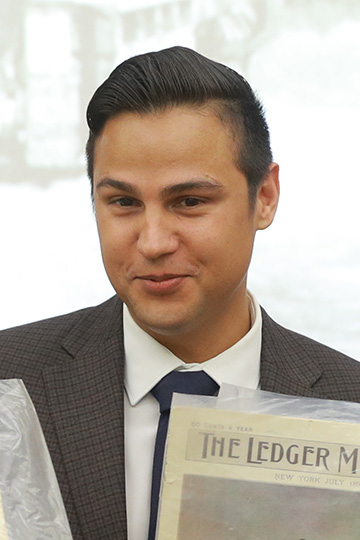
Ayendy Bonifacio is a Dominican American scholar, writer, and poet currently serving as Assistant Professor of English at the University of Toledo's College of Arts and Letters. Born in Santiago De Los Caballeros, Dominican Republic, and raised in East New York, Brooklyn, he earned his Ph.D. from Ohio State University and has established himself as a significant voice in American literature, Latine studies, and diaspora studies. His research focuses on the intersections of memory, migration, race, and colonial legacies in the Americas, with particular attention to nineteenth-century to contemporary print culture. Bonifacio's scholarly work bridges academic and public discourse, appearing in venues ranging from American Periodicals and ASAP/Journal to The New York Times and Slate . He explores how literary forms negotiate cultural identity across borders, with special emphasis on Dominican and Latinx experiences. Bonifacio's publications reveal a consistent trajectory examining transnational literary connections, particularly between Anglophone and Hispanophone traditions. His work frequently addresses anti-Blackness within Latinx communities, diasporic identity formation, and the material history of print culture. The 2024 monograph Paratextuality in Anglophone and Hispanophone Poems in the U.S. Press, 1855–1901 represents a significant contribution to understanding how multilingual poetry circulated in nineteenth-century American periodicals. Top ten best non-fiction books of 2017 (The Latino Author for Dique Dominican ) Bonifacio's writing has received support from prestigious organizations including the National Endowment for the Humanities (NEH), the Digital Media and Composition Institute (DMAC), the Ohio Arts Council, and the Society for Nineteenth-Century Americanists. His creative work spans multiple genres, including the memoir Dique Dominican (2017), poetry collection To the River, We Are Migrants (2020), and the forthcoming novel Bless Me, Papi (2025). He maintains an active presence in public intellectual discourse through contributions to major media outlets where he addresses contemporary issues of race, immigration, and academic labor.