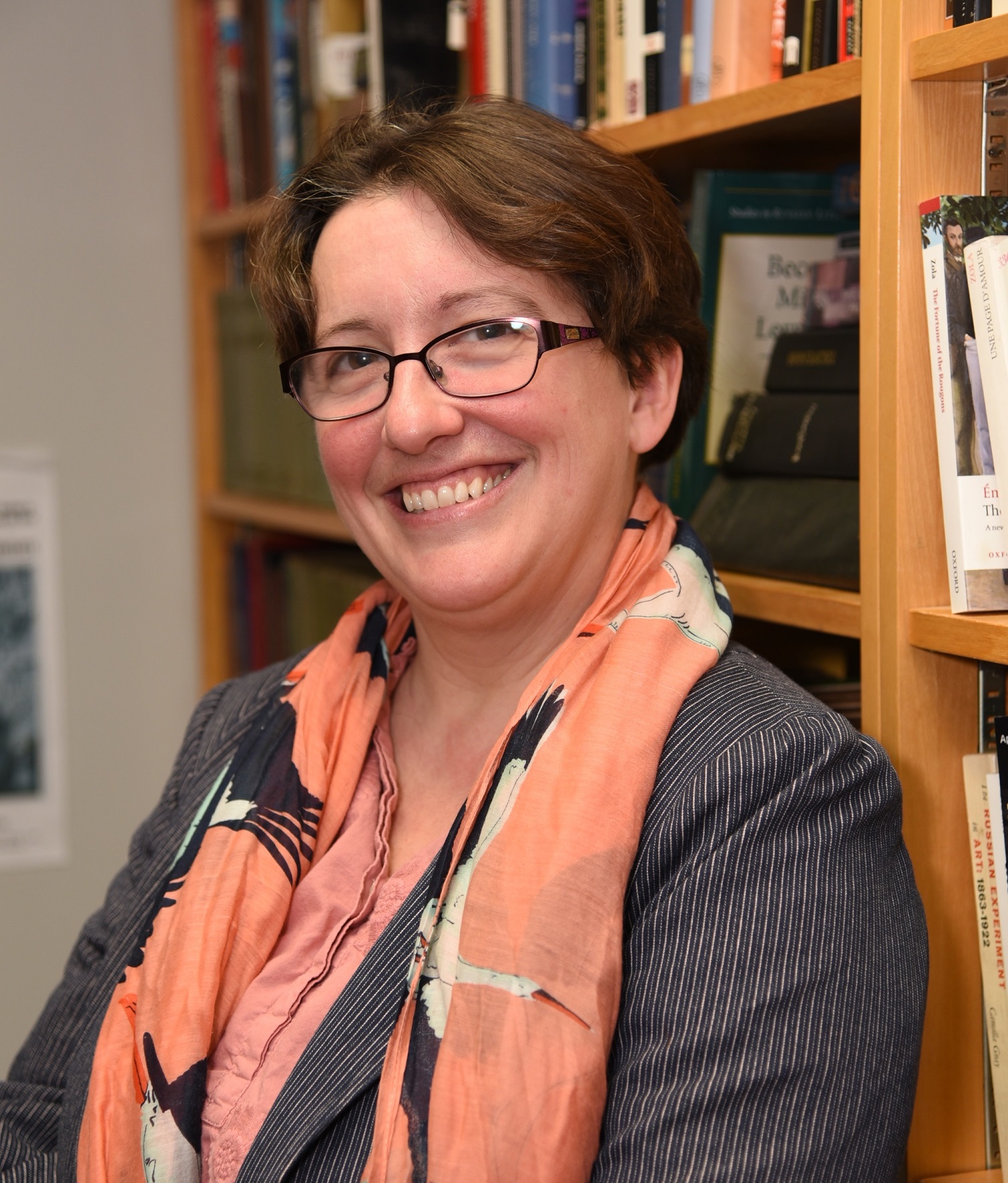
Kate Holland is an Associate Professor and Acting Associate Chair (Graduate) at the University of Toronto, specializing in 19th-century Russian literature and its cultural contexts. Her work focuses on the history of the novel, Russian literary theory, and the interplay between Russian and European literary traditions. She teaches courses such as 'The Golden Age of Russian Literature' and 'Dostoevsky in Literary Criticism and Theory.' Dr. Holland earned her PhD from Yale University (2004) and a BA/MA from the University of Cambridge (1998). Her research explores themes like genre evolution in Dostoevsky’s works, the publication culture of 19th-century Russian periodicals, and the theoretical frameworks of Historical Poetics. Her recent publications include A Dostoevskii Companion: Texts and Contexts (2018) and The Novel in the Age of Disintegration (2013), analyzing Dostoevsky’s engagement with genre and modernity. Her scholarship frequently examines narrative form, cultural history, and the intersection of literature with philosophical and religious thought.
Harsha Ram is an Associate Professor in the Department of Comparative Literature at the University of California, Berkeley. His research focuses on Russian and European Enlightenment, modernist literature, and the cultural histories of the Caucasus region. He holds dual B.A. Honors degrees in Italian and Russian from the University of Sydney and University of New South Wales, and a Ph.D. in Comparative Literature from Yale University. His work bridges literary theory, post-colonial studies, and geopoetics, with a particular emphasis on Georgia's literary modernism and its intersections with Russian imperial culture. Key themes include spatial theory, peripheral modernisms, and the transnational dimensions of cultural production. Recent work examines the role of ritual feasts in Georgian national identity and the geopoetics of Eurasian avant-garde movements. Ram has published extensively on figures like Velimir Khlebnikov and Boris Pasternak, exploring their engagement with imperial legacies and revolutionary aesthetics. His book The Imperial Sublime: A Russian Poetics of Empire (2003) remains a seminal study of Russian imperial poetics. Current projects include studies on Georgian literary encounters with Russian culture and the symbolic dimensions of Caucasus representations. His scholarship frequently appears in leading journals such as Modernism/Modernity , Slavic Review , and Ab Imperio . He has held visiting positions at institutions globally and actively participates in interdisciplinary dialogues between literary studies, history, and cultural geography.
Prof. Dr. Alexander Stroh-Steckelberg is Professor of Political Science with a focus on African Politics & Development Policy at the University of Bayreuth since 2022. He serves as Deputy Head of the Bayreuth International Graduate School of African Studies (BIGSAS) until 2025 and has held prior roles as Junior Professor and Senior Fellow at BIGSAS (2015–2021). His academic career includes research associate positions at the GIGA German Institute of Global and Area Studies (2006–2015) and teaching roles at the Universities of Abomey-Calavi, Heidelberg, and Lüneburg. Stroh-Steckelberg’s research spans comparative democracy studies , judicial politics , electoral systems , political party dynamics , and development policy in Africa, with regional expertise in Francophone West Africa and Rwanda . His work emphasizes institutional diffusion, informal networks in courts, and the interplay between formal and informal governance structures. Recent publications reveal a focus on judicial appointment policies , electoral manipulation , and local governance challenges across Africa. He contributes to methodological advancements in comparative area studies and network analysis , particularly in non-Western democracies. Stroh-Steckelberg is actively involved in academic communities including the American Political Science Association , German Political Science Association , and Association for African Studies in Germany .
Christopher P. Atwood is a Professor of Mongolian and Chinese Frontier and Ethnic History and Department Chair of East Asian Languages and Civilizations at the University of Pennsylvania. He holds a PhD from Indiana University's Central Eurasian Studies Department. His research focuses on the interplay of culture, political power, and historiography in Mongol and Inner Asian contexts. Atwood's work spans topics such as Mongol nationalism, Yuan dynasty historiography, and the socio-economic history of nomadic societies. Education: AB from Harvard University (1986), PhD from Indiana University (1994). He previously taught at Indiana University for two decades, serving in administrative roles. His affiliations include visiting scholar positions at institutions like the Institute for Advanced Study (Princeton) and Peking University. Research interests include environmental history (e.g., marmot-human relations), political dynamics (e.g., Mongol empires and comparative imperial formations), and literary studies (e.g., Mongolian poetry and textual canonization). He has authored works like the Encyclopedia of Mongolia and the Mongol Empire and collaborates on projects such as the Sources of Mongolian Tradition . Teaching includes courses on Inner Asian civilizations, the Mongol Empire, and the Secret History of the Mongols . He emphasizes interdisciplinary approaches, blending philology, environmental history, and cultural analysis to reconstruct nomadic and steppe societies.
Celâl Sengör serves as Professor of Geology at Istanbul Technical University since 1992, following prior roles as Reader (1986-1992) and Lecturer (1981-1986) in the same department. His international experience includes Visiting Research Fellow at the University of Oxford's Department of Earth Sciences (1989), Visiting Scientist at the Lunar and Planetary Institute (1984-1985), and Research Assistant at the University of Houston (1975-1976). He earned all academic degrees from the State University of New York: Bachelor's (1978), Master's (1979), and PhD (1982). Professor Sengör's research centers on continental formation mechanisms , regional tectonics , seismotectonic processes , and Asian plate dynamics . His work integrates field geology with theoretical models to reconstruct Earth's crustal evolution, particularly focusing on the complex deformation history of Eurasia. This research has established fundamental frameworks for understanding mountain belt formation and continental collision zones. His exceptional contributions are recognized by numerous prestigious honors: Mary C. Rabbitt Award (Geological Society of America, 2017) Membership in Leopoldina National Academy of Sciences (2012) Gustav Steinmann Medal (Geological Union, 2010) Gordon W. Moore Distinguished Scholar at Caltech (2001-2002) Election to US National Academy of Sciences (2000) Bigsby Medal (Geological Society of London, 1999) Membership in Société Géologique de France (1994) Honorary membership in Austrian Geological Society (1990) Fellowship in Geological Society of America (1988) Honorary doctorate from Université de Neuchatel (1988) Foreign membership in American Philosophical Society, US National Academy of Sciences, and Russian Academy of Sciences Professor Sengör has held significant leadership roles including President of the Earth Sciences Society of Turkey (2005) and Chairman of the History of Geology Division at the Geological Society of America (2001-2002). While his academic supervision and grant activities aren't detailed in available records, his institutional leadership demonstrates substantial influence in global geological communities. His current research continues to advance tectonic theory through comparative analysis of continental collision zones worldwide.
Fabio Franceschi is an Associate Professor of Ecclesiastical Law, European Ecclesiastical Law, and Law and Religion at the Faculty of Law, Sapienza University of Rome. He teaches courses including Diritto Ecclesiastico (Ecclesiastical Law), Diritto Ecclesiastico Europeo (European Ecclesiastical Law), and Law and Religion. His institutional affiliation is with the Department of Legal and Economic Studies at Sapienza University of Rome. Franceschi's research interests focus on ecclesiastical law and the relationship between law and religion in contemporary society, the history of relations between State and Church in Italy (particularly in pre- and post-unification periods), canon law, and intercultural law. His work examines religious freedom, secularism, religious confessions, and the legal frameworks governing religious institutions in increasingly multicultural and multireligious societies. His publication record includes over 60 academic works in Italian and English, with his most notable contribution being the 'Compendium of Ecclesiastical Law,' which has gone through multiple editions. His recent scholarship addresses contemporary issues such as religious freedom in MENA countries, end-of-life decisions from religious perspectives, and the financial operations of religious institutions. Franceschi is actively involved in research groups including 'DiReSom (Law and Religion in Multicultural Societies)' and the executive committee of the interdisciplinary research center 'ORFECT - Observatory on Religious Freedom in the Jurisprudence of the European Court of Human Rights.' He also coordinates the research group 'Tradizioni religiose, diritti umani e diritto interculturale' (Religious Traditions, Human Rights and Intercultural Law). He serves on the scientific committee of the legal journal 'SudEuropa. Quadrimestrale di civiltà e cultura europea' and the editorial board of 'Il Diritto ecclesiastico.' His teaching materials for attending students are available on the university's E-Learning platform, and he maintains regular office hours for student consultations.
Simon King is a Professor of Speech Processing at the University of Edinburgh , affiliated with the School of Philosophy, Psychology and Language Sciences . He serves as Director of the Centre for Speech Technology Research (CSTR) and teaches courses like Speech Processing and Speech Synthesis , while directing the MSc in Speech and Language Processing . Research Interests His research focuses on: Developing new acoustic models (e.g., Linear Dynamical Models, factorial-HMMs) for speech recognition Advancing unit selection and HMM-based speech synthesis Integrating articulatory measurement data for enhanced modeling Exploring perceptual measures in synthesis criteria Building multilingual speech systems to identify universal speech building blocks Publication Trends Simon's recent work emphasizes deep learning (DNNs, LSTMs) in speech synthesis, multilingual frameworks , and articulatory-acoustic feature integration . His studies often bridge grapheme-based modeling , perceptual error reduction , and noise-robust synthesis . Scientific Awards EPSRC Advanced Research Fellowship (2005-2009) Students & Collaborations He has supervised numerous PhD students including Rasmus Dall, Tom Merritt, and Srikanth Ronanki. Current research fellows like Mirjam Wester and Zhizheng Wu contribute to projects such as Natural Speech Technology (NST) and Simple4All .
Professor Dan Meagher is a Chair in Law at Deakin University's Faculty of Business and Law, where he leads research in constitutional law and statutory interpretation. He serves as Director of Research at Deakin Law School and actively contributes to legal scholarship through publications, editorial work, and supervision of doctoral candidates. Doctor of Philosophy, University of New South Wales Master of Laws, Monash University Bachelor of Economics, Monash University Bachelor of Laws (LLB), Monash University His research focuses on constitutional law, statutory interpretation, and human rights protections. He explores the principle of legality, responsible government norms, and the interplay between common law and statutory frameworks, often advocating for enhanced rights protections through judicial interpretation. Professor Meagher's scholarly output highlights trends in Australian constitutionalism, including proportionality in secondary legislation, non-discrimination principles, and the evolution of common law rights. His work bridges doctrinal analysis with practical implications for legislative drafting and judicial review. Elected Fellow of the Australian Academy of Law Comments Editor for the Public Law Review Director of Research at Deakin Law School He supervises doctoral research on topics like human rights protection and legislative drafting models. His professional activities include co-editing major legal texts and contributing to debates on constitutional evolution and judicial interpretation.
Susan Fino is a Professor at the College of Liberal Arts and Sciences, Wayne State University. Her research focuses on public law, American constitutional law, administrative law, and the role of state supreme courts. She holds a B.A. from Johns Hopkins University, an M.A. and Ph.D. from Rutgers University. She has received the President's Award for Excellence in Teaching. Her courses include American Government (PS1010) and Constitutional Law (PS5110/PS5120), taught across multiple terms from 2023 to 2025. Dr. Fino's research explores judicial federalism, state constitutional frameworks, and legal interpretations of rights. Her work analyzes topics like church-state relations, taxation provisions in state constitutions, and assisted suicide debates. She has written extensively on state supreme court dynamics, including landmark cases and institutional performance metrics. Her scholarship bridges legal theory with practical governance challenges at both state and federal levels. Her publications span over three decades, addressing evolving legal landscapes such as the Rehnquist Court’s federalism approach and technological impacts on criminal sentencing. She consistently engages with issues at the intersection of law, politics, and societal values.
Nancy Margaret Reid is a University Professor of Statistical Sciences at the University of Toronto, holding the Canada Research Chair in Statistical Theory and Applications. She has served as Scientific Director of the Canadian Statistical Sciences Institute (2015–2019) and led the Department of Statistical Sciences as Chair (1997–2002). Her research focuses on theoretical statistics, particularly likelihood inference and foundational aspects of statistical methodology. Reid earned her PhD from Stanford University (1979) under Rupert G. Miller, with Brad Efron and Vernon Johns on her committee. Reid's accolades include Fellowships from the Royal Society, Royal Society of Canada, and National Academy of Sciences, as well as the Guy Medal in Gold (2022) and David R. Cox Award (2023). She has authored influential books like *Theory of the Design of Experiments* and contributed to courses on mathematical statistics and likelihood inference. Active in academic service, she teaches graduate-level courses and has advised numerous students and postdocs in theoretical and applied statistical research.
Tanya Trussler is Associate Professor in the Department of Economics, Justice, and Policy Studies at Mount Royal University. Her research examines structural determinants of violent crime, policing practices, crime prevention strategies, and public perceptions of criminal justice systems. Research explores police-community relations across different contexts, including recent projects on rural versus urban policing perceptions in Alberta and religious influences on policing in Pacific Island countries. Methodologically specializes in survey research and comparative analysis. Recipient of multiple research grants including from Immigration, Refugees and Citizenship Canada, and British Columbia's Crime Reduction Research program. Actively presents findings at major conferences including Congress of the Humanities and Social Sciences.
Joselyn Muhleisen serves as a Lecturer in the Department of Public Affairs at the Marxe School of Public and International Affairs, Baruch College, City University of New York. She teaches core courses including Citizenship and Public Affairs, Comprehensive Public Policy & Administration, and capstone seminars in Public and International Affairs, with active teaching assignments extending through Spring 2025. Her academic foundation includes: PhD in Political Science, The Graduate Center, CUNY (2016) MPhil in Political Science, The Graduate Center, CUNY MA in European Union International Relations and Diplomacy, College of Europe Brugge, Belgium BS in Public Affairs and English, Baruch College Dr. Muhleisen's research centers on international regimes, regulatory politics, and global governance , with specialized expertise in trade/financial regulation within transatlantic frameworks. Her scholarship critically examines EU-US regulatory convergence, Brexit's implications for global finance, and the institutional dynamics of international organizations. She has established herself as a leading voice in comparative policy analysis through foundational texts and systematic field reviews. Her 2016-2020 publications reveal a cohesive scholarly trajectory focused on advancing methodological rigor in comparative policy studies. The works collectively analyze historical evolution, theoretical frameworks, and cross-national applications of policy analysis, with particular emphasis on European and transatlantic contexts. This body of work demonstrates consistent engagement with both classical scholarship and contemporary developments in governance studies. Her honors include: Fulbright Study Grant to European Union (2007-2008) Getting to Know Europe Grant (European Commission) Doctoral Student Research Grant (2011) 23rd Street Scholarship for Excellence in Public Affairs (2007) Alfred Zweifach Award (2007) Colin Powell Fellowship (2007) Grant for Internship Travel to Romania (2005) USA Today Best and Brightest Nomination (2005) As Faculty Advisor since 2015, she mentors honors students and serves on multiple committees including the Excelsior Service Fellowship Committee and Undergraduate Honors Program Committee. Her grant portfolio features significant research funding including Fulbright and European Commission support for transatlantic regulatory studies. She actively contributes to academic governance through the Journal of Comparative Policy Analysis Award Committee and International Comparative Policy Analysis Forum leadership. She maintains active collaboration with the International Comparative Policy Analysis Forum as an officer and regularly presents at major conferences including the European Union Studies Association. Her research network includes prominent scholars like Iris Geva-May and Diane Hoffman, with ongoing projects examining post-Brexit financial governance structures.
Mulki Al-Sharmani is a Professor at the University of Helsinki, affiliated with the Faculty of Arts and the Department of Cultures (specializing in Middle Eastern Studies). Her research focuses on Islamic feminism, Muslim family law, gender studies, and transnational migrant communities. She examines how religious texts and practices intersect with legal frameworks and social dynamics in contexts like Egypt, Finland, and the Somali diaspora. Her work includes analyzing Islamic legal reform, gender equality in marriage, and the lived experiences of Muslim women. Key publications explore Qur'anic hermeneutics, the role of feminist activism in legal change, and the wellbeing of transnational families. She has contributed to projects like 'Reclaiming Adl and Ihsan in Muslim Marriage' and co-edited volumes on Islamic ethics and family law reform. Research interests: Islamic feminist theory, Middle Eastern legal traditions, transnational family dynamics, and religious praxis. Recent articles highlight themes like Qur'anic ethics of marriage, legal pluralism in Finland, and the political dimensions of Egyptian family law reform. Active in international conferences, including presentations at SOAS University of London, American University in Cairo, and panels on Islamic law and gender at venues like MESA and EASR. Involved in interdisciplinary initiatives such as the Africa Research Forum and Musawah's global network for equality in Muslim family laws.
Jonathan R. Lyon is Professor of History of the High and Late Middle Ages at the Institute for Austrian Historical Research within the Faculty of Historical and Cultural Studies at the University of Vienna. He maintains office hours on Thursdays from 14:00-16:00 (available via Zoom by appointment) and can be contacted at jonathan.lyon@univie.ac.at or +43-1-4277-27297. His educational background includes: B.A. in History and Latin, Colgate University (1997, Summa cum laude) Exchange year at Albert-Ludwigs-Universität Freiburg (1996) M.A. in History, University of Notre Dame (1999) Ph.D. in History, University of Notre Dame (2005) Lyon's research centers on the Holy Roman Empire during the High and Late Middle Ages, European political and social structures (1000-1500), the evolution of statehood, corruption mechanisms, medieval kinship systems, and gender dynamics with particular emphasis on masculinity. His work examines how political power, social networks, and religious institutions intersected in shaping medieval governance and community life, often challenging traditional narratives about medieval state formation through comparative analysis of German and Hungarian contexts. Analysis of his 15 most recent publications reveals consistent chronological focus on the 12th-15th centuries with increasing attention to corruption, gender, and monastic institutions since 2015. His scholarship demonstrates methodological diversity through charter analysis, prosopography, and comparative institutional studies, while maintaining thematic continuity in examining power dynamics between nobility, monarchy, and religious entities across Central Europe. His major scientific awards include: 2024 Otto Gründler Book Prize for Corruption, Protection and Justice in Medieval Europe: A Thousand-Year History 2017 John Nicholas Brown Prize for Princely Brothers and Sisters: The Sibling Bond in German Politics, 1100–1250 Lyon has secured prestigious research funding including the Fulbright Fellowship (2000-2001), DAAD Research Fellowship (2007), FWF Lise Meitner Fellowship (2013-2014), and Alexander von Humboldt Research Fellowship (2017-2018). He served as Academic Director of the Berlin Consortium for German Studies (2012-2013) and currently advises the Manchester Medieval Sources Series. His ongoing projects include editing charters of Quedlinburg abbesses and authoring an introductory text on the medieval Holy Roman Empire.
Norman M. Naimark serves as the Robert & Florence McDonnell Professor of East European Studies and Professor of History at Stanford University, with courtesy appointments in German Studies. He holds senior fellowships at both the Hoover Institution and Freeman Spogli Institute for International Studies, and is affiliated with The Europe Center and the Center on Democracy, Development and the Rule of Law. Education: Ph.D. in History, Stanford University (1972) Naimark specializes in Soviet-era Eastern European history, with dual research pillars: Soviet policies in post-WWII Europe and 20th-century genocide/ethnic cleansing phenomena. His work bridges historical analysis with contemporary human rights discourse, emphasizing geopolitical power dynamics and systematic violence against civilian populations. Methodologically, he combines archival rigor with comparative frameworks across national contexts. His publication trajectory from 1979–2019 reveals evolving focus from Marxist movements in partitioned Poland to Soviet occupation mechanics, culminating in comprehensive genocide studies. The 2019 monograph on Stalin's postwar European sovereignty struggles synthesizes decades of research into Soviet imperial practices. Scientific awards: Officer's Cross of the Order of Merit of the Federal Republic of Germany (1996) Richard W. Lyman Award for outstanding faculty volunteer service (1995) Stanford Dean's Teaching Award (1991-92, 2002-3) Naimark's academic leadership includes directing Stanford's Global Studies Division, Bing Overseas Studies Program, and Center for Russian, East European, and Eurasian Studies. His research informs current policy discussions on authoritarianism and democratic resilience, as evidenced by recent engagements with Belarusian democracy movements and U.S.-Russia relations. He collaborates extensively through Stanford's interdisciplinary centers, particularly contributing historical perspectives to The Europe Center's sovereignty research and the Center on Democracy, Development and the Rule of Law's governance initiatives.