Monika Gabryś-Sławińska is a Professor at the Department of Polish Literary History , part of the Faculty of Languages, Literatures and Cultures at the University of Maria Curie-Skłodowska (UMCS). Her research spans 19th- and 20th-century Polish literature , focusing on Stefan Żeromski , historical journalism , text editing , voice emission , and museology . MA in Polish Philology (1998, UMCS) PhD in Literary Studies (2007, UMCS) Habilitation in Literary Studies (2016, UMCS) Her research interests include political commentary in historical press , media's role in cultural identity , and sociolinguistic trends . She has edited over 29 academic volumes and authored 5 monographs. Scientific awards: Bronze Cross of Merit KEN Medals (Bronze, Silver) 8 Rector's Awards (UMCS) Lublin Mayor's Medal (2019) She has participated in 5 research grants , organized 35 academic conferences , and contributed extensively to Annales UMCS as a scientific editor.
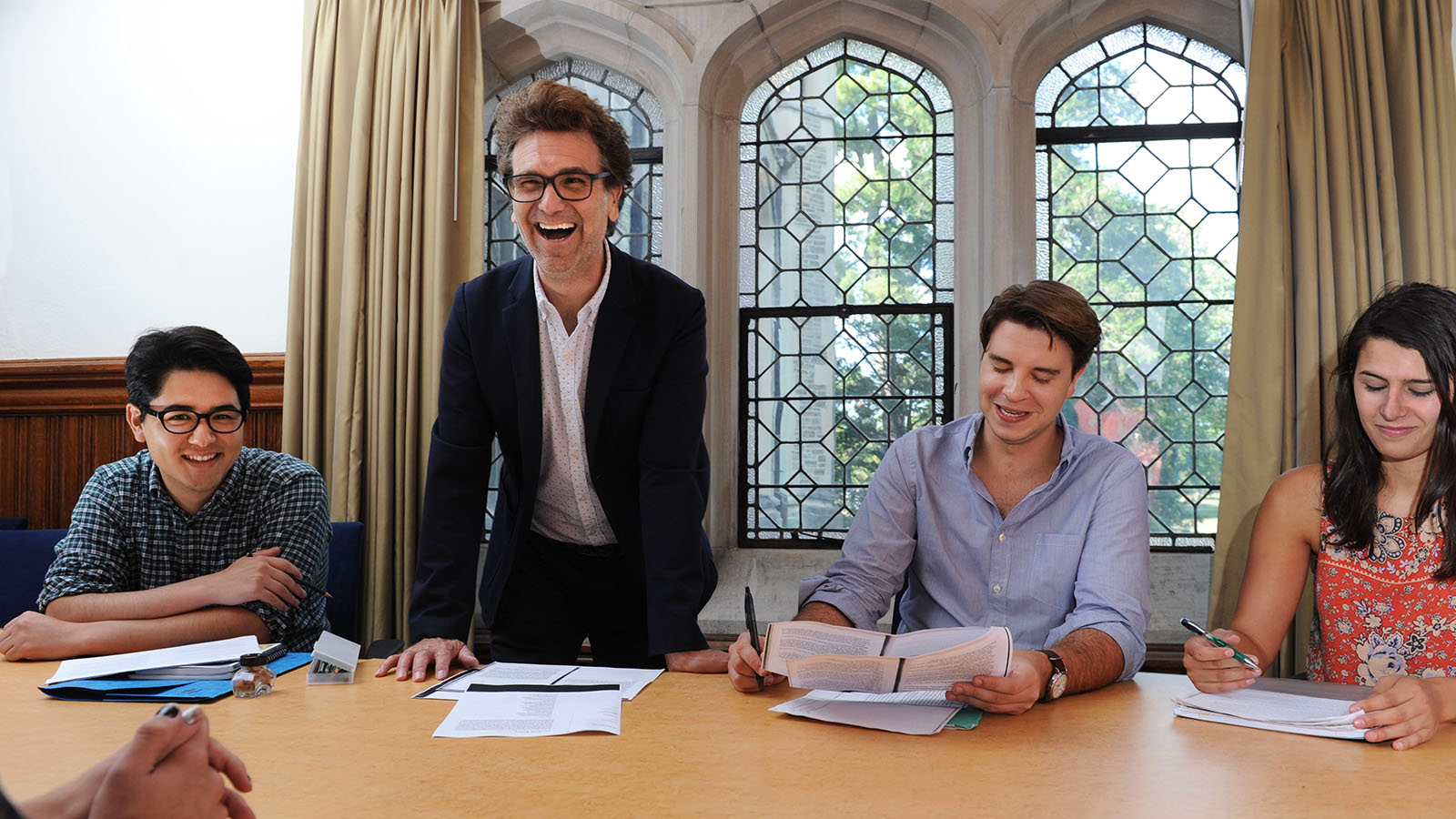
David Means is a Visiting Associate Professor of English at Vassar College, where he has taught since 2001. He holds a BA from The College of Wooster and an MFA in poetry from Columbia University. His academic work centers on creative writing, modern and contemporary fiction and poetry, and American culture. Education: BA, The College of Wooster MFA, Columbia University in the City of New York Means is a celebrated author of short fiction and novels, known for his lyrical prose, experimental narrative structures, and deep exploration of trauma, memory, and redemption. His work frequently appears in The New Yorker , Harper’s , The Paris Review , and other prestigious literary journals. His writing often returns to themes of violence, loss, and the quiet grace that emerges in their aftermath, drawing comparisons to Flannery O’Connor and Denis Johnson. His stories are marked by a nonlinear sense of time and a profound empathy for marginalized or broken characters. His recent publications include the story collection Instructions for a Funeral (2019) and Two Nurses, Smoking , with his novel Hystopia longlisted for the Man Booker Prize. His forthcoming non-fiction book, Pivot: Ruminations in the Shadow of Death , reflects on mortality and personal reflection. Selected Awards and Honors: Guggenheim Fellowship (2013) Three O. Henry Prizes Three Pushcart Prizes Los Angeles Book Prize for Fiction Finalist, National Book Critics Circle Award Finalist, Frank O’Connor International Short Story Prize Longlisted, Man Booker Prize Means has advised and influenced many emerging writers through his teaching and public readings. While specific students are not named in the sources, his role as a mentor is evident in his sustained presence in creative writing programs. He has no known research grants or lab affiliations, as his work is primarily literary and individual. He continues to publish and engage in public discourse on the nature of storytelling, including critiques of AI-generated fiction.
Qianwen Wang is a tenure-track Assistant Professor in the Computer Science department at the University of Minnesota, Twin Cities. Her research combines interactive visualization with interpretable machine learning to foster intuitive, efficient, and reliable Human-AI collaboration. She actively seeks motivated students, research assistants, and interns to join her dynamic research team at UMN CS. Dr. Wang's research focuses on three primary themes: Human-AI Collaboration, where she designs tools to facilitate Human-AI interaction; Automatic & Intelligent Visualization, where she develops techniques to make visualizations accurately interpreted and easily used; and VIS+(X)AI in Biomed/Healthcare, where she studies how visualization and explainable AI can promote scientific discoveries in biomedicine and healthcare. Her work has made significant contributions to visualization, human-computer interaction, and bioinformatics, with particular applications in biomedical knowledge graphs and single-cell omics analysis. Her recent publications demonstrate a strong trend toward integrating visualization with large language models and graph neural networks for biomedical applications. She has published extensively at top venues including IEEE VIS, ACM CHI, and Nature Medicine, with a focus on making AI systems more interpretable and useful for domain experts, particularly in healthcare contexts. Her work often bridges theoretical advances in visualization with practical applications in genomics and healthcare. Two IEEE VIS Honorable Mention Awards (2022, 2024) Best Paper Award from IMLH@ICML 2021 Two Best Abstract Awards from BioVis ISMB (2021, 2022) HDSI Postdoctoral Research Fund Award Research covered by MIT News and Nature Technology Features Dr. Wang actively contributes to the academic community through service roles including General Chair for ISMB BioVis, VisNotes and Poster Chair for IEEE PacificVis, and Program Committee member for IEEE VIS, ACM CHI, and ACM IUI. Her research has been supported by various grants that enable her team to develop innovative visualization techniques and explore their practical applications in biomedical domains. Her research group maintains an active presence in the visualization and HCI communities, with members participating in major conferences and workshops. The lab focuses on creating tools that bridge the gap between complex AI models and human understanding, with particular emphasis on making these technologies accessible and useful for domain experts in biomedical research.
Oleksandr Kapranov is an Associate Professor of English at NLA University College's Teacher Education program. His work intersects discourse analysis, climate change communication, and English language teaching (ELT), with a focus on sustainable development education and intercultural communication. Research areas include political speeches (e.g., Keir Starmer, Rishi Sunak), corporate disclosures (Bank of England, Vedanta Resources), and media framing (Greenpeace branches, King Charles III). Key pedagogical interests: digital competence, beginner EFL training, and discourse markers in academic writing. His recent publications analyze climate change discourse through syntactic structures, metonymy, modality, and evidentiality, emphasizing institutional and political narratives. While no formal awards are listed, his work spans interdisciplinary collaborations with NGOs, governments, and universities.
Joep Cornelissen holds a part-time Chair in Strategy and Organization at the University of Liverpool Management School and is a Professor of Corporate Communication and Management at Rotterdam School of Management, Erasmus University. His academic career spans strategic management, organizational theory, and corporate communication. His research interests center on processes of strategizing and organizational change, with a particular focus on innovation, entrepreneurship, and the development of scientific reasoning within management and organization theory. He actively collaborates with entrepreneurs and managers from diverse sectors, including regional development agencies, corporations, NGOs, and startups, to ensure the practical relevance of his work. Currently, he is leading a multi-year project on corporate purpose and sustainability, seeking partnerships in the Liverpool city region and beyond. Professor Cornelissen’s publications reflect a commitment to advancing theoretical and methodological rigor in management studies. Recent work explores the interplay between communication, strategy formulation, and organizational change, while also addressing critical methodological questions such as theoretical triangulation and causal mechanisms. His contributions span both empirical studies and methodological debates, emphasizing the practical implications of organizational research. While specific grants or advising students are not detailed here, Professor Cornelissen collaborates extensively with various organizations to enhance the applied relevance of his research, particularly in the realm of corporate sustainability and strategic change. He is affiliated with the Brett Centre for Entrepreneurship, contributing to research initiatives that bridge academic inquiry and practical business challenges.
Deborah Fox is Associate Professor in Midwifery at the University of Technology Sydney (UTS), Faculty of Health, and a core member of the Centre for Midwifery, Child and Family Health. She serves as Co-lead of the Maridulu Budyari Gumal SPHERE Maternal and Women's Clinical Theme and Chair of the National Publicly Funded Homebirth Consortium. In 2024, she received the Faculty of Health Dean's Academic Excellence Award for Research (Mid Career Researcher), following her 2021 award as Highest Performing Early Career Researcher from the School of Nursing and Midwifery. Her research focuses on optimizing physiological processes and positive experiences for women with complex pregnancies, with particular emphasis on the mediation of technology in midwifery practice. Current projects include evaluation of non-invasive fetal ECG beltless and wireless fetal monitoring in labor and birth, and examining the social, economic and environmental impacts of telemonitoring and telehealth in pregnancy and postpartum care. Dr. Fox's scholarly work demonstrates consistent focus on technology's role in maternity care, women's experiences of monitoring during labor, and innovative approaches to midwifery practice. Her recent publications show increasing emphasis on digital health solutions, AI applications in women's health, and pandemic impacts on maternal care systems globally. Faculty of Health Dean's Academic Excellence Award for Research (Mid Career Researcher) 2024 Highest Performing Early Career Researcher award from School of Nursing and Midwifery 2021 Editorial Board Member, Women and Birth journal Dr. Fox is actively involved in higher degree research supervision and has developed innovative teaching resources, including an Objective Structured Clinical Examination for perinatal mental healthcare. She is scheduled to spend three months as a Visiting Scholar at the University of Oxford in 2025.
Lena Berggren serves as an Associate Professor in the Department of Historical, Philosophical and Religious Studies at Umeå University, Sweden, with her office located in Humanisthuset (HUM.H.125), Umeå. She holds the title of Docent and has been honored as a Distinguished university teacher for exceptional pedagogical contributions. Her academic qualifications include the Swedish Docent credential (a post-doctoral habilitation) and recognition as a Distinguished university teacher, reflecting dual expertise in research and education. Berggren's research centers on Swedish fascism, antisemitism, and ultra-nationalism during the interwar period, with specific focus on clerical fascism intersections with Lutheranism and völkisch thought. She simultaneously advances university pedagogy through investigations into scientific methodology development and assessment strategies for students, creating a unique bridge between historical scholarship and educational innovation. Analysis of her publication trajectory reveals persistent examination of extremist ideologies' historical roots and modern manifestations, culminating in her 2024 co-authored book '100 år av svensk nazism' which directly addresses contemporary far-right movements in Sweden. Her scientific recognition includes: Distinguished university teacher award Berggren secured research funding for the project 'Swedish fascism 1920-1950' (2007-2008), demonstrating sustained investigative focus. While no formal advisee list is documented, her pedagogical publications indicate active mentorship in historical methodology and academic writing development.
Genesea M. Carter serves as the Associate Director of Composition and Associate Professor in the English and University Composition Program at Colorado State University. She holds a PhD from the University of New Mexico. Her research focuses on administrative systems in higher education, including curriculum design, teacher training, and workload equity, and their impact on instructors’ well-being. She also investigates how students from diverse backgrounds navigate academia, with a focus on working-class pedagogy and identity development. Her recent co-edited collection Systems Shift: Creating and Navigating Change in Rhetoric and Composition Administration (2023) addresses institutional transformation. Earlier work includes Class in the Composition Classroom: Pedagogy and the Working Class (2017), exploring socioeconomic diversity in education. Her articles span topics like digital literacy, interdisciplinary pedagogy, and critical theory in composition studies. Dr. Carter’s scholarship emphasizes equity, intersectionality, and dismantling neoliberal structures in academia. She has contributed to journals such as Composition Studies , Journal of Teaching Writing , and Open Words , and her work bridges practical administration with theoretical frameworks in rhetoric and composition.
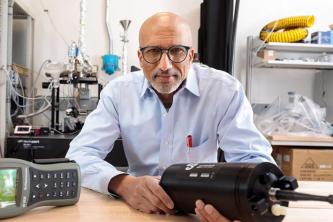
Supratik Guha is a Professor at the Pritzker School of Molecular Engineering and Senior Advisor to Argonne National Laboratory's Physical Sciences and Engineering directorate. His work bridges industrial R&D with academic and national lab research, focusing on quantum computing , semiconductor materials , and sensor networks for water and soil monitoring. Guha leads Argonne’s quantum information science strategy and serves as Faculty Director for the University of Chicago Center in Delhi. Education: PhD in Materials Science (USC, 1991), BTech in Engineering Physics (IIT Kharagpur, 1985) Research interests span multiple domains: Quantum technologies focusing on erbium-doped oxides for quantum memory and quantum interconnects Sensor networks for soil and water quality monitoring using cyberphysical systems Nanofabrication techniques including controlled spalling for heterogeneous material integration Advanced memory technologies exploring ferroelectric and optically addressable memory at atomic scales Scientific awards include: Election to National Academy of Engineering (2015) APS Prize for Industrial Applications of Physics (2015) Vannevar Bush Faculty Fellow (2018) Fellow of Materials Research Society and American Physical Society IBM Corporate Award (2013) Advising notable students like Manish Kumar Singh (co-founder memQ ), Cheng Ji (now at Intel), and Vamsi Nittala (now at Micron Technology). His group contributes to major DOE , NSF , and USDA funded projects including: Q-NEXT - DOE National Quantum Information Center AIFARMS - NSF/USDA AI for Agriculture Institute Thoreau Project - Geospatial sensor networks Labs and teams operate across University of Chicago and Argonne National Lab , with facilities for molecular beam epitaxy , nanofabrication , and optical/electrical characterization . The group has spawned startups like memQ (quantum networking) and K1 Semiconductors (wide-bandgap material transfer).
Michaela Bürger-Koftis serves as Associate Professor in the Department of Modern Languages and Cultures at the University of Genoa's School of Humanities. Her teaching portfolio includes advanced courses such as German Literature and Culture III , German Linguistics (LM) , and Cultures of German-speaking Countries across undergraduate and master's programs focused on teaching, publishing, and intercultural communication. Her research investigates polyphonic structures in multilingual literature, with emphasis on German-Russian linguistic intersections and autobiographical narratives. Key projects explore lyrical diary forms and creative writing through the lens of polyphony, examining how multilingual expression shapes narrative identity and literary innovation in contemporary works. Recent publications demonstrate consistent focus on the Polyphony research initiative, revealing evolving methodologies in multilingual creativity and writing. This work establishes frameworks for analyzing cross-linguistic literary production while documenting the project's development from 2018-2023. No scientific awards are documented in available sources. While specific student advisees remain unlisted, Bürger-Koftis contributes to academic governance as a member of the School of Humanities Library Board. Her collaborative research with institutions like Catania University demonstrates institutional partnership development within multilingual literary studies. The Polyphony project functions as an interdisciplinary research hub with dedicated web infrastructure, facilitating scholarly exchange on multilingual writing practices and serving as a model for digital humanities collaboration in literary studies.
Megan Callow serves as an Associate Teaching Professor in the Department of English at the University of Washington, Seattle, and holds the position of Director of Writing for the campus. Since 2019, she has directed the Program for Writing Across Campus (PWAC), advancing writing instruction across academic disciplines. Her educational background includes: Bachelor of Arts in English from University of California, Berkeley (2003) Master of Arts in Liberal Arts from St. John's College (2006) Doctor of Philosophy in English Education from University of Maryland (2015) Dr. Callow specializes in Writing in the Disciplines (WID) and science writing, with deep expertise in rhetoric and composition, writing pedagogy, and faculty development for writing instruction. Her research examines how writing is taught and learned across scientific and technical fields, develops cross-disciplinary writing curricula, and explores online learning environments for writing education. She investigates genre theory, interdisciplinary writing practices, and science/technology writing integration. No scientific awards were documented in the source material. Information regarding graduate student advising or research grants was not provided in the available text. No dedicated research labs or collaborative teams were mentioned in the source documentation.
Babak Falsafi is a Full Professor at the School of Computer and Communication Sciences (IC) at EPFL, leading the Parallel Systems Architecture Laboratory (PARSA). He is a renowned expert in computer architecture, datacenter systems, and cloud-native server design. His research focuses on post-Moore era computing, emphasizing heterogeneous architectures, energy efficiency, and scalable IT infrastructure. Falsafi is the founder of EcoCloud, an EC-sponsored industrial-academic consortium investigating sustainable information technology. He holds ACM and IEEE fellowships, a Sloan Research Fellowship, and has contributed to major projects like Optimus Prime (data transformation acceleration), AstriFlash (flash-based online service systems), and Midgard (virtual memory re-design). His work spans hardware-software co-design, memory systems, and security. Falsafi advises numerous PhD students and collaborates with industry partners such as Google and Cavium. Key achievements include pioneering scalable multiprocessor architectures, snoop filters in IBM BlueGene, and spatial memory streaming in ARM cores. His lab develops open-source tools like QFlex for server simulation. He frequently presents at top conferences (HPCA, ISCA, MICRO) and chairs workshops on post-Moore infrastructure. Teaching roles include leading courses in computer architecture and parallel systems across multiple EPFL departments (SIN, EDIC, SSC, SMA). His work addresses datacenter challenges like the 'data tax' and mitigating latency through specialized accelerators.
Professor Jennifer M. Welsh is a leading scholar in global governance and security, holding the Canada 150 Research Chair at McGill University. She previously served as Professor at the European University Institute and the University of Oxford, where she co-founded the Oxford Institute for Ethics, Law and Armed Conflict. Her work focuses on humanitarian intervention, the 'Responsibility to Protect' (R2P), UN Security Council dynamics, and Canadian foreign policy. Welsh advised UN Secretary-General Ban Ki-moon on R2P (2013–2016) and directed a five-year European Research Council project on 'The Individualisation of War.' Education : D.Phil. in International Relations, St. Antony's College, University of Oxford (Oxford, England) Masters and Doctorate from University of Oxford (Rhodes Scholar) BA, University of Saskatchewan (Canada) Research Interests : Welsh examines ethical and legal dimensions of armed conflict, atrocity prevention, and norms governing state sovereignty. Her work bridges theoretical analysis and policy implementation, with key contributions to R2P frameworks and non-state actor engagement in conflict zones. Recent publications explore localization in governance, Canada's geopolitical role, and civilian self-protection mechanisms. Key Awards : Leverhulme Trust Research Fellowship Trudeau Fellowship Grants & Advising : Directed a €2.5M ERC-funded project (2014–2019) Advisory roles include Peace Research Institute Frankfurt, Global Centre for R2P, and Auschwitz Institute Editorial boards: Global Responsibility to Protect , International Journal , and Ethics and International Affairs Labs/Teams : Directs McGill's Centre for International Peace and Security Studies (CIPSS), fostering interdisciplinary research on global security challenges.
Justin Russell Greene serves as an Advanced Instructor in the Department of English within Virginia Tech's College of Liberal Arts and Human Sciences. With over 15 years of teaching experience across multiple institutions, he currently teaches courses in film, literature, and writing at Virginia Tech, where he has been employed since 2019. His academic journey spans various teaching positions at Virginia Tech, Hampden-Sydney College, Virginia Commonwealth University, and several community colleges. Greene earned his BA, MA, and PhD in English and Media, Art, and Text from Virginia Commonwealth University. His educational background reflects his interdisciplinary approach that bridges traditional literary studies with contemporary media and cultural analysis. He has also completed professional development certifications in Anti-Racist Teaching and Foundations of Online Teaching at Virginia Tech. His research focuses on the intersections of cinema, media, and cultural studies, with particular attention to authorship, celebrity, and gender performance. Greene examines how authors and celebrities construct their identities across various media platforms, exploring topics ranging from Quentin Tarantino's cinematic masculinity to Roxane Gay's digital presence. His work often analyzes the performative aspects of identity in contemporary culture, particularly through fashion, social media, and visual storytelling. Greene's scholarly output demonstrates a consistent focus on authorial identity construction across media platforms. His publications reveal a trajectory from examining literary authors' fashion choices to analyzing digital performances of identity on social media, and more recently to cinematic studies of directors like Quentin Tarantino and Jordan Peele. The evolution of his work reflects broader cultural shifts toward digital and visual media while maintaining a consistent theoretical framework centered on performance and identity construction. Joyce Gentry Smoot Award (2025) for Excellence in Teaching by an Instructor As an educator, Greene has served as a reader on graduate student capstones and has been actively involved in curriculum development and pedagogical innovation. He has participated in numerous professional development activities focused on writing instruction, anti-racist pedagogy, and the integration of AI in teaching. His teaching philosophy emphasizes building student confidence in writing abilities, recognizing diverse student backgrounds, and providing individualized feedback to help students develop their unique voices. Greene is currently working on projects examining Jordan Peele's Nope (2022) regarding point-of-view and gore, as well as speculative adaptations in contemporary US media. His research interests continue to evolve with cultural trends while maintaining his core focus on performance, identity, and media representation.
John Lowe is a Teaching Professor of Sequential Art at Savannah College of Art and Design (SCAD), holding this position since 2012. Previously, he served as Dean of the School of Communication Arts (2008–2012), Chair of the Sequential Art Department (2003–2008), and Professor of Sequential Art (2002). His career spans academic leadership and professional inking for major comic publishers like DC Comics, Marvel Comics, and Archie Comics. Education: M.F.A., Sequential Art, Savannah College of Art and Design B.F.A., Drawing/Studio Art, University of Knoxville His research interests focus on advancing sequential art education and visual storytelling techniques. He has curated exhibitions such as Contemporary Cartoonists (2006) and Panel Progressions: 100 Years of Sequential Art (2005). His publications include textbooks like Foundations in Comic Book Art (2014) and articles in Varoom Magazine . Awards: Presidential Fellowship (SCAD, 2006) Outstanding Graduate Student (SCAD, 2002) Board of Trustees Fellowship (SCAD, 2000) He has advised numerous students through his editorial roles in anthologies and has engaged in civic initiatives linking art education to community projects.