Aykut Shen holds a PhD and is a Researcher affiliated with the RNA (epi)Genetics Lab at the University of East Anglia (UEA), specifically within the School of Biological Sciences. His work focuses on molecular mechanisms underlying RNA processing and aging, with a strong emphasis on epigenetic regulation and developmental biology. Recent research includes studies on insulin signaling's role in reproductive aging and the critical function of U6 snRNA m6A modifications in RNA splicing accuracy. His publications span Aging Cell and Nucleic Acids Research, demonstrating contributions to both basic biology and translational insights into aging. No scientific awards or grants are explicitly listed, but his research has garnered citations and social media engagement across platforms like Bluesky and Mendeley. Shen collaborates internationally, with projects involving institutions in multiple countries, as indicated by his network map. His lab's work bridges model organisms (C. elegans) and human systems, highlighting translational potential in genetic and epigenetic research.
Scott W. Stevens is an Associate Professor and Associate Chair for Undergraduate Education in the Molecular Biosciences department at the University of Texas at Austin, College of Natural Sciences. His research focuses on understanding the structure and function of ribonucleoprotein (RNP) complexes, particularly the spliceosome. Dr. Stevens' research interests center on RNA processing and splicing mechanisms. His laboratory investigates how RNA and protein assemble into large RNP complexes, how these complexes function, and how they are rearranged during their action. His work has significant implications for understanding human diseases caused by RNP malfunction. His research methodology combines yeast genetics, biochemistry, cryo-electron microscopy, and X-ray crystallography. More recently, his lab has expanded into mammalian systems by designing human cells and mice to study splicing reactions in these model organisms. Dr. Stevens has published extensively on spliceosome structure and function, with research spanning from fundamental molecular mechanisms to potential therapeutic applications. His publication record shows consistent productivity from the early 2000s through 2023, demonstrating sustained research impact in the field of RNA biology. His collaborative work extends across disciplines, as evidenced by publications in medical physics and environmental science alongside his primary molecular biology research.
Dr. Bill Soderstrom is an ARC Future Fellow and leads the Microbial Super-Resolution Microscopy Lab at the Australian Institute for Microbiology and Infection (AIMI), UTS. He holds roles including Program Director for the Bachelor of Advanced Science (Pre-Med and Pharma Majors) and serves on the UTS Academic Board (2023-2024). With a PhD in Biophysics (Stockholm University, 2014) and MSc in Engineering Physics (KTH & Karolinska Institute), his research focuses on bacterial morphology during UTIs, employing advanced imaging and genetic techniques. His lab develops methodologies like cryo-CLEM and vertical imaging of bacteria to study cell division dynamics. Key achievements include securing $3M+ in grants (ARC, MRFF), pioneering UTI vaccine development, and receiving the Dean's Award and FASM Fellowship. His work impacts medical imaging, microbial pathogenesis, and antibiotic alternatives. Education: - PhD in Biophysics, Stockholm University, 2014 - MSc in Engineering Physics (KTH/Karolinska Institute), 2010 Research Interests: Utilizing super-resolution microscopy and microfluidics to investigate UTI-causing bacteria (e.g., UPEC, Klebsiella) under stress. Projects include identifying division inhibitors, imaging protein complexes in live bacteria, and developing mRNA vaccines for UTIs. Lab innovations: cryo-CLEM, vertical bacterial imaging, and multi-species infection models. Grants & Collaborations: - $1.8M MRFF grant for UTI mRNA vaccine (2023) - ARC Discovery Project on DamX dynamics (2021) - Collaboration with CSIRO/UNSW on vaccine development Labs & Teams: Lab webpage: soderstromlab.com Interdisciplinary team includes postdocs (e.g., Dr. Alaska Pokhrel), PhD/Master’s students, and international collaborators (OIST Japan, Institut Cochin France).
Kelly Nguyen is a Researcher at the Molecular Immunity Unit of the University of Cambridge , affiliated with the MRC Laboratory of Molecular Biology (LMB). Their work focuses on elucidating the molecular architecture and regulation of telomerase, a critical enzyme for maintaining chromosome stability, and related processes in telomere biology. Research Focus: Telomere maintenance mechanisms, human telomerase holoenzyme structure, and implications for diseases like cancer and premature aging syndromes. Methodology: Integrated structural biology approaches (biochemistry, cryo-EM) combined with in vivo studies in mammalian cells. Their recent publications highlight structural insights into telomerase dimerization, recruitment, and DNA interactions, as well as spliceosomal complexes. Key trends include: Deciphering telomerase assembly and regulation via high-resolution cryo-EM. Investigating RNA-mediated processes (e.g., LINE-1 retrotransposition) and protein-DNA interactions critical for genome integrity. Group members include researchers contributing to structural studies and functional analyses of telomere biology.
Overview Prof. Julia Kehr is a Professor of Molecular Plant Genetics at the University of Hamburg. She leads the Research Unit Molecular Plant Genetics within the Department of Biology and serves as Deputy Managing Director. Her academic career includes professorships at Universidad Politécnica de Madrid (2008–2012) and Habilitation in Plant Physiology from Universität Potsdam (2006). She previously led research groups at the Max-Planck-Institut für Molekulare Pflanzenphysiologie (1999–2008). Education PhD in Molecular Plant Physiology, Universität Potsdam (1999) Habilitation in Plant Physiology, Universität Potsdam (2006) Diplom in Biology, Universität Gießen (1994) Research Interests Prof. Kehr's work focuses on molecular mechanisms of long-distance RNA transport in plants, extracellular vesicle-mediated communication, and plant-microbe interactions. Her lab investigates RNA-binding proteins (e.g., GRP7, HSC70), viral RNA interactions, and systemic signaling pathways. Key themes include: Phloem sap composition and transport Role of RNAs in plant defense and development Proteomic and genomic approaches to study plant stress responses Publications Recent work emphasizes CRISPR-based virus detection, RNA phase separation, and EV isolation protocols. Her 2025 Nature Plants paper challenges assumptions about mobile mRNA datasets, while 2024 studies highlight practical EV isolation guidelines for plant-microbe research. Awards & Grants Not explicitly listed, but her extensive publication record and leadership roles indicate sustained research funding. Her work on crop virus diagnostics and phloem biology aligns with agricultural and biotech grants. Labs & Teams Leads the Molecular Plant Genetics Unit at UHH, collaborating with institutions like the Centro de Biotecnología y Genómica de Plantas (Spain) and the exRNA consortium for plant-microbe studies.
Professor Raymond O'Keefe serves as Professor of Molecular Genetics and Head of the Division of Evolution, Infection and Genomics at the University of Manchester. With over two decades of academic service since joining as a Research Fellow in 1997, he has established himself as a leading researcher in RNA biology and genetic mechanisms. Dr. O'Keefe earned his undergraduate degree from Connecticut College in 1987, followed by work with Nobel Laureate Dr. George Palade at Yale University. He completed his PhD in Molecular and Cellular Biology from SUNY Stony Brook in 1994, conducting research at Cold Spring Harbor Laboratory under Dr. David Spector. After receiving the Hitchings-Elion Postdoctoral Fellowship to work with Dr. Andrew Newman at the MRC Laboratory of Molecular Biology in Cambridge, he joined Manchester in 1997. His research focuses on pre-mRNA splicing mechanisms and non-coding RNA (ncRNA) function. His lab investigates how splicing errors contribute to diseases including diabetes, cancer, and developmental disorders, while also pioneering large-scale functional analysis of ncRNAs using molecular barcoded deletion strains in Saccharomyces cerevisiae. Analysis of his 76 research outputs reveals a strong emphasis on molecular genetics, with particular focus on neurodevelopmental disorders, mitochondrial translation defects, and splice variant interpretation in clinical contexts. His work bridges fundamental molecular mechanisms with clinical applications. Hitchings-Elion Postdoctoral Fellowship from The Burroughs Wellcome Fund Significant media coverage for work on Perrault syndrome (picked up by 14+ news outlets) Extensive social media engagement with research (100+ X posts, 4+ Wikipedia references) Professor O'Keefe actively contributes to education through teaching Molecular Biology (BIOL10221), Gene Regulation and Disease (BIOL31181), and coordinating the Biochemistry Research Skills Module (BIOL20312). He also serves as a Medical Student Problem Based Learning tutor and has supervised 20 students through their academic work. His current research includes the project 'Pleiotropic disorders of mitochondrial translation' (2022-2025), examining connections between mitochondrial function and human disease.
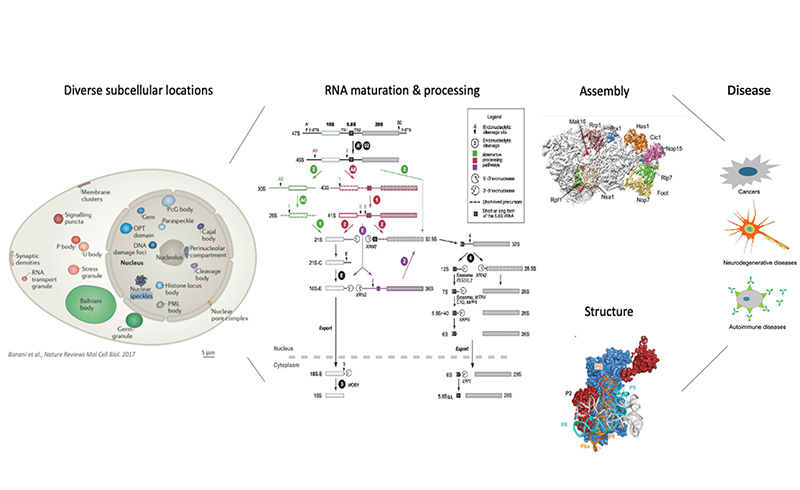
Marlene Oeffinger is an Associate Professor at the Faculty of Medicine, University of Montreal and holds a cross-appointment at the Division of Experimental Medicine, McGill University . She serves as Research Director of the Ribonucleoprotein Biochemistry Research Unit at the Montreal Clinical Research Institute (IRCM). Her research focuses on RNA maturation pathways, ribosome biogenesis, and their links to neurodegenerative diseases like Alzheimer's and ALS through RNA-protein complex dynamics. Education : Master's in Cell Biology (University of Vienna), PhD in Molecular Biology (University of Edinburgh). Training : Postdoctoral work in David Tollervey's lab (Edinburgh) and Mike Rout's lab (Rockefeller University). Her work combines proteomics , biochemical assays , and computational approaches to map RNA maturation networks and their connections to DNA damage repair. Recent articles highlight discoveries in archaeal ribosome evolution, mRNA export mechanisms, and RNA structure probing in yeast. She has received prestigious awards including the CIHR New Investigator Award , FRQ-S Junior Scholar Fellowships , and Revson Foundation Biomedical Fellowship . Marlene's lab trains students and researchers in RNA biology, with current members like Master's student Mauricio Hernandez Magana. Her affiliations span multiple platforms at the IRCM, including bioinformatics , proteomics , and molecular biology . She leads grants from CIHR , FRQNT , and Brain Canada , advancing understanding of RNA's role in disease etiology.
Henriette Skovgaard Andersen is a researcher at the Department of Biochemistry and Molecular Biology, University of Southern Denmark. Her work focuses on molecular biology, genetics, and RNA splicing mechanisms, particularly in neurodegenerative diseases like spinal muscular atrophy and Costello syndrome. She utilizes advanced sequencing technologies and oligonucleotide-based therapies to explore gene regulation and splicing defects. Her research spans translational medicine, with a focus on: RNA splicing regulation in genetic disorders Development of splicing-correcting therapeutics Neurodegenerative disease mechanisms Recent publications highlight her expertise in SMN2/SMN1 gene interactions, HRAS mutations, and resveratrol's role in metabolic disorders. Collaborations include international conferences and workshops on sequencing technologies and presentation techniques. She contributes to peer-reviewed journals and is involved in academic workshops, demonstrating active participation in research networks and educational events.
Mara Guadalupe Freire Martins is a Coordinating Researcher at CICECO - Aveiro Institute of Materials, Chemistry Department, University of Aveiro, Portugal. She serves as Vice-Director of CICECO and Deputy Chair of the Scientific Council of the University of Aveiro. Freire is a member of the European Academy of Sciences and the Lisbon Academy of Sciences, and serves as one of the Chairs of the Content Selection Advisory Board (CSAB) from Scopus. Freire graduated in Chemistry and completed her PhD in Chemical Engineering. Her research spans multiple disciplines at the intersection of chemistry, biotechnology, and materials science, with a focus on developing sustainable solutions for biopharmaceutical production and healthcare applications. Her scientific interests focus on four main areas: Biopharmaceutical Purification: Development of cost-effective purification processes for high-value biopharmaceuticals including antibodies, recombinant proteins, and nucleic-acid-based products. Diagnostic Technologies: Creation of efficient pre-treatment techniques for biological samples to enable early-stage disease detection, particularly for cancer biomarkers. Sustainable Extraction: Development of green recovery processes for therapeutic compounds from biomass using ionic liquids and deep eutectic solvents. Therapeutic Ionic Liquids: Synthesis and application of novel ionic-liquid-based drugs with analgesic, anti-inflammatory and antioxidant properties. Freire's publication record demonstrates consistent innovation in sustainable separation technologies. Her recent work shows a growing emphasis on RNA therapeutics, with numerous publications on mRNA extraction, stabilization, and delivery systems. She has pioneered the use of aqueous biphasic systems and ionic liquids for biopharmaceutical applications, creating bridges between fundamental chemistry and practical healthcare solutions. Her scientific achievements have been recognized with numerous awards: ECTP-NETZSCH Young Scientist Award (2014) Top 20 "Women in Science" in Portugal (2016) Rising Star in Green Chemistry by Green Chemistry journal (2017) 100 Women in Chemistry by Royal Society of Chemistry (2018) Vicente de Seabra Medal (2018) Best Researcher Award from University of Aveiro (2021) Professor Almiro e Castro Award (2023) Women TechEU awardee (2024) Freire has demonstrated exceptional mentorship, supervising 4 junior researchers, 20 post-doctoral researchers, and 25 PhD, 72 MSc and 49 BSc students. She has coordinated or participated in over 25 R&D projects, including two European Research Council (ERC) grants and two PathFinder projects from the European Innovation Council (EIC). Her work has led to 15+ filed patents, 4 licensed patents, and the creation of the RYAPURTECH spin-off company. She leads research within the G5 - Biomimetic, Biological and Living Materials and L4 - Health groups at CICECO, fostering interdisciplinary collaboration between chemists, engineers, and biomedical researchers to address pressing healthcare challenges through sustainable chemical technologies.
Reinhard Lührmann is a Professor and Director at the Max Planck Institute for Multidisciplinary Sciences, leading the Department of Cellular Biochemistry. He holds an honorary professorship at Georg-August University of Göttingen. His research focuses on RNA splicing mechanisms, particularly the spliceosome's structure and function. He earned his PhD from the University of Münster in 1975 and has held roles at the Max Planck Institute for Molecular Genetics (1981–1988), University of Marburg (1988–1999), and currently directs the MPI department since 1999. Research Interests: Lührmann’s lab investigates how the spliceosome recognizes intron/exon boundaries in complex metazoan pre-mRNAs, the assembly of catalytically active spliceosomes, and the structural basis of splicing. Techniques include biochemical purification, mass spectrometry, RNA engineering, X-ray crystallography, and cryo-EM to visualize spliceosome components. Work emphasizes mammalian systems but also uses yeast for core mechanisms. Publications highlight structural insights into spliceosome activation, RES complex roles, and small molecule inhibitors targeting splicing. Collaborations with structural biologists (e.g., Stark, Kastner) and functional studies on catalytic steps underscore his interdisciplinary approach. Labs/Teams: His group is part of the Max Planck Institute’s Molecular Biology and Structural Biology research networks. The lab’s homepage is here .
Brage Storstein Andresen is a Professor in Translational Biology at the Department of Biochemistry and Molecular Biology, University of Southern Denmark. His research focuses on molecular genetics, RNA splicing mechanisms, and genetic diseases, particularly in the areas of metabolic disorders and enzyme deficiencies. His research interests center on understanding how genetic mutations affect RNA splicing and contribute to disease, with particular expertise in exon vulnerability, pseudoexon activation, and developing RNA-based therapies. His work bridges fundamental molecular biology with clinical applications, especially in newborn screening and metabolic disorders like propionic acidemia and medium-chain acyl-CoA dehydrogenase deficiency. Analysis of his recent publications reveals a strong focus on RNA splicing mechanisms, with increasing emphasis on therapeutic applications. His research combines molecular biology, biochemistry, and genetic engineering approaches, particularly CRISPR technology and splice-switching oligonucleotides, to develop treatments for genetic disorders. A significant portion of his work addresses metabolic diseases and cancer-related pathways involving protein kinase CK2. Active participant in multiple research projects through 2026 Editor of research journal Membership in scientific committees Professor Andresen has delivered numerous presentations on genetic splicing mechanisms and their disease implications, including the notable talk 'WHEN THE GENETIC CODE IS NOT ENOUGH: How single nucleotide changes can affect pre-mRNA splicing and cause disease.' His research has attracted significant media attention, with coverage in multiple news outlets and social media platforms.
David R. Corey is a Professor in the Department of Pharmacology at the University of Texas Southwestern Medical Center's School of Medicine, holding a secondary appointment in the Department of Biochemistry. He has been a faculty member since 1992, progressing from Assistant Professor to Associate Professor in 1998 and Full Professor in 2003. His educational background includes: BA in Chemistry from Harvard University (1985) PhD in Chemistry from University of California at Berkeley (1990) Postdoctoral training with Dr. Charles Craik at University of California at San Francisco (1990-1992) Dr. Corey's research focuses on nucleic acid therapeutics , particularly antisense oligonucleotides and RNA interference technologies. His laboratory investigates how synthetic nucleic acids can target disease-causing RNA molecules, with significant work on trinucleotide repeat disorders including spinal muscular atrophy, Duchenne muscular dystrophy, and Fuchs' endothelial corneal dystrophy. His research bridges fundamental molecular mechanisms with therapeutic applications, exploring nuclear RNA interference pathways and novel delivery strategies. Analysis of his publication trends shows consistent innovation in RNA-targeting therapeutics, with recent work emphasizing nuclear aspects of gene regulation and overcoming challenges in allele-selective inhibition. His contributions have directly informed multiple FDA-approved oligonucleotide therapies. Dr. Corey has established himself as a leader in translating basic RNA research into clinical applications, with his work appearing in top journals including Nature, Cell, and Nucleic Acids Research. His research program continues to advance the frontier of nucleic acid-based treatments for genetic disorders.
Andrew S. Weyrich is an Adjunct Professor in the Department of Internal Medicine at the University of Utah , where he also serves as Vice President for Research and President of the University Research Foundation. His research investigates how platelets regulate thrombosis and inflammation through mRNA splicing and translational control, a field now recognized as "thromboinflammation." Education History: Postdoctoral Fellowship at University of Utah (Nora Eccles Harrison CVRTI) Postdoctoral Fellowship at Thomas Jefferson University PhD from Bowman Gray School of Medicine MA from Wake Forest University BS from Baldwin-Wallace College Research Interests center on platelet biology, thrombosis, inflammation, and molecular mechanisms of anucleate cell function. His group discovered signal-dependent pre-mRNA splicing in platelets, redefining understanding of non-genomic regulatory processes in blood clotting and immune responses. Recent Publications address miRNA regulation in GPVI signaling, platelet abnormalities in neurodegenerative diseases, glucose metabolism roles in thrombosis, and platelet microparticle interactions with tumors. Keywords span Hematology, Molecular Biology, and Translational Medicine. Scientific Awards include the prestigious William Dameshek Prize (ASH), H.A. and Edna Benning Presidential Endowed Chair, and John R. Hoidal Senior Investigator Award. He also serves on the NIH NHLBI Advisory Council. As a mentor, Dr. Weyrich directs training grants for medical students and postdoctoral fellows. His leadership at the University of Utah has driven research growth, safety initiatives, and programs addressing the opioid crisis, equity in research, and pandemic responses like COVID-19 surveillance testing.
Dr. Saverio Brogna is a Reader in RNA Biology at the University of Birmingham's School of Biosciences. His research focuses on RNA processing mechanisms, nonsense-mediated mRNA decay (NMD), and ribosomal functions within the nucleus. He leads a research group investigating the interconnections between pre-mRNA processing, translation, and mRNA stability. Brogna has held prestigious fellowships from the Wellcome Trust and Royal Society, enabling independent research since 2000. Education: Laurea (MA) in Biological Sciences (University of Pavia), PhD in Genetics (Cambridge University). Career path includes postdoctoral work at Brandeis University (USA) under Michael Rosbash. He teaches eukaryotic gene expression and cell biology modules, and supervises graduate/undergraduate students. His lab utilizes Drosophila and Schizosaccharomyces pombe models, with a focus on visualizing nascent RNA processing and nuclear ribosome roles. Key research areas include: 1) NMD mechanisms linking splicing to translation, 2) nuclear ribosome localization and function, and 3) development of chromosomal visualization techniques. Lab facilities include the Birmingham Fly Facility. Brogna actively recruits PhD/postdoc researchers and maintains an open lab portal on Facebook. Scientific awards include the Wellcome Trust Travelling Fellowship (2000) and Royal Society Research Fellowship (2004-2013). His work has been published in Nature Structural & Molecular Biology , EMBO Journal , and RNA .
Juannan Zhou is a Professor in the Department of Biology at the University of Florida , where they recently established their research lab. Their work focuses on genotype-phenotype mapping using machine learning , mathematical modeling , and wet lab experiments to understand evolutionary dynamics. Research Lab : Department of Biology, University of Florida Contact : juannanzhou@ufl.edu Key research themes include: Mapping genotype-phenotype relationships in diploid organisms Investigating protein fitness landscapes through unsupervised language models Developing machine-learning assisted directed evolution techniques Studying complex probability distributions over biological sequence spaces Exploring interactions between biochemical constraints and evolutionary outcomes Recent publications demonstrate technical innovations in: Gaussian process priors for sequence-function modeling Field-theoretic density estimation methods Higher-order epistasis analysis Nonparametric Bayesian approaches to biological sequence space Differentiable Smith-Waterman algorithms for sequence alignment The lab actively seeks postdocs, lab technicians, and graduate students interested in machine learning applications in population genetics and evolutionary modeling . Current projects include developing gpmap-tools for genotype-phenotype map visualization and implementing empirical variance component regression frameworks.