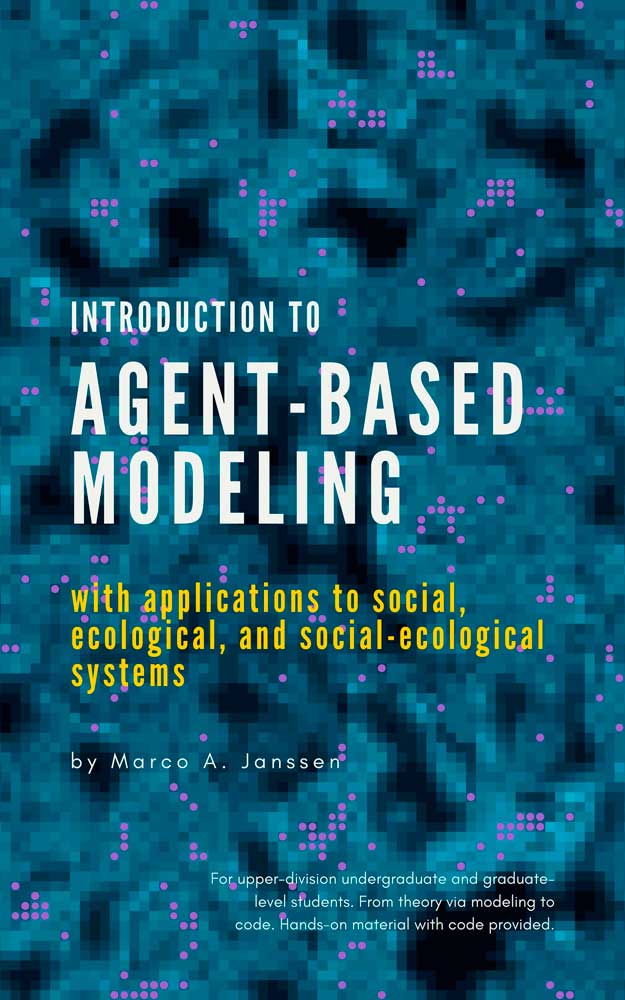
Marco Janssen is a Professor in the School of Sustainability and Director of the Center for Behavior, Institutions, and the Environment (CBIE) at Arizona State University (ASU). He holds affiliated roles across multiple institutions including the Biosocial Complexity Initiative, Center for Social Dynamics and Complexity (CSDC), and the ASU-SFI Center for Biosocial Complex Systems. His work focuses on governance of shared resources (water, energy, critical minerals) through behavioral experiments, agent-based modeling, and case studies. Education: PhD in Mathematics (Maastricht University, 1996) and MA in Econometrics (Erasmus University Rotterdam, 1992). Research interests include social-ecological systems, collective action challenges, and institutional design. Active in open science initiatives to enhance accessibility of research and educational materials. Key affiliations include the Julie Ann Wrigley Global Futures Laboratory, School of Human Evolution and Social Change, and the Complex Adaptive Systems School. Grants funded by NSF and Sloan Foundation support projects on commons governance, cyberinfrastructure for modeling, and urban sustainability (e.g., ASU Project Cities).
Maithilee Kunda is an Associate Professor in the Department of Computer Science and Computer Engineering at Vanderbilt University's School of Engineering. She leads the Laboratory for Artificial Intelligence and Visual Analogical Systems and co-leads the Vanderbilt Initiative for Autism, Innovation, and the Workforce. Her research focuses on AI-driven cognitive systems, particularly visual reasoning and technology applications for neurodiverse populations, including autism spectrum disorder. Dr. Kunda holds a B.S. in Mathematics with Computer Science from MIT (2007) and a Ph.D. in Computer Science from Georgia Tech (2013). She was honored as an MIT Technology Review Innovator Under 35 in 2016 for her groundbreaking work. Her research bridges computational models of visual thinking and real-world impact, emphasizing neurodiverse cognition. Notable projects include developing AI systems for autism-related social skills interventions, designing visual analogy problem-solving frameworks, and advancing nonverbal communication understanding in AI. Her work addresses challenges in abstract reasoning tasks (e.g., Raven's Matrices), visual imagery-based learning, and ethical AI integration. She advocates for inclusive technology design, leveraging both generative AI and cognitive principles to create human-centered solutions. Key awards: MIT Technology Review Innovator Under 35 (2016) Her labs focus on practical AI applications for education, healthcare, and workforce development, emphasizing interdisciplinary collaboration between engineering, psychology, and neuroscience.
Dr. Holly Doel-Mackaway is an Associate Professor at Macquarie Law School and a leading expert in children's rights, Indigenous studies, and international law. She co-leads the Children’s Rights, Participation and Protection Research Stream in Macquarie’s Faculty of Arts and serves as Co-Editor-In-Chief of the Australian Journal of Human Rights. Her interdisciplinary research focuses on advancing children’s rights globally, with a particular emphasis on Indigenous children’s participation in law and policy development. Dr. Doel-Mackaway holds a PhD in Law from Macquarie University and has extensive international experience with organizations like UNICEF and Save the Children. She teaches courses on Child and Elder Law, International Human Rights Law, and Research Methodologies. Recognized for her teaching excellence, she won the Vice-Chancellor's Learning & Teaching Award in 2021 and was nominated again in 2024. Her research includes groundbreaking work such as the 2022 book Indigenous Children's Right to Participate in Law and Policy Development , which provides a framework for involving Indigenous youth in policy decisions. She leads major grants like the 2024 ARC Linkage Grant on child-centered evidence for social change and collaborates with NGOs and governments across five continents. Key awards include the Macquarie University Executive Dean’s Higher Degree Research Excellence Award (2017) and the Erasmus+ Mobility Grant (2023). She actively participates in international committees like LAWASIA’s Human Rights Committee and advises on child rights in Australia, the Pacific, and beyond. Current research projects include exploring intergenerational policymaking, child protection in the Pacific, and the impact of the Voice to Parliament referendum on Indigenous rights.
Christoph Frei is a Professor and Chair of the Department of Mathematical and Statistical Sciences at the University of Alberta. He holds a PhD in mathematical finance from ETH Zurich and previously worked as a researcher at École Polytechnique in Paris. His research focuses on quantitative finance, risk management, and mathematical economics, with applications to algorithmic trading, credit risk, and digital currencies. Education: PhD in Mathematical Finance, ETH Zurich Postdoctoral Researcher, École Polytechnique (Paris) Bachelor/Master in Mathematics, ETH Zurich His work bridges academia and industry through collaborations with institutions like ATB Financial, Canadian Western Bank, and the Federal Reserve System. Key research interests include over-the-counter markets, financial regulation, and machine learning applications in risk prediction. Frei has received notable recognition, including the Best Paper in Asset Pricing Award (2019). Current industry partnerships include AI-driven customer risk prediction projects with ATB Financial and credit risk analysis with Canadian Western Bank. He actively contributes to professional organizations like PRMIA Edmonton and advises on financial technology innovation. Research grants come from NSERC, SSHRC, and Mitacs. His consulting roles have spanned risk modeling at UBS and Credit Suisse, emphasizing practical applications of theoretical frameworks.
Wesley Willett is an Associate Professor in the Department of Computer Science at the University of Calgary, holding the NSERC CRC II Chair in Visual Analytics. His primary research focuses on information visualization, human-computer interaction, and new media applications. He leads the Data Experience Lab and Interactions Lab, exploring innovative methods for data representation and interaction in augmented/virtual reality environments. Education includes a B.S. in Computer Science from the University of Colorado (2006) and a Ph.D. in Computer Science from UC Berkeley (2012). His work bridges technical innovation with user-centered design principles, emphasizing ethical considerations in data visualization and inclusive representation. Key research contributions include: spatial visualization techniques for large environments, gesture-based interfaces for AR/VR, and physical data representations through projects like Cetonia (swarm robotics visualization) and Data Embroidery. His work has been recognized with Best Paper awards at CHI 2015 and Pervasive 2010. Current research emphasizes immersive analytics, wearable visualization systems, and demographically diverse anthropographics. He collaborates with urban designers, neurologists, and environmental scientists to apply visualization in diverse domains like epilepsy surgery planning and air quality monitoring.
Elisa Morgera is a Professor of Global Environmental Law at the University of Strathclyde and the UN Special Rapporteur on Climate Change and Human Rights (2024–present). She previously directed the UKRI GCRF One Ocean Hub (2019–2024), a transformative ocean governance initiative spanning 22 institutions globally. Her research focuses on international environmental law, human rights, equity, and oceans governance, with particular attention to Indigenous peoples, small-scale fishers, and climate justice. Education includes a PhD in International Law from the European University Institute and an LLM in Environmental Law from University College London. She also holds an adjunct professorship at the University of Eastern Finland. Research interests integrate environmental law with human rights, equity, and sustainability, addressing topics like benefit-sharing in natural resources, marine biodiversity, and corporate accountability. She has advised UN agencies, governments, and NGOs, and contributed to Scottish human rights frameworks, including recommendations for a legal right to a healthy environment. Key awards include election to the Royal Society of Edinburgh (2022). Her work spans over 180 publications, including articles on climate governance, ocean defenders' rights, and BBNJ Agreements. She leads interdisciplinary projects funded by UKRI, the EU, and global partnerships. Elisa has advised on over 30 international initiatives, including contributions to the UN Special Rapporteur on Human Rights and the Environment. Her advisory roles include the Scottish Government’s Human Rights Leadership Task Force (2018–2020), shaping national human rights legislation. Her One Ocean Hub and other collaborations emphasize equity and inclusion in ocean policy, involving communities in decision-making processes.
Michał Pałasz, PhD, is an Associate Professor at Jagiellonian University's Faculty of Management and Social Communication, Institute of Culture. His research focuses on management in the Anthropocene, posthumanism, ecological humanities, and climate policy. He serves as a European Climate Pact Ambassador, advocating for socio-environmental change through academic and community engagement. His research interests include exploring non-human agency, degrowth, and critical management studies. He has published extensively on climate action, cultural management, and digital culture, with notable works like Culture Management Must Fuel Socioenvironmental Change (2024) and Language Affects Climate (2024). His work bridges theory and practice, emphasizing inclusive and planetary-bound solutions. Pałasz has collaborated on projects such as Tick-tock, the End of the World (2022), examining multidisciplinary responses to the climate crisis. His academic contributions span journal articles, edited books, and conference presentations, often addressing the intersection of management, culture, and environmental sustainability. He teaches courses on posthumanistic management and climate policy, integrating critical perspectives into education. His work highlights the urgency of rethinking management practices to address polycrisis challenges, advocating for more-than-human-centered approaches.
Jane Henderson is an Assistant Professor of Geography at Dartmouth College. Her research focuses on Black geographies beyond the plantation, examining intersections of race, space, and environment in settler colonial contexts. She holds a B.A. from the University of San Diego and a Ph.D. from the University of California, Berkeley. Her work engages Black Caribbean intellectual traditions and interrogates Indigenous and Black spatial claims through her hometown of Minneapolis, Minnesota. Teaching interests include courses on Race, Space and Nature; Racial Capitalism; and Human Geography fundamentals. Her publications address racial justice in academic disciplines and abolitionist frameworks in geographical practice. She actively contributes to inclusive pedagogy and critical spatial theory. No formal grants or awards are listed, though her research demonstrates engagement with critical social justice themes. She advises students through structured processes outlined in her Letter of Recommendation Request Form.
Seongtae Kim is an Assistant Professor of Supply Chain Management at Aalto University School of Business. He joined Aalto in 2019 after postdoctoral research at the Swiss Federal Institute of Technology Zurich. His PhD in Supply Chain Management was obtained from the University of Hull’s Logistics Institute (2013–2016). His research focuses on supply chain sustainability, risks, complex networks, and digital transformation. Key projects include a four-year Academy of Finland-funded initiative on supply chain restructuring amid disruptions. He serves as an associate editor for the International Journal of Operations and Production Management and editorial board member for Decision Sciences and Journal of Supply Chain Management , earning review service awards. His work emphasizes interdisciplinary connections between environmental, social, and governance issues in global supply chains. Research awards include the JSCM Best Paper Award (2020) and Chris Voss Best Paper Award (2022). Current grants involve analyzing supply chain resilience during megadisruptions. His articles span topics like ethical sourcing, shareholder value effects of disruptions, and green practices in multi-tier networks. He advocates for integrating diversity, equity, and inclusion into sustainable operations, addressing paradoxes in lean manufacturing and sustainability performance.
Stephen Sliwa is the Executive Program Director of Teacher Education and an Adjunct Professor at Queen’s University’s Faculty of Education. He holds an MA from Trent University, MEd and MPA degrees from Queen’s University. Previously, he served as Director of Education and CEO of the Upper Canada District School Board, with extensive experience as a superintendent, principal, and teacher in K-12 education. His research focuses on Indigenous Studies foundations, special education support, intermediate education design, and public sector management. His academic work spans historical analyses of Indigenous-white relations, policy development for inclusive education, and digital learning strategies. He has contributed to provincial education guides and government reports on topics like disability inclusion and Indigenous economic development. Publications include book reviews in Canadian Social Studies and Saskatchewan History , practical guides for teachers, and case studies on Indigenous communities. His work bridges academic research with actionable strategies for educators and policymakers.
Truong Q. Nguyen is a Professor in the Electrical and Computer Engineering (ECE) Department at the University of California San Diego (UCSD), affiliated with the Jacobs School of Engineering. He holds positions at the Center for Wireless Communications and the California Institute for Telecommunications and Information Technology. His research focuses on image/video processing, wavelets, 3D video technology, and applications in healthcare and robotics. He has authored influential textbooks like Wavelets & Filter Banks and pioneered low-power video processing algorithms for mobile devices. Nguyen earned his B.S., M.S., and Ph.D. in Electrical Engineering from the California Institute of Technology (1985–1989). He held roles at MIT Lincoln Laboratory and Boston University before joining UCSD in 1998. His honors include the IEEE Signal Processing Paper Award (1992), NSF Career Award (1995), IEEE Fellow (2005), and UCSD’s Distinguished Teaching Award (2019). His research interests span 3D video processing, machine learning for health monitoring, and biomedical imaging. Notable contributions include wavelet-based compression techniques and AI-driven medical image analysis. He leads the UCSD Video Processing Lab, exploring computer vision, robotics, and generative AI applications. Nguyen is committed to educational innovation, co-creating programs like the Hands-on Curriculum, Summer Research Internship Program (SRIP), and Project-in-a-Box (PIB) for K-12 students. Nguyen’s work bridges academia and industry, with patents in wavelet design and signal analysis. Recent projects include NSF-funded initiatives to develop inclusive engineering curricula and collaborate on graduate pathways programs through the Inclusive Engineering Consortium (IEC).
Richard Wong is an Assistant Teaching Professor in the Department of Mathematics at Rice University. Prior to this role, he was a postdoc in the algebraic topology group at UCLA. He earned his Ph.D. in Mathematics from the University of Texas at Austin in 2021 under the advisement of Andrew Blumberg, and holds a B.S. in Mathematics (highest honors) from Rutgers University (2015) with a minor in cognitive science. His research focuses on computations in equivariant and stable homotopy theory, particularly applying these methods to modular representation theory of finite groups. Teaching is a central part of his work, emphasizing inclusive and equitable practices. Notably, he received the Liggett Instructor Award for teaching and was a Project NExT Fellow. He has organized undergraduate colloquia and contributed to outreach initiatives like the Summer BRIDGE Program and the Mathematicians of Color Alliance of Texas (MOCAT). His efforts to promote diversity in mathematics include mentoring underrepresented students and delivering expository talks on topics like algebraic topology.
Natalia Molina is a Distinguished Professor and Dean’s Professor of American Studies and Ethnicity at the University of Southern California, where she is a leading scholar in U.S. history, Latinx studies, immigration, race, and public health. She is Vice President and President-Elect (2028) of the Organization of American Historians and a 2020 MacArthur Fellow, recognized for her transformative work on racial formation. Her education includes a B.A. in History and Women’s Studies from UCLA, and an M.A. and Ph.D. in U.S. History from the University of Michigan, Ann Arbor. Molina’s research centers on the interconnected histories of race, place, gender, and citizenship. She is best known for her theory of racial scripts , which explains how racial categories are constructed relationally across groups and time. Her work spans public health history, foodways, and immigrant placemaking, with a deep commitment to community-centered storytelling and public engagement. Her recent publications explore Latinx cultural identity through food, sports, and media, reflecting a shift toward personal and public narratives that connect historical scholarship with contemporary life. Her books have received numerous accolades, including a James Beard Award nomination and the PROSE Award finalist status. MacArthur Fellowship (2020) James Beard Award Media Nominee (2023) PROSE Awards Finalist (2023) Pacific Coast Branch of the AHA’s Norris & Carol Hundley Award Susanne M. Glasscock Humanities Book Prize LA Times Essential Book New York Times Best Books About California Molina is a dedicated mentor and public intellectual, having advised university diversity initiatives and served on the boards of the Huntington Library and the Library of Congress Scholars Council. She has held leadership roles at UC San Diego, including Associate Vice Chancellor for Faculty Diversity and Equity. Her current research focuses on the immigrant workers who built and sustained the Huntington Library, reclaiming their overlooked contributions. She is also a Distinguished Lecturer for the Organization of American Historians and has been a fellow at the Huntington Library and the National Endowment for the Humanities. Her public writing in outlets like the Los Angeles Times , Washington Post , and Inside Higher Ed demonstrates her commitment to bridging academic scholarship with broader societal conversations.
Sanna Järvelä is a Professor in the Faculty of Education and Psychology at the University of Oulu, where she leads the Learning and Educational Technology Research Lab (LET). She is a leading figure in learning sciences, with a focus on self-regulated learning, collaborative learning, and AI integration in educational contexts. Her research is supported by major international and national grants, including from the Jacobs Foundation. Research Interests: Self-regulated learning and socially shared regulation Computer-supported collaborative learning (CSCL) Artificial intelligence and adaptive technologies in education Development and application of multimodal research methods Her work bridges theoretical advancement with innovative methodological practices, contributing significantly to the understanding of learning in digital environments. While no specific publications are listed, her research output is extensive and highly cited, evidenced by her inclusion in Stanford University’s top 2% most-cited scientists list (2024). Scientific Awards and Honors: Member of the Finnish Academy of Science and Letters (2015) Francqui Chair, Ghent University (2015–2016) Learning Sciences Fellow (2022) Knight First Class of the Order of the White Rose of Finland (2022) Finnish Ostrobothnia Cultural Foundation Science Prize (2023) Stanford University’s Top 2% Scientist List (2024) Advising and Grants: As the head of the LET Lab and co-PI of the Center for Learning and Living with AI (CELLA), funded by the Jacobs Foundation, she mentors researchers and leads large-scale interdisciplinary projects. She also leads the University of Oulu’s Profi 7 Hybrid Intelligence research programme, shaping strategic research directions in AI and education. Labs and Teams: She founded and leads the Learning and Educational Technology Research Lab (LET), a vibrant research group focused on advancing knowledge about technology-enhanced learning. She is also a member of the OECD PISA 2025 ‘Learning in the Digital World’ expert team, influencing global educational policy and assessment frameworks.
Associate Professor Sunny-Boy Ahmar Mahboob is a distinguished linguist at the University of Sydney, where he serves as Degree Coordinator for the Master of Crosscultural and Applied Linguistics program within the Department of Linguistics, Faculty of Arts and Social Sciences. With extensive experience in applied linguistics and language education, Dr. Mahboob has established himself as a leading expert in World Englishes, TESOL, and language variation research, both nationally and internationally. Dr. Mahboob's educational background includes: BA from Karachi MA from Karachi MA from Indiana University MEd from Sydney PhD from Indiana University (2003) Dr. Mahboob's primary research focuses on language variation in global contexts, with particular attention to World Englishes, the NNEST (Non-Native English Speaking Teachers) movement, language policy, and decolonial approaches to linguistics. His work critically examines how language policies and practices affect educational outcomes and social justice, especially in postcolonial contexts like Pakistan and the Middle East. He pioneered 'appliable linguistics' - an approach that bridges theoretical linguistics with practical applications in education and policy, emphasizing the need for linguistic theories to address real-world problems. His recent publications reveal a strong trajectory toward decolonial linguistics, with increasing focus on subaltern perspectives, environmental connections to language diversity, and critical examinations of colonial legacies in language education. Dr. Mahboob's work consistently addresses power dynamics in language teaching and the need for more inclusive approaches that value linguistic diversity across educational contexts from primary schools to universities. Dr. Mahboob has received numerous prestigious awards: 2019: Australia's Research Field Leader in English Language and Literature (The Australian's Research magazine) 2012: Fellow of the National Talent Pool; President's Programme for Highly Qualified Overseas Pakistanis 2006: Faculty of Arts and Social Sciences Teaching Award, University of Sydney 2005: Teaching Initiative Award and Fellow of the Association of Pacific Rim Universities 2004: ECU Research and Creativity Award 2002: 'Distinguished President Award' from INTESOL, Indianapolis As an academic mentor, Dr. Mahboob supervises research students including Ruohong CAO (Developing Mandarin Learning Materials for Young Learners in Australia through Positive Discourse Analysis) and Tracy GAO (Evaluating Chinese Language Textbooks: A Sociosemiotic Perspective). His editorial work includes serving as Editor of TESOL Quarterly (2014-2017) and Associate Editor for multiple linguistics journals. Dr. Mahboob has secured significant research funding for projects including the SLATE (Scaffolding Literacy in Academic and Tertiary Environments) project and indigenous language funding initiatives in Australia. Dr. Mahboob founded and leads the International Free Linguistics Conference series, which has become an important platform for critical and alternative approaches to linguistics. His 'SLATE project' focuses on genre-based pedagogy for academic writing, and he actively collaborates with researchers across multiple continents through the World Englishes research network. His recent work increasingly explores the connections between language diversity and environmental sustainability, positioning linguistic ecology as a critical component of broader ecological concerns.