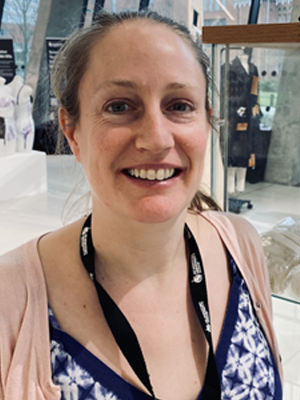
Ken Aldren S. Usman is an Associate Research Fellow at the Institute for Frontier Materials (IFM) , Deakin University, and a PhD Candidate at the same institution since 2018. His work focuses on nanomaterials synthesis and processing, with specialization in MXene-based high-strength fibers. Supervised by Prof. Joselito Razal (ARC Research Hub director) Collaborates with MXene pioneers Prof. Yury Gogotsi (Drexel) and Prof. Babak Anasori (Purdue) Global collaborations: Drexel, Purdue, University of the Philippines, RMIT, University of Sydney, Qingdao University
Professor Alison Gault is a Full Professor at the Belfast School of Art, Ulster University. She specializes in textile design and sustainable fibre research, with a focus on knitting technology and healthcare-related design applications. As Placement and Employability Coordinator, she bridges academic training with industry needs, while her research explores natural fibre composites and circular economy models. BA (Hons) & Postgraduate in Fashion & Textiles (Ulster University) Senior Fellow of the Higher Education Academy (HEA) Fellow of the Centre of Higher Education Research and Practice Her research interests span three key areas: Sustainable Textiles (natural fibre composites, circular economy), Heritage Reinterpretation (Rathlin wool's cultural significance, maritime history), and Design for Wellbeing (palliative care applications, centenary healthcare journeys). She actively collaborates with European institutions and has presented at EFYE, ELSE, IFKT, and Autex conferences. Recent publications highlight her work on regenerative design ecosystems, Rathlin wool utilization, and sustainable fibre systems. Key collaborations include projects with Dr. Andrea Duffy across 2023-2025. Collaborative Award for Teaching Excellence 2017 Finalist Active AHRC-funded Green Transition Ecosystem project Alison supervises PhD researcher Gillian Steel and has participated in 39 academic activities since 2012, including organizing conferences on regenerative design and presenting at international venues. Her work contributes to UN Sustainable Development Goals 12 (Responsible Consumption) and 13 (Climate Action).
Dr. Saikat Ghosh is a Research Fellow in Textile Recycling at the Department of Design and Architecture , School of Arts and Humanities , University of Huddersfield. His work focuses on sustainable textile technologies, particularly integrating nanotechnology for material innovation and recycling solutions. Research Areas : Technical Textile, Sportswear, Nanotechnology, Textile Recycling Key Collaborations : Parikshit Goswami, Martin Vallati, Minas Robinson, Subrata Rana, Athanasios Angelis-Dimakis Recent research highlights include AI-driven textile sorting systems using spectrophotometry and ZnO-based fabric modifications using wool fibers as reducing agents. His 2020-2024 publications emphasize nanofinishing techniques for sportswear applications, aligning with UN Sustainable Development Goals for environmental sustainability. He presented "From Waste to Fibre: Electrospinning Cellulosic Materials from Post-consumer Waste for Sustainable Material" at a 2025 conference, demonstrating ongoing contributions to circular economy practices in textile industries.
Dr. Angela Davies is an Associate Professor in Textile and Garment Technology at De Montfort University, affiliated with the School of Fashion and Textiles within the Faculty of Arts, Design and Humanities. She serves as the Programme Leader for the MSc Sustainable Textile Technologies and is a core member of the Textile Engineering and Materials (TEAM) research group and the Infectious Disease Research Group (IDRG). Her educational background includes a BSc (Hons) in Clothing Design and Production (2002), a PhD in Technical Textiles (2009), and a PG Certificate in Higher Education (2016), all from De Montfort University. She is a Fellow of the Higher Education Academy. Dr. Davies' research focuses on sustainable textile development, medical and healthcare textiles, performance textiles, wearable technologies, and textile end-of-life management. Her work integrates material performance, biodegradation, and infection control, particularly in reusable hygiene and medical products. She emphasizes product durability, quality control, and innovation in sustainable textiles. The 15 most recent publications reflect a strong trajectory in sustainable and medical textiles, with key themes including biodegradation, infection control through laundering, reusable hygiene products, moisture management, and circular economy strategies. Her work bridges engineering, healthcare, and environmental sustainability, often involving interdisciplinary collaboration. Scientific awards include: Research and Teaching Awards 2023–24 – Knowledge Exchange (Leicestershire Police Force Hijab Uniform Project) Research and Teaching Awards 2023–24 – TEAM Research Team Recognition Dr. Davies is actively involved in advising PhD students and securing external funding. She serves as first supervisor for Eden Coe, Megan Melhuish, Tiffanni Trench, Katie Silver, and Irina Moreno, and as second supervisor for Jennifer Dranttel and James Stewart. Her funded projects include AHRC Design Exchange initiatives on reusable period products, ERDF-supported Quality by Design in pharmaceuticals, and the Leicester Textiles Renewal project. She leads knowledge exchange with UK businesses and public services, including Leicestershire Police and British Wool. She is actively engaged with the TEAM research group and contributes to public service innovation through consultancy, including the development of the Bluelight hijab and sustainable sportswear with Bolster.
Pere Ysas Solanes is Professor in the Department of Modern and Contemporary History at Universitat Autònoma de Barcelona's Faculty of Humanities, specializing in 20th-century Spanish political history. With 235 research outputs and an h-index of 5, he directs the Grup de Recerca sobre Dictadures i Democràcies (GReDD) and serves as Principal Investigator for international projects including ARENAS (Analysis of and Responses to Extremist Narratives, 2023-2027). His academic background includes: PhD in History from Universitat Autònoma de Barcelona (1984) Doctorat in Filosofia i Lletres from Universitat Autònoma de Barcelona (1979) Degree in Filosofia i Lletres from Universitat de Barcelona (1977) Ysas Solanes' research centers on political culture, particularly examining communist movements (66% fingerprint relevance), Spanish democratic transition dynamics, and Francoist regime social conflicts. His work bridges broad historical analysis with specific investigations into Catalan autonomy restoration and right-wing evolution in post-dictatorship Spain. Recent publications demonstrate evolving focus toward democratic memory studies and extremist narrative analysis. His 15 most recent publications reveal consistent thematic development across decades, with increasing emphasis on comparative democratic transitions (Spain, Portugal, Argentina, Chile) and contemporary applications of historical frameworks to modern political challenges. Key subfields include Spanish right-wing politics (1977-1996), labor movement resistance during Francoism, and Catalan institutional history. As active supervisor of 30 research projects, he mentors emerging scholars in modern Spanish history while leading major collaborations like the European Commission-funded ARENAS project analyzing extremist narratives through historical frameworks. His current grants include 'LA DERECHA EN LA ESPAÑA DEMOCRATICA' (2021-2025) and 'Sabadell: ciudadanía y libertades públicas' (2020-2022) focused on urban democratic memory models. Within the Grup de Recerca sobre Dictadures i Democràcies, Ysas Solanes coordinates interdisciplinary teams examining dictatorship legacies and democratic consolidation processes. His leadership connects historical scholarship with contemporary policy challenges through projects analyzing social media's role in extremist narratives and urban spaces as democratic memory sites.
Siw Fosstenløkken is a Professor at OsloMet's Faculty of Technology, Art and Design, Department of Computer Science, specializing in Innovation, Digital Transformation and Sustainability. She serves as an elected representative on the Faculty Board of TKD (2023-2027) and participates in committees like the Academic Affairs Committee. Her work bridges academia and industry through lifelong learning initiatives. PhD Program: PINS (Innovation for Sustainability) Teaching Levels: Bachelor (Applied Computer Technology), Master (Innovation and Entrepreneurship), PhD, and Lifelong Learning Research focuses on innovation ecosystems , agile methods , and sustainable digital transformation . Publications address organizational adaptation to AI, SME networking strategies, and green infrastructure education. Her work emphasizes user-driven innovation and competence development in professional contexts. Scientific contributions include: Dynamic Capabilities : Digital/AI integration frameworks Regional Development : Inventor-investor matchmaking Bærekraft : Green infrastructure education programs Recognition includes Status as Merited Teacher (2023). She holds an Adjunct Professor position at HVL, Bergen, until 2024. Teaching emphasizes authentic learning environments with over 9000 students reached during the pandemic.
Tess van de Voorde is a Researcher at the Biointeractions and Plant Health group within Wageningen University & Research (WUR), actively leading multiple agricultural research projects focused on soil-plant health dynamics. Her work integrates ecological principles with practical farming applications to enhance disease suppression and soil resilience. Her research spans Soil Health (100% fingerprint relevance), Primary Productivity (56%), and Ecosystem Services (56%), with emphasis on Disease Suppression through biochar, soil amendments, and macrofauna management. She investigates how sustainable practices like cover cropping and soil biodiversity enhancement combat pathogens such as Pythium while maintaining grassland productivity. Recent projects target climate-resilient cropping systems and residue management in potato production. Analysis of her 2024-2025 publications reveals strong interdisciplinary trends: 80% connect soil microbiology to agricultural outcomes, with recurring subfields including bioassay validation, viral ecology in wildlife, and keratin-based soil amendments. Her work consistently bridges laboratory findings with field applications, particularly in Dutch horticulture and arable systems. Van de Voorde leads 9 LVVN-funded projects including Wool for Crop Resilience 2.0 (2024) and Increasing Climate-Change Resilience Through Diversified Cropping Systems (2025-2028), securing continuous grant support for soil health innovation. She actively disseminates knowledge through 13 oral presentations, 2 press features (including The Ancient Secrets of Black Soil ), and the Handbook of Soil Biology and Disease Suppression . As part of WUR's PE&RC graduate school network, she collaborates with the Soil Biology team on long-term experiments (LTEs) examining soil structure-function relationships. Her research group employs molecular and ecological approaches to develop field-ready tools for measuring soil suppressiveness, directly supporting Dutch agricultural sustainability initiatives.
Klaus Doschek-Held is a Professor affiliated with the Chair of Thermal Processing Technology , focusing on metallurgical processes and waste valorisation. His research spans lithium-ion battery recycling, slag upcycling, and sustainable construction materials. Key collaborations include institutions like University of Leuven , Chair of Waste Processing Technology , and Christian-Doppler Laboratories . Research activities emphasize circular economy principles, with publications in Journal of Environmental Chemical Engineering , Results in Materials , and symposium proceedings. His work bridges pyrometallurgy, biohydrometallurgy, and AI-driven waste management. Recent projects include GECCO 2, a research lab for eco-friendly residual building materials, and investigations into phosphide formation in industrial slags. He actively presents at conferences like the Slag Valorisation Symposium .
Professor Cécile Chazot is a faculty member at Northwestern University, serving as the Principal Investigator of the Sustainable Polymer Innovation Laboratory (SPIn lab) within the Department of Materials Science and Engineering. She leads an interdisciplinary research team focused on sustainable polymer manufacturing and recycling technologies. Her research interests span sustainable and scalable materials design, with particular emphasis on fiber-based materials, biopolymers, and green chemistry approaches. The SPIn lab's work encompasses fundamental understanding of polymer properties and their hierarchical self-assembly, development of room-temperature processing methods using green solvent alternatives, and creation of functional materials with tailored mechanical and optical properties including stimuli-responsive colorimetric sensing capabilities. The research portfolio demonstrates a strong focus on sustainable manufacturing processes, including interfacial photopolymerization for high-resolution printing, scalable synthesis of ultrathin polymer films, and innovative recycling strategies for textiles. Recent work includes developing dynamic structural colors in cholesteric cellulose composites, understanding wool hierarchical structures, and creating roll-to-roll processing methods for elastane recovery. Professor Chazot is deeply committed to educational initiatives and diversity in STEM, as evidenced by her development of the MICRO online undergraduate program designed to promote equitable access to materials science education. The SPIn lab culture emphasizes collaboration, safety, and creating an inclusive environment where diversity of thought and background drives sustainable innovation. The laboratory's impact extends beyond research through educational outreach and promoting the socio-technical context of polymer manufacturing innovation.
Ana Cristina Luz Broega is an active Assistant Professor at the University of Minho's School of Engineering, Azurém Campus, where she directs the Master's in Fashion Communication Design program and teaches courses spanning Fashion Design Project, Advanced Apparel Design, and Ethical Fashion. Her academic career at the institution began in 1997 as an Intern Assistant, progressing through Assistant Professor positions since 2008, with significant leadership roles including membership on the Master's in Design and Marketing Steering Committee. PhD in Textile Engineering - Textile Physics (2008), University of Minho School of Engineering Master's in Design and Marketing (2001), University of Minho School of Engineering Bachelor's in Textile Engineering (1994), University of Beira Interior Broega's research centers on sustainable fashion systems with particular emphasis on psychological comfort dimensions in clothing, circular economy implementation, and creative process innovation. Her work bridges textile engineering with human-centered design, examining how emotional, social, and cultural factors influence garment acceptance and usage patterns. Current investigations explore aging populations' clothing needs, gender-neutral fashion frameworks, and waste valorization through surface design. Analysis of her recent publications reveals a strong trajectory toward systemic sustainability solutions, with increasing focus on circular business models, emotional durability, and cross-sensory design methodologies. Her work consistently connects material science with consumer behavior, demonstrating how technical textile properties intersect with psychological comfort perception to drive sustainable adoption. Curricular Merit for Research in Textile Field (2005) Award for Best Final Average in Bachelor's Engineering (1994), Order of Engineers Portugal Broega actively mentors doctoral and master's students across fashion design, sustainability, and communication fields while leading European Commission-funded projects including Fashion Alive (2022-2034) and TEXSTRA (2017-2020). Her research grants focus on sustainable education frameworks, textile innovation, and cross-border design collaboration. As principal organizer of the International Congress on Fashion and Design (CIMODE) since 2012, she facilitates global knowledge exchange among designers, researchers, and industry professionals. Her work integrates closely with the Textile Science and Technology Center (2C2T), leveraging university-industry partnerships to advance sustainable textile applications while directing the Fashion Communication Design program that connects academic research with market innovation through collaborative platforms like A Malha.
Graça Maria Barbosa Soares is a Professor at the University of Minho specializing in Textile Engineering . Her research focuses on sustainable textile technologies, including enzyme-based effluent treatment, thermal comfort materials, self-cleaning fabrics, and UV protection systems. Academic Background: PhD in Textile Engineering (2001) from University of Minho Research Highlights : Developed multifunctional cotton with TiO 2 nanoparticles and phase change materials (PCMs) for thermal regulation and photocatalytic self-cleaning Innovated PVC-based synthetic leather with PCM integration for automotive comfort applications Explored cyclodextrin-based eco-friendly textile finishes Advanced hydrogel functionalization for improved wound dressings Publication Trends : Focus on sustainability across textile processing and material design Integration of nanotechnology for functional properties Thermal management applications in both apparel and automotive sectors Additional Contributions : Extensive work on natural dyeing systems and bio-based textile treatments Recent exploration of photocatalytic air purification using TiO 2 in asphalt mixtures
Professor Robert Fitch is a distinguished academic leader and one of Australia's foremost authorities in robotics at the University of Technology Sydney (UTS), where he serves as Professor in the School of Mechanical and Mechatronic Engineering. He holds significant leadership roles as Director of the NSW Defence Innovation Network and was previously Director of UTS Tech Lab and Head of School of Mechanical and Mechatronic Engineering from 2019-2023. His career bridges academia, research, and industry collaboration to develop engineering solutions for tomorrow's societal challenges. PhD from Dartmouth College (1998-2004) Former Senior Research Fellow at Australian Centre for Field Robotics, University of Sydney Current Director of NSW Defence Innovation Network (since 2023) Founding Co-Director of NSW Space Research Network (2021-2023) Professor Fitch specializes in autonomous field robotics, developing outdoor robotic systems for diverse industry applications from agriculture to aeronautics, environmental science to space exploration. His research spans multiple domains including multi-robot coordination, hydrogen storage systems, maritime robotics, and AI-driven automation. He operates at the critical nexus of academia, research, and industry, collaborating with businesses and government organizations to deliver innovative solutions to complex real-world challenges. His work demonstrates exceptional translational impact, turning academic research into commercial ventures and practical applications. His recent publications reveal a strong focus on advancing robotics through novel planning algorithms for multi-robot systems operating in complex environments. There's a clear trend toward practical applications in maritime operations, hydrogen energy storage, and warehouse automation, reflecting his commitment to solving real-world engineering challenges. His research integrates theoretical advances with industry needs, particularly in marine robotics, autonomous systems for agriculture, and energy storage technologies. Professor Fitch's work has received significant recognition with numerous accolades and extensive media coverage including appearances on ABC's flagship 7.30 program, Weekend Australian, BBC, and The Hindu. His research has been featured in over 15 news outlets and blogged about extensively, demonstrating its broad societal impact. He has graduated 20 PhD students who are now leading work in field robotics, mechanical and mechatronic engineering, and autonomous systems. Since 2011, he has secured nearly $30 million in grants funding over 50 projects, including major collaborations with industry partners like Space Machines Company, Advanced Navigation, and Australian Wool Innovation. His leadership has been instrumental in growing startups from small beginnings to significant operations, such as Space Machines Company which launched the largest Australian-made satellite into orbit aboard a SpaceX transporter in March 2024. Professor Fitch leads the UTS Robotics Institute and has been instrumental in establishing collaborative spaces like UTS Tech Lab, which has fostered successful partnerships with multiple companies. His work with Wildlife Drones demonstrates how academic research can translate into successful commercial ventures, having grown from research projects into an established business. His leadership extends to numerous industry and academic organizations, boards, and committees, where he serves as director, chair, and co-chair.
Dr. Forbes Brien is an Associate Professor at the School of Animal and Veterinary Science , University of Adelaide, specializing in genetic improvement of sheep with a focus on lamb survival and reproductive efficiency . Based at the Roseworthy campus, his career spans academic research, industry development, and practical farming experience from a wool-producing property in Victoria. Education : B.Sc and M.Sc in Agricultural Science (University of Melbourne), PhD in Quantitative Genetics (University of Edinburgh) His research integrates quantitative genetics with livestock breeding , particularly examining genetic correlations between survival traits and production characteristics. Recent publications emphasize technological applications in sheep reproduction and economic modeling of breeding programs. Scientific Recognition includes: Fellow of the Australian Association of Animal Breeding and Genetics (2021) President of 2021 AAABG Conference Guest-Editor for Sheep CRC special editions Lead Writer for Australian Wool Innovation genetic reviews (2011–present)
Shigeru Asaba is a Professor at Waseda University , affiliated with the Faculty of Commerce and Graduate School of Business and Finance. His research bridges theoretical and applied studies in Strategy , Industrial Organization , and Corporate Governance , with a focus on family firms and technology management. He earned a Ph.D. in Administration from UCLA (1999) and a Doctorate in Economics from University of Tokyo (1990). Asaba’s research explores how family firms balance tradition and innovation in R&D-intensive sectors, emphasizing patent efficiency and incremental innovation . His work on business imitation and dominant design strategies has influenced understanding of competitive dynamics in technology sectors. Recent studies (2020s) examine intangible investments , patent stock valuation , and global corporate governance models . His publications since 1992 highlight trends in R&D efficiency , inventory productivity , and international business strategies . Key themes include family firm behavior , patent systems , and rivalry-based strategic decisions . He is a member of the Academy of Management and the Asia Academy of Management. Scientific recognition : Best Paper Award, Association of Japanese Business Studies (1998) Organizational Society Takamiya Award (1996) Asaba has secured multiple grants from the Japan Society for the Promotion of Science, including projects on international patent strategies and corporate governance diversity . He serves as a Concurrent Researcher at Waseda’s Center for a Carbon Neutral Society (2024-2026).
Dr. Mirim Shin is a Research Fellow at the Brain and Mind Centre within the Faculty of Medicine and Health at The University of Sydney, where she also holds affiliations with the Charles Perkins Centre. Her work bridges circadian biology, sleep science, and mental health across developmental stages, with current focus on youth mental health and technology-driven interventions. Education Bachelor of Health Science (First Class Honors, 2011) - Thesis: "Positive emotions associated with Counter-Strike game playing" PhD (2015) - Thesis: "Influence of sleeping apparel and bedding textile on thermal comfort and sleep" Dr. Shin's research centers on establishing causal relationships between objective circadian disturbances and mental illness progression. Her work spans neurosciences and mental health with specialization in depression, sleep disorders, and health psychology. Early career focused on sleep-thermoregulation interactions in aging populations evolved into dementia care quality improvement, now pivoting to youth mental health where she investigates sleep-wake cycle disruptions as modifiable targets for intervention. Her methodological approach combines actigraphy, physiological monitoring, and digital phenotyping to quantify circadian rhythms in clinical populations. Analysis of her 15 most recent publications (2023-2025) reveals a dominant focus on circadian-metabolic-immune interactions in youth mood disorders, with increasing emphasis on biomarker discovery (insulin resistance, skin temperature rhythms) and digital intervention development. Parallel work continues in dementia care through community-based rehabilitation models, demonstrating her dual expertise across age spectra. Scientific Awards BMC Emerging Researcher Award (2025) Dr. Shin has secured competitive funding including the Global Youth Mood Disorders Citizen Science Initiative (2024) from the Circadian Mental Health Network and earlier Australian Wool Innovation grants for sleepwear research (2015). While no formal advisees are documented, her collaborative publications indicate active mentorship within multidisciplinary teams spanning psychiatry, geriatrics, and engineering. She leads the Youth Mental Health & Technology Team within the Brain and Mind Centre's Translational Research Collective, developing circadian-targeted interventions using wearable sensors and digital platforms. Current initiatives include international circadian rhythm studies in youth and implementation of home-based dementia reablement programs.