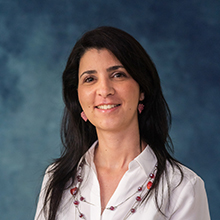
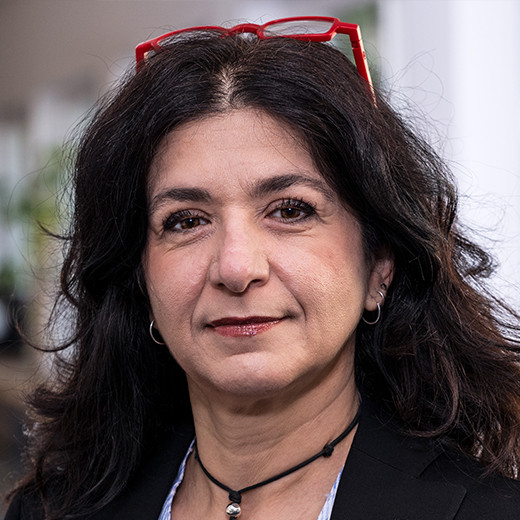
Maria Letizia Marchegiani is an Assistant Professor at the University of Parma , affiliated with the Department of Engineering and Architecture . Previously, she held academic positions at Aalborg University (2019) and Oxford Robotics Institute (2014-2018). Education: PhD in Computer Science and Engineering from Sapienza - University of Rome , MSc/BEng in Computer Engineering Her research interests span signal processing , machine learning , and their applications to robotics , autonomous systems , intelligent transportation , and intelligent healthcare . She explores intersections between auditory perception , cognitive modeling , and energy-efficient wearable systems . Recent publications demonstrate expertise in acoustic event localization , ML-SDWSN architectures , thermal camera integration for vehicles, and privacy-preserving wearable systems . Her work addresses challenges in network reliability , urban soundscapes , and human-robot collaboration .
Maria Elisa Fina is a Researcher (RtdB) at Ca' Foscari University of Venice, affiliated with the Department of Comparative Linguistic and Cultural Studies and the Interdepartmental School of Economics, Languages and Entrepreneurship for International Exchanges. Her work focuses on multimodal analysis of cultural heritage communication, translation studies, and audiovisual translation. She teaches courses in translation technologies, post-editing, and audiovisual translation at both undergraduate and master's levels. Education: Bachelor's in Literary and Technical-Scientific Translation (University of Salento, 2011) PhD in Linguistic, Historical-Literary, and Intercultural Studies (Ca' Foscari University, 2016) Research Interests: Multimodal analysis of audio guides, intersemiotic translation, museum communication for children, digital storytelling, and accessibility in cultural mediation. She has contributed to projects like DIETALY (PRIN 2020) and iNEST Tourism, exploring translation in cultural heritage contexts. Notable Achievements: Winner of the AIA/Carocci PhD Prize 2017 for best PhD thesis in Anglistica Published Investigating Effective Audio Guiding (Carocci, 2018) Recipient of the 2021 Ca' Foscari Excellence Award Teaching: Courses include Translation and Post-Editing Technologies , Audiovisual Translation and Audiodescription , and Translation Technologies: Tools and Methods . She emphasizes practical skills in translation technology and digital tools. Lab/Team Affiliations: Collaborates with research groups on accessibility in cultural heritage, digital humanities, and language mediation. Active in editorial boards of Trans-Kata and Le Simplegadi .
Grazia Ragone is a Postdoctoral Researcher at the IVU Laboratory , Department of Computer Science, University of Bari Aldo Moro. Holding a PhD in Human-Computer Interaction from the University of Sussex and a Master's in Psychological Research Methods, she specializes in Usability, User Experience (UX), and Human-Centered AI , focusing on systems that integrate human factors for enhanced technology interaction. Academic Background: PhD in Human-Computer Interaction (University of Sussex, UK), Master’s in Psychological Research Methods (University of Bari) Key Research Areas: Social Motor Synchrony, Child-Computer Interaction, Trustworthy AI, Embodied Interaction, Autism Research, Usability Engineering Her recent work on the Future Artificial Intelligence Research (FAIR) project develops new metrics for human-AI symbiosis. She has presented at major conferences like Interaction Design and Children (IDC) and Advanced Visual Interfaces (AVI) , with publications in ACM Transactions and Springer LNCS. Scientific awards include the Microsoft Research Best Student Research Competition (2021) and IDC Conference Best Work in Progress (2020). Grazia actively contributes to academic governance as a member of ACM SIGCHI and SIGCHI Italy , and has organized international conferences like INTERACT 2021. She has delivered workshops on Child-Centered AI at institutions including the University of Delft and Sussex University.
Nicola Maria Dusi is an Associate Professor in the Department of Communication and Economics at the University of Modena and Reggio Emilia (UNIMORE). She specializes in semiotics of cinema and media, with a focus on contemporary television series, intermediality, and transmedia storytelling. Her academic work bridges theoretical frameworks with practical analysis of audiovisual media products. Dr. Dusi's research interests encompass multiple dimensions of media studies. She investigates how contemporary television series construct narrative meaning through complex storytelling techniques, with particular attention to the interplay between fiction and documentary elements. Her work on intermediality explores how different media forms interact and transform content across platforms. She has conducted extensive research on the representation of historical events in television miniseries, notably analyzing the Chernobyl TV series as a case study of cultural memory construction. Her scholarly contributions also include studies on biopics, autism representation in media, and the semiotics of cinema archives. She approaches these topics through socio-semiotic frameworks that examine both textual structures and audience reception. Her recent publications reveal a consistent focus on contemporary media phenomena, particularly the evolution of television seriality in the streaming era. She examines how modern TV series negotiate between factual and fictional elements, creating complex narrative ecosystems that extend beyond the screen through paratexts and fan engagement. Her work on Chernobyl demonstrates how a TV miniseries functions as both historical representation and cultural commentary, blending documentary approaches with dramatic storytelling. She also explores more technical aspects of media representation, such as the aesthetics of blurred vision and data moshing in digital media, analyzing how these techniques affect meaning construction and viewer experience. Dr. Dusi is actively involved in teaching courses directly related to her research expertise. She teaches 'Semiotics of Cinema and Media' for Communication Sciences students, covering theoretical frameworks and analytical methods for examining audiovisual texts. Her course includes modules on basic semiotic theories, analysis of cinema and media, and specialized topics in contemporary media studies. She also teaches 'Intermediate Languages' for the Master's Degree in Advertising, Digital Communication, and Business Creativity. Her teaching emphasizes both theoretical knowledge and practical application, incorporating current media examples to illustrate concepts and encouraging students to develop critical analytical skills for understanding complex media phenomena.
Marco Carli is a Full Professor at the Department of Industrial, Electronic, and Mechanical Engineering, Roma Tre University, Italy. He holds a Laurea in Telecommunication Engineering from Università degli Studi di Roma 'La Sapienza' and a Ph.D. from Tampere University of Technology. His research focuses on digital signal and image processing applied to multimedia communications, including digital watermarking, multimedia quality evaluation, and information security. He has led projects such as EHEM (medieval architecture modeling), ISEEYOO (AI-based anomaly detection), and INSECTT (secure IoT-AI systems). Carli serves as an Associate Editor for IEEE Transactions on Image Processing and Area Editor for Signal Processing: Image Communication. He is an IEEE Senior Member. His work spans over 55 journal publications and numerous conferences, addressing topics like immersive VR applications, cybersecurity, and perceptual quality metrics. Education: Laurea in Telecommunication Engineering, Università di Roma 'La Sapienza', 1990s Ph.D. in Telecommunication Engineering, Tampere University of Technology, Finland Projects: EHEM: Digital modeling of medieval architecture and art ISEEYOO: Anomaly detection in Cyber-Physical Systems INSECTT: Secure IoT systems with AI Research Interests: Signal/image processing for multimedia Quality evaluation and watermarking Cybersecurity and IoT applications Awards: None explicitly listed Grants/Advising: Multiple EU-funded projects (e.g., ImmerSAFE, RESISTO, ATENA) and collaborations with industry partners like Thales Alenia Space.
Silvia Grandi is an Assistant Professor at the University of Bologna's Department of the Arts since 2005. Her research focuses on contemporary art history, particularly 20th-century art scenes and synergies between visual/sound experiments. She specializes in video art, performance art, and art-fashion intersections. She organizes exhibitions collaborating with institutions and publishes on these topics. Her articles address sustainability, tourism, energy transitions, and policy analysis. She teaches courses like 'Fenomenologia dell'arte contemporanea' and 'Fenomenologia delle Arti applicate.' Contact: sil.grandi@unibo.it. Education Background: No explicit details provided in texts. Her academic trajectory can be inferred through her 20-year tenure at the University of Bologna. Research Interests: Silvia Grandi explores the evolution of video art and performance in contemporary contexts, analyzing how these mediums intersect with broader cultural narratives. Her work bridges art history with socio-political frameworks, emphasizing interdisciplinary approaches. Recent studies investigate the role of art in addressing environmental and sustainability challenges, reflecting her broader engagement with societal issues. Publications Trends: Her 15 most recent articles (2022-2024) span sustainability policy, rural tourism innovation, energy transitions, and educational reforms. These reflect her expertise in linking artistic and cultural phenomena with socio-environmental challenges. For instance, 2023's Rural Tourism Creative Innovations explores pandemic-driven adaptations in Kazakhstan and Italy, while 2024's La filiera delle plastiche addresses waste management and circular economy strategies. Awards/Grants: No specific awards listed, but her active participation in EU policy evaluations and international collaboration indicates grant-supported research. She contributes to institutional projects like the STeMA-TIA 3.0 model for territorial assessment. Advising & Labs: While no formal advisee list exists, her role in organizing exhibitions and curating the 'ARTYPE' series demonstrates mentorship in curatorial and academic practices. She collaborates with GIS teams on spatial analysis projects.
Letizia Bollini is a Professor at the Faculty of Design and Arts of the Free University of Bozen-Bolzano , specializing in Digital Design . Her work bridges physical and digital realms ("phygital"), focusing on cultural heritage, memory preservation, and user experience. Role : Professor of Digital Design Institution : Free University of Bozen-Bolzano Key Themes : Phygital narratives, cultural heritage ecosystems, digital mortality Research Interests include: Designing multimodal interfaces for cultural heritage Temporal dimensions of digital memory Accessibility in digital typography Geo-referenced storytelling for urban history Gender perspectives in design technology Her scientific contributions span from 2018 to 2024, addressing digital humanities, user experience, and sustainable design practices. Though no explicit awards are listed, her work has been showcased in events like the World Usability Day in Bozen (2023-2024).
Luisa Lugli is a Full Professor in the Department of Philosophy at the University of Bologna. Her research focuses on embodied cognition, legal and institutional concepts, perception, and social psychology. She explores how abstract concepts are shaped by cultural, sensory, and motor experiences, with particular attention to gender representation, gesture influence, and spatial-numerical associations. Research Interests : Embodied Cognition Legal Conceptualization Sensory-Motor Interaction Cross-Cultural Semantics Gestural Effects in Cognition Attention and Perception Her recent work examines how manual gestures influence random number generation, the role of sound in speed perception, and cultural variability in gender conceptualization. She has contributed to advancing methodologies in online experimental psychology, particularly during pandemic constraints. No scientific awards are explicitly listed, though her extensive publication record highlights significant contributions to cognitive and legal psychology. Advising & Grants : No advisees or grants explicitly mentioned. Collaborations focus on interdisciplinary teams in cognitive science and legal studies. Labs/Teams : Engaged in experimental psychology and legal jurisprudence research groups at the University of Bologna.
Prof. Maura Mengoni is an Associate Professor at the Department of Industrial Engineering and Mathematical Sciences of the University of Macerata (UNIVPM). Her work focuses on human-centered design methodologies integrating advanced technologies like AI-driven systems, XR applications, and affective computing. She leads research in smart manufacturing systems, ergonomic assessment tools, and inclusive technology development for diverse user groups including people with disabilities. Key projects include SOPHIA's IoT architecture for predictive maintenance and emotion-aware interfaces for automotive safety. Research interests span industrial automation, virtual/augmented reality applications, and multimodal interaction design. Recent studies investigate cognitive workload in driving simulators, emotion-based museum experiences, and facial expression analysis for educational evaluation. Her work bridges engineering with humanities through projects like Civitas, enhancing cultural heritage accessibility via spatial augmented reality at Urbino’s Ducal Palace. Publications emphasize interdisciplinary approaches, including collaborative designs with end-users for accessible technologies and data fusion techniques in manufacturing. She has pioneered systems linking customer emotions to shopping experiences and developed tools for ergonomic risk assessment using RGB camera networks.
Enrico Rizzuto is an Ordinary Professor at the University of Genova , Department of Naval, Electrical, Electronic and Telecommunications Engineering (DITEN). His research focuses on naval engineering, underwater acoustics, and noise reduction technologies with environmental and operational applications. Teaches Costruzioni Navali 1/3 and Sicurezza delle Strutture Marine in the Naval Engineering undergraduate and master's programs Key research areas: ship noise emissions, hydrodynamic modeling, structural integrity, and sustainable maritime technologies Active in computational and experimental studies for underwater radiated noise reduction, airborne noise propagation, and environmental impact assessments Contributed to international conferences and collaborative projects like LIFE-PIAQUO and AQUO Current research includes hybrid propulsion systems, cabin acoustics, and maritime cyber resilience Recent Publications analyze noise patterns in ships, propeller optimization, hull structural uncertainties, and environmental protection strategies. His work bridges naval architecture with data-driven approaches for sustainable maritime solutions. Contact: enrico.rizzuto@unige.it | +39 010 33 52340
Carlo Gioia is a PhD researcher at Kunstuniversität Linz and Research Assistant at the Interuniversity Department of Regional and Urban Studies and Planning (DIST) at Polytechnic University of Turin. He serves as an external lecturer in Film and Media Engineering, teaching Interactive Media courses and delivering lectures on New Media Art and (S)low Technologies across multiple institutions including the University of Turin and A. Casella Conservatory. Educational Background: Master's degree in Cinema and Media Engineering from Polytechnic University of Turin Currently pursuing PhD at Kunstuniversität Linz Carlo investigates the intersection of art, science, technology, and marginal territories, examining computational cultures, landscape ecologies, and collective agency. His research engages strategies such as salvage, patchwork, and redundancy, exploring experimental models of (s)low-tech and benign computing that prioritize sustainability, accessibility, and the right to opacity in digital interactions. He approaches computation as a fragmented, relational, and context-aware practice deeply embedded within social and local fabrics, rejecting linearity in favor of iterative and collectively negotiated alternatives of experimental knowledge. His recent publications reveal a strong focus on rural technologies, sustainable computing practices, and the reimagining of traditional interfaces through contemporary digital technologies. A recurring theme is the exploration of how technologies reconfigure placemaking practices, community infrastructures, and spatial computing in marginal territories, with particular attention to the relationship between traditional knowledge systems and emerging technologies. His work often transforms vernacular tools into contemporary interfaces, creating what he terms 'technological disobedience' as a form of cultural and political resistance. Research Collaborations: Interuniversity Department of Science, Project and Policies of the Territory Department of Control and Computer Engineering at Polytechnic University of Turin Carlo co-founded the Radura collective in 2025, a research and open experimentation platform operating at the intersection of artistic practices, political ecologies, and emerging technologies in rural contexts. His work takes the form of multi-channel installations and experimental projects like 'Folk Interfaces' that explore the relationship between traditional rural practices and contemporary digital technologies, emphasizing sustainability, accessibility, and community-based knowledge systems.
Monica Betta is an Assistant Professor at IMT School, affiliated with the MOMILAB research group. Her expertise lies in computational methods for biomedical signal analysis, focusing on EEG-based sleep research and mathematical modeling of physiological systems. She holds a PhD in Automation, Robotics, and Bioengineering from the University of Pisa, Italy, and completed a visiting research stint at the Centre d'Investigation et de Recherche sur le Sommeil in Switzerland. Education: Bachelor's in Biomedical Engineering (2006–2009), University of Pisa Master's in Biomedical Engineering (2009–2012), University of Pisa PhD in Automation, Robotics, and Bioengineering (2012–2016), University of Pisa Visiting Researcher (2015–2016), Centre Hospialier Universitaire Vaudois, Switzerland Research Focus: Dr. Betta’s work integrates computational tools for EEG analysis in sleep (e.g., REM/NREM detection, ocular artifact removal) with epidemiological modeling for disease control. She explores how sensory experiences influence brain activity during sleep and wakefulness, leveraging mathematical models to optimize public health interventions like vaccination strategies. Recent Trends in Publications: Her recent studies emphasize interdisciplinary approaches, including EEG-fMRI investigations of slow-wave subtypes and thalamic activity, biomarkers for cardiovascular risk in sleep apnea, and telemedicine applications for cardiac rehabilitation. She also addresses methodological advancements in EEG signal processing and functional connectivity metrics for vigilance assessment. Awards & Grants: No specific awards mentioned. Active in collaborative research projects involving sleep epidemiology and biomedical engineering. Labs & Teams: Principal investigator at MOMILAB, leading projects on sleep neurophysiology and computational health analytics. Collaborates internationally with institutions like the University of Lausanne and the University of Pisa.
Fabrizio Sors is a Contract Professor at the Department of Life Sciences, University of Trieste, where he serves as a member of the Boards of Studies for the Psychological Sciences and Techniques programs (PS01, PS01A) and Applied Social and Cognitive Psychology (PS52A). His academic role focuses on course recommendations and curriculum development within the psychology department. Dr. Sors specializes in Sports Psychology with a particular focus on how auditory information influences perceptual-motor skills in athletic performance. His research examines how sound cues affect anticipation in sports like volleyball, soccer, and other ball sports. He investigates how ecological sounds can enhance athletic performance, how auditory-motor experience affects spatial predictions, and how sensory integration contributes to sports expertise. His work bridges cognitive psychology with practical applications in sports training and performance enhancement. His research portfolio includes significant projects such as "The contribution of acoustic information to the anticipation of serve depth in volleyball," where he served as Scientific Manager, and "Fairytales and Audios for Boosting Attention and Scholastic skills: FABA–School," where he participated as a researcher. These projects demonstrate his commitment to applying psychological principles to real-world contexts both in sports performance and educational settings. Principal Investigator for "Il contributo delle informazioni acustiche all'anticipazione della profondità del servizio nella pallavolo" (2021-2023) Participant in "Fairytales and Audios for Boosting Attention and Scholastic skills: FABA–School" (2023-2024) Dr. Sors maintains an active publication record with numerous articles in cognitive psychology and sports science journals, particularly focusing on the intersection of auditory perception and motor performance. His recent work spans topics from smartphone effects on cognition to the role of sound in sports performance and perceptual phenomena.
Francesco Brusco is a Contract Lecturer in the Department of Cultural Heritage Sciences (DISPAC) at the University of Salerno. He holds a PhD in Musicology from the University of Pavia and is actively engaged in interdisciplinary research at the intersection of music, art history, and cultural studies. Based in Pisa, he contributes significantly to scholarship on Italian popular music and British rock, particularly The Beatles and Fabrizio De André. PhD in Musicology, University of Pavia Graduate studies, University of Salerno Thesis on music in Vermeer’s paintings His research interests span Popular Music Studies , Musicology , Art History , and Cultural Heritage . He explores authorship, studio production, and the socio-cultural dimensions of music, with a focus on 20th-century Italian and British music scenes. His work often bridges disciplines, analyzing how music interacts with visual art and broader historical narratives. Brusco’s publications reflect a deep engagement with the aesthetics and cultural impact of major musical works. His recent articles and books analyze Sgt. Pepper , the White Album , and the collaborative nature of De André’s music. He emphasizes the role of the recording studio as a creative instrument and examines how collective production challenges traditional notions of authorship. His notable works include the books La voce del padrone (2022), Guccini. Frammenti di un discorso musicale (2020), and Estetica di Sgt. Pepper (2017). His journal articles appear in Analitica , Musica/Realtà , and Riscontri , covering topics from avant-garde experiments to transnational musical influences. While no formal scientific awards are listed, his scholarly output and academic appointments reflect recognition in his field. He mentors students through his teaching and research, contributing to the next generation of music and cultural scholars. Brusco has not established a named laboratory or research team, but his work is deeply collaborative, drawing on interviews with musicians, producers, and technicians. His research methodology combines archival work, oral history, and critical analysis, particularly in reconstructing the history of Italian recording studios and the creative ecosystems around major artists.
Francesca Pola is an Associate Professor of Contemporary Art History at the Faculty of Philosophy, Vita-Salute San Raffaele University (Milan). She also teaches Art Criticism and Art Literature, and actively contributes to the ICONE and CRISI research centers as a board member. Bachelor's, Master's, and PhD from Catholic University of the Sacred Heart Fulbright Distinguished Lecturer (2016) at Northwestern University Her research spans 20th-century Italian and American art, with a focus on Piero Manzoni, ZERO movement, and post-war art systems in Milan, Rome, and Turin. She explores interdisciplinary intersections between art, digital culture, and neurosciences. Recent publications analyze François Morellet's deconstruction, Studio Azzurro's multimedia installations, and NFT's role in post-digital art. Her work combines archival research with curatorial innovation. Scientific Awards: Fulbright Distinguished Lecturer (2016) She curates artist archives (Rodolfo Aricò, Mario Nigro) and leads public engagement initiatives like NEFFIE at MIA Photo Fair, collaborating internationally with ZERO Foundation and Fondation Leblanc.