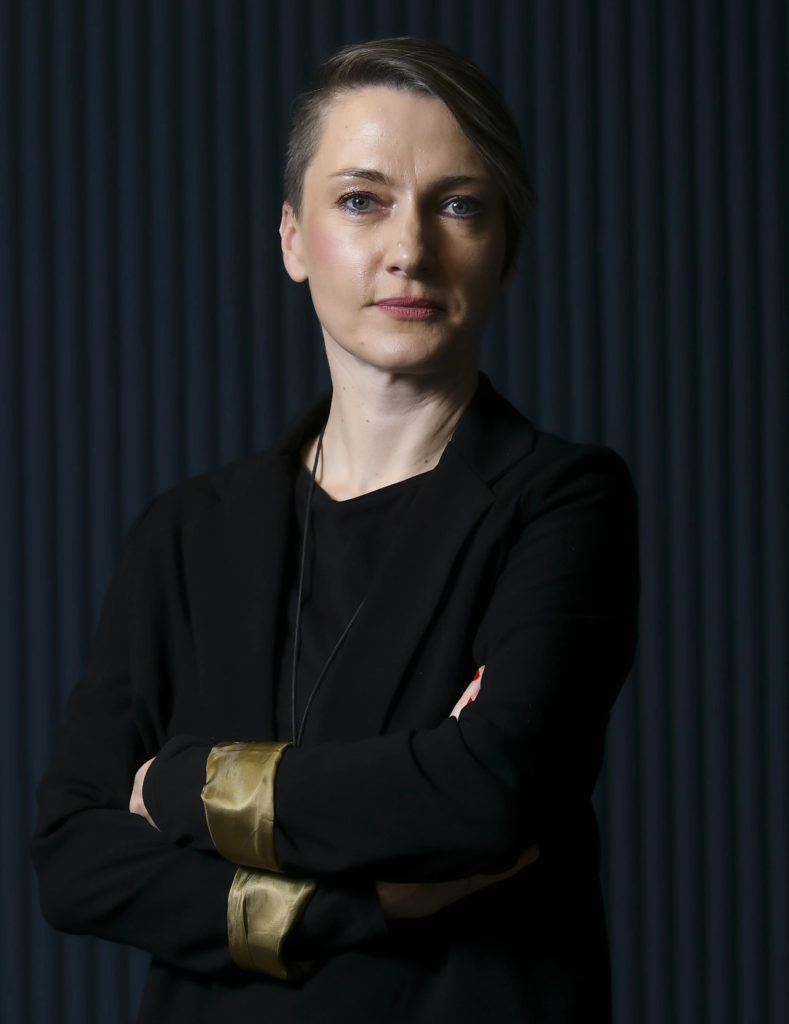
Aleksandra Krstić is a full professor at the Faculty of Political Science, University of Belgrade, where she teaches courses including Political Journalism , Visual Representation of Politics , and Media and Journalism in a Global Context . She serves as Vice-Dean for Research Activities and leads the Center for Media and Media Research. PhD in Culture and Media (2015) from University of Belgrade Master's and BA in Journalism from Faculty of Political Science Her research examines media representation of EU institutions , authoritarian communication , digital journalism ethics , and migrant portrayal in Serbian media . Recent work analyzes visual security narratives , presidential communication strategies , and opinion dynamics in social media . Scientific awards include the Đoko Vlajković Foundation Award (2018) and multiple European integration media awards. She leads international projects like DepolarisingEU (COST Action 22165) and Strengthening Local Media in Serbia (US Alumni Grant). Krstić collaborates with institutions including International Organization for Migration (IOM) and European Commission, and serves on editorial boards for Journal of Regional Security and Political Perspectives .
Prof. Dr. Novica Milić serves as a full professor at the Faculty of Media and Communications (FMK), Singidunum University in Belgrade, Serbia. His academic appointments include teaching Renaissance literature and contemporary literary theory at the Faculty of Philology until 2008, followed by media and communication theory at the Faculty of Arts. He has held visiting positions at Yale University, the University of Sheffield, and the University of Vienna, establishing an international scholarly profile. His educational background features: Graduation from the Department of General Literature and Literary Theory, Faculty of Philology, University of Belgrade (1982) Master's degree (1987) with thesis "Literary understandings of Paul de Man and the theory of deconstruction" Doctorate (2001) with dissertation "Theoretical problems of reading as the basis of modern understanding of literature" Professor Milić's research critically examines intersections between Communication Theory, Media Theory, Political Theory, and Aesthetics. His work investigates how media shapes democratic processes, analyzes power structures in contemporary art through post-aesthetic frameworks, and explores philosophical underpinnings of communication. With roots in literary deconstruction, his scholarship bridges historical perspectives with current challenges in digital media landscapes, emphasizing the role of critical theory in understanding modern societal transformations. His recent publications (2020-2024) demonstrate sustained interdisciplinary engagement across democracy studies, political narratology, and post-aesthetic theory. These works reveal consistent thematic threads connecting media philosophy, political communication, and aesthetic critique, particularly examining how digital platforms reshape democratic discourse and how power operates through contemporary art forms. The publications reflect deep integration of literary theory with political philosophy, showing evolution from classical textual analysis toward modern media ecology concerns. No scientific awards were documented in the available materials. While specific student advising details and grant information remain unmentioned, his extensive publication record (approximately 100 works) and course development—including advanced seminars on political philosophy and methodology—suggest significant mentorship activities and research leadership within the Faculty of Media and Communications ecosystem. Though no dedicated laboratories or formal research teams are referenced, his work operates within FMK's interdisciplinary structure encompassing Media and Communications, Digital Arts, and Political Studies departments, indicating collaborative engagement across Singidunum University's academic framework.
Dijana Stojić is an Assistant at the Department of Computer and Software Engineering, Faculty of Technical Sciences in Čačak, University of Kragujevac. She has held this position since January 2018 while pursuing her doctoral studies in Electrical and Computer Engineering with a specialization in Computer Engineering, which she began in 2021. Her academic journey began with excellent results at the 'Vuk Karadžić' elementary school in Čačak, followed by the Technical School in Čačak where she majored in computer electrical engineering. She earned her Bachelor's degree in Computer Engineering in 2011 (average grade 9.37) and Master's degree in 2012 (perfect average grade 10.00) from the Faculty of Technology in Čačak. Her Master's thesis, 'Software Support for Active RFID Localization,' was supervised by Prof. Dr. Siniša Ranđić. Dijana's research spans multiple domains within computer engineering, with recent publications focusing on practical applications of technology in diverse fields. Her work demonstrates strong expertise in IoT systems, machine learning applications, blockchain technology, and human-computer interaction. She has published extensively on topics including earthquake detection using mobile phones, predictive models for identifying students with difficulties in online learning, medical applications like ECG monitoring with Arduino, agricultural engineering applications, and infrastructure monitoring systems. Award for best first-year student at Faculty of Technology in Čačak Award for best second-year student at Faculty of Technology in Čačak Her professional activities include serving as Student Vice-Dean at the Technical Faculty in Čačak from December 2010 to September 2012, participating in the TEMPUS SIGMUS project, and completing an internship at D.O.O. DOCUS from June 2013 to June 2014. She was a scholarship holder of the Ministry of Education, Science and Technological Development from April 2013 to March 2017 and has been involved in significant research projects including 'Development and modeling of energy efficient, adaptable, multiprocessor and multisensory electronic low-power systems' (TR 32043) and the 'German-Serbian Collocation Dictionary for German Language and Teaching' (DeSKoll).
Željko Marković is a full professor at the Faculty of Philosophy within the University of Novi Sad. He has held academic positions since 1989, progressing from assistant professor to his current rank. His professional affiliations also include teaching roles at the University of Cologne (2000–2005) and Korea University of Foreign Studies in Seoul (2017–2020). Education: Graduated in Serbo-Croatian language and Yugoslav literature (1987), earned a master's degree in philology (1993), and completed his doctorate in comparative linguistics (2011). Research interests focus on comparative and contrastive grammar of Slavic languages, lexical semantics, and toponymy. His work explores phonological systems, situational verb usage, and historical language influences. Publications include foundational works on Slovenian grammar, Slavic phonological systems, and monographs analyzing visual perception verbs and urbanonyms. His recent articles examine semantic roles, historical texts, and regional linguistic impacts. International collaboration spans study visits at Jagiellonian University (Kraków), University of Ljubljana, University of Veliko Tarnovo, and Lusatian-Serbian Institute in Bauzen.
Katarina R. Stanojevic is an Assistant Professor at the Department of Didactic and Methodological Sciences, Faculty of Pedagogical Sciences, University of Kragujevac. Her work focuses on music pedagogy and interdisciplinary educational approaches. She holds a diploma in General Music Pedagogy from the Faculty of Music in Belgrade (2007) and pedagogical qualifications from her current institution (2023). Her research explores modern teaching methodologies, particularly in music education, including topics such as youth musical taste analysis, media influence on educators, and interdisciplinary approaches to understanding musical works. She has contributed to international conferences and publications, addressing challenges in contemporary education and cultural studies. Stanojevic teaches courses such as Methodology of Teaching Musical Culture and Methodical Practicum of Musical Culture at undergraduate and master's levels. Her consultations are held weekly on Monday and Tuesday.
Milena Vukmirović is an Associate Professor at the Faculty of Forestry , University of Belgrade , with a focus on urban design and urbanism . Her work bridges academic research, civic engagement, and urban policy implementation. Teaching at all academic levels (Basic, Master’s, Doctoral studies) Advisor to Belgrade's Chief Urban Planner since 2015 Member of international academic networks (AESOP Young Academics) As co-founder of the 5km/h citizens' association (IFP member), she advocates for human-scale urban development. Her research combines climate-sensitive urban design with digital public space analysis , particularly through Places and Technologies conference contributions. 7 international journal publications 3 top-tier M21a journal articles Co-author in 5 conference proceedings Scientific awards include participation in COST Action 358 (Pedestrian Quality Needs) and COST Action TU 1203 (Crime Prevention through Urban Design). She currently leads the national Modernization of the Western Balkans project. Her professional affiliations span: Urban Laboratory (founding member) International Federation of Pedestrians Faculty of Architecture alumni network
Sunčica Zdravković is a full professor at the Department of Psychology within the University of Novi Sad's Faculty of Philosophy and Faculty of Technology. Her research focuses on visual perception, particularly brightness and color perception under varying illumination conditions, using psychophysical and behavioral methods. PhD in Psychophysics: Visual Perception (Rutgers University, 2002) MSc in Cognitive Neuroscience (Rutgers University, 2000) BSc in Psychophysics: Visual Perception (University of Belgrade, 1994) Her work investigates how humans maintain object identity through changing lighting conditions, employing classical psychophysics, reaction time experiments, and eye movement measurements. Recent publications analyze illumination frameworks, perceptual grouping, and neural processing of brightness constancy. DPS Award 'Ljuba Stojić', 2010 Visiting Professor at Swansea University, 2012-2013 Visiting Scientist at Max Planck Institute, 2004 Scholarships from Italian Ministry of Science (2003) and Serbian Ministry of Science (1994-1995) She teaches courses on Perception, Cognitive Neuroscience, and Experimental Psychology at undergraduate, master's, and doctoral levels. Her lab explores perceptual illusions, spatial-temporal dynamics, and neurocognitive mechanisms of vision.
Vladimir Zlokolica is a researcher affiliated with Singidunum University, holding a PhD in Telecommunications and Information Processing from Ghent University (2006) and a Master's degree from the same institution (2005). He obtained his Bachelor's degree in Electrical Engineering from Novi Sad (2001). His research focuses on Medical Imaging , Computer Vision , and Automotive Perception Systems , particularly in advanced image processing techniques for 3D medical imaging and motor vehicle environmental modeling. His work includes segmentation algorithms for cardiovascular diagnostics and innovative methods for automotive image generation and enhancement. Publications from 2017-2020 demonstrate expertise in 3D image analysis , medical applications , and automotive vision systems . Notable contributions include techniques for left atrial appendage segmentation, vessel delineation, and quality metrics for 3D visual content. Despite no explicit scientific awards mentioned, his collaborations with institutions like Ghent University and Singidunum University highlight his academic engagement.
Оливера Парлић Карајанковић is a Professor at the Department of Sculpture, Faculty of Fine Arts, University of Belgrade, where she has worked since 2005. Her artistic practice explores the intersection of human experience and materiality through sculptural forms. Education: BA (1997), MA (2000), PhD (2014) in Sculpture from the Faculty of Fine Arts, University of Belgrade. Research Interests: Her work interrogates the bidirectional relationship between humans and objects, focusing on how materials absorb creator/user intentions, document psychological states, and serve as metaphors for existential fragility. She investigates themes of lost function, memory preservation, and prosthetic replacements in sculpture. Awards: FLU Award for Portrait FLU Award from the Sreten Stojanovic Fund Notable Exhibitions: Solo shows include Вежбе пролазности (2017), Јавна соба (2017), and Ерос немогућих сусрета (2014). Group exhibitions span international venues like the China Art Museum (Shanghai, 2017) and Angewandte Innovation Lab (Vienna, 2017).
Predrag Terzić serves as a full Professor in the Department of Digital Arts at the Faculty of Media and Communications (FMK), Singidunum University in Belgrade, Serbia. His academic career spans over a decade with teaching appointments at both the University of Business Studies in Banja Luka (since 2009) and FMK, where he currently instructs courses including Introduction to Digital Art, Interactive Installations, and New Media and Art. His academic foundation includes: Bachelor's degree from the Faculty of Fine Arts, University of Arts in Belgrade (2000) Master's degree from the same institution (2004) Ph.D. in Intermedia Studies (Theory of Art and Media program) from the University of Arts in Belgrade (2010) Terzić's research centers on the philosophical and theoretical intersections of digital technologies and artistic expression. His work critically examines media-induced loneliness, digital image perception, visibility politics, and the societal implications of new media. As an active curator and theoretician, he has organized over a dozen international exhibitions challenging conventional artistic boundaries across Europe and North America. His publication trajectory reveals a consistent evolution from foundational studies in image visibility toward contemporary explorations of media psychology and digital existentialism. The works collectively form a cohesive investigation into how digital environments reshape human cognition, social interaction, and artistic creation, with increasing emphasis on the psychological consequences of media saturation. Professor Terzić contributes significantly to academic discourse as editor of CascaJournal and through writings for Remont magazine, Kultura, and Supervisuelna. His curatorial practice demonstrates strong international engagement with exhibitions at institutions including the Museum of Contemporary Art of Republika Srpska, National Museum of Montenegro, and Gallery of the Serbian Academy of Sciences and Arts. He actively participates in the FMK Lab's interdisciplinary research initiatives in digital media.
Dragana Bјekić is a Full Professor at the Department of Social Sciences and Humanities, Faculty of Technical Sciences Čačak, University of Kragujevac, Serbia. She has held academic positions at this institution since 1989, progressing from Assistant Trainee to Full Professor in 2011, where she remains active. Her academic credentials include a PhD in Psychology from Belgrade University's Faculty of Philosophy (1999), an M.Sc. in Psychology (1993), and dual graduated studies in school psychology-pedagogy and clinical psychology (1984-1988). Dr. Bјekić's research spans multiple interconnected domains within educational psychology, with particular emphasis on psychology of education and e-education, teacher psychology and professional development, communication aspects in educational contexts, adult education and long-life learning, and engineering education. Her work demonstrates a consistent focus on practical applications of psychological principles to improve teaching practices, educational systems, and student outcomes. She has developed specialized expertise in inclusive education, particularly for students with disabilities, and has pioneered work in digital psychological resilience, especially relevant during the pandemic period. The analysis of her recent publications (2020-2024) reveals a clear trajectory focusing on emerging educational challenges, particularly the intersection of psychological principles with digital education technologies. Her work increasingly addresses psychological resilience in educational contexts, entrepreneurship competence among educators, and innovative teaching methods including augmented reality applications for students with learning disabilities. A significant portion of her recent research examines the adaptation of teaching practices during the pandemic, analyzing both teacher and student perspectives on e-education. Dr. Bјekić has secured multiple research grants from the Ministry of Education, Science and Technology Development of the Republic of Serbia (2020-2024) and has coordinated or participated in numerous international projects including ERASMUS+ initiatives like DigiPsyRes (Enhancing digital and psychological resilience) and ALLVET. She has supervised multiple student research projects and mentored early-career academics in teacher education and psychology. Her interdisciplinary approach bridges psychology, education, and engineering contexts, creating a unique research profile that addresses both theoretical and practical challenges in contemporary educational systems. She maintains active collaborations with international research networks including the TEPE network and Association of Teacher Education in Europe.
Gordana Đukanović is an Associate Professor at the Faculty of Forestry, University of Belgrade, where she has been employed since October 1, 1994. She currently teaches courses in geometry, engineering graphics, and related subjects across multiple academic programs including Basic Academic Studies, Master's programs, and Vocational Studies. Education: Graduated from the "Vuk Karadžić" High School (mathematics department - programmer) in Loznica Graduated from the Faculty of Civil Engineering in Belgrade (Construction department) on March 7, 1988 Defended her master's thesis from the Faculty of Architecture in Belgrade on December 26, 2000 Defended her doctoral dissertation from the Faculty of Architecture, University of Belgrade on November 2, 2012 Professor Đukanović specializes in the geometry of architectural form with research focusing on descriptive geometry, relativistic geometry, engineering graphics, and photogrammetry. Her work bridges architectural theory with practical applications in forest engineering and building design. She has published 49 papers including more than 5 peer-reviewed scientific papers in journals, 35 papers presented at congresses and symposia, one practical guide, and numerous studies and projects for wood processing companies. Her recent publications demonstrate a strong interdisciplinary approach connecting geometry with environmental science, architecture, and engineering. The research spans from theoretical mathematical explorations to practical applications in air pollution analysis, flood management, structural integrity assessment, and renewable energy systems design. Scientific Awards and Recognition: University Scholarship as one of the three students with the best grade point average during the first two years of university Certified court expert in the field of building valuation Professor Đukanović serves as a member of the Serbian Society for Geometry and Graphics (SUGIG) and the International Society for Geometry and Graphics (ISGG). She has passed the professional exam in civil engineering at the Association of Engineers and Technicians of Serbia. Her teaching responsibilities include courses in descriptive geometry with engineering graphics for Ecological Engineering in Land and Water Resources Protection, Furniture and Wood Products Construction, and Technology of Wood House Production.
Milan P. Milikić is an Assistant Professor at the Faculty of Pedagogical Sciences, University of Kragujevac in Jagodina. He holds a Doctorate in Mathematics Teaching Methodology (2023), a Master's in Teaching Methodology (2023), and a Diploma in Mathematics (2010/2012). His primary research focuses on mathematics education methodologies, particularly in elementary and primary education, with a strong emphasis on technology integration (e.g., GeoGebra) and pandemic-era educational challenges. Professional activities include teaching core subjects like Mathematics Teaching Methodology, Methodical Mathematics Practicum, and Geometry Concepts Development. He actively participates in international projects such as the Erasmus+ 'Out and About' initiative (2021–2023) and bilateral cooperation with Montenegro and Slovenia. His memberships include the Society of Mathematicians of Serbia and expert roles in textbook evaluation committees. Key research themes include online learning efficacy during crises, software applications in geometry education, and pre-service teacher competencies. His work bridges traditional pedagogical methods with modern digital tools, emphasizing practical classroom applications.
Jelena Plašić serves as a Lecturer in the Department of Information Technologies at the Faculty of Technical Sciences, University of Kragujevac. She holds office number 130 at Saint Sava 65, 32102 Čačak, Serbia, with contact details +381 032/302-734 and email jelena.plasic@ftn.kg.ac.rs. Her academic journey began with a Graduate Computer Scientist degree from the University of Kragujevac's Faculty of Science and Mathematics, followed by a Master of Information Technology Engineer degree from the Faculty of Technical Sciences in Čačak (2020). Her research focuses on data science applications in business intelligence , with particular expertise in cloud-based analytics, CRM systems, and educational technology transformation. She teaches core computing courses including Introduction to Programming, Programming Practicum, Programming Languages, E-Business, and Software Engineering. Her publication record reveals a strong trajectory in applying machine learning and data warehousing to solve business problems, with increasing sophistication from foundational CRM studies (2018) to advanced sustainable supply chain analytics (2025). Recent publications demonstrate a clear evolution toward integrated cloud analytics solutions , with 8 of her 14 works (2020-2025) focusing on Microsoft Fabric, big data modeling, and predictive analytics. Her work bridges theoretical frameworks with practical business applications across diverse sectors including education, healthcare, and manufacturing. She actively contributes to academic discourse through conference organization for ITOP and TIE events, and participates in faculty promotion initiatives.
Zorana Đorđević is a Research Associate at the Department of Materials Science within the Institute for Multidisciplinary Research at the University of Belgrade. She holds a PhD in History and Philosophy of Natural Sciences and Technology and specializes in archaeoacoustics, cultural heritage, and architectural history. Her research focuses on the acoustic properties of medieval sacral architecture, including ceramic acoustic vessels, sound propagation in historical buildings, and digital preservation of cultural heritage. She has led fieldwork in Serbia, organized international conferences, and collaborated with French institutions on ancient architectural acoustics. Recent Projects: 2019–Present: Bilateral project with University of Poitiers on ancient architectural acoustics 2017–2022: COST Action European Network for Environmental Citizenship 2011–2019: Science Theory and Practice in Society (Serbian Ministry-funded) Scientific Awards: Seal of Excellence from European Commission for MSCA postdoctoral proposal Academic Contributions: Authored exhibitions on archaeoacoustics and Serbian chemistry heritage; served as demonstrator in architectural studies at Belgrade University (2006–2009).