Professor Jonathan Murray is a Personal Chair of Film Theory, History, and Criticism at the School of Design , University of Edinburgh . As a renowned scholar in Scottish and British cinemas, he co-edits the Journal of British Cinema and Television and contributes to Cineaste . Active in film festivals as a host and curator, he has influenced both academic and public engagement with cinema. PhD and MA in Film and Television Studies and Scottish History, University of Glasgow Research Interests : Jonathan specializes in contemporary Scottish and British cinemas, focusing on cultural identity, adaptation, and espionage themes. His work bridges academic criticism with public discourse, emphasizing animation, documentary, and historical analysis. He explores intersections of film with popular music, design, and societal narratives. Article Trends : His recent publications highlight European cinematic duality, American adaptations, and Scottish cultural heritage. Themes span from Martin Scorsese’s ethical storytelling to Agnieszka Holland’s political narratives and Scottish film’s evolution from Whisky Galore! to Trainspotting . Scientific Awards : 2016 BAFTSS Best Monograph Award 2017 BAFTSS Best Journal Article Award (Shortlisted) 2018 BAFTSS Best Journal Article Award 2019 BAFTSS Best Journal Article Award Supervision : He supervises PhD students Dan Castro and Nelson Correia. His editorial leadership and festival involvement underscore his commitment to advancing film scholarship and practice.
Prof. Dr. Clarissa Vierke is a specialist in Swahili Language and Literature at the University of Bayreuth , with a focus on literary connections across the Indian Ocean and African continent. She was awarded the German National Merit Foundation scholarship during her studies in African Languages, Social Anthropology, and Literatures in African Languages at Bayreuth and Leiden. Academic Degrees : Doctorate in African Studies (2010, Bayreuth), Studies in African Studies (1999-2005, Bayreuth/Leiden) Her research spans historical Swahili manuscripts (18th-19th century), contemporary poetry (hiphop, newspaper poetry), and aesthetic practices that examine how poetic form shapes lifeworlds. She leads the project Poetry as Aesthetic Practice (Madagascar/Tanzania) and contributes to manuscript studies and decolonial aesthetics . Recent publications include co-edited volumes on African Artistic Practices (2024), Decolonial Aesthetics (2023), and Travelling Texts (2020). She serves on editorial boards for journals like Matatu and Swahili Forum . Scientific Awards : Wissenschaftspreis (University of Bayreuth, 2012), Heinz-Maier-Leibnitz-Prize (DFG, 2012) Prof. Vierke is Chairperson of the Afrophone Caucus of the African Literature Association (2015–present) and organizes the annual Swahili Colloquium . Her work bridges precolonial and contemporary Swahili traditions, emphasizing textual mobility and multilingual contexts .
Charles Denroche is Senior Lecturer in Linguistics and Applied Language Studies at the University of Westminster, based in the School of Humanities within the College of Liberal Arts and Sciences. His interdisciplinary career combines bioscience (Magdalen College, Oxford) with advanced linguistics (PhD UCL-IOE, PGDip Westminster, PGCE TESOL IOE), and extensive professional experience as translator, lexicographer and language educator. Education & Training MA in Bioscience – Magdalen College, University of Oxford PhD in Education (Linguistics) – UCL Institute of Education, University of London Post-Graduate Diploma in Linguistics – University of Westminster PGCE TESOL – UCL Institute of Education Certificate in English Phonology – International Phonetic Association Studies in Italian Language & Literature – University of Florence Studies in Germanistik & Anglistik – Heinrich Heine University of Düsseldorf Research Interests Denroche’s work centres on how meaning is made through language. His research integrates cognitive linguistics , semiotics and translation studies to explore the roles of metaphor and metonymy in discourse, multimodal communication and pedagogy. He is particularly interested in the cognitive processes that underlie figurative language, the interface between grammar and semantics, and how these insights can inform translator training and language education. Current projects extend his theory of metonymic processing to literary translation collaboration and the analysis of visual and multimodal texts, aiming to bridge theoretical linguistics with practical applications in education and professional practice. Recent Publications & Trends Over the past decade Denroche has produced a coherent body of work that moves from foundational theory-building—most notably the 2015 monograph Metonymy and Language —to innovative methodological applications such as using drawing as a research tool for metaphor-led discourse analysis. Across 15 key outputs (2011-2024), the research trajectory shows a consistent focus on metaphtonymy (the interplay of metaphor and metonymy) at text level and on developing practical frameworks for translators, educators and discourse analysts. Honours & Awards Award of Excellence in Teaching and Learning (2008) – Westminster Exchange, University of Westminster Doctoral Supervision & Grants Denroche currently supervises one active doctoral researcher (MPhil/PhD) investigating metaphor in Arabic urban literature. He welcomes applications from prospective postgraduate students in the areas of figurative language, semiotics/multimodality, discourse analysis and translation/interpreting studies. Professional Memberships & Service International Association for Cognitive Semiotics (IACS) Researching and Applying Metaphor (RaAM) External examiner for Birkbeck, University of Hertfordshire, UCL Institute of Education Reviewer for American Journal of Semiotics , Journal of Pragmatics , Language and Cognition , Cognitive Linguistics Studies , Metaphor and the Social World
Annetta Alexandridis is an Associate Professor in the Department of History of Art and Visual Studies at Cornell University, affiliated with the College of Arts and Sciences and the Institute for European Studies. She earned her Ph.D. from Ludwig-Maximilians-Universität Munich, where her dissertation won the Munich University Association's Förderpreis and a German Archaeological Institute travel scholarship. Her research spans Roman sculpture, Greek mythological iconography, and intersections of gender/animal studies with archaeology. She examines how media like plaster casts and photographs shape archaeological knowledge, particularly through colonialist and Enlightenment discourses. Her current work investigates human-animal boundaries in antiquity and co-directs the Harvard-Cornell Sardis excavation funerary culture survey. Key publications include Destroy the Copy – Plaster Cast Collections in the 19th and 20th Centuries (2022) Mensch und Tier in der Antike (2008) Archäologie der Photographie (2004) Die Frauen des römischen Kaiserhauses (2004) Scientific honors include: 2015–16 Cornell Society for the Humanities Fellow 2005–06 Harvard Center for Hellenic Studies Junior Fellow 1997–98 German Archaeological Institute travel scholarship Munich University Association Förderpreis for dissertation She co-curates Cornell's plaster cast collection with Verity Platt, advises cross-departmental dissertations, and co-ordinates graduate exchange with Freiburg University. Her teaching integrates material analysis with theoretical approaches to antiquity.
Gabriela Jarzębowska-Lipińska is an Assistant Professor at the School of Liberal Arts, University of Warsaw, specializing in Critical Animal Studies and Environmental Humanities. Her work examines interspecies relations through historical, cultural, and sociological lenses. Education: PhD in Cultural and Religious Studies (2020, University of Warsaw) International Experience: Fulbright Junior Fellow (2018–2019), visiting scholar at Linköping University (2016) and UC Santa Cruz (2019) Research focuses on animal representation in culture, environmental conflict rhetoric, and modernity's impact on human-animal relations. She explores topics like rat extermination as cultural practice, interspecies ethics in state socialism, and posthumanist collectives. Her recent publications address factory farming as capitalist imagination failure, animal biographies, and urban rodent media narratives. Key scientific contributions include the concept of "species cleansing" and critical analysis of sanitary discourse in totalitarian regimes. She advocates for animal welfare frameworks that challenge anthropocentric policies.
Nathaniel B. Jones is an Associate Professor of Art History and Archaeology and Director of Graduate Studies at Washington University. His work focuses on Greco-Roman art's intersections with social practice, theory, and aesthetics. He holds a PhD from Yale University (History of Art) and a BA from Grinnell College (Classics and Art History). Research emphasizes meta-pictorial reflections in Roman art, spatial-temporal dynamics, and art collection practices. Supported by institutions like the National Gallery of Art and the Institute for Advanced Study, his scholarship bridges ancient artistic practices with modern theoretical frameworks. Selected Awards: 2021 First Book Award (The Classical Association of the Middle West and South) for Painting, Ethics, and Aesthetics in Rome Teaching spans ancient Mediterranean visual culture, emphasizing critical analysis of material evidence. Courses include 'The Age of Augustus' and 'Pictorial Illusion in the Ancient Mediterranean.' Recent grants include Washington University's 'Literacies for Life' Faculty Engagement Grant (2023).
PD Dr. Jens Wolff is a German theologian and researcher at the Faculty of Theology, University of Rostock . His work bridges image theory , cultural hermeneutics , and negative theology , with a focus on Lutheran theology and its intersections with literature and art . Education : Studied at Eberhard-Karls-Universität Tübingen, Martin-Luther-Universität Halle/Wittenberg, Ludwig-Maximilians-Universität München. Academic Timeline : 1995–1998 Heidelberg Academy researcher, 1998–2002 assistant at Münster's Faculty, 2003 PhD, 2005 ordained pastor, 2009–2012 DFG project on Sigmund von Birken, 2012–2015 DFG project on Image Theory, 2015 habilitation. Wolff's research explores image and media theory through theological lenses, interrogating figurative knowledge , religious rhetoric , and intercultural hermeneutics . His work connects Baroque literature (e.g., Klopstock, Hamann) with contemporary philological and deconstructive methods , examining tensions between sacralization and secularization . His recent publications analyze the word of God as performative polysemy in Lutheran thought, death and utopia in Stefan Andres' work, and iconic anthropology in Reformation contexts. He co-edited the two-volume Bild und Tod (2016), a foundational text on image-death relations. Awards: Martin-Luther-Preis für den akademischen Nachwuchs (2005) for his dissertation on Metapher und Kreuz . Wolff's advising and collaborative work focus on interdisciplinary image studies , including DFG-funded projects and symposia like the Image and Sound conference (2014). He maintains links to institutions in Bratislava , Frankfurt , and Brazil .
Dr. Darren Elliott-Smith serves as Senior Lecturer in Film & Gender Studies within the Communications, Media and Culture department at the University of Stirling's Faculty of Arts and Humanities. He currently teaches across all levels in film, television and gender studies, and holds the position of Programme Director for the MLitt/MSc (Applied) in Gender Studies. His research focuses primarily on representations of queerness, gender, sexuality and psychoanalysis in horror film and television. This work extends to curation theory in film and visual art programming, cult and experimental film studies, adaptation studies, and queer theory. His scholarly output includes a monograph, numerous journal articles, and significant contributions to edited collections across multiple academic presses. Elliott-Smith's research output demonstrates a consistent focus on queer perspectives within horror media, with particular attention to marginalized identities and alternative cinematic narratives. His work bridges theoretical analysis with practical applications through videographic film projects and video essays. Tutor of the Year 2018 (University of Hertfordshire) Professionally, he maintains active roles as Fellow of the Higher Education Academy and Founding Member of BAFTSS Horror Studies Special Interest Group. His industry experience includes previous work as Film Curator and Programmer for the BFI, Mainline Pictures, The Odyssey Cinema, and as Film Manager for the Film Education Consortium for Hertfordshire (2007-2010). He is also recognized online as the Queer Horror Doctor through his digital presence. His academic journey includes a BA (Hons) in Communication Studies from the University of Sunderland, an MA in the History of Film and Visual Media from Birkbeck College, University of London, and a PhD in 'New Queer Horror in Film and Television' completed at Royal Holloway, University of London in 2013 under the supervision of Prof. Mandy Merck.
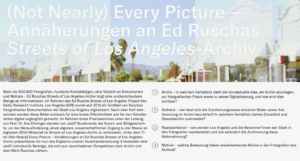
Prof. Dr. Eva Ehninger is a leading academic at the Institute for Art and Visual History at Humboldt University of Berlin , holding the Professorship for Modern Art History . Her research bridges photography theory, modernism, postcolonial studies, and transcultural methodologies , with a focus on visual media’s role in constructing social order. Education: Heidelberg, University of Michigan, Frankfurt/Main Doctoral thesis: Vom Farbfeld zur Land Art (2011, Benvenuto-Cellini Prize) Her research explores how photography, media, and art mediate social, political, and cultural dynamics. Current projects include the Käte Hamburger Kolleg inherit-heritage in transformation and Art Education Between Heritage Making and Critical Transregionality , analyzing entanglements between South Asian and European art education histories. Publications like The Modern Dream of Order (2025) and Ed Ruscha’s Streets of Los Angeles contributions examine Los Angeles as a site of visual critique and urban documentation. Her scholarly output spans 15 recent works addressing topics such as Victorian photography’s social imagination , biological metaphors in Smithson’s art , and dialogue in Nauman’s practice , reflecting interdisciplinary intersections of art history, media theory, and critical studies . She has received prestigious support from institutions like the Getty Research Institute and Terra Foundation for American Art . Scientific awards: Benvenuto-Cellini Prize (for dissertation) Grants: Studienstiftung des deutschen Volkes, Fulbright Commission, BMBF Ehninger supervises 10 ongoing PhD projects and co-edits journals like kritische berichte and Zeitschrift für Kunstgeschichte . She is a Vertrauensdozentin (Trusted Academic Advisor) for the Studienstiftung des deutschen Volkes, demonstrating her commitment to academic mentorship.
Lukas Engelmann is a Senior Lecturer at the University of Edinburgh , specifically within the Science, Technology and Innovation Studies department under the School of Social and Political Science . His research focuses on the history and sociology of biomedicine , with particular interest in epidemiological reasoning , visual cultures of disease , digital epidemiology , and decolonial approaches to medical history . The Epidemy Lab , which he founded, explores the historical development of epidemiology and its contemporary influence on data-driven public health and pandemic policy-making . Engelmann's work has been funded by prestigious grants including an ERC Starting Grant (2021-2025) for his research on the history of epidemiological reasoning, and support from the Wellcome Trust for projects examining the social dimensions of digital health . His book 'Mapping AIDS' (2018) established him as a leading scholar in medical visualization , while 'Sulphuric Utopias' (2020) with Christos Lynteris explores the technological history of maritime sanitation and its political implications. Recent publications emphasize the visual and data practices that have shaped epidemiology, including works on epidemic modeling during the COVID-19 pandemic , the history of plague mapping , and the ethical implications of digital phenotyping . He has also contributed to interdisciplinary discussions on syndemics , co-infection epistemology , and the commercialization of bacteriology in the early 20th century. His scientific contributions have earned recognition through editorial roles in journals like Big Data and Society , and collaborative projects such as 'Working with Diagrams' (2022) which investigates the epistemological role of visual tools in medical knowledge production. Scientific Awards and Funding: ERC Starting Grant (2021-2025) Wellcome Trust Institutional Support Fund British Academy/Leverhulme Small Research Grant Chancellor's Fellowship (University of Edinburgh) 'Sulphuric Utopias' listed in The Guardian's 30 Books to Understand the World (2020)
Dr. Philip Tallon is an Associate Professor of Theology and Dean of the School of Christian Thought at Houston Christian University. He holds a PhD in Theology from the University of St. Andrews, an MA in Theology from Asbury Theological Seminary, and a BA in English from the University of South Florida. His teaching spans courses such as Theology and Culture , Christian Theology and Tradition , and Film, the Visual Arts, and Apologetics . Dr. Tallon’s research focuses on theological aesthetics, particularly how the arts enrich theological understanding. He explores intersections between Christian truth and artistic expression in his work, including contributions to the Transpositions blog and Seedbed . His academic interests extend to C.S. Lewis, Sherlock Holmes philosophy, and theodicy through aesthetic frameworks. He has published widely on topics ranging from Wesleyan theology to horror film analysis, including books like The Poetics of Evil (2011) and edited volumes such as The Philosophy of Sherlock Holmes (2012). His articles engage with theological aesthetics, ethical dilemmas in literature, and philosophical arguments for God’s existence. A member of the Evangelical Philosophical Society and the Wesleyan Theological Society, Dr. Tallon balances academic work with ministry involvement and outdoor activities. He maintains an active presence on Twitter (@philiptallon) and contributes to academic and popular theological discourse through writing and speaking engagements.
Lisa Lowe is the Samuel Knight Professor of American Studies at Yale University, with affiliate appointments in the Programs in Ethnicity, Race, and Migration and Women's, Gender, and Sexuality Studies. She has previously taught at the University of California, San Diego, and Tufts University, establishing a distinguished interdisciplinary career in American Studies, Comparative Literature, and critical race theory. Education: Stanford University – European Intellectual History University of California, Santa Cruz – French Literature and Critical Theory Lowe's research focuses on the intersections of colonialism, race, immigration, and globalization. Her work critically examines how liberal modernity is built upon racial capitalism, settler colonialism, and transnational displacement. She is a leading voice in transnational feminism and Asian American studies, analyzing how immigrant subjects are constructed as 'perpetual foreigners' within national cultures. Her scholarship bridges literary analysis, historical critique, and political theory to interrogate the legacies of empire. Her recent publications show a sustained engagement with the entanglements of liberalism, empire, and intimacy across continents. Themes include racial capitalism, the transpacific, feminist resistance, and the cultural politics of globalization. Her work consistently challenges disciplinary boundaries and calls for a rethinking of American Studies through a global and decolonial lens. Scientific Awards and Honors: Guggenheim Fellow American Council of Learned Societies Fellow Rockefeller Foundation Fellow Mellon Foundation Fellow UC Humanities Research Institute Fellow University of California President's Faculty Research Fellow (2011–12) Visiting Fellow, School of Advanced Study, University of London F. Ross Johnson-Connaught Distinguished Visitor, Munk School of Global Affairs, University of Toronto (2012) Carl Bode - Norman Holmes Pearson Award (2018) Richard A. Yarborough Prize (2018) Finalist, John Hope Franklin Award (2016) Nicolás Guillén Outstanding Book Award (2018) 1997 Book Award in Cultural Studies, Association for Asian American Studies Lowe has been a mentor to numerous scholars, particularly from underrepresented backgrounds, recognized by the Richard A. Yarborough Prize. She has received multiple grants and fellowships supporting her research, including from the Mellon, Rockefeller, and Guggenheim Foundations. She co-convened the Mellon Sawyer Seminar 'Comparative Global Humanities' at Tufts and has been an Affiliate Scholar at the Boston Psychoanalytic Society and Institute (2022–2023). She has also served as a visiting fellow and speaker at numerous international institutions, indicating sustained collaborative and advisory engagement. Lowe co-edits the influential book series Perverse Modernities with Jack Halberstam at Duke University Press, shaping contemporary critical theory. She has also co-edited special issues and volumes that have advanced the field of Asian American Studies. Her scholarly network includes leading institutions across the U.S. and globally, and she continues to be a central figure in interdisciplinary humanities.
Ben Seymour is a Lecturer in Fine Art at the Department of Art, Goldsmiths, University of London. His research focuses on the intersections of urban regeneration, gentrification, and culture, alongside critical analyses of contemporary capitalism's ideologies, including precarious labor, creative economy, and financialization of art. He is also a writer and Deputy Editor of Mute Magazine , contributing to debates on digital culture, political economy, and artistic resistance. Position: Lecturer in Fine Art Institution: Goldsmiths, University of London Research Themes: Urban Regeneration, Gentrification, Art and Capitalism, Cultural Politics Email: b.seymour@gold.ac.uk Ben's academic and artistic work critically examines urban development processes, particularly in London's Hackney and other global cities, through films, articles, and visual essays. He has explored the socio-political consequences of regeneration projects, linking them to broader capitalist dynamics such as financialization and the erosion of community spaces. His practice extends to curatorial and editorial projects, including co-programming films on gentrification and organizing reading groups on Marx's Capital in Hackney and Brooklyn. His films have been internationally screened at festivals and galleries in Edinburgh, Leeds, NYC, Amsterdam, and Spain, addressing themes of urban utopianism and capitalist critique.
Kevin Buckelew is an Assistant Professor of Religious Studies at Northwestern University specializing in Chinese Buddhism, with particular expertise in Chan (Zen) traditions and Buddhist-Daoist interactions. He earned his B.A. in Liberal Arts from Sarah Lawrence College and his Ph.D. in East Asian Languages and Cultures from Columbia University. Affiliation: Northwestern University, Religious Studies Department Education: B.A. (Sarah Lawrence College), Ph.D. (Columbia University) His research explores Chan Buddhist claims to authority equivalent to the historical Buddha, focusing on embodiment, gender, and institutional practices during the Song dynasty. He also investigates Buddhist-Daoist intellectual exchanges, particularly regarding theories of liberation and bodily practices. Recent publications include Discerning Buddhas: Authority, Agency, and Masculinity in Chan Buddhism (2025) and co-edited volume Buddhist Masculinities (2023). His work appears in top journals like Harvard Journal of Asiatic Studies and T’oung Pao , supported by Fulbright and Bukkyo Dendo Kyokai grants. Scientific Awards: Fulbright Program Grant Bukkyo Dendo Kyokai Grant Buckelew's scholarship combines textual analysis, historical methodology, and thematic explorations of moral responsibility and gender construction in premodern Chinese religious contexts.
Jennifer A. Sandlin is an Associate Professor of Justice and Social Inquiry in the School of Social Transformation at Arizona State University (ASU). Her work focuses on public pedagogy, popular culture, and the intersections of education with consumption. She teaches courses on consumption and education, social justice, and cultural pedagogy. Sandlin holds a Ph.D. in Adult Education from the University of Georgia (2001), with a dissertation on educational programs for welfare recipients. She has authored/co-edited numerous books, including Paranoid Pedagogies (2018) and Critical Pedagogies of Consumption (2010), and has published widely in journals such as Journal of Consumer Culture and Adult Education Quarterly . Her research explores anti-consumerism activism, informal learning through popular culture, and the theory/practice of public pedagogy. She co-edits the Journal of Curriculum and Pedagogy and serves on editorial boards for multiple academic journals. Sandlin has received awards including the Early Career Award from the Commission of Professors of Adult Education (2005) and recognition as an Emerging Scholar by the American Association of University Women (2005). Her recent work addresses conspirituality, eco-horror, and pandemic pedagogies, reflecting her commitment to critically examining cultural and social structures. She actively engages in public scholarship through co-edited volumes and research on topics like Disney’s cultural curriculum and the political economy of consumption.