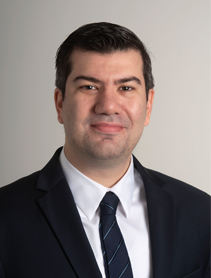
Philippos Mordohai is Professor in the Department of Computer Science at Stevens Institute of Technology's Charles V. Schaefer, Jr. School of Engineering and Science. He earned his PhD in Electrical Engineering from the University of Southern California and conducts research in geometric computer vision, 3D reconstruction, and robotic perception. His research combines machine learning and parallel programming to develop novel approaches for depth estimation, scene understanding, and autonomous navigation. Current projects include real-time dense mapping for underwater environments and domain generalization for stereo matching algorithms. Dr. Mordohai serves as associate editor for IEEE Transactions on Pattern Analysis and Machine Intelligence and has chaired multiple international computer vision conferences. His research has been supported by NSF, DOE, and Google, with applications in robotics, mixed reality, and autonomous systems.
Dr. Jose Luis SANCHEZ LOPEZ is a Research Scientist at the Interdisciplinary Centre for Security, Reliability and Trust (SnT) of the University of Luxembourg, leading the Aerial Robotics Lab (AeRoLab) within the Automation & Robotics Research Group (ARG). He joined SnT in 2017 as a Postdoc Research Associate, promoted to Research Scientist in 2021. His research focuses on autonomous robotics, particularly aerial systems, emphasizing situational awareness, SLAM, and trajectory planning. Education: Ph.D. in Robotics (2017), M.Sc. in Automation & Robotics (2012), and Engineering degree in Industrial Engineering (2010), all from the Technical University of Madrid. Visiting Research: Arizona State University (2012), LAAS-CNRS (2014–2016). Research Interests: Multi-agent robotic systems, sensor fusion, localization/mapping, computer vision, machine learning, and trajectory control. He has authored over 56 peer-reviewed publications, with an h-index of 18. Projects: Leads projects like DEUS (PI), NEDA, ÄerdFly (PI), and RoboSAUR. Contributions span European, Luxembourg, and Spain-funded initiatives, focusing on autonomous systems, 5G integration, and construction-site robotics. Teaching: Lectured in MICS, BiCS, BING (Uni.lu) and GITI (UPM). Actively involved in academic service as a reviewer, editor, and competition participant (e.g., IMAV, IARC). Outreach: National Coordinator for Luxembourg’s Robotics European Week, promotes robotics education in schools and public events.
Davide Scaramuzza is a Professor and Director of the Robotics and Perception Group at the University of Zurich. He holds a Ph.D. from ETH Zurich and has conducted postdoctoral research at the University of Pennsylvania and Stanford. His research focuses on autonomous drone navigation using visual and event-based sensors, leading to breakthroughs like AI drones outperforming human pilots in racing (Nature 2023). He pioneered algorithms for Mars helicopter navigation and developed the PX4 autopilot system. Key awards include the Kiyo-Tomiyasu IEEE Technical Field Award (2024), ERC Consolidator Grant (2019), and multiple best paper awards. His entrepreneurial ventures include co-founding Zurich-Eye (later Meta Zurich) and SUIND for agricultural drones. He co-authored the textbook Introduction to Autonomous Mobile Robots , widely used in academia. Research spans event camera algorithms, visual-inertial SLAM, and reinforcement learning for agile flight. His lab's work is featured in IEEE Spectrum, The Guardian, and Forbes. He advises UN initiatives on AI for disaster response and nuclear safety. Current projects include Graph-Generating State Space Models (CVPR 2024) and event-based vision for automotive systems (Nature 2024).
Keenan Albee is a Robotics Technologist at NASA’s Jet Propulsion Laboratory and an incoming Assistant Professor at the University of Southern California (starting Fall 2025). His research focuses on autonomous robotics for extreme environments including lunar missions, microgravity, and underwater operations. Education: Ph.D. in Aeronautics and Astronautics (Autonomous Systems), MIT (2022) S.M. in Aeronautics and Astronautics, MIT (2019) B.S. in Mechanical Engineering, Columbia University (2017) Albee’s work integrates optimal control , reinforcement learning , and motion planning to develop autonomy for mobile robotic systems operating under uncertainty. His expertise spans space robotics , microgravity systems , and underwater robotics , with a focus on environment-aware algorithm design. Recent research includes parametric information-aware motion planning (RATTLE algorithm), distributed multi-agent exploration, and robust control for uncooperative targets. His publications highlight on-orbit validation of autonomy algorithms via NASA’s Astrobee platform and upcoming lunar missions. Scientific Awards: NASA Space Technology Research Fellowship (2022) Albee actively develops open-source autonomy frameworks and will establish the Laboratory for Autonomous Systems in Exploration and Robotics (LASER) at USC. His work bridges theoretical control methods with real-world deployment, including first-of-its-kind achievements in space robotics.
Guoquan Huang is an Assistant Professor in the Department of Mechanical Engineering at the University of Delaware. He holds a B.Eng. in Automation from the University of Science and Technology, Beijing (2002), and M.Sc. and Ph.D. degrees in Robotics from the University of Minnesota (2009 and 2012). Prior to his current role, he was a Postdoctoral Associate at MIT's Computer Science and Artificial Intelligence Laboratory (CSAIL). His research focuses on robotics, computer vision, and autonomous systems, emphasizing probabilistic perception, estimation, and control for ground, aerial, and underwater vehicles. He leads the development of the OpenVINS platform for visual-inertial estimation and has contributed to advancements in SLAM (Simultaneous Localization and Mapping), sensor fusion, and multi-robot coordination. Education: B.Eng in Automation (Electrical Engineering), University of Science and Technology, Beijing, 2002 M.Sc. in Robotics, University of Minnesota, Twin Cities, 2009 Ph.D. in Robotics, University of Minnesota, Twin Cities, 2012 His research interests span robotics, computer vision, and autonomous systems , with a focus on: Visual-inertial navigation and SLAM Sensor fusion (LiDAR, IMU, camera) Autonomous vehicle control and safety Multi-robot cooperative localization His recent publications (2023–2025) emphasize robust algorithms for navigation in GPS-denied environments, real-time sensor calibration, and dataset development for aerial visual localization. He has pioneered techniques like decoupled error-state estimation and consistent parallel frameworks for SLAM. Labs/Teams: Leads the development of the OpenVINS research platform, focusing on visual-inertial state estimation. Collaborates on projects involving human-swarm interactions and resilient ground vehicle navigation.
Professor Jouni Mattila is a leading academic in Machine Automation at Tampere University's Faculty of Engineering and Natural Sciences, affiliated with the Automation Technology and Mechanical Engineering department. He is part of the IHA-Innovative Hydraulics and Automation research group. His expertise spans autonomous mobile working machines, nonlinear control engineering, and safety-critical systems like those in the ITER project. He holds a Technical Editor role in ASME/IEEE Transaction on Mechatronics (2015-2020). Research interests include real-world autonomous systems, whole-body motion control for rough-terrain robots, energy-efficient actuators, and teleoperation systems. His work integrates advanced control theory, AI, and robotics for heavy-industry applications. Recent publications focus on robust control frameworks, LiDAR-inertial SLAM navigation, and fault-tolerant systems for mobile robots. Publications highlight advancements in hydraulic/electromechanical actuator systems, visual-inertial feedback control, and energy-efficient robotics. Awards/recognitions are not explicitly listed, but his contributions are evident through collaborations with Finnish industry and big science projects. Advising focuses on MSc and Dr (Tech) students in robotics and automation, with a mission to bridge academia and industry for high-tech innovation. Labs/teams include the Intelligent Hydraulics and Automation (IHA) group, emphasizing practical R&D in cleantech and heavy-duty robotics. Ongoing projects address challenges in autonomous rock-breaking systems, exoskeleton control, and energy-efficient robotic actuators.
Dr. Hakki Erhan Sevil is an Associate Professor in the Department of Intelligent Systems and Robotics at the University of West Florida, within the Hal Marcus College of Science and Engineering. He holds a Ph.D. in Mechanical Engineering from the University of Texas at Arlington and has extensive research experience in robotics, intelligent systems, and autonomous control. His work spans theoretical and applied domains, focusing on resilient and intelligent robotic systems. Ph.D., Mechanical Engineering, University of Texas at Arlington M.S., Mechanical Engineering, Izmir Institute of Technology B.S., Mechanical Engineering, Izmir Institute of Technology Dr. Sevil's research interests lie at the intersection of robotics, artificial intelligence, and control systems. He specializes in autonomous navigation, fault detection and isolation (FDI), multi-agent coordination, computer vision, and bio-inspired computational methods. His work emphasizes real-world implementation in unmanned and self-sustained systems, particularly in challenging environments. His recent publications and projects highlight a strong trend toward intelligent, resilient, and distributed robotic systems. Themes include entropy-based behavior modeling for UAV swarms, assistive robotics for household tasks, post-disaster damage assessment using aerial vision, and advanced guidance for GPS-denied navigation. These reflect a multidisciplinary approach combining machine learning, control theory, and robotics engineering. 2024 Faculty Excellence in Teaching Award, UWF 2024 Faculty Excellence in Undergraduate Research Mentoring Award, UWF DURIP Grant ($478,000) from ONR (with IHMC) USDA Grant ($728,000) with New Mexico State University US Air Force SBIR/STTR Grant ($110,000) with Catalano Aerospace AFWERX Funding for Distributed Behavior Research Dr. Sevil actively mentors Ph.D. and M.S. students and leads the Sevil Research Group, which has secured multiple internal and external grants from NSF, NASA, ARL, ONR, and USDA. He has served as PI and Co-PI on funded projects and advises student teams that have won national awards. His lab, the Intelligent Systems and Robotics Lab, is highlighted in university communications and national challenges. The group collaborates with IHMC, NMSU, and industry partners, fostering innovation in autonomous systems. The Sevil Research Group operates within the Intelligent Systems and Robotics Lab at UWF, conducting cutting-edge research in autonomous navigation, swarm intelligence, and resilient robotics. The lab collaborates with the Institute for Human and Machine Cognition (IHMC), New Mexico State University, and private aerospace firms. It supports student-led projects, participates in national robotics challenges, and maintains active GitHub repositories for open research dissemination.
Dr. Clark N. Taylor is an Associate Professor of Computer Engineering and Director of the ANT Center at the Air Force Institute of Technology (AFIT), located at Wright-Patterson Air Force Base, Ohio. He is actively engaged in research and education within the Graduate School of Engineering and Management, focusing on advanced navigation and sensor fusion technologies for autonomous systems. Ph.D., Electrical and Computer Engineering (Computer Engineering), University of California, San Diego, 2004 M.S., Electrical and Computer Engineering, Brigham Young University, 1999 B.S., Electrical and Computer Engineering, Brigham Young University, 1995 Dr. Taylor's research spans computer engineering, navigation systems, and autonomous robotics, with a strong emphasis on sensor fusion, state estimation, and robust uncertainty modeling. His work integrates vision, inertial, magnetic, and pressure sensors for navigation in GPS-denied environments, particularly for unmanned aerial vehicles (UAVs). He is a leading expert in factor graph-based estimation, visual-inertial odometry, cooperative localization, and magnetic navigation. His publications demonstrate a consistent trend toward robust, uncertainty-aware estimation frameworks. Over the past decade, his research has evolved from early work on visual stabilization and pose estimation to advanced topics such as conservative covariance estimation, invariant filtering, and machine learning for spacecraft pose estimation. His recent articles focus on factor graphs, multi-agent fusion, and deep learning, indicating a trajectory toward intelligent, resilient navigation systems for defense and aerospace applications. Scientific awards include a Best Presentation in Session award at the ION GNSS+ conference in 2021. His research is supported by the U.S. Air Force and related defense agencies, with applications in surveillance, autonomous refueling, and on-orbit inspection. Dr. Taylor has advised numerous MS and PhD students, particularly in the areas of UAV navigation, sensor fusion, and cooperative localization. His lab, the ANT Center, focuses on advanced navigation and tracking, bringing together students and researchers to develop cutting-edge solutions for real-world operational challenges. The team conducts both simulation and experimental work, often integrating novel sensor modalities and estimation algorithms for improved system performance.
Helen Oleynikova is a Lecturer at the Department of Mechanical and Process Engineering at ETH Zürich, where she is part of the Autonomous Systems Lab. She works on the intersection of perception and planning, particularly for micro-aerial vehicles. Her research focuses on real-time onboard mapping, planning, and localization using visual-inertial systems and signed distance fields. Research Interests: Helen's work spans robotics, autonomous systems, and computer vision, with a focus on enabling safe and efficient navigation in complex environments. She specializes in visual-inertial odometry, SLAM, 3D mapping using signed distance fields, and real-time path planning for MAVs. Her projects often involve embedded systems and FPGA-based high-speed vision for obstacle avoidance. Publication Trends: Her recent publications (2023–2019) show a consistent focus on real-time, onboard algorithms for autonomous navigation. Key themes include signed distance function maps, collision-free motion generation, global localization, and efficient exploration. She frequently publishes in top-tier robotics conferences such as ICRA and IROS, and journals like IEEE RA-L and Journal of Field Robotics. Professional Experience: Senior Researcher, Autonomous Systems Lab, ETH Zürich Senior Software Engineer, Isaac 3D Perception, Nvidia Senior Scientist, Microsoft Mixed Reality and AI Lab, Zürich Software Engineer, Google (StreetView) Contributor, Willow Garage (ROS, TurtleBot Arm) Education: PhD in Robotics, ETH Zürich (2019) MSc in Robotics, ETH Zürich BSc in Robotics, Olin College of Engineering (2011) Advising and Grants: While no formal students are listed, she has collaborated extensively with researchers at ETH Zürich and industry labs. Her work has been supported through institutional affiliations and industry research roles. She has contributed to open-source robotics software, particularly in ROS-based systems for manipulation and navigation. Labs and Teams: Helen is a key member of the Mobile Manipulation team at the Autonomous Systems Lab at ETH Zürich. She has also been involved in projects at Nvidia, Microsoft, Google, and Willow Garage, focusing on real-world deployment of autonomous systems.
Guillermo Gallego is a Professor of Robotic Interactive Perception at the Faculty of Electrical Engineering and Computer Science , Technische Universität Berlin , holding the Einstein Center Digital Future (ECDF) Professorship since 2019. His research bridges robotics , computer vision , and applied mathematics , focusing on optimization methods for interdisciplinary imaging and control problems. Education : PhD in Electrical and Computer Engineering (Georgia Tech, 2011), MS in Mathematics (Georgia Tech, 2009), MS in Electrical Engineering (Georgia Tech, 2007), MS in Mathematical Engineering (Universidad Complutense de Madrid, 2005). Gallego's work explores event-based vision to enhance robot perception through low-latency sensing and real-time 3D reconstruction . He previously held postdoctoral positions at the Institute of Neuroinformatics (University of Zurich/ETH Zurich) and Technical University of Madrid (Marie Curie Experienced Researcher). His interdisciplinary projects span applications in ocean remote sensing , autonomous driving , and space exploration . Key scientific awards include the Fulbright Fellowship (2005-2010) and Marie Curie Experienced Researcher (2011-2014). His recent publications focus on event camera algorithms for optical flow , SLAM , and noise estimation , reflecting his leadership in event-based vision research. Collaborations include institutions like University of Zurich , Georgia Tech , and University of Pennsylvania . Research Grants : Funded through ECDF and Marie Curie programs. Labs : Affiliated with the Einstein Center Digital Future and Institute of Neuroinformatics (Zurich/ETH Zurich).
Dr. Antonio Ortiz is a Researcher at the University of Bonn, affiliated with the Life and Medical Sciences Institute (LIMES) and the IRU Mathematics and Life Sciences group. He works under the supervision of Professors Alexander Effland and Jan Hasenauer. His research focuses on Computer Vision in Medical Imaging and Machine Learning applications. He holds a Ph.D. in Electric and Electronics Engineering from Cinvestav, Mexico (2023), a Master's in Computer Science from Cicese, Mexico (2019), and a Bachelor's in Mechatronic Engineering (2017). His research integrates Bayesian methods, deep learning, and optical flow techniques for cardiac MRI segmentation, visual-inertial SLAM systems, and 3D shape measurement. Recent work emphasizes adaptive algorithms for medical imaging and robotics applications. Publications span medical imaging, robotics, and materials science, with a focus on algorithmic innovation and interdisciplinary applications. No scientific awards are explicitly mentioned, but his work demonstrates strong academic contributions. His advising activities and grants are not detailed in the provided text. He collaborates within the Effland Lab and IRT Mathematics and Life Sciences team.
Pierre-Yves Lajoie is an Assistant Professor in the Department of Computer Engineering and Software Engineering at Polytechnique Montréal, a leading engineering school affiliated with Université de Montréal. His research focuses on robotics and artificial intelligence, with specialization in robotic perception for single and multi-agent systems. He has held research positions at prestigious institutions including the Massachusetts Institute of Technology (2019), Samsung AI Center (2023), and University of Oxford (2024). Education: Ph.D. in Computer Engineering, Polytechnique Montréal Dr. Lajoie's research interests span across robotics, computer vision, and distributed systems. He specializes in developing algorithms for robotic perception in challenging environments, with applications in aerial, underground, indoor, and space robotics. His work focuses on enabling robots to understand their surroundings through visual and sensor data, particularly in collaborative multi-robot scenarios where communication may be limited or unreliable. His primary research center of excellence is the Industry of the Future and Digital Society, with secondary centers in Modeling and Artificial Intelligence and New Frontiers in Information and Communication Technologies. His publication record demonstrates a strong focus on collaborative SLAM (Simultaneous Localization and Mapping) systems, with recent work addressing challenges in planetary exploration, swarm robotics, and pedestrian positioning. His research combines computer vision, machine learning, and distributed systems to create robust solutions for real-world robotic applications, particularly in environments with communication constraints. Scientific Awards: Vanier Canada Scholarship Best Paper Award at IEEE ICC 2024 Dr. Lajoie is actively recruiting graduate students for PhD and Master's programs, with openings for Fall 2025 and Spring 2026. He encourages students to apply for various scholarship opportunities including NSERC, FRQ, and IVADO scholarships at multiple academic levels. His research is supported by collaborations with academic and industrial partners, focusing on applications in space robotics, automated manufacturing, and service robotics. He has supervised research projects in areas such as search and rescue with sparsely connected swarms and distributed risk-aware exploration systems.
Associate Professor Mingxi Zhou is affiliated with the University of Rhode Island ( URI )'s Graduate School of Oceanography and Department of Oceanography . His research focuses on marine robotics, autonomous underwater vehicles (AUVs), and underwater navigation, with an emphasis on vehicle autonomy and multi-vehicle collaboration. Ph.D., Memorial University of Newfoundland (2017) M.Eng., Memorial University of Newfoundland (2012) B.Eng., Central South University (2009) His work addresses challenges in adaptive formation control, sensor fusion, and accessible unmanned platform development. Recent publications highlight deterministic learning algorithms, underwater pose estimation, and fault isolation in soft robotics. His research trends include advancements in autonomous systems, collaborative AUVs, and robust navigation under dynamic uncertainty, leveraging technologies like sonar, visual-inertial odometry, and distributed learning frameworks. He currently teaches OCG120G: World of Robots and OCE/ELE550: Ocean Systems Engineering . He founded the SOS Lab in 2018 at URI's Narragansett Bay Campus, prioritizing student training on interdisciplinary skills and providing competitive financial support.
Claire Dune is an Assistant Professor at the University of Toulon, affiliated with the COSMER Laboratory (Mechanical and Robotic Systems Design Laboratory). Her research focuses on robotics, computer vision, and underwater systems, with applications in environmental monitoring and human-robot interaction. She teaches computer science, numerical methods, image processing, and visual servoing. Institution: University of Toulon Laboratory: COSMER (Mechanical and Robotic Systems Design Laboratory) Academic Rank: Assistant Professor Email: claire.dune@univ-tln.fr Her research centers on perception for robot control, particularly in underwater robotics and computer vision. Key interests include visual servoing, SLAM, gesture recognition for diver-robot interaction, and autonomous capabilities in real-world marine environments. She applies deep learning and sensor fusion techniques to enhance underwater visual perception and navigation. The recent publications demonstrate a strong trend in underwater robotics, with focus areas including tether dynamics (catenary modeling), ROV localization using umbilicals and IMUs, long-term visual localization in deep-sea environments, and color restoration in underwater imagery. Her work bridges theory and real-world application, contributing datasets like 'Eiffel Tower' for benchmarking and advancing multi-agent SLAM systems. Claire Dune has contributed to leading journals such as IEEE Robotics and Automation Letters, Ocean Engineering, and The International Journal of Robotics Research. Her editorial and survey work highlights her leadership in the domain of deformable object manipulation. Retrieval of benthic habitat abundance and bathymetry from hyperspectral data (DESIS) in shallow waters ROV localization using ballasted umbilical equipped with IMUs MAM3SLAM: Towards underwater robust multi-agent visual SLAM Eiffel Tower: A Deep-Sea Underwater Dataset for Long-Term Visual Localization Challenges and Outlook in Robotic Manipulation of Deformable Objects Claire Dune actively collaborates with researchers such as Vincent Hugel, Juliette Drupt, and Andrew Comport. She has supervised or co-supervised numerous research projects and publications, particularly in underwater robotics and assistive technologies. Her work involves experimental robotics and system integration, often validated in real marine environments. She leads research in the COSMER laboratory focused on underwater robotics, including projects on tethered ROVs, diver-robot communication via gesture recognition, and environmental monitoring using visual and hyperspectral data. Her team develops practical solutions for marine science and offshore operations, emphasizing robustness and autonomy.
George Mann is a Professor at Memorial University of Newfoundland's Faculty of Engineering and Applied Science. He holds a B.Sc. in Mechanical Engineering from the University of Moratuwa (Sri Lanka), an M.Sc. in Computer Integrated Manufacturing from Loughborough University (UK), and a Ph.D. in Intelligent Control from Memorial University. His research focuses on intelligent control systems, robotics, and machine vision, with significant contributions to autonomous navigation, sensor fusion, and UAV technologies. He leads the Intelligent Systems Laboratory (ISLAB) and has pioneered work on LiDAR-assisted radar enhancement, multi-robot localization, and exoskeleton control systems. **Education**: B.Sc., Mechanical Engineering, University of Moratuwa (Sri Lanka) M.Sc., Computer Integrated Manufacturing, Loughborough University (UK) Ph.D., Intelligent Control, Memorial University (Canada) **Research Interests**: Dr. Mann’s work spans autonomous systems, UAV navigation, sensor fusion (e.g., LiDAR, radar, INS), and robotics applications in mining, healthcare, and environmental monitoring. His recent projects include developing computationally efficient NMPC algorithms for UAVs and creating robust localization systems for heterogeneous multi-robot networks. **Publications**: His articles emphasize advancements in navigation algorithms, disturbance estimation for multi-rotor stability, and AI-driven sensor integration. Key themes include improving system robustness under uncertainty and optimizing computational efficiency in real-time control. **Labs & Teams**: Director of ISLAB, collaborating on exoskeleton development (e.g., Anthro-X) and UAV plume tracking for environmental sensing. Active in industry partnerships like C-CORE for mining automation.