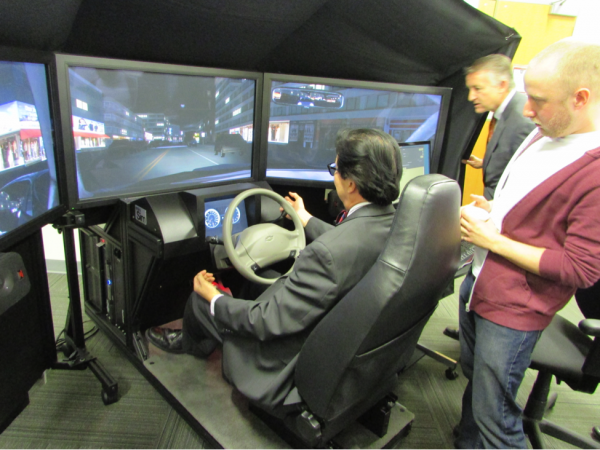
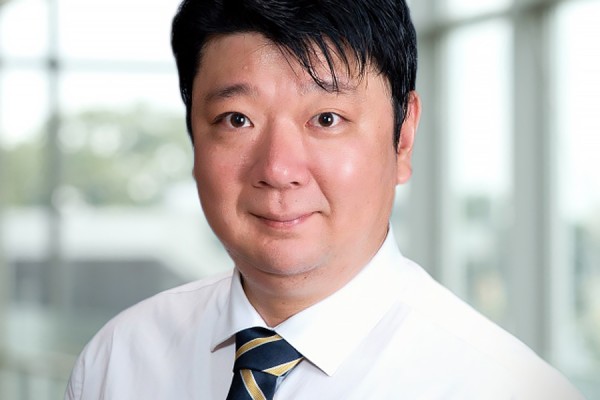
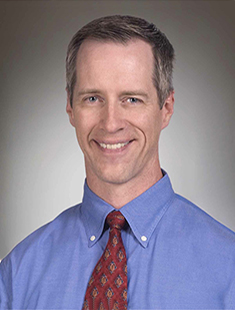
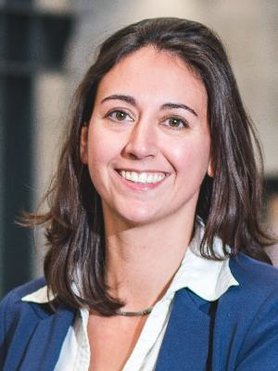
Professor Mohammad FARD is a faculty member at RMIT University's School of Engineering, specializing in Mechanical Engineering and Intelligent Systems. He leads research in autonomous vehicles, crash safety, and driver monitoring using AI. His industry experience includes six years at Nissan Technical Centre, focusing on vehicle body design. He holds a PhD from Tohoku University and has collaborated across Engineering, Health, and Science disciplines, achieving international media coverage for work on driver drowsiness and road safety. Research Interests: Autonomous Vehicles Advanced Crash Safety Driver State Monitoring AI in Noise/Vibration Human Factors/Ergonomics Teaching & Projects: Teaches Advanced CAE, Vehicle NVH, and research supervision in areas like crash simulation and vibration control. Current projects include Formula One safety barriers and driver education for autonomous vehicles. Awards & Labs: No awards listed. Active in cross-disciplinary teams and labs addressing automotive innovation and safety.
Dr. phil. Stefan Ladwig is a researcher at the Institute for Automotive Engineering (Institut für Kraftfahrzeuge) at RWTH Aachen University, specializing in traffic psychology, user acceptance, and human-machine interaction for automated driving systems. His work addresses psychological and ergonomic aspects of emerging mobility technologies, including seating ergonomics, trust-building mechanisms, and communication strategies for autonomous delivery robots. Research Focus: Automated driving, interior design psychology, driver/passenger behavior, and safety requirements. Projects: Lead roles in UrbANT (autonomous delivery robot) and SteeringBow (dynamic driving experience). Collaborations: Affiliated with Aldenhoven Testing Center, Future Mobility Partnership e.V., and innocam.NRW. Ladwig’s recent publications examine rotated seating positions, visual dominance in speed adaptation, and trust-relevant driving scenarios, reflecting his interdisciplinary approach to optimizing human-vehicle interactions. His work spans ergonomics, energy management, and behavioral interventions to enhance safety and usability in next-generation mobility solutions.
Professor Chris Lee is a faculty member in the Department of Transportation Science and Engineering at the University of Windsor's Faculty of Engineering. His research focuses on advancing transportation safety through the analysis of driver behavior, traffic flow dynamics, and the integration of emerging technologies like autonomous vehicles and machine learning. Key areas include collision risk prediction, driver vigilance assessment, and the development of advanced car-following models. He has contributed to initiatives such as the Transportation Science and Engineering scholarship program, supporting student research in innovative technologies like driving simulators for lane change behavior studies. His work bridges engineering and human factors, addressing challenges such as driver response to autonomous systems, heavy vehicle traffic management, and cross-cultural automotive design. Lee's interdisciplinary approach leverages data analytics, physiological signals, and machine learning to solve real-world transportation problems. His research has implications for policy-making, infrastructure design, and vehicle safety standards. Lee has collaborated extensively on projects analyzing crash precursors, variable speed limits, and the impact of ITS (Intelligent Transportation Systems) on safety. His publications span over two decades, demonstrating a commitment to both academic rigor and practical applications in transportation engineering. Notable contributions include refining car-following models, studying driver aggression, and evaluating the effectiveness of traffic management strategies.
Cyriel Diels is a researcher at the Royal College of Art's Intelligent Mobility Design Centre (IMDC) , focusing on automotive and transport design at the intersection of human factors, technology, and sustainable mobility. His career spans academia (Coventry University, RCA) and industry (Jaguar Land Rover, Transport Research Laboratory). Expertise : Human-machine interaction in automated vehicles, motion sickness mitigation, passenger experience design Key Projects : DOMUS (EU), SIMUSAFE (EU), UK CITE (Innovate-UK) Recent research explores motion discomfort alleviation through design interventions and adaptive HMI solutions in autonomous vehicles. Funded by European Commission, Innovate-UK, and automotive industry partners, his work combines cognitive psychology with applied transport design . Publications analyze: Simulator sickness management Visual-motion cue conflicts Seating appearance effects on comfort Warning sign design for vehicle interfaces Multi-axis motion sickness mechanisms Automated driving trust compatibility Current students include Yi Li, Pooya Sareh, Robin Severs, and Selin Zileli. Collaborative projects span future cities , intelligent mobility , and human-centered vehicle design .
Prof. Peter Vink is a Professor of Environmental Ergonomics at TU Delft's Faculty of Industrial Design Engineering (IDE), specializing in comfort and human-centered design for transportation systems. His work focuses on improving comfort in aircraft and automotive interiors, with notable contributions to seat design, noise/vibration mitigation, and sustainable aviation innovations like the Flying-V project. He holds leadership roles in projects such as ComfDemo and collaborates with industries like BMW and aerospace firms. Awards include the Crystal Cabin Award 2023 and Officer in the Order of Orange-Nassau (2023). Vink has advised 27 PhD students and is an acclaimed educator, winning the Pluim Award for inspiring teaching. His research integrates scientific rigor with practical applications, bridging academia and industry to enhance human well-being in travel environments. Affiliations: TU Delft IDE, Human-Centered Design Department Key Projects: Flying-V aircraft interior design, turboprop cabin demonstrator, BMW seat contour research Research Interests: Environmental ergonomics, sustainable aviation, seat and cabin design, passenger comfort metrics, and human factors in transportation systems. His work addresses challenges like zero-emission aircraft ergonomics and balancing lightweight materials with comfort needs. Awards: Crystal Cabin Award 2023 (aircraft interiors) Officer in the Order of Orange-Nassau (2023) Hal W. Hendrick Award (2011) for ergonomics contributions Most Inspiring Teacher (Pluim Award, 2021) Advising & Grants: Supervised 27 PhD students, with ongoing projects in aviation ergonomics and sustainable design. Collaborations with BMW, aerospace firms, and EU-funded initiatives like ComfDemo. Active in editorial roles for journals like Applied Ergonomics and Work . Labs/Teams: Leading IDE's research on vehicle comfort, collaborating with TU Delft's Aerospace Engineering faculty on projects like the Flying-V. Involved in developing emotion-aware car seats and smartphone-friendly ergonomic chairs.
Matthew B. Panzer serves as Associate Dean for Graduate Education and Post-Doctoral Affairs at the University of Virginia's School of Engineering and Applied Sciences, holding professorships in Mechanical & Aerospace Engineering and courtesy in Biomedical Engineering. As Deputy Director of the Center for Applied Biomechanics, he leads research in impact biomechanics and injury prevention. Education: B.S. in Mechanical Engineering, University of Waterloo, 2003 M.S. in Mechanical Engineering, University of Waterloo, 2006 Ph.D. in Biomedical Engineering, Duke University, 2012 Research Focus: Panzer's work employs computational and experimental methods to investigate high-rate non-linear mechanics in tissue mechanics, impact biomechanics, vehicle crashworthiness, military blast/ballistics, and sports injury. Current projects include traumatic brain injury mechanisms in football helmet impacts, biological tissue characterization, human body model development for automotive safety, and protective system design. His approach integrates finite element modeling with experimental validation to translate biomechanical findings into clinical and safety applications. Publication Trends: Recent work (2022-2025) emphasizes brain injury metrics, sex-specific biomechanical responses, and finite element model validation across automotive, sports, and military contexts. Key themes include rotational loading effects, biofidelic model development, and injury risk function derivation, demonstrating strong interdisciplinary integration of neuroscience, engineering, and computational science. Awards: Shannon Fellow (2024-2027) Copenhaver Fellow (2023) MAE Early Career Researcher of the Year (2021, 2022) UVA Research Achievement Award (2019) MAE Young Research of the Year (2018, 2019) Grants and Teaching: Panzer has secured over 40 research grants as Principal Investigator from federal agencies and industry partners. He teaches graduate courses including MAE 6710: Finite Element Analysis (annually since 2015), MAE 7030: Injury Biomechanics, and MAE 6952: Impact Mechanics, mentoring graduate students in biomechanics research despite no specific advisees listed in source materials. Laboratory Leadership: At the Center for Applied Biomechanics, Panzer directs teams conducting experimental testing and computational modeling to advance injury mechanism understanding and develop protective technologies for automotive, sports, and military applications.
Fregolent Annalisa is a Full Professor at the University of Rome La Sapienza, specializing in mechanical and structural engineering. Her research focuses on nonlinear dynamics, vibration analysis, and dynamic substructuring techniques. She has contributed significantly to advancing methodologies for joint identification, structural health monitoring, and the analysis of complex mechanical systems. Her work spans applications in aerospace, agricultural machinery, and noise reduction. Notable areas include the development of digital twins for hydraulic systems, experimental identification of pneumatic components, and the study of friction-induced vibrations using advanced substructuring techniques. She has published extensively on nonlinear modal coupling, contact acoustics, and error propagation in structural analysis. Key achievements include pioneering studies on configuration-dependent dynamics and the optimization of vibration transmission in mechanical linkages. Her research integrates experimental and numerical methods to address challenges in structural dynamics and mechanical system design. Research Highlights: Dynamic Substructuring Techniques Nonlinear Joint Identification Structural Health Monitoring Pneumatic and Hydraulic System Modeling Friction-Induced Vibration Analysis
Eunsik Kim is a Professor at the University of Windsor , holding a position in the Department of Mechanical, Automotive, and Materials Engineering within the Faculty of Engineering . His research focuses on ergonomics, occupational safety, and biomechanics, with applications in automotive design, workplace safety, and human-machine interaction. He leads the Occupational Safety and Ergonomics research lab , where students explore real-world solutions for challenges such as driver fatigue, musculoskeletal risks in manual labor, and automation in agriculture. Key research interests include: Ergonomics : Optimizing workstation designs, automotive seating, and anti-vibration tools Biomechanics : Analyzing human posture, musculoskeletal loading, and workplace ergonomics Machine Learning : Developing AI-driven systems for posture recognition, workload prediction, and task automation Autonomous Vehicles : Investigating human factors in driving automation and takeover scenarios Education Innovation : Gamification in engineering labs to enhance student motivation and learning Collaborations include projects with Ewha Womans University (South Korea) on autonomous vehicle comfort and a prototype robotic system for mushroom harvesting. His work often bridges theoretical research with practical applications, addressing both industry and academic challenges. Awards and Recognition: Students Ilfeoma Michael and Elnaz Akhavan Rezaee received accolades at the Association of Canadian Ergonomists conference for their lab research Advising and Grants: Professor Kim mentors students in interdisciplinary projects, focusing on ergonomics, robotics, and AI. His research has led to innovations in workplace safety and automated systems, supported by institutional and collaborative funding. Labs/Teams: The Occupational Safety and Ergonomics Lab and partnerships with South Korean institutions drive cutting-edge studies in automotive safety, robotics, and human factors engineering.
Pablo José Fernández Galdo is a faculty member at the University of A Coruña, affiliated with the University College of Industrial Design and the Department of Civil Engineering. His expertise lies in Engineering Projects, with a strong focus on industrial design, product development, and additive manufacturing. He is an active member of the research group 'Observatorio para el diseño e innovación en movilidad, medios de transporte y automoción', contributing to innovation in transportation and mobility systems. His research interests span Industrial Design , Product Development , Additive Manufacturing , Automotive Design , Urban Furniture , and Smart Mobility . He emphasizes design methodology, sustainability, and user-centered innovation, particularly in educational and real-world applications. His work integrates design with engineering principles to solve contemporary mobility challenges. The recent articles and project concepts reflect a strong trend toward future mobility , including autonomous vehicles, electric transportation, shared urban mobility, and habitat vehicles for sports tourism. Many projects are linked to industry collaborations, especially with SEAT/Cupra, indicating applied research with commercial relevance. There is a recurring focus on design for experience , adaptability , and innovation in public and personal spaces . He has supervised numerous final-year and master's theses, mentoring students in advanced design projects. His collaborative work includes publications in engineering education and service-learning practices, highlighting his commitment to pedagogical innovation. His research has been supported through various R&D contracts with entities such as Fundación PRODINTEC, TELEVES S.A., CTAG, and LOREFAR S.L., demonstrating strong industry engagement. He has contributed to books and journal articles, particularly in the domain of design education and applied engineering. He is involved in designing experimental projects, models, and prototypes, often in collaboration with students and other researchers. His work environment fosters innovation through hands-on workshops and real-world design challenges, especially in the context of sustainable and intelligent mobility solutions.
Anil K. Bajaj is the Alpha P. Jamison Professor of Mechanical Engineering at Purdue University's West Lafayette School of Mechanical Engineering. He holds a B.Tech. from Indian Institute of Technology, Kharagpur (1973), an M.S. from Indian Institute of Technology, Kanpur (1976), and a Ph.D. from the University of Minnesota (1981). His research focuses on nonlinear systems, structural dynamics, aeroelastic stability, and bifurcation phenomena, with applications in MEMS, transportation, and human-machine interaction. Key research areas include modeling nonlinear systems, flow-induced vibrations, impacting systems, and micro/nano-technology. He has pioneered studies on internal resonances in mechanical systems and aeroelastic damping of flexible structures. His work integrates experimental validation, computational modeling, and theoretical analysis. Recent articles explore advanced topics like bistable systems, nonlinear MEMS resonators, and transmission noise mitigation. Awards include the 2009 Mentorship Award and ASME Fellowship. He advises graduate students in dynamics and vibration, and collaborates with industry on automotive and biomedical applications. His labs focus on nonlinear dynamics, MEMS design, and seat-occupant systems modeling.
Marc Pomplun is a Professor and Chair of the Department of Computer Science at the University of Massachusetts Boston, and Director of the Visual Attention Laboratory. His research focuses on analyzing, modeling, and simulating human vision through eye-tracking, cognitive modeling, and interdisciplinary applications in education, neuroscience, and human-computer interaction. Education: Ph.D. in Cognitive Science (University of Bielefeld, Germany, 1998) Diploma Thesis in Computer Science (University of Bielefeld, 1994) Research Interests: Marc’s work spans visual attention, eye movements, dyslexia, human-computer interaction, and computational modeling of vision. He uses eye-tracking to study reading, memory, and visual search, and applies findings to assistive technologies and educational tools. Publications & Trends: His recent work includes AI-driven medical imaging for Alzheimer’s and cancer detection, gaze-based biometric identification, and adaptive learning systems for neurodiverse learners. He has published extensively in journals like Vision Research , PLoS ONE , and Journal of Vision . Scientific Awards: No specific awards are listed in the provided text. Advising & Grants: While no specific students are named, Marc has mentored numerous researchers and received funding for projects like GeoGaze, which integrates gaze data into geoscience education for neurodiverse learners. Labs & Teams: He directs the Visual Attention Laboratory at UMass Boston, focusing on interdisciplinary research in vision science and technology.
Anil Bajaj is the Alpha P. Jamison Professor of Mechanical Engineering at Purdue University's College of Engineering. He specializes in nonlinear dynamics, mechanical systems, and advanced material behavior, with a focus on applications in automotive engineering, MEMS/NEMS, and vibrational analysis. His research often involves numerical modeling, experimental validation, and bifurcation analysis of complex systems. Key research interests include bistable systems, viscoelasticity, resonance phenomena, and the dynamics of nonlinear structural components such as beams, plates, and trusses. He has contributed significantly to understanding parametric resonances, chaos in mechanical systems, and mitigation strategies for noise and vibrations in vehicles. Prof. Bajaj has collaborated on projects involving seat-occupant systems, fluid-structure interactions, and MEMS switch dynamics. His work frequently integrates computational methods like incremental harmonic balance and reduced-order modeling to predict and analyze nonlinear responses. He is affiliated with Purdue's ProEd Academic Advisory Committee and holds an office in ME 3180. His recent articles highlight advancements in reservoir computing with bistable systems, torsional vibration mitigation in vehicle drivelines, and stability analysis of viscoelastic structures. Despite his extensive publications, no specific awards or student advisories are listed in the provided materials.
José Ramón Méndez Salgueiro is a Lecturer at the Department of Civil Engineering, affiliated with the University School of Industrial Design at the University of A Coruña. His work focuses on design innovation in mobility, transportation, and automotive systems within an interdisciplinary engineering framework. Research Group : Observatory for Design and Innovation in Mobility, Means of Transport, and Automotive Teaching : Courses in Industrial Design Engineering, including Design Projects, Product Development, and Final Degree/Master's Projects His research explores synergies between engineering and creative design, emphasizing modular solutions, sustainable practices, and user-centered mobility systems. He has supervised numerous thesis projects since 2013, spanning topics like electric vehicles, adaptive furniture, and gamified transportation concepts. Thesis supervision highlights include collaborative works with Cupra/Seat on sports cars and SUVs, modular housing for students, and innovative designs for urban footwear, bicycles, and nautical vessels. His contributions bridge technical engineering with artistic interpretation in projects like gastronomic viewpoints, glamping structures, and coworking furniture.
Mark E. Benden is a Professor and Director of the Center for Worker Health at Texas A&M University's Department of Environmental & Occupational Health. His research focuses on ergonomics and occupational health interventions targeting sedentary behavior, obesity, and workplace design across office and educational settings. Education: PhD in Interdisciplinary Engineering, Texas A&M University MS in Industrial Engineering, Texas A&M University BS in BioEngineering, Texas A&M University Dr. Benden's work pioneers stand-capable workstation implementations, demonstrating measurable impacts on physical activity, productivity, and health outcomes. His research spans childhood obesity interventions in classrooms, remote worker ergonomics, and digital human modeling applications. He has developed patented ergonomic solutions including adjustable footrests and deployable floor mats that address workplace sedentariness. His 2024-2025 publications reveal expanding focus areas: accessibility of assistive technology, health equity in obesity interventions, and specialized ergonomic challenges in dental professions. Recent work increasingly integrates digital human modeling for remote work solutions while maintaining core emphasis on sedentary behavior reduction. Scientific Awards: Fellow, National Academy of Inventors (2023) Innovation Award, Texas A&M System (2018) Inc 5000 Company Honor, Stand2Learn (#567 Fastest Growing Company) (2018) Aggie 100, Stand2Learn (#5) (2018) US Top 10 Most Innovative Product Designer, Healthcare Design Magazine (2008) Buildings Magazine Editor's Top 100 for Ntune Seating System (2007) Platinum ADEX Award for NeXtepTM and BalanceTM Chair (2005-06) Platinum ADEX Award for AbStoolTM (2004-05) As Director of the Center for Worker Health, Dr. Benden leads research translating ergonomic principles into commercial products through Stand2Learn, which achieved national recognition as a top-growing company. His work informs ANSI/HFS 100 computer workstation standards and drives evidence-based interventions for worker health improvement.
Suzanne Hiemstra-van Mastrigt is a Professor and Director of the Seamless Personal Mobility Lab at Delft University of Technology's Faculty of Industrial Design Engineering. Her work focuses on human-centered mobility systems, including Mobility as a Service (MaaS), shared autonomous vehicles, and air-rail integration. She holds a PhD from TNO on passenger seat comfort and contributed to the EU H2020 PASSME project improving airport passenger experience. Her academic journey includes postdoctoral research on airport systems and collaborations with industry partners like aircraft and car manufacturers. She teaches courses on mobility, human factors, and user-centered design, and has supervised numerous student projects. Notable achievements include the 2016 Best Dissertation Award in Ergonomics and Crystal Cabin Awards recognition for innovative aircraft seat concepts. Her research spans resilience strategies in transport systems, BRT configurations, and pandemic-ready mobility infrastructure. Media engagements include op-eds on rail travel alternatives and documentaries on sustainable transport solutions. She directs the Seamless Personal Mobility Lab, exploring future mobility scenarios and fostering interdisciplinary collaboration.