Vanessa Lopez is a Senior Research Scientist and manager of the AI for Health and Social Care team at IBM Research Ireland since 2012. Her work focuses on enhancing AI systems through semantics and knowledge graphs to improve healthcare and scientific discovery. IBM Research Ireland, AI for Health and Social Care team Research interests: Semantics, Knowledge Graphs, NLP, Drug Discovery, Clinical Trials Optimization Her recent publications emphasize multimodal knowledge integration for accelerated discovery, biochemistry model evaluation, and peptide bioactivity prediction frameworks. She has contributed to open-source tools like Zshot and Otter-Knowledge. 2022 IBM Outstanding Technical Achievement Award 2017 US-Ireland Research Innovation Award 2022 IBM Patent Master Inventor Vanessa leads projects like Claims Audit (fraud detection), Cognitive Care Mentor (patient-centric analytics), and BlueLENS (knowledge graph querying). She has co-organized AI/semantic web challenges and served on editorial boards.
Dr. Serdar Arslan is a Lecturer at the Department of Computer Engineering at Cankaya University. He holds a PhD in Computer Engineering from Middle East Technical University (METU), with a thesis on multidimensional data indexing. His academic background includes a Master's (2005) and Bachelor's (2001) in Computer Engineering from METU and Hacettepe University, respectively. His research focuses on database systems, machine learning, multimedia data indexing, and forecasting models. Education: Bachelor of Engineering, Computer Engineering, Hacettepe University (2001) Master of Science, Computer Engineering, METU (2005) Doctor of Philosophy, Computer Engineering, METU (2018) Research Interests: Machine Learning applications in healthcare forecasting and financial markets Advanced indexing techniques for multimedia databases (e.g., MM-FOOD structure) Natural language processing for stance detection in political discourse Hybrid forecasting models combining LSTM and Prophet algorithms Domain-specific NLP for product name extraction in Turkish text Publications: His recent work emphasizes machine learning-driven solutions for complex systems, including pandemic modeling, cryptocurrency analysis, and conflict discourse analysis. His earlier contributions focused on multimedia indexing and image retrieval systems using MPEG-7 standards. The 2025 paper on OSINT architecture frameworks highlights his expanding focus on cybersecurity and system design. Labs/Teams: While no specific lab is mentioned, his GitHub repositories (e.g., Forecasting, NLP projects) suggest active involvement in collaborative research projects related to his domains.
Associate Professor Sonika Tyagi leads the Digital Health and Bioinformatics research lab at RMIT University's School of Computing Technologies. She is an affiliate Machine Learning scientist at Monash University and holds leadership roles in the Australasian Institute of Digital Health (AIDH) and Australian Research Council (ARC). Her research focuses on integrating machine learning with genomics and healthcare data to address clinical challenges, such as preterm birth prediction and antibiotic resistance. Research Interests: Multimodal data integration for personalized medicine AI-driven genomics and healthcare analytics Biomedical data standardization and infrastructure Natural language processing of unstructured medical data Key Projects: EHR-QC and EHR-ML pipelines for clinical outcome prediction GenomicBERT for genomic sequence analysis SuperbugAI flagship project on antibiotic resistance Awards: Healthcare Innovator Award 2024 (AI in Health) Women in AI (WAI) Awards Finalist 2022 Brilliant Women in Digital Health 2023 Grants & Funding: NHMRC grants (2017-2025) AISRF EMCR Fellowship (2020) Industry and university grants for equitable AI resources She advises diagnostic startups and collaborates with clinical institutions to translate research into practical solutions. Her lab trains over 30 students, focusing on interdisciplinary data science and computational biology.
Dr. Oluwafemi Olukoya is a Lecturer in the School of Electronics, Electrical Engineering and Computer Science at Queen's University Belfast. His research focuses on privacy, malware analysis, systems security, and cybercrime, with an emphasis on mobile systems security, sustainable malware analysis, and cyber-attack attribution. He is particularly interested in interdisciplinary projects addressing socio-technical dynamics in cybersecurity. Research interests include malware detection engineering, digital forensics, and integrating legal/regulatory frameworks with software development. He is actively involved in PhD supervision and has secured research funding, including participation in the NIO New Deal Cyber Bid project (AIDE_NICYBER2025). Dr. Olukoya has published extensively in top-tier venues, leveraging machine learning for cybersecurity challenges such as concept drift in malware classification and vulnerability detection. He received the Queen's Merit Award for Fellowship in 2022. His work bridges technical cybersecurity solutions with real-world regulatory and societal implications, contributing to both academic and applied domains.
Jihyeon Ha is an Assistant Professor in the Department of Marketing at the Tippie College of Business, University of Iowa. She holds a PhD in Marketing from Emory University, an MS in Business Administration, and a BBA from Seoul National University. Education: PhD in Marketing, Emory University MS in Business Administration, Seoul National University BBA, Seoul National University Her research focuses on leveraging Social Media , Digital Content , and Unstructured Data Analysis using Machine Learning techniques to explore Causal Inference in marketing contexts. A key publication analyzed paywall suspensions' impact on digital news subscriptions in Marketing Science (2023). Recent presentations at institutions like University of South Florida, Texas A&M, and National University of Singapore highlight her expertise in Multimodal Representation Learning for branded content and Natural Language Processing in brand personality assessment.
Dr. Suzan Arslanturk is Associate Professor in Computer Science and Industrial & Systems Engineering at Wayne State University's College of Engineering. She directs the Machine Learning and Health Informatics Laboratory, focusing on predictive analytics for healthcare applications. Research domains include: Cancer subtyping through multi-omics data integration Biomarker discovery for prostate cancer using cross-cancer learning Drug repurposing for cancers with DNA-repair deficiencies Neonatal brain anomaly detection via MRI analysis Operational healthcare optimization during medical surges Leads the development of deep learning frameworks for medical imaging segmentation and clinical text analysis. Publications demonstrate innovations in multimodal data fusion, domain adaptation, and unsupervised abnormality detection. Advises PhD candidates in computational healthcare research and directs academic programs in data mining and intelligent systems.
Li-minn Ang (Kenneth) is Professor of Electrical and Computer Engineering at the University of the Sunshine Coast's School of Science and Engineering. His research integrates Internet of Things (IoT), machine learning, and embedded systems for applications in smart cities, agriculture, and health. He has secured over $1.8 million in research grants and published three books with 180+ papers. Current projects develop application-specific IoT architectures and multimodal analytics for big data systems. Professor Ang teaches Internet of Things (ENG103), Applied Mathematics (MTH103), and Calculus (MTH104), serving as program coordinator for Electrical Engineering. Professional memberships include Senior IEEE status and HEA Fellowship. Laboratory resources support FPGA development, sensor networks, and IoT prototyping.
Marc Bravin is a Lecturer at Lucerne University of Applied Sciences and Arts in the Lucerne School of Computer Science and Information Technology, affiliated with the Digital Business Lab. He is also the Co-Founder & CTO of Gopf AG since 2023. Bravin holds a PhD in AI and Business from the University of Lucerne, alongside Master and Bachelor degrees in Computer Science from Lucerne University of Applied Sciences and Arts, with an apprenticeship in Computer Science at Pilatus Aircraft Ltd. PhD in AI and Business, University of Lucerne Master of Science in Engineering, Lucerne University of Applied Sciences and Arts Bachelor of Science in Computer Science, Lucerne University of Applied Sciences and Arts Apprenticeship in Computer Science, Berufsbildungszentrum Sursee His research focuses on Data Science, Machine Learning, Computer Vision, NLP, Self-Supervised Learning, and Digital Marketing . Key projects include CIRRNET, Health Innovation Transfer Study, Recommender Systems for Food and Telecom, and AI-based Employer Attractivity Benchmarking. He has also contributed to innovative ventures like AI Ice Cream and automated beer recipe generation. His publications span topics such as social media trend analysis, AI creativity, and machine learning applications. Notable works include studies on TikTok content prototypicality and minimal hand pose estimation for touchable systems. Best Poster Video Award (2022) for 'Minimal Hand Pose Estimation' Best Paper in AMA Conference Track (2022) for work on social media creativity Bravin’s career includes roles as a Data Scientist, Research Associate, and Software Developer in firms like Jaywalker Digital AG and Pilatus Aircraft Ltd. He collaborates with industry partners such as Prepress Media AG and Betty Bossi, applying AI to real-world challenges. He leads the Digital Business Lab’s initiatives in AI-driven innovation and maintains active involvement in academic-industry partnerships through projects like the Health Innovation Transfer Study.
Cédric Hammou Fadili is a researcher at the Conservatoire National des Arts et Métiers (CNAM) with a focus on Artificial Intelligence , Natural Language Processing , and Digital Humanities . His work bridges computational methods with sociocultural challenges, particularly in Amazigh/Berber language preservation and low-resource language processing . Active in chatbot development for education and language learning (2022-2024) Pioneering semantic wiktionaries for social sciences (2017-2022) Key contributions to blockchain-AI integration for model transparency (2020-2021) Research Trends : His 15 most recent publications (2019-2024) emphasize chatbot personalization , Arabic/Berber language normalization , and semantic knowledge organization . Technical approaches frequently combine deep learning (Bi-LSTM), ontological modeling , and linked open data frameworks. Collaborative Networks : Worked with institutions in Morocco (Rabat), Tunisia (Tunis), Egypt (Cairo), and France (CNAM, Inalco). Key collaborators include M. Chakiri (Berber ontologies), C. Jouis (contextual data exploration), and J-G. Ganascia (semantic mining). Long-Term Impact : His career spans from 1997 (SemioNet project) to 2024, consistently focusing on cultural preservation through digital methods , including semantic web applications (1998-2016), collaborative portals (2003-2008), and multilingual knowledge systems for Francophone regions.
Aron Henriksson is a Senior Lecturer and Associate Professor at the Department of Computer and Systems Sciences, Stockholm University. He co-leads the Natural Language Processing Research Group and contributes to the Learning Analytics and AI for Education Group , focusing on large language models, privacy, explainability, and domain adaptation across healthcare and education. His research integrates AI and NLP into critical domains, including Developing SweClinEval - the first Swedish clinical NLP benchmark Privacy-preserving techniques for LLMs using pseudonymization Multimodal prediction models for healthcare outcomes (e.g., COVID-19 mortality) Educational applications of retrieval-augmented generation Henriksson teaches courses in Big Data, AI management, NLP, and information retrieval. His work bridges technical innovation with practical implementation across EU-funded projects like Extreme Food Risk Analytics (EFRA) and clinical AI initiatives, emphasizing ethical AI deployment and data utility preservation.
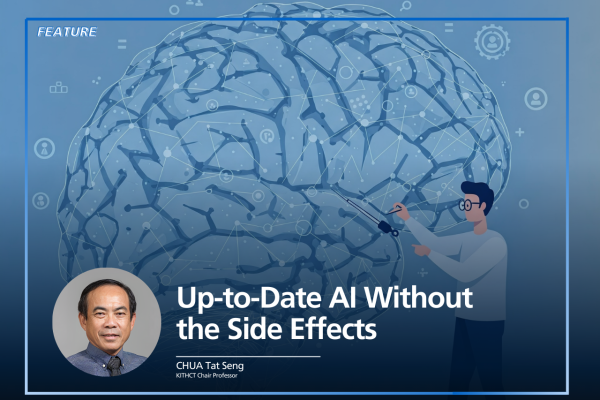
Professor Chua Tat Seng is a distinguished academic at the National University of Singapore's School of Computing, serving as KITHCT Chair Professor and Director of the NUS-Tsinghua Extreme Search Center (NExT). He also holds Distinguished Visiting Professorships at Tsinghua and Zhejiang Universities in China. PhD in Computer Science (University of Leeds, 1983) Founding Dean of School of Computing (1998-2000) Co-founded ViSenze and 6Estates technology startups His research focuses on unstructured multimodal data analytics, with particular emphasis on multimedia information retrieval, social media analytics, recommendation systems, and trustworthy AI. He has pioneered work in computational wellness and fintech applications, establishing the Lab for Media Search and leading NExT++ research initiatives. Over 300 publications in leading venues (CVPR, SIGIR, WWW, AAAI) Recipient of ACM SIGMM Technical Achievement Award (2015) Supervised 37 PhD students since 2004 Editorial leadership in ACM Transactions and IEEE Multimedia Recent work explores multimodal LLMs, knowledge editing techniques (AlphaEdit), and 3D generation frameworks, reflecting his commitment to advancing web intelligence and user empowerment.
Daniel Kang is an Assistant Professor at the Siebel School of Computing and Data Science, University of Illinois. His research focuses on machine learning systems, cybersecurity for AI models, and database optimization for unstructured data. He specializes in developing robust systems for large language models (LLMs), including defenses against adversarial attacks and benchmarking frameworks for AI agents. His work bridges machine learning and systems research, addressing challenges such as prompt injection vulnerabilities, zero-day exploit mitigation, and privacy-preserving inference via zero-knowledge proofs. He has contributed to tools like LEAP for processing unstructured data and AIDB for ML-driven databases. Key collaborations include studies on AI safety, vulnerability exploitation, and ethical AI evaluation. His research outputs emphasize practical applications of ML systems in cybersecurity, data engineering, and interdisciplinary domains like social science analytics.
Besat Kassaie is a Postdoctoral Researcher collaborating with Renée Miller. His research focuses on information extraction, natural language processing, and data privacy. Key areas include improving unstructured data quality through updatable extracted views, mathematical information retrieval (MathIR), and ontology matching techniques. His work spans theoretical advancements in information systems and practical applications in healthcare analytics. Notable contributions include frameworks for automated view maintenance, differential privacy methods for text data, and systems for detecting math answers using neural networks like Tangent-L. Kassaie's articles demonstrate a strong emphasis on database systems optimization, dynamic data processing, and the intersection of AI with mathematical problem-solving. His research bridges foundational computer science principles with real-world challenges in data privacy and interpretability.
Jerry Spanakis is an Assistant Professor at Maastricht University with dual affiliations: the Department of Advanced Computing Sciences (Faculty of Science and Engineering) and the Maastricht Law+Tech Lab (Faculty of Law). His roles include leading the EU Horizon project VOXReality, researching for NSMD/HumanAds/RegTech4AI initiatives, and serving as a technical expert for the European Commission’s e-enforcement academy. He coordinates MaastrichtNLP (NLP research group) and participates in the Open Science Community Maastricht. Education: PhD in Computational Intelligence (2007–2012) from the National Technical University of Athens, School of Electrical & Computer Engineering. Research Focus: Social Machine Learning: Developing responsible AI systems for societal challenges, including interpretable models for consumer protection and regulatory compliance. Computational Social Media: Analyzing social media data to detect online harms (e.g., misleading ads, content moderation failures) and model user behavior. Structuring Unstructured Data: Semantic organization of legal texts, social media, and multimodal data for applications in law, aviation, and public health. Publication Trends: Jerry's recent work (2023–2025) emphasizes NLP innovations for legal and regulatory domains, multilingual information retrieval, and ethical AI frameworks. Key themes include Large Language Model applications in law, influencer marketing compliance, and cross-lingual neural machine translation. Scientific Awards: None reported. Advising & Grants: Jerry supervises 7 PhD candidates and 100+ Master’s/Bachelor’s students in NLP, machine learning, and social computing. He leads the €2.8M EU project VOXReality (voice-driven XR interactions) and contributes to NWO/Philips grants on mental health analytics. Current grants focus on: AI-driven legal process automation (RegTech4AI) Dark pattern detection in e-commerce (NSMD) Influencer marketing transparency (HumanAds) Labs & Teams: Jerry founded MaastrichtNLP, a university-wide NLP research group, and co-leads the Law+Tech Lab, which develops computational tools for legal compliance. His teams collaborate with Deloitte, the European Commission, and healthcare institutions on applied AI projects.
Tarique Anwar is a Lecturer in the Department of Computer Science at the University of York, UK, since 2021. He holds a PhD in Data Science from Swinburne University of Technology, Australia. As Programme Leader for both MSc and BSc Data Science programs, he oversees admissions and curriculum development. His academic roles include Data Science Admissions Tutor and membership in the Artificial Intelligence Group. Research interests span Data Science , Machine Learning , Artificial Intelligence , and Social Media Analysis , with a focus on solving real-world problems using structured/unstructured data. Notable areas include mental health detection via social media, network analysis, and explainable AI. His work addresses challenges in: Depression severity assessment using attention mechanisms Rumor source detection in social networks Eating disorder classification through multimodal learning Geographic-social-temporal pattern mining He supervises MS/PhD students in Data Science and Analytics, emphasizing interdisciplinary research. His publications (2020–2025) demonstrate expertise in AI applications for health, social networks, and optimization. Labs/Teams: Artificial Intelligence Group at the University of York, collaborating with industry and academic partners globally.