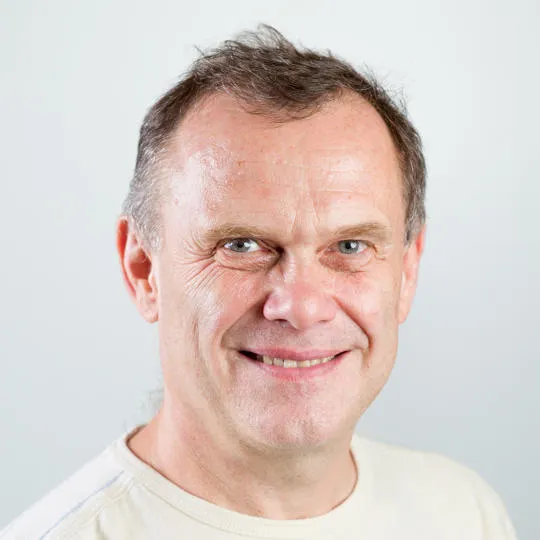
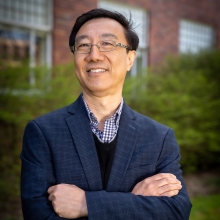
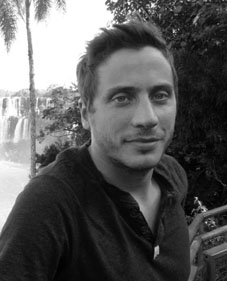
Jean-Pierre Leburton is the Gregory Stillman Professor of Electrical and Computer Engineering and a Research Professor in multiple laboratories at the University of Illinois Urbana-Champaign. He holds joint appointments in the Department of Physics and the Coordinated Science Laboratory. His academic journey includes roles as Visiting Professor at institutions like the Swiss Federal Institute of Technology (EPFL) and the University of Tokyo. Leburton’s research focuses on nanoscale semiconductor devices, quantum structures, and bio-nano-electronics, with notable contributions to DNA sensing and data storage technologies. Education: PhD in Theoretical Solid State Physics, University of Liège, Belgium (1978) Licence in Physics, University of Liège, Belgium (1971) Research Interests: Transport and optical processes in quantum wells/wires/dots Spintronics and single-electron effects Interaction between biomolecules and semiconductors 2D materials and nanofluidic systems Awards & Honors: IEEE Nanotechnology Council Pioneer Award (2021) Life Fellow of IEEE Member of Royal Academy of Science (Belgium) Listed in multiple Who’s Who editions Grants & Leadership: Funding from NSF, DARPA, and industry partners like Oxford Nanopore Chair roles in IEEE Nanotechnology Council committees Editorial Board member for Nanotechnology (IoP) Labs & Affiliations: Affiliated with the Micro and Nanotechnology Laboratory, Frederick Seitz Materials Research Laboratory, and the Beckman Institute’s Computational Electronics Group.
Professor Jürgen Berndt is a distinguished mathematician specializing in differential geometry, particularly focusing on the geometry of submanifolds, Riemannian manifolds, and Lie group actions. He holds the position of Professor of Mathematics at King’s College London, where he has been since 2009 and served as Head of the Department of Mathematics until 2013. **Education:** PhD in Mathematics, University of Cologne, 1989 Habilitation in Mathematics, University of Cologne, 1995 **Research Interests:** Explores geometric problems with algebraic, analytic, and topological connections, including submanifold geometry, curvature properties, homogeneous spaces, and Lie group symmetries. His work emphasizes symmetric spaces and their applications, with over 50 research articles and four books. **Grants & Collaborations:** Secured grants from EPSRC, JSPS, and others. Collaborated with mathematicians globally, including those from Argentina, Japan, Spain, and the USA. Advised numerous PhD students, many now in academic and industry roles. **Professional Engagement:** Organized 42 conferences/workshops, including the UK-Japan Winter Schools. Served on editorial boards and grant review panels, and delivered invited talks worldwide.
Christine Aikens is a University Distinguished Professor of Chemistry at Kansas State University (KSU), where she leads the Aikens Research Laboratory. Her work focuses on theoretical and computational studies of nanomaterials, particularly noble metal nanoparticles and their applications in catalysis, energy, and biorenewables. She holds a B.S. from the University of Oklahoma (2000) and a Ph.D. in Physical Chemistry from Iowa State University (2005), followed by postdoctoral research at Northwestern University (2005–2007). Her research emphasizes understanding structure-property relationships in nanomaterials, including optical properties, electron dynamics, and catalytic reactivity. Major areas include plasmon-enhanced photocatalysis, bioinspired water splitting catalysts, and ligand effects on nanoparticle stability. She collaborates with experimental groups globally, including the Di Sun and Ackerson groups for nanocluster characterization and synthesis. Dr. Aikens has received numerous awards, including the NSF CAREER (2010), Sloan Fellowship (2011), Camille Dreyfus Teacher-Scholar (2011), and 2020 ACS Rising Star Award. Her lab has pioneered computational methods like TDDFT+TB for nanoscale systems and contributed to software development for teaching nanoscience (NUITNS program). Grants: DOE, NSF, Air Force Office of Scientific Research Students: Advised 15+ graduate students and postdocs, including current researchers Sulalith Samarasinghe and Gayathri Habarakadage Active in professional service, she co-organized the 2024 International Symposium on Monolayer-Protected Clusters and frequently presents at Gordon Research Conferences. Her lab's work bridges theory and experiment, advancing sustainable materials and energy solutions.
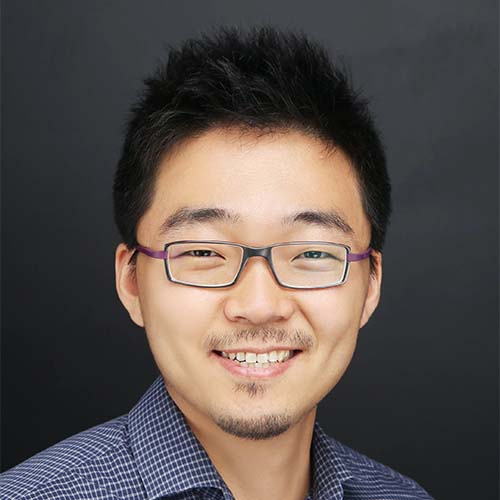
Ethan Ahn is an Associate Professor at George Mason University's Department of Electrical and Computer Engineering, part of the Volgenau School of Engineering. Previously, he held academic positions at the University of Texas at San Antonio (2016–2023) and served as a senior panel process engineer at Apple and a postdoctoral researcher at Stanford University. He leads the Mason Nanoelectronics Lab, focusing on nanoscale materials and devices for energy-efficient electronics, spintronics, and beyond-CMOS technologies. Educational Background: PhD in Electrical Engineering, Stanford University (2015) MS and BS in Electrical Engineering, Korea Advanced Institute of Science and Technology (KAIST, 2005–2007) Research Interests: His work spans emerging nanomaterials (e.g., graphene, MoS2), energy-efficient logic/memory devices, and carrier transport mechanisms. Key areas include spintronics, phase-change memory, and energy harvesting systems. His lab collaborates with industry and government through VMEC and VAST alliances. Grants & Awards: Recipient of over $4M in funding, including the AFOSR Grant in Quantum Electronic Solids and the NSF EAGER Grant in Electronics/Photonics. He serves on IEEE technical committees and the editorial board of Scientific Reports. Labs & Teams: The Mason Nanoelectronics Lab operates a state-of-the-art nanofabrication facility, advancing research in nanoelectronics and workforce development. The lab explores biomedical devices, energy solutions, and smart infrastructure integration.
Simone Parisi is a Postdoctoral Researcher at the Department of Civil and Mechanical Engineering, Technical University of Denmark (DTU), specializing in thermal energy systems and turbomachinery. He completed his PhD at DTU in 2024 with research on turbomachinery for packed-bed thermal energy storage systems under Professor Fredrik Haglind's supervision. His research focuses on: Thermal Energy Storage (including cryogenic and pumped thermal systems) Advanced Turbomachinery design and modeling Power cycle optimization (Rankine, Brayton, and hybrid cycles) Two-phase flow applications for waste heat recovery Numerical methods for compressor and turbine performance prediction Recent publications demonstrate deep expertise in energy storage integration, with emphasis on liquid air systems coupled with solar or district cooling, and innovative two-phase turbine modeling. His work bridges theoretical non-dimensional analysis with practical industrial applications in geothermal and waste heat utilization. Dr. Parisi actively contributes to major EU-funded projects including EMPOWER (geothermal/waste heat power generation) and Best4Grid (battery-grid stability), collaborating with Professor Haglind's research group. Current work explores zero-dimensional compressor models and hybrid storage-district energy synergies.
Xin Li is a Professor and Chair of the Department of Mathematics at the University of Central Florida (UCF), affiliated with the College of Sciences. His research focuses on approximation theory, optimization, and advanced nanomaterials including perovskite quantum dots, plasmonic sensors, and neuromorphic optoelectronic systems. He leads the STATESS Project, a NSF-funded initiative supporting STEM students through scholarships and mentorship. Key research areas include nanomaterial synthesis, optoelectronic device development, and machine learning applications in material science. Notable projects involve gas sensing systems, graphene-integrated photonic devices, and deep learning-based intrusion detection in optical fiber networks. Teaching responsibilities include advanced mathematics courses like Analysis I and Matrix & Linear Algebra. Professional service includes leadership in academic administration and collaborative interdisciplinary research initiatives. Publications emphasize cutting-edge applications in nanotechnology, plasmonics, and energy systems, with a focus on material stability, sensor optimization, and optoelectronic innovation. Current work explores hybrid materials for neuromorphic computing and high-performance photovoltaic systems.
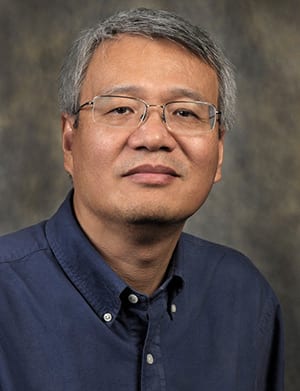
Michael Qian is a Professor in the Department of Food Science & Technology at Oregon State University's College of Agricultural Sciences. He is also a core member of the Oregon Wine Research Institute and has extensive professional affiliations including the Executive Committee of the Agricultural and Food Chemistry Division of the American Chemical Society, the Institute of Food Technologists, American Dairy Scientist Association, and American Society of Enology and Viticulture. Dr. Qian received his B.S. in Chemistry from Wuhan University (1982), M.S. in Food Science from the University of Illinois at Urbana-Champaign (1989), and Ph.D. in Food Science from the University of Minnesota (2000). His research focuses on flavor chemistry and technology, with particular emphasis on wine and grape flavor chemistry to identify and quantify flavor compounds important to wine quality and understand how they change the chemical composition of fruit after winemaking and during aging. His laboratory research is centered on aroma and flavor compound identification and characterization, flavor compounds chemical and biochemical generation, and flavor retention and deterioration during processing and storage. Current projects involve flavor chemistry of small fruits, grape and wine, beer, hop, and dairy products. He specializes in solventless sample preparation techniques such as solid phase micro-extraction, solid phase dynamic extraction, stir bar sorptive extraction and instrumental analysis with GC, fast GC, HPLC, GC-MS, GC-MS/olfactometry, and multi-dimensional GC/GC-MS analysis. Dr. Qian's publication record demonstrates consistent expertise in food flavor chemistry, particularly in wine, beer, and distilled spirits analysis. His recent work shows increasing focus on advanced analytical techniques for detecting smoke exposure in wine, volatile phenol analysis, and comprehensive two-dimensional gas chromatography for flavor profiling across diverse food and beverage matrices. FEMA Excellence in Flavor Science, Flavor and Extract Manufacturers Association of the U.S. (FEMA). (October 24, 2022) Distinguished Lipid and Flavor Science Award in honor of Stephen S. Chang, The Institute of Food Technologists (IFT). (July 10, 2022) 2020-21 James and Mildred Oldfield/E.R. Jackman Team Award, College of Agricultural Sciences. (2021) Industry Partner Award, Oregon Wine Board. (February 22, 2021) Stay at Home Hero Award, Oregon State University College of Agricultural Sciences. (October 2020) Fellow, American Chemical Society (ACS). (August 2019) Distinguished Service Award, American Chemical Society-Agricultural Food Chemistry Division. (2018) Fellow, American Chemical Society – Agricultural & Food Chemistry Division. (August 2014) Honorary State FFA Degree Recipient, Oregon FFA Association. (2010) Emerging Scholar Award, The Honor Society of PHI KAPPA PHI. (2006) Dr. Qian has served as past chair of the Agricultural and Food Chemistry Division of the American Chemical Society and is an elected fellow of this division. His research has been supported by various funding sources related to food science, viticulture, and enology, with numerous publications spanning food chemistry, analytical techniques, and flavor science. As a core member of the Oregon Wine Research Institute, Dr. Qian contributes to collaborative research efforts focused on advancing the science of wine production and quality. His laboratory serves as a hub for flavor chemistry research with state-of-the-art analytical instrumentation for comprehensive flavor analysis across multiple food and beverage systems.
Ahlam Al-Rawi is an Associate Lecturer in the Department of Physics at the University of Central Florida (UCF), affiliated with the College of Sciences. Her work bridges physics and interdisciplinary research, focusing on molecular dynamics simulations, surface physics, and nanoscale systems. She holds a faculty position emphasizing both teaching and research. Research Interests: Dr. Al-Rawi specializes in computational studies of nanostructures, peptide-membrane interactions, and surface dynamics. Her research explores molecular mechanisms in materials science using advanced simulation techniques, including molecular dynamics and Monte Carlo methods. Key themes include nanomaterial behavior, biomolecular interactions, and surface thermal phenomena. Publications Overview: Her work spans over two decades, with contributions to understanding nano-island diffusion on metal surfaces, peptide channel formation in membranes, and vibrational dynamics of nanoparticles. Recent studies (2013) also address educational methodologies in physics pedagogy. Awards & Recognition: No scientific awards or fellowships are explicitly mentioned in her profile. Advising & Grants: While no advisees or grant details are listed, her publications indicate active collaboration in computational physics and biophysical chemistry research. Labs & Teams: Affiliated with the UCF Department of Physics labs focusing on theoretical and computational studies in surface physics and nanomaterials.
Il-Yeol Song is a Professor of Information Science at Drexel University's College of Computing & Informatics (CCI). His research focuses on modeling & design theory applications, particularly in conceptual modeling , data warehousing , big data analytics , UML , healthcare informatics , and smart health . PhD, Computer Science, Louisiana State University (1988) MS, Systems Sciences, Louisiana State University (1984) BS, Nuclear Engineering, Han-Yang University, Seoul, Korea (1975) Song has contributed extensively to data science and big data, with over 25 years of research in DOLAP (Data Warehousing and OLAP) and DaWaK (Big Data and Knowledge Discovery). His work bridges database systems with healthcare applications and educational standards modeling. Recent publications analyze the evolution of data & knowledge engineering and trends in big data research. He has co-edited proceedings for conferences like DaWaK 2019 and DOLAP 2020 , reflecting his leadership in data science. ACM Distinguished Scientist Recipient of the 2001 Christian R. and Mary Lindback Distinguished Teaching Award Song serves on editorial and conference committees, advancing database education through workshops and curriculum development. His email is song@drexel.edu , and his research is available at cci.drexel.edu/faculty/song .
Dhara Trivedi serves as Assistant Professor in Physics at Clarkson University's Coulter School of Engineering & Applied Sciences, leading interdisciplinary research at the intersection of condensed matter physics, materials science, and computational chemistry. Her work focuses on atomistic-level modeling of charge/energy transfer processes in next-generation materials for energy and environmental applications. Her academic foundation includes: Ph.D. in Physics from University of Rochester (2015) M.Sc and B.Sc in Physics from Gujarat University, India Trivedi's research program develops quantum-classical computational frameworks to investigate electronic processes in perovskites, 2D materials, and metal-organic frameworks. Key thrusts include plasmon-enhanced energy transfer, characterization of nanoscale interfaces, and non-adiabatic dynamics in photoexcited systems. This work bridges fundamental physics with practical applications in solar energy harvesting and environmental remediation, leveraging time-domain ab initio methods to simulate real-world material behaviors. Analysis of her recent publications reveals a strategic pivot toward computational materials discovery, with dominant themes in perovskite photovoltaics (35%), MOF-based environmental applications (30%), and quantum dynamics methodology development (25%). Her group increasingly employs high-throughput screening and data mining techniques to accelerate materials design, particularly for solar cells and water purification systems. The Trivedi Research Group maintains active projects on spacer engineering in 2D perovskites, toxic oxoanion capture using functionalized MOFs, strain effects in hybrid perovskites, and plasmonic nanolaser mechanisms. The team operates at the physics-chemistry-engineering nexus, utilizing advanced simulation tools to address critical challenges in renewable energy and environmental sustainability.
Dr. Mohammad El Smaily is an Associate Professor in the Department of Mathematics and Statistics at the University of Northern British Columbia (UNBC), part of the Faculty of Science and Engineering. He holds a PhD in Mathematics from Aix-Marseille Université (2008). Before joining UNBC, he held postdoctoral positions at the University of British Columbia (PIMS postdoc), Carnegie Mellon University, and the University of Toronto (NSERC postdoc). His research focuses on Partial Differential Equations (PDEs) , dynamical systems , and their applications in population dynamics , mathematical biology , and ecology . Key areas include reaction-diffusion models, integro-difference equations, and the analysis of traveling waves in heterogeneous environments. Recent work explores mixed local/nonlocal operators , nonlinear advection-diffusion systems , and free boundary problems in ecological contexts. His publications span topics like front propagation in shear flows, Wolbachia infection models, and spectral analysis of nonlocal operators. Dr. El Smaily currently advises students in MSc and PhD Mathematics programs at UNBC. His research has been supported by collaborations with institutions globally, including the University of New Brunswick and INRAE (France). Publications (selected): Over 20 peer-reviewed articles, including work on KPP equations, integro-difference systems, and predator-prey dynamics with free boundaries. Full list available on Google Scholar .
Juntao Huang is an Assistant Professor at the University of Delaware , specializing in computational mathematics and applied mathematical modeling. His research bridges numerical analysis, machine learning, and physical systems, focusing on hyperbolic partial differential equations, kinetic theory, and high-order numerical methods. Dr. Huang's work emphasizes machine learning-based moment closures for equations in fluid dynamics, radiative transfer, and semiconductor physics. He develops implicit-explicit (IMEX) schemes for stiff hyperbolic systems and investigates bound-preserving discontinuous Galerkin methods in reactive flows. His publications highlight adaptive sparse grid algorithms and stability-preserving time integrators . His recent article trends include machine learning integration into kinetic models (BGK equations, Boltzmann transport), multi-scale hyperbolic systems , and thermodynamically stable PDE formulations . This aligns with his interest in non-equilibrium flow modeling and numerical methods for Vlasov-Maxwell equations in plasma physics. Dr. Huang's advising and grant information isn't present in the provided texts, but his technical contributions span from lattice Boltzmann methods for convection-diffusion equations to curved interface treatments in kinetic simulations. His work also explores information theory through generalized Kullback-Leibler divergences in Tsallis statistics.
Lev Levitin is a Senior Research Fellow in the Department of Physics at Royal Holloway, University of London. His work focuses on superfluidity, quantum fluids, and low-temperature physics. He has contributed to major projects like SquBa (Quantum fluid Bath noise reduction) and the European Microkelvin Platform (EMP). Recent research includes studies on chiral superfluid helium-3, cosmological phase transitions, and nanofluidic confinement effects. Key projects include: SquBa (2024-2027) : Silencing quantum circuit noise using quantum fluids. EMP (2019-2023) : Collaborative European platform for ultra-low temperature physics. Levitin’s datasets include groundbreaking work on superfluid 3He surface states (2021) and quasi-two-dimensional chiral superfluidity (2024). His research has been featured in over 30 news outlets and widely shared on academic platforms like Mendeley.
Xavier Rojas is a Royal Society University Research Fellow and Proleptic Lecturer in the Department of Physics at Royal Holloway, University of London. He holds a doctorate from École Normale Supérieure (2011) and completed postdoctoral research at the University of Alberta (2012–2015) and Royal Holloway (2015–2016). His research focuses on three main areas: Superfluid Optomechanics, Topological Superfluidity, and Nano-Electro-Mechanical Systems (NEMS). He leads projects such as SquBa (EPSRC-funded) and the QUEST-DMC collaboration (STFC-funded), exploring quantum technologies and dark matter detection. His work integrates nanofluidics, low-temperature physics, and quantum mechanics. Education: PhD in Physics, École Normale Supérieure (2011); Postdoctoral Fellowships at University of Alberta (2012–2015) and Royal Holloway (2015–2016). Research Interests: Superfluid Optomechanics: Developing cavity optomechanical systems using superfluid helium in nanofluidic resonators to probe quantum limits. Topological Superfluidity: Studying helium-3 in nanoscale geometries to model topological quantum matter. NEMS: Designing ultra-sensitive mechanical probes for quantum regimes and quantum fluid studies. Recent Articles: Focus on superfluid dynamics, dark matter detection via superfluid bolometers, and optomechanical systems. Key contributions include quasi-two-dimensional superfluid phases and ambient-temperature optomechanical transparency. Awards: Royal Society University Research Fellowship (2016–present). Grants & Advising: Principal Investigator for projects like Superfluid Optomechanics for Quantum Sensing (Royal Society, 2022–2025). Collaborates widely, including with the QUEST-DMC consortium. Labs/Teams: Leads the Xavier Rojas Lab (www.xrojaslab.org), specializing in ultra-low temperature quantum systems and nanofluidics.
Hartwin Peelaers is an Associate Professor in the Department of Physics & Astronomy at the University of Kansas, part of the College of Liberal Arts & Sciences. His research focuses on computational condensed matter theory, particularly using density functional theory (DFT) to design advanced materials for nanoscale and energy devices. He holds dual positions at the Gray-Little Hall and Malott Hall campuses in Lawrence, KS. Education: PhD in Physics, University of Antwerp (2009) MS in Physics, University of Antwerp (2005) BS in Physics, University of Antwerp (2003) Research interests center on layered battery electrodes, photovoltaic materials, and low-dimensional material properties. His work emphasizes computational design of heterostructures, defect engineering in oxides like Ga2O3 and Al2O3, and electronic/thermal properties of novel materials for energy applications. Recent studies explore memristor materials, 2D molecular crystals, and interlayer exciton dynamics in hybrid systems. Publications reflect a focus on wide-bandgap semiconductors, defect characterization, and device-relevant material properties. His work bridges theory and experiment, with contributions to Ga2O3 alloys, V2O5 ionic transport, and MoS2-based heterostructures. No scientific awards are listed, but his extensive postdoctoral experience (including roles at UC Santa Barbara and the Belgian American Educational Foundation) underscores his research expertise. He has advised no listed students, though his research group likely engages in graduate training. Lab affiliations are not explicitly stated, though his work involves collaborations with experimental groups.