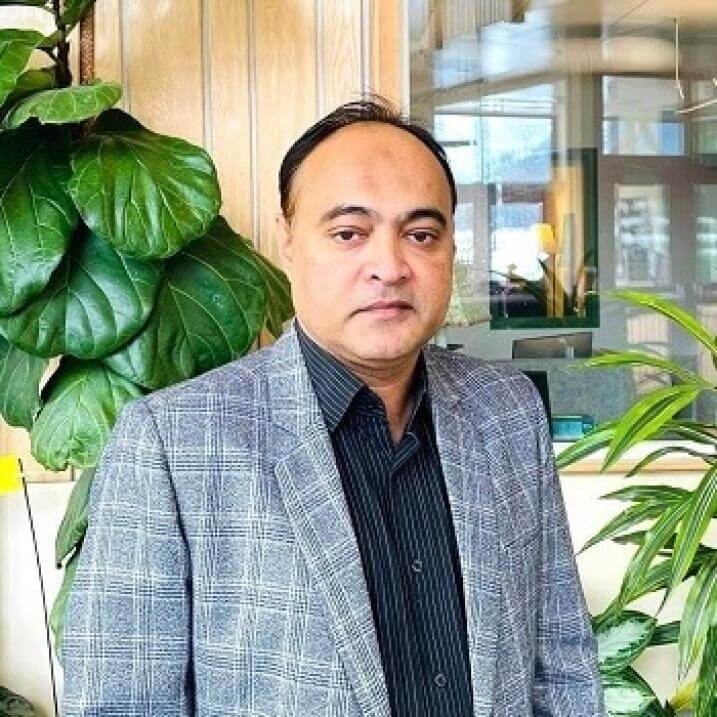
Vasit Sagan is a Professor of Geospatial Science and Computer Science at Saint Louis University's School of Science and Engineering . He directs the Remote Sensing Lab , serves as Deputy Director of the Taylor Geospatial Institute , and holds the role of Associate Vice President for Geospatial Science in the Office of the Vice President for Research and Partnership. Education: Ph.D. from Peking University (2006) Leadership: Director of Remote Sensing Lab; Deputy Director, Taylor Geospatial Institute Research Interests center on geospatial computer vision , integrating remote sensing, photogrammetry, machine learning/AI, and imagery analysis. His work addresses critical challenges in food and water security , ecosystem monitoring , and social instability at scales ranging from local to global. He has secured over $50M in grants as PI/Co-PI and authored 150+ peer-reviewed publications. Recent Publications highlight his interdisciplinary approach, with studies on crop yield prediction via satellite/UAV imagery, disease detection in wheat, urban tree species classification, and deep learning applications for water quality monitoring. These works span agricultural technology , environmental science , and security informatics , emphasizing data fusion and AI-driven geospatial analysis. Scientific Awards include: 2021 Best Paper Award (Remote Sensing) Best Paper Award (International Archives of Photogrammetry) Advising and Grants : He has mentored numerous doctoral, master's, and postdoc researchers, and led major funded projects focused on geospatial AI and environmental sustainability. Labs and Facilities : Remote Sensing Lab at Saint Louis University and collaborative work with the Taylor Geospatial Institute.
Prof. Dr. Bruno Studer is a Full Professor at the Department of Environmental Systems Science, ETH Zürich, and Head of the Zurich-Basel Plant Science Center. His research focuses on plant genetics, genomics, and agricultural innovation, particularly in crop improvement, disease resistance, and microbiome interactions. He leads projects on genomic selection, plant breeding, and phenotyping technologies, addressing challenges in food security and environmental resilience. Affiliations: Department of Environmental Systems Science, ETH Zürich; Zurich-Basel Plant Science Center Research interests span plant-microbe interactions, genetic diversity in forage crops, and the development of tools for precision agriculture. His work integrates genomic prediction, digital phenotyping, and machine learning to enhance crop yields and environmental adaptability. Recent studies address bacterial leaf spot diseases, stomatal trait variation, and root rot resistance mechanisms in plants. Publications highlight advancements in genomic approaches for apple and ryegrass breeding, as well as microbial community dynamics linked to plant health. He contributes to initiatives like the Swiss Apple Core Collection and develops technologies like the FruitPhenoBox for rapid fruit trait analysis.
Posy Busby is an Associate Professor in the Department of Botany and Plant Pathology at Oregon State University, affiliated with the College of Agricultural Sciences. Her research focuses on plant microbiome ecology, particularly plant-fungal interactions and their roles in disease dynamics and community ecology. She leads the Busby Lab, which investigates endophyte impacts on plant health and explores microbiome applications in sustainable agriculture and reforestation. Busby has secured grants from USDA-NIFA and participates in the Andrews Forest LTER grant leadership. Her work integrates genomic and ecological approaches to study microbial community assembly, with recent emphasis on Populus and potato systems. Key research themes include host genotype influences on microbiome composition, priority effects in microbial colonization, and microbiome-mediated disease suppression. Collaborative projects, such as the continental-scale Populus mycobiome study with the Peay Lab, highlight her interdisciplinary approach. Busby’s publications emphasize fungal diversity, pathogen interactions, and microbiome functionality. Notable contributions include defining mechanisms of microbiome-plant genotype interactions and identifying beneficial endophytic yeasts in Populus. Her work has been featured in Nature Microbiology , Current Biology , and Annual Review of Phytopathology , reflecting her impact on both fundamental and applied plant science. Grants & Leadership: USDA-NIFA grant (2020), Co-PI on Andrews Forest LTER8 (2022), NSF CAREER Award (2022) Labs/Teams: Busby Lab, part of the OSU Plant Pathology Program Future Work: Expanding microbiome applications in climate-resilient agriculture and forest health
Xan Chacko is an Assistant Teaching Professor and Interim Director of the Program in Science, Technology, and Society (STS) at Brown University, where they also serve as Director of Undergraduate Studies. A feminist science studies scholar, Chacko focuses on natural history, ecology, agriculture, and conservation through the lens of colonial extraction and climate catastrophe, with seed banking as a central case study in their research on biodiversity conservation. Chacko's educational background includes: PhD in Science and Technology Studies, University of California at Davis (2018) MSc, Imperial College (2008) BA, Wellesley College (2005) Research examines how data practices in seed banks ignore complexities of colonial histories while claiming to secure humanity's future, revealing how classification systems erase local and indigenous knowledge. Chacko analyzes the relationship between physical seeds and their metadata, demonstrating how data storage choices reflect scientists' expectations for the future. Their feminist STS approach extends to teaching data, algorithms, and code's societal impacts. Analysis of recent publications shows consistent focus on seed banking's colonial legacies, invisible labor in science, and data's role in biodiversity narratives. The work spans history of science, feminist theory, and political ecology, highlighting gaps in data systems that perpetuate colonial power structures while proposing alternative epistemic frameworks. Chacko supervises undergraduate students from data and computer science pursuing STS as an additional concentration. They participated in Brown's Data Science Institute (DSI) faculty fellowship and are developing a new course on data and algorithms with a DSI fellow, bridging computational science and critical STS perspectives. As co-editor of 'Invisible Labour in Modern Science' and contributor to collaborative projects like the DSI fellowship, Chacko engages with institutional initiatives while directing the STS program's undergraduate curriculum and research directions.
Bengt Nilsson is a University Lecturer at the Department of Forest and Wood Technology within the Faculty of Engineering at Linnaeus University. His academic career spans forest bioenergy research and rural emergency services, with a particular focus on sustainable forest management practices and community resilience. He serves as Deputy Head of Department and is an active member of "The Bridge" collaboration council between IKEA and Linnaeus University, contributing to multidisciplinary research on home life and production conditions. Dr. Nilsson completed his doctoral thesis in 2016 titled "Extraction of logging residues for bioenergy – effects of operational methods on fuel quality and biomass losses in the forest" at Linnaeus University. His educational background demonstrates a strong foundation in forest technology and sustainable resource management, though specific undergraduate and master's details aren't provided in the available materials. Dr. Nilsson's research interests span two primary domains: forest bioenergy systems and rural emergency response. His early work focused on optimizing forest fuel extraction methods, particularly comparing traditional dried-stacked versus fresh-stacked approaches for logging residues. More recently, his research has shifted toward forest fire management and sustainable co-utilization of rescue resources in rural Sweden. His work addresses critical challenges in sustainable forestry practices while simultaneously strengthening community resilience against natural disasters. This dual focus reflects his commitment to practical solutions that bridge environmental sustainability and public safety concerns in rural communities. An analysis of Dr. Nilsson's publication history reveals a clear transition from forest bioenergy research (2015-2018) toward rural emergency services (2020-2024). His earlier work centered on technical aspects of logging residue extraction, moisture content, and nutrient cycling in forest ecosystems. More recently, his research has examined volunteer emergency response systems, part-time firefighter integration, and multi-agency collaboration during forest fires. This evolution demonstrates how his expertise in forest management naturally extended to emergency response systems in rural communities. The interdisciplinary nature of his work combines forestry science with social science perspectives on community resilience and emergency management. Dr. Nilsson has secured funding for several significant research initiatives: "Sustainable shared use of rescue resources in Swedish rural areas" (2020-2024), where he served as project manager "SimWood" project optimizing biomass use in Kronoberg, particularly in Uppvidinge municipality "Sustainable use of virgin and recovered raw material streams for innovative bio-based products" initiative As project manager for the "Sustainable shared use of rescue resources" project (2020-2024), Dr. Nilsson led a multidisciplinary team of researchers from Health and Care Sciences, Fire Technology, Political Science, and Forestry. This collaboration challenged traditional scientific methods to develop evidence-based strategies for organizing part-time firefighters, SMS lifeguards, and resource mobilization during forest fires. His work has directly contributed to knowledge development for increased safety in rural areas, with findings now being used to shape new emergency response strategies. He has successfully bridged academic research with practical implementation in community safety systems. Dr. Nilsson is actively involved with the Forest Management research group at Linnaeus University, where he contributes to advancing sustainable forestry practices. His current "Seed Project" focuses on integrating human and technological resources to strengthen local community resilience against forest fires. This initiative represents a practical application of his research, bringing together academic expertise with on-the-ground emergency response needs. His work with "The Bridge" collaboration further extends his impact into product development and home safety considerations through the IKEA partnership, demonstrating his ability to translate research into real-world applications.
Professor Christine Schmitt is a Chaired Professor of Physical Geography with a focus on Human-Environment Research at the University of Passau since April 2021. She contributes to international policy consulting and serves on advisory boards including the German Society for Tropical Ecology (gtö) and BayWISS Joint Academic Partnership Life Sciences and Green Technologies. Previously, she was a Senior Researcher at the Center for Development Research (ZEF) of the University of Bonn. Current Affiliation: University of Passau Prior Affiliation: Center for Development Research (ZEF), University of Bonn Her research spans vegetation geography, global change, and sustainable development, emphasizing tropical mountain forests and human-environment interactions. She analyzes climate change effects on biodiversity, carbon storage, and ecosystem services across East Africa and Europe. Recent publications highlight her work on tropical forest carbon stocks (2021 Nature ), agroforestry dynamics in Ghana and Myanmar, and community-based conservation strategies in Ethiopia and Kenya. The 15 most recent articles reflect her focus on biodiversity patterns , land-use conflicts , and climate adaptation frameworks . Maria von Linden Fellowship (2019-2020) IPBES Expert (2014) Global Forest Expert Panel on REDD+ (2012) Professor Schmitt supervises doctoral students including Kerstin Hikel (seed dispersal in Kenyan forests) and Su Mon San (remote sensing in Myanmar). Her lab integrates vegetation surveys, remote sensing, and interdisciplinary methods to address conservation challenges.
Juan Carlos Linares Calderón is a Full Professor at Pablo de Olavide University in the Department of Physical, Chemical and Natural Systems. His research focuses on Mediterranean relict forests' response to climate change through multidisciplinary approaches combining dendrochronology , ecophysiology , genomics , and epigenetics . PhD in Science (2008) from University of Jaén Principal Investigator in 10+ national/international projects Research Themes Specializing in climate change impacts on forest ecosystems , Linares leads the Forests Ecology and Global Change Lab . His work spans from individual tree responses to large-scale biogeographical patterns, challenging CO 2 -induced growth paradigms and emphasizing forest management as climate modulator. Scientific Contributions Over 162 publications with 82,704 reads and 9,074 citations Highly Cited Author status (Ioannidis et al., 2020) Developed SAPFLUXNET global transpiration database Email: jclincal@upo.es
Lou Anella is a Professor in the Department of Horticulture & Landscape Architecture at Oklahoma State University (OSU), where he has served since 2008. He also holds roles as Director of the Botanic Garden and with OSU Extension since August 1997. His expertise spans horticultural production, landscape management, and plant science, with a focus on ornamental plants, flood tolerance in trees, and sustainable gardening practices. Anella holds a Ph.D. in Floriculture and Ornamental Horticulture from Cornell University (1997), an M.S. in Ornamental Horticulture from Cornell, and a B.A. from Vassar College. His teaching portfolio includes courses such as Landscape Irrigation, Public Garden Management, and Woody Plant Materials, reflecting his commitment to both academic instruction and practical application. His research emphasizes plant adaptation to environmental stresses, particularly flood tolerance in Acer species, and the development of regionally appropriate plant selections. He leads the Oklahoma Proven program, which evaluates and promotes plants suitable for Oklahoma conditions. Anella has secured grants for initiatives like the Horticulture Education Center and the Treewalk Village project, supporting educational and community engagement efforts. His scholarly work includes extension publications on native plant cultivation and peer-reviewed articles on topics like tree transplantation success and seedling responses to flooding. As Botanic Garden Director, he oversees conservation efforts and public education in horticulture.
Mohammed Salim Uddin is an Assistant Professor in the Department of Forestry at the Rubenstein School of Environment and Natural Resources, University of Vermont, where he integrates social-ecological systems theory with practical climate change adaptation strategies. His work emphasizes community-led resilience building in vulnerable coastal regions, particularly in Bangladesh and Malaysia, through interdisciplinary approaches that bridge environmental science and social justice. Dr. Uddin's educational foundation includes a Ph.D. in Natural Resources and Environmental Management (2021), M.S. in Natural Resource Management (2011), and dual M.S. and B.S. degrees in Forestry (2004), all from the University of Manitoba and University of Chittagong. He further enhanced his pedagogical skills with a Certificate in Higher Education Teaching (2019). His research program rigorously examines social-ecological resilience through frameworks analyzing human-environment interactions under climate stress. Key focus areas include community-based disaster governance , nature-based adaptation solutions , and environmental justice in resource management. He investigates how social learning processes and institutional structures either mitigate or exacerbate vulnerability, with fieldwork spanning developed and developing contexts to identify transferable resilience principles. Analysis of his 2019-2025 publications reveals a concentrated research trajectory on coastal Bangladesh's climate challenges, with 60% of recent work addressing cyclone impacts, sea-level rise adaptation, and disaster risk governance. His scholarship consistently employs mixed-methods approaches combining quantitative environmental assessments with qualitative community engagement, highlighting the critical role of local knowledge in policy implementation. Dr. Uddin's scientific contributions have been recognized through prestigious awards including: Social Sciences and Humanities Research Council (SSHRC) Post-Doctoral Fellowship International Development Research Center (IDRC) Doctoral Research Awards University of Manitoba Graduate Fellowship Stephen and Alison Philips Awards in Environmental Studies He actively contributes to academic training through courses including Climate Change Fundamentals, Environmental Sustainability, and Climate Change Adaptation and Mitigation, while his research program is sustained by competitive fellowships supporting field investigations in climate-vulnerable communities. Current projects examine policy-practice gaps in disaster risk reduction and nature-based adaptation solutions for coastal livelihood systems. Though specific laboratory facilities aren't detailed in available materials, his research methodology emphasizes community-engaged fieldwork across Bangladesh's coastal zones, collaborating with local organizations and international institutions to develop contextually relevant resilience frameworks.
Christian Wirth is a Professor at Leipzig University, where he serves as Director of the Botanical Garden and heads the Special Botany and Functional Biodiversity Group. He is also the founding director of the German Centre for Integrative Biodiversity Research (iDiv) Halle-Jena-Leipzig. His research integrates botany and plant ecology with species conservation, focusing on biodiversity-ecosystem functioning relationships in terrestrial ecosystems. Education includes: Diploma in Biology (1996) from University of Bayreuth PhD (summa cum laude, 2000) from University of Bayreuth Wirth's research examines how natural and human-induced biodiversity changes affect ecosystem processes like carbon storage, water consumption, and energy balance. His pioneering work includes developing trait-based approaches (TRY database) and investigating climate change impacts on forests. Current projects focus on forest conservation, functional diversity, and biogeochemical cycling using advanced facilities like the Leipzig Auwaldkran canopy crane and ARBOfun research arboretum. His publications emphasize biodiversity-ecosystem functioning relationships, with recent work exploring drought resilience in forests, root trait economics, soil microbial interactions, and remote sensing applications. Research consistently demonstrates how plant traits and community composition mediate ecosystem responses to global change stressors. Major research projects include: NFDI4BioDiversität (2021-2025): Biodiversity and environmental data infrastructure Faktencheck Artenvielfalt (2021-2024): National biodiversity assessment Quantifizierung der Kommunikationsdienstleistung durch Biodiversität (2017-2021) Wirth leads the Special Botany group investigating functional biodiversity significance and directs field research facilities including the Leipzig Auwaldkran. His team collaborates extensively within iDiv's interdisciplinary research framework.
Dr. Fawad Ali is an Advance Queensland Industry Research Fellow at Griffith University's Centre for Planetary Health and Food Security, specializing in environmental sustainability and management. His research focuses on sustainable crop production systems with particular expertise in tropical fruits, rice, and coffee breeding. Education: PhD in Plant Breeding and Genetics, Southern Cross University (2016-2021) MSC (Hons) in Plant Breeding and Genetics, University of Agriculture Faisalabad (2010-2012) BSC (Hons) in Plant Breeding and Genetics, University of Agriculture Faisalabad (2006-2010) Dr. Ali's research spans plant breeding, quantitative genetics, and environmental remediation, with emphasis on developing sustainable agricultural systems that address food security and environmental challenges. His work integrates molecular biology, field trials, and computational approaches to improve crop resilience and quality. His publication record reveals strong focus areas in environmental remediation (particularly arsenic and heavy metal contamination), tropical fruit breeding (papaya and citrus), and stress-responsive crop improvement. Recent work demonstrates innovative approaches combining microbial solutions with plant systems for pollution mitigation. Awards & Recognition: Best Poster Award at TropAg 2019 Qualified Person (QP) certification for Intellectual Property and Plant Breeding Rights (IP Australia, 2022-2025) Dr. Ali actively supervises doctoral research, currently serving as Associate Supervisor for genomic platform development in Australian papaya. His funded research includes the $646,000 Advance Queensland Industry Research Fellowship project 'Invigorating the Coffee Industry in Tropical North Queensland' and the 'National Papaya Breeding and Evaluation Program' ($1.5M). He collaborates extensively with industry partners to translate research into practical agricultural solutions, particularly in specialty coffee and tropical fruit production. His laboratory work encompasses plant tissue culture, molecular biology techniques, field-based breeding trials, and environmental remediation experiments, with strong emphasis on industry-relevant outcomes and consumer preferences.
Martin Béland is a Full Professor in Silviculture and Forest Ecology at the School of Forestry, University of Moncton, located at the Edmundston campus. His research focuses on silvicultural practices, boreal forest dynamics, and sustainable forestry strategies, with a particular interest in natural regeneration, stand dynamics, and ecological processes. His work spans both theoretical and applied aspects, including the use of advanced models (e.g., SORTIE-ND) and field-based methodologies like marteloscopes for training forestry professionals. Key research areas include the effects of even- and uneven-aged silvicultural systems on forest resilience, windthrow susceptibility in hardwood stands, and the long-term implications of harvesting and site preparation on species like jack pine and balsam fir. Béland has also explored the economic and ecological value of hardwood stands post-selection cutting, as well as green supply chain strategies in the lumber industry. His publications highlight a commitment to bridging ecological knowledge with practical forestry applications, emphasizing sustainable practices in boreal and Acadian forest regions. While no specific awards are listed, his extensive body of work reflects significant contributions to silvicultural science and forest management education.
Dr. John C. Tyndall is a Professor in the Department of Natural Resources Ecology and Management at Iowa State University's College of Agriculture and Life Sciences. He directs the PLUS Lab (People, Land Use and Society), where he leads research at the intersection of natural resource economics, policy, and sociology within forestry, agriculture, and urban contexts. His work focuses on financial and economic explorations of environmental quality management in highly managed landscapes. Dr. Tyndall's educational background includes a B.S. in Sociology and Environmental Studies from Western Michigan University (1991), an M.S. in Forest Resource Management from Iowa State University (1996), and a Ph.D. in Natural Resource Economics from Iowa State University (2003). His academic journey has positioned him as a leading expert in conservation economics and policy. His research interests span natural resource economics, conservation planning, ecosystem services valuation, and sustainable agricultural systems. Dr. Tyndall specializes in developing and applying economic frameworks to evaluate conservation practices, particularly in the context of water quality management and agricultural landscapes. His work bridges the gap between economic theory and practical conservation implementation, with a focus on spatially targeted approaches that maximize environmental benefits per conservation dollar spent. Analysis of Dr. Tyndall's recent publications reveals a strong focus on precision conservation, ecosystem service valuation, and the development of decision-support tools for conservation planning. His work increasingly incorporates social equity considerations into environmental management frameworks while maintaining a strong economic foundation. The Agricultural Conservation Planning Framework (ACPF) and related tools like PT 2 and FiNRT represent significant contributions to making conservation planning more effective and cost-efficient. Through his leadership of the PLUS Lab, Dr. Tyndall has mentored numerous graduate students who have gone on to contribute significantly to the fields of natural resource economics and conservation science. His collaborative approach is evident in the extensive list of interdisciplinary projects and co-authored publications spanning multiple institutions and disciplines. Dr. Tyndall's work has practical applications through several conservation planning tools he has helped develop, including the Prairie and Tree Planting Tool (PT 2 ), the Agricultural Conservation Planning Framework Financial and Nutrient Reduction Tool (ACPF FiNRT), and economic evaluation tools for barriers to minimize sportfish escapement. These tools represent the applied dimension of his research, translating complex economic analyses into practical decision support for conservation practitioners.
Cory Garms is a Courtesy Faculty member in the Department of Forest Engineering, Resources & Management at the College of Forestry. His research focuses on remote sensing technologies, lidar-based forest inventory, climate change impacts on tree species, and sensor calibration for environmental monitoring. Collaborating with Dr. Bogdan Strimbu since June 2024, his work bridges technical innovation with ecological applications. Key research areas include spectral imaging systems, tree physiology under environmental stress, and sustainable forest management strategies. His studies often integrate cutting-edge sensors like lidar and unmanned aircraft systems to improve accuracy in forest inventories and ecological assessments. Publications from 2024 emphasize advancements in airborne imaging performance metrics and collaborative military-environmental projects, while earlier work (2020-2021) explores tree morphology, climate adaptation, and disease resistance in species like Douglas-fir and Pinus strobiformis. No scientific awards or grants are explicitly listed in the provided texts. Collaborative projects and institutional affiliations remain central to his academic profile.
Dr. Marjorie Lundgren is a Senior Research Fellow at the Lancaster Environment Centre (LEC), Lancaster University . Her research focuses on the evolution of photosynthetic systems, particularly C2 and C4 photosynthesis, integrating plant ecophysiology, leaf anatomy, and phylogeographic methods. She earned her PhD from the University of Sheffield in 2015 and completed postdoctoral work at the University of Sheffield, Massachusetts Institute of Technology , and the Arnold Arboretum of Harvard University . She supervises 4 postgraduate research students, including Alvaro Herrera Seller and Quentin Herzig. Research Themes : Photosynthesis evolution, leaf anatomical adaptation, biogeography, and crop engineering. Scientific Leadership : Member of the LEC Photosynthesis Team and UKRI Future Leaders Fellow . Recent Research Trends : Her work bridges computational modeling, genomic analysis, and empirical studies to decode photosynthetic innovation. Key areas include C4 pathway optimization, anatomical constraints on carbon fixation, and climate-driven niche expansion in photosynthetic lineages. Collaborations span plant taxonomy (e.g., Alloteropsis semialata ), metabolic trade-offs in C2 systems, and data standardization initiatives like the ESS-DIVE reporting format . Scientific Awards : UKRI Future Leaders Fellow Advising and Collaborations : Supervises postgraduate projects on photosynthesis, leaf anatomy, and evolutionary physiology. Collaborates with institutions including Dryad, ESS-DIVE, and Harvard University’s Arnold Arboretum.