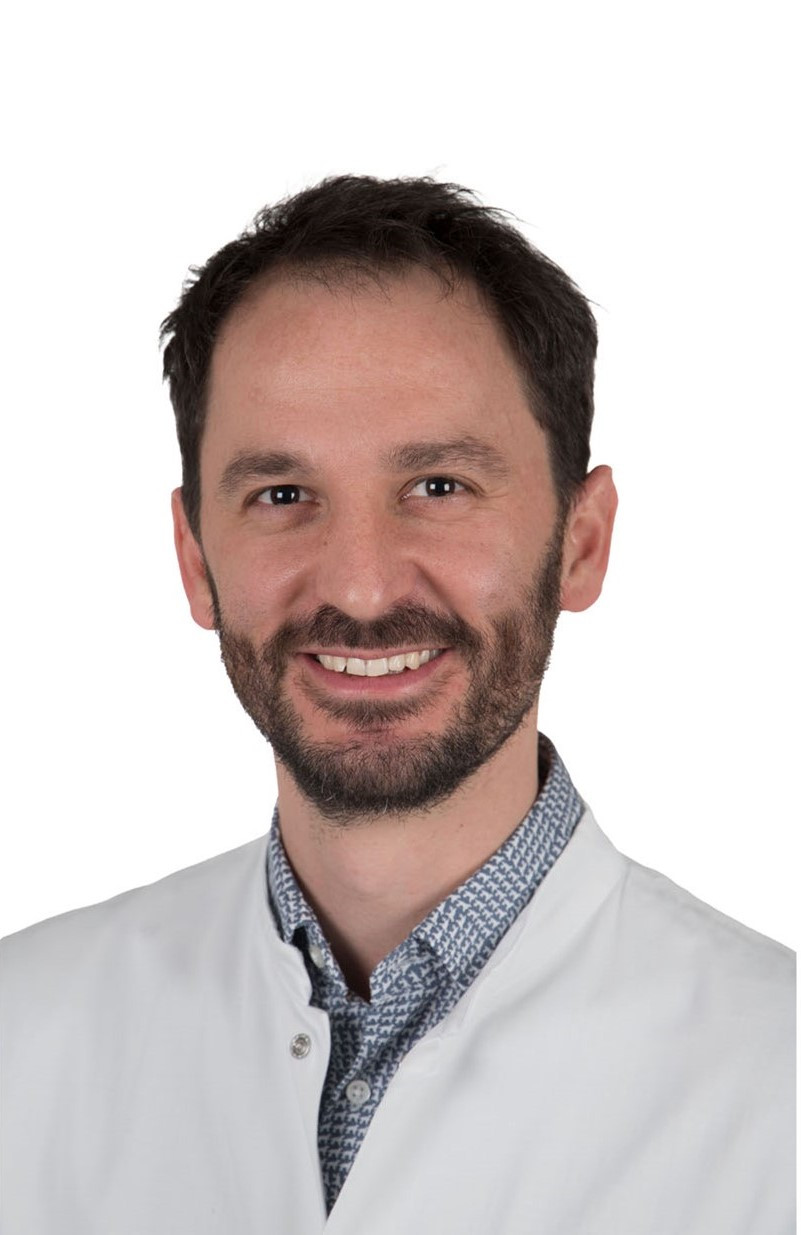
Prof. Michael Moor is a tenure-track Assistant Professor for Medical AI at ETH Zurich's Department of Biosystems Science and Engineering in Basel. Previously, he conducted postdoctoral research at Stanford University under Prof. Jure Leskovec, focusing on medical foundation models. His work spans causal learning, multimodal AI, and sepsis prediction. Moor holds an MD from the University of Basel and a PhD from ETH Zurich's Machine Learning and Computational Biology Lab under Prof. Karsten Borgwardt. Research Interests: Generalist medical AI models Multimodal medical reasoning Zero-shot and few-shot learning Clinical causal inference Retrieval-augmented language models Sepsis prediction systems Key Achievements: Published foundational work in Nature (2023) on generalist medical AI Developed Med-Flamingo multimodal model (2023) Zero-shot causal learning framework accepted to NeurIPS 2023 (Spotlight) International sepsis prediction study with 156k ICU patients (2023) Lab Activities: Leads ETH's Medical Foundation Models group, collaborating with Stanford HAI and NASA Ames. Active in creating medical AI benchmarks like AgentClinic and developing retrieval-augmented systems like Almanac.
Dr. Christina Allen is a Professor of Orthopaedics & Rehabilitation at Yale School of Medicine, where she serves as Chief of Yale Sports Medicine and Vice Chair of Athletic Medicine and Community Outreach. She is the Orthopaedic Team Physician for Yale Athletics and has extensive experience with U.S. national teams, including U.S. Soccer and USA Taekwondo. Education: BS in Biomedical Engineering, Duke University (1983); MD, UCLA School of Medicine (1995) Training: Orthopaedic Residency and Sports Medicine Fellowship, University of Pittsburgh Research Interests focus on: Revision ACL reconstruction outcomes and predictors Meniscus transplantation and cartilage repair Proximal hamstring avulsion repair Quantitative MRI for joint kinematics and cartilage changes Post-ACL revision infection risk factors Scientific Awards include: Kappa Delta Ann Doner Vaughn Award (2019) NIH R01 Competitive Renewal Grant (2017) AOSSM O’Donoghue Award (2014) Clinical Roles span: Team physician for U.S. Soccer (Women's/Men's National Teams) Former team physician for San Francisco Deltas (NASL Champions 2017) Medical Board member, World Taekwondo (London Olympics 2012, Rio Olympics 2016) Publications highlight a 20-year longitudinal focus on: Machine learning models for surgical outcome prediction Graft choice impact on revision ACL longevity Cartilage degeneration after meniscectomy Biomechanical MRI analysis of joint kinematics Infection rates in revision surgeries Return-to-sport protocols for athletes
Dr. Timothy Hresko is a Professor of Orthopedic Surgery at Harvard Medical School and serves as an Orthopedic Surgeon in the Orthopedics and Sports Medicine Department at Boston Children's Hospital. He also holds the position of Director of Spine Research and Quality Improvement in the Department of Orthopedic Surgery. Dr. Hresko received his medical degree from Columbia University, College of Physicians and Surgeons in 1981. He completed his internship at New England Deaconess Hospital in 1982, followed by residency at New England Medical Center in 1987, and a fellowship at Boston Children's Hospital in 1988. He is certified by the American Board of Orthopedic Surgery. His research focuses on orthopedic surgery, particularly spine surgery and pediatric orthopedics. Dr. Hresko's work centers on scoliosis treatment, spinal deformity correction, and outcomes of pediatric spinal fusion surgeries. He has conducted extensive research on surface topography measurements for scoliosis assessment, bracing techniques for adolescent idiopathic scoliosis, and surgical outcomes for various spinal conditions. His recent work explores the biomechanical effects of thoracolumbosacral orthosis design and the relationship between spinal deformity and patient self-image. Dr. Hresko's recent publications demonstrate a strong emphasis on technological advancements in spine surgery, including robotic pedicle screw placement and computer vision algorithms. His work also explores the relationship between socioeconomic factors and surgical outcomes, as well as innovative approaches to non-surgical management of scoliosis. Scoliosis Research Society (SRS) Pediatric Orthopaedic Society of North America (POSNA) American Academy of Orthopaedic Surgeons (AAOS) American Board of Orthopaedic Surgery As Director of Spine Research and Quality Improvement, Dr. Hresko leads initiatives to enhance patient outcomes and optimize care pathways for children with spinal conditions. His work emphasizes evidence-based approaches to pediatric spine care, with particular attention to quality improvement and research translation into clinical practice.
Stefan Kluge is a Professor at the Department of Intensive Care within the University Medical Center Hamburg-Eppendorf . With over 150 publications in 2025-2024 alone, his work focuses on critical care medicine, sepsis, ARDS, and cardiogenic shock. His recent research explores ARDS impact on liver cirrhosis outcomes Hyperoxia effects in traumatic brain injury Biomarkers for cardiogenic shock prognosis Novel retrograde limb perfusion techniques during ECPR Dual-energy CT for body composition analysis He contributes extensively to German national guidelines for nosocomial pneumonia and participates in multi-center critical care trials. Stefan Kluge's collaborations span neuro-intensive care , cardiovascular research , and infection/immunity domains. His work integrates machine learning applications and medical informatics to improve ICU decision-making.
Nabeel Nabulsi is a Senior Research Scientist in the Department of Radiology & Biomedical Imaging at Yale School of Medicine. He serves as Associate Director of the Yale PET Center, Deputy Director of the PET Center Chemistry Section, and Director of Regulatory Affairs and Quality Control at the Yale PET Center. His research focuses on developing radiopharmaceuticals for PET imaging in CNS disorders and oncology, particularly targeting Alzheimer's disease, pancreatic cancer, and FAAH inhibition. BA in Chemistry (pre-Medicine), University of Texas at Arlington (1980) MS in Organic Chemistry, Texas Tech University (1984) PhD in Organic/Bioorganic Chemistry, Louisiana State University (1991) Dr. Nabulsi specializes in synthetic methodologies for radiopharmaceuticals with short half-life radionuclides (C-11, F-18). His work explores: Synaptic density imaging via SV2A radioligands in Alzheimer's and schizophrenia Neuroimmune mechanisms in PTSD and alcohol use disorder Pancreatic cancer detection through PepT1 transporter-targeted radiotracers Endocannabinoid system analysis in psychiatric disorders HDAC6 imaging for neurodegenerative research Key collaborations include Richard Carson, Jean-Dominique Gallezot, and Yiyun Huang. He contributes to clinical trials on synaptic density in Alzheimer's disease and cortisol metabolism imaging.
Gianmarco Pinton is an Associate Professor in the Department of Biomedical Engineering at the University of North Carolina at Chapel Hill. His research focuses on nonlinear ultrasound and mechanical wave propagation, with applications to medical imaging and therapy. He specializes in traumatic brain injury, shear shock waves, and ultrasound therapy. Ph.D., M.S., and B.S.E. in Biomedical Engineering/Physics from Duke University His lab develops physics and simulation tools for nonlinear wave propagation, aiming to create advanced diagnostic ultrasound methods. Key areas include traumatic brain injury, transcranial imaging, and therapeutic ultrasound. His recent work explores super-resolution imaging, brain motor circuits, and Alzheimer's disease vascular mapping using ultrasound. Article trends highlight innovations in transcranial ultrasound, super-resolution techniques, lung imaging, and neuromodulation. His publications address image degradation, contrast agents, and shear wave dynamics in neurological contexts.
Aline Herlopian, MD, is an Associate Professor of Neurology at Yale School of Medicine, specializing in epilepsy and treatment-resistant seizures. She serves as Medical Director of the Clinical Neurophysiology/EEG Lab and Director of Clinical Trials in Epilepsy. Her clinical focus includes catastrophic epilepsies and innovative treatments like brain stimulation, laser therapy, and surgical resection. Clinical Epilepsy Fellowship, Massachusetts General Hospital (2017) Clinical Neurophysiology Fellowship, Massachusetts General Hospital (2016) Neurology Residency, University of Arkansas for Medical Sciences (2015) MD, American University of Beirut (2008) Her research explores neural network dynamics in epilepsy, EEG pattern classification via machine learning, and global health applications in neurological care. She has authored 15+ publications in 2024-2025, including peer-reviewed articles and book chapters on epilepsy subtypes and surgical approaches. Inaugural Global Health Education Innovation Award (2025) Dr. Herlopian leads clinical trials in epilepsy and collaborates extensively with Yale Institute for Global Health. She is a renowned advisor for patient education, emphasizing seizure demystification through analogies, and contributes to Yale Co-Authors networks in neurology research.
Benjamin Shore, MD, MPH, FRCSC, is Associate Professor of Orthopedic Surgery at Harvard Medical School and a practicing pediatric orthopedic surgeon at Boston Children’s Hospital. He serves as Co-Director of the Cerebral Palsy and Spasticity Center and Director of the Pediatric Orthopaedic Surgery Fellowship. Education and Training Undergraduate: Biology, University of Victoria, 1999 MPH: Harvard School of Public Health, 2013 MD: University of Western Ontario, 2003 Residency: Orthopedic Surgery, University of Western Ontario, 2008 Fellowship 1: Pediatric Orthopedics, Royal Children's Hospital, Melbourne, 2009 Fellowship 2: Pediatric Orthopedics, Boston Children’s Hospital, 2010 Research Focus Dr. Shore’s research centers on improving outcomes for children with cerebral palsy and other complex musculoskeletal conditions. His work spans hip surveillance and reconstruction, gait abnormalities, trauma care, and the implementation of evidence-based surgical pathways. He has pioneered investigations into anesthesia protocols, infection prevention, and patient-reported outcome measures for pediatric orthopedic populations. Scientific Awards St. Giles Young Investigator Award (POSNA) Clinician Scientist Development Program Award (CSDP) Charles H. Hood Foundation Child Health Research Award Leadership & Multi-Disciplinary Teams At Boston Children’s Hospital, Dr. Shore leads a high-performance team within the Cerebral Palsy and Spasticity Center that integrates orthopedic surgery, neurology, physical therapy, and social work to deliver patient- and family-centered care. He mentors fellows and residents and actively contributes to national consensus projects using Delphi methodology to standardize surgical indications in cerebral palsy.
Professor Ruurd Jaarsma serves as Clinical and Academic Director of Orthopaedics and Trauma Surgery for the Southern Adelaide Local Health Network, practicing at Flinders Medical Centre and Flinders Private Hospital. He holds full membership in Flinders University's College of Medicine and Public Health, Flinders Health and Medical Research Institute, and Medical Device Research Institute within the College of Science and Engineering, bridging clinical practice and academic research since relocating from the Netherlands in 2004. His educational credentials include: MD from University of Groningen, Netherlands (1994) Orthopaedic Surgeon certification from Dutch College of Orthopaedic Surgeons (2003) PhD from University of Nijmegen, Netherlands (2004) FRACS (Orth) from Royal Australasian College of Surgeons (2009) FA(Orth)A from Australian Orthopaedic Association (2012) Research centers on orthopaedic trauma, paediatric orthopaedics, and biomechanical engineering of implants, with specialized focus on rotational malalignment after long bone nailing. His work directly supports UN Sustainable Development Goal 3 (Good Health and Well-being) through trauma care innovation and surgical education. Current investigations integrate machine learning with fracture diagnostics to improve clinical decision-making. Recent publications demonstrate strong AI integration in orthopaedic trauma, featuring machine learning algorithms for scaphoid fracture probability estimation, deep learning classification of tibial plateau fractures, and open-source neural networks for distal radius fracture detection. Concurrent clinical trials address compartment syndrome diagnosis while biomechanical studies examine acetabular fracture outcomes, reflecting his dual focus on computational innovation and clinical validation. His scientific recognition includes: 2006 Burns Alpers Award for excellence in teaching from Flinders University As Director of Orthopaedic Training, he supervises Australian Orthopaedic Association accredited fellowships with registered interests in orthopaedic surgery, biomechanical engineering, and musculoskeletal medicine. His supervisory framework emphasizes translational research connecting biomechanical principles with surgical practice. External engagement includes active participation in SA State Trauma Committees, driving statewide improvements in trauma systems and surgical protocols. Professor Jaarsma maintains clinical-academic synergy through Flinders Medical Centre's orthopaedic department, where he leads trauma service development while directing research initiatives in the Medical Device Research Institute. His current projects focus on AI-driven fracture assessment tools and biomechanical optimization of implant systems, with ongoing collaborations across the Machine Learning Consortium and international orthopaedic networks.
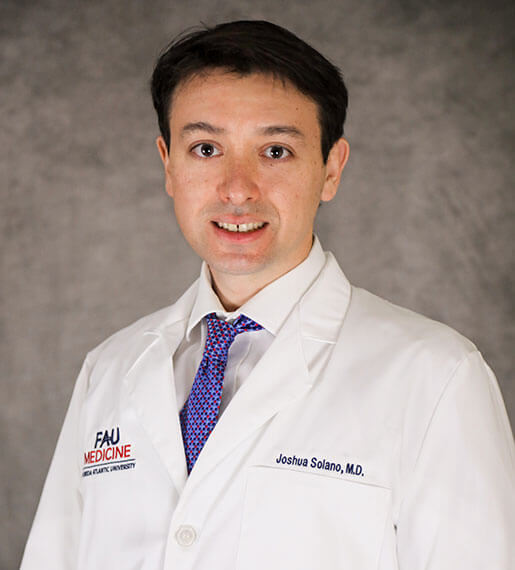
Joshua J. Solano, M.D., FAAEM is an Associate Professor of Emergency Medicine and Clerkship Director for the Emergency Medicine Residency program at the Florida Atlantic University Charles E. Schmidt College of Medicine. As Clerkship Director, he works alongside residents to promote best practices for emergency department patient care. Dr. Solano is board certified in emergency medicine and maintains active membership in the American College of Emergency Physicians and the American Academy of Emergency Medicine. Dr. Solano's educational background includes a BS in Biology and BA in History from Duke University, followed by his MD from the University of Florida. He completed his emergency medicine residency at Beth Israel Deaconess Medical Center in Boston and served on faculty at Harvard Medical School as an instructor and assistant program director before joining FAU. In his final year in Boston, he completed the Rabkin Medical Education Fellowship. Dr. Solano's research focuses on geriatric emergency medicine, particularly head trauma management in elderly patients, anticoagulation risks, and emergency department quality assurance. His recent publications demonstrate a strong emphasis on developing clinical decision rules for geriatric head trauma and understanding medication interactions in older emergency patients. He has also contributed significantly to medical education literature, developing innovative residency training curricula. His scholarly work shows a clear progression toward establishing evidence-based guidelines for geriatric emergency care, with numerous publications on intracranial hemorrhage risk assessment, anticoagulation management, and fall prevention strategies. Dr. Solano's research bridges clinical practice with educational innovation, making significant contributions to both patient care protocols and emergency medicine training. 2017: Attending Role Model Award, Beth Israel Deaconess Medical Center 2016-2017: Rabkin Medical Education Fellowship 2011: Alpha Omega Alpha Medical Honor Society 2011: Chapman Humanism Society 2010: Equal Access Clinic Service Award 2010: Lawrence M. Goodman Award for Medical Student Research 2010: Community Service Award As Clerkship Director, Dr. Solano oversees medical student education in emergency medicine and has implemented electronic evaluation systems that have increased the quality and quantity of student assessments. His clinical work includes staff positions at Bethesda East Hospital and Delray Medical Center. Dr. Solano's research program demonstrates strong institutional support through multiple publications and ongoing investigations into geriatric emergency care protocols.
Prim. Clin. Assoc. Prof. PD Dr. Dietmar Dammerer, MSc PhD is the head of the Clinical Department of Orthopaedics and Traumatology at Krems University Hospital, affiliated with Karl Landsteiner Private University of Health Sciences. He has been in this role since February 2022, leading the merger of orthopedics and traumatology into a unified clinical department. A dual-trained specialist, he is recognized for his expertise in endoprosthetics and tumor orthopedics, and actively promotes interdisciplinary collaboration and team-based medicine. His educational background includes a PhD in Musculoskeletal Sciences (2015), an MSc in Advanced Orthopaedics and Traumatology (2017), and board certification in both orthopedics and traumatology (2017, 2018), culminating in habilitation in 2019. He has received prestigious Traveling Fellowships from the European Hip Society and European Musculo-Skeletal Oncology Society. Dietmar Dammerer’s research focuses on orthopedic oncology, joint reconstruction, biomechanics, and minimally invasive surgery. His work emphasizes the integration of clinical inquiry with research to improve patient outcomes. Recent publications analyze pelvic sarcoma reconstruction, spinal metastases, cartilage repair techniques, and health disparities in sarcoma care. His 15 most recent articles reflect a strong trend in musculoskeletal oncology, surgical biomechanics, and evidence-based orthopedic practice, with frequent use of systematic reviews, retrospective studies, and multicenter collaborations. Topics include implant performance, surgical safety, and global access to specialized care. Scientific awards include: Traveling Fellow Stipendium from the European Hip Society (2018) Traveling Fellow Stipendium from the European Musculo-Skeletal Oncology Society (2020) He is deeply committed to mentoring and team development, emphasizing that medical success is measured by the success of one’s colleagues. He leads a research-active department that hosts international observers, conducts training courses for physicians across Europe, the Middle East, and Africa, and maintains a high rate of peer-reviewed publication. The department collaborates closely with the Departments of Biomechanics and Anatomy and Developmental Biology, reflecting a multidisciplinary research approach.
Assoc. Prof. Dr. Levent ŞAHİN is a prominent academic in Emergency Medicine at Kafkas University's Faculty of Medicine. He holds a PhD in Internal Medical Sciences from İnönü University (2015) and an MD from Cumhuriyet University (2007). Currently serving as Head of the Department of Internal Medical Sciences (2022-) and Education Coordinator (2020-), his career spans 13 years of academic experience. Academic Affiliation: Kafkas University, Faculty of Medicine, Department of Internal Medical Sciences Previous Institutions: İnönü University (2011-2015) Research Pillars: Cardiovascular Emergencies (acute myocardial infarction biomarkers, cardiac trauma) Toxicology (organophosphate poisoning, drug-induced toxicity) Geriatric Medicine (diabetes-cholestasis relationships in elderly, climate/poisoning patterns) Pediatric Emergencies (head trauma assessment, spinal cord protection) Pandemic Medicine (N95 respirator effects, COVID-19 neurological complications) Medical Education (first aid training, textbook authorship) Publication Trends: Over 80 publications since 2019, with 15 recent works focusing on cardiovascular biomarkers (2024), neurological complications (2023), toxicology (2022), and pandemic-related clinical issues (2021). His experimental pharmacology research includes studies on hydrogen-rich saline and dragon fruit extract. Leadership: Department Head (2022-), Education Coordinator (2020-) Editorial Roles: Editor for Journal of Emergency Medicine Case Reports (2024), Taktik Sahada Acil Tıp (2024) Professional Memberships: ATUDER (2016-), TATD (2016-)
Karol Budohoski, MD, PhD, FRCS, is an Assistant Professor in the Department of Neurosurgery at the University of Utah , with additional Adjunct Assistant Professor status in Radiology & Imaging Sciences. He specializes in cerebrovascular , endovascular , and skull base neurosurgery , treating complex pathologies like brain aneurysms, arteriovenous malformations, and skull base tumors. Education: PhD in Neurosurgery (University of Cambridge), MD (Medical University of Warsaw), Clinical Fellowships at University of Utah and UCSF His academic focus on subarachnoid hemorrhage pathophysiology and cerebral vasospasm has led to innovations in brain monitoring tools. Recent publications (2023-2025) span neurovascular surgery , stroke interventions , global neurosurgery , and cerebral autoregulation studies. He practices at the Clinical Neurosciences Center in Salt Lake City, Utah, with a patient rating of 4.9/5 (125 reviews), praised for clarity, attentiveness, and technical expertise.
Maryellen L. Giger, Ph.D. is the A.N. Pritzker Distinguished Service Professor of Radiology, Committee on Medical Physics, and the College at the University of Chicago. She serves as Vice-Chair of Radiology (Basic Science Research) and was the immediate past Director of the CAMPEP-accredited Graduate Programs in Medical Physics/Chair of the Committee on Medical Physics. Her career spans over 30 years of pioneering research in computer-aided diagnosis, machine learning, and deep learning applications in medical imaging. Dr. Giger's research focuses on computational image-based analyses for cancer risk assessment, diagnosis, prognosis, and response to therapy, particularly in breast cancer, lung cancer, prostate cancer, lupus, bone diseases, and more recently, COVID-19. Her work has evolved from developing computer-aided diagnosis systems to utilizing 'virtual biopsies' in imaging genomics association studies for discovery. She has made significant contributions to quantitative imaging, radiomics, and AI applications in medical imaging, with emphasis on translating research into clinical practice. Her publication record shows a clear trajectory from foundational work in computer vision for medical imaging to cutting-edge AI and deep learning applications. The recent publications demonstrate her leadership in large-scale collaborative efforts like the Medical Imaging and Data Resource Center (MIDRC), focus on health equity through AI analysis, and expansion into diverse applications including gynecological imaging, lung cancer screening, and trauma assessment. Her work consistently bridges technical innovation with clinical relevance. Dr. Giger has received numerous prestigious honors including membership in the National Academy of Engineering, the William D. Coolidge Gold Medal (the highest award from AAPM), and being named one of the 50 most impactful medical physicists in the last 50 years. She is a Fellow of multiple professional societies including AAPM, AIMBE, SPIE, SBMR, and IEEE. Her 2019 TIME magazine recognition for QuantX, the first FDA-cleared machine-learning-driven system for cancer diagnosis, highlights her translational impact. As an educator and mentor, Dr. Giger has guided over 100 graduate students, residents, and medical students throughout her career. She has secured substantial research funding including NIH R01 grants and serves as contact PI for the NIH NIBIB-funded & ARPA-H-funded Medical Imaging and Data Resource Center (MIDRC). Her leadership extends to former presidencies of the American Association of Physicists in Medicine and SPIE, and she was the inaugural Editor-in-Chief of the SPIE Journal of Medical Imaging. Dr. Giger co-founded Quantitative Insights, Inc. through the University of Chicago's New Venture Challenge, which developed QuantX - the first FDA-cleared AI system for cancer diagnosis. She leads the Medical Imaging and Data Resource Center (MIDRC), a critical resource for AI development in medical imaging that received the 2023 DataWorks Prize. Her research laboratory bridges engineering, physics, and clinical medicine to develop and validate quantitative imaging biomarkers and AI tools for precision medicine.
Dr. Robert V. O'Toole serves as Professor of Orthopaedics at the University of Maryland School of Medicine, holding key leadership roles including Vice-Chair for Research, Chief of Orthopaedics at R Adams Cowley Shock Trauma Center, and Director of Clinical Research. He also leads the Orthopaedic Traumatology Fellowship Program and heads the Division of Orthopaedic Trauma within the Department of Orthopaedics. His educational background includes a BS and MS in Mechanical Engineering from Carnegie Mellon and Stanford Universities, followed by an MD from Harvard Medical School. His clinical training encompasses General Surgery internship at Brigham and Women's Hospital, Orthopaedic Residency through Harvard Combined Program, and Orthopaedic Trauma Fellowship at University of Maryland's Shock Trauma Center. Dr. O'Toole's research focuses on critical areas of orthopaedic trauma including surgical site infection prevention, pelvic and acetabular fracture management, biomechanics of fracture fixation, and complications like compartment syndrome and nonunion. His work integrates clinical trials, biomechanical studies, and retrospective analyses to address high-impact trauma challenges. His publication record demonstrates consistent contributions to orthopaedic trauma literature, with recent work emphasizing infection prevention strategies, pelvic fracture outcomes, and biomechanical optimization of fracture fixation techniques across high-impact journals like Journal of Orthopaedic Trauma and Injury . Shock Trauma Hero Award, Clinical Service (2014, 2015) Top 10 Orthopaedic Trauma Association Papers (2014, 2015) Orthopedics This Week's 19 Best Orthopedic Traumatologists in North America (2015) Carnegie Mellon Football Man of the Year Award (2015) Elected Faculty Marshall by medical students (2016) As Program Director for the Orthopaedic Traumatology Fellowship, he mentors future trauma specialists while securing over $30 million in research funding. His active grants include Department of Defense projects on infection prevention and blood clot management, supported by a 10-member research team conducting 16 prospective clinical trials. He directs one of the nation's largest orthopaedic trauma research groups at Shock Trauma Center, collaborating with the Major Extremity Trauma Research Consortium (METRC) to advance evidence-based trauma care through integrated clinical research infrastructure.