Geert Deconinck is a full professor at KU Leuven , leading the Electrical Energy Systems and Applications (ELECTA) research group within the Department of Electrical Engineering (ESAT). He also serves as scientific leader of the EnergyVille research center's algorithms domain, focusing on smart electrical networks and thermal systems. M.Sc. and Ph.D. from KU Leuven Head of ELECTA since 2012 (10 professors, 8 postdocs, 70+ PhDs) Over 8 million EUR research budget in last 5 years 44 completed PhDs and 10 current advisees IEEE Transactions editorial board member His research spans smart grid architectures , distributed control , and cyber-physical security , with recent focus on EV-grid integration , renewable energy democratization , and multi-carrier energy systems . Current projects include: Smart Charging - E-Mobility meets Renewable Energy Early Detection and Defense Systems for Smart Grids Open-source P2P energy sharing platforms Microgrid control strategies for PV-battery systems Awarded IET Fellow and IEEE Senior Member status, his work combines machine learning with power systems engineering through both theoretical modeling and experimental validation . He has contributed over 575 publications with 9800+ Google Scholar citations.
Maxime Gobert is a researcher at the University of Namur's Faculty of Computer Science, specializing in database systems and software engineering. Having completed his PhD in March 2023 titled 'Design, Manipulation and Evolution of Hybrid Polystores,' Gobert has established himself as an expert in hybrid database systems, particularly focusing on the HyDRa framework for modeling and evolving polystores. His research interests span database systems, hybrid polystores, database schema evolution, software engineering, data-intensive systems, and static program analysis. Gobert's work bridges theoretical database concepts with practical applications, particularly in NoSQL databases like MongoDB and complex hybrid data storage environments. His publication record demonstrates a clear trajectory from his 2013 Master's thesis on database reverse engineering through to his recent work on database testing best practices and sign language processing applications. His research shows strong collaboration with colleagues at the University of Namur, particularly with Professor Cleve A., and extends to international collaborations as evidenced by his 2016 guest researcher position at the University of Geneva. Best New Idea and Emerging Results (NIER) Paper Award at the 20th IEEE Working Conference on Source Code Analysis and Manipulation (SCAM 2020) Jean Fichefet 2013 award Gobert has contributed significantly to the development of the HyDRa framework for hybrid polystore management and has extended his research into sign language processing through collaborative projects creating bilingual sign language dictionaries and parallel corpora. His work demonstrates both technical depth in database systems and a commitment to applying this expertise to accessibility-focused applications.
Stijn Viaene is a Full Professor at KU Leuven and Partner at Vlerick Business School, specializing in digital transformation, IT management, and business process innovation. He holds a Doctorate in Information Systems Management from KU Leuven and serves as Programme Director of Take The Lead. His research focuses on leveraging technology (big data, AI, blockchain) for enterprise digitalization, with a strong emphasis on leadership, agility, and business-IT alignment. He is the author of Digital Transformation Know How: Connecting digital transformation, agility and leadership and teaches across MBA, Executive Development, and Digital Leadership programs. Recent work explores AI-driven leadership, blockchain platforms for sustainability, and intra-organizational labor platforms. He also serves as Jury President for the Data News Awards and Board Member at Herita vzw. Education: Doctor in Information Systems Management (KU Leuven). Research interests include digital innovation ecosystems, process management, and governance frameworks for digital value creation. His articles address topics such as ambidextrous ERP systems, paradox management in transformations, and open innovation in public administration. Advising & Grants: Involved in multiple industry-public sector collaborations. Notable projects include blockchain-based water trade platforms and frameworks for sustainable digital ecosystems. His work bridges academic research with practical business applications through case-based teaching and action design research methodologies. Labs/Teams: Active in Vlerick’s Digital Transformation and IT Management research groups, contributing to initiatives like the Digital Leadership programme and strategic consulting for global organizations.
Steve Muylle is a Full Professor of Digital Strategy and Business Marketing at Vlerick Business School and Ghent University, and serves as Associate Dean Digital Learning. His expertise spans digital transformation, B2B marketing, and leveraging technologies like AI, blockchain, and IoT. He holds a Doctor in Business Engineering from Solvay Management School and has held visiting roles at SMU’s Cox School of Business and Vanderbilt University’s Owen Graduate School. Education: PhD in Business Engineering (Solvay Management School) Visiting Doctoral Researcher (Owen Graduate School of Management, Vanderbilt University) Research Interests: Digital strategy, B2B customer experience, AI-driven marketing, and digital innovation frameworks. His work emphasizes actionable insights for executives in sectors like energy, healthcare, and finance. Recent trends in his publications focus on agentic marketing, VR in education, and competitive digital innovation. Impact: Designs executive programs like the Digital Strategy Open Programme and the Executive Master Class in B2B Marketing/Sales. Recognized for contributions to digital learning and open banking strategies. Board member at multiple firms.
Amélie Lachapelle serves as Assistant Professor at the University of Namur's Faculty of Law, with cross-appointments in the Faculty of Economic, Social and Management Sciences. Her primary research affiliations include the Centre de Recherche Information, Droit et Société (CRIDS) and Namur Digital Institute (NaDI), with additional membership in UCLouvain's Centre de Recherche sur l'Etat et la Constitution (CRECO). She currently teaches Comparative Law, Environmental Law, Sustainable Development Law, and Economic Law across multiple faculties while leading research at the intersection of digital governance and ecological transition. Her educational background includes a Bachelor of Laws from FUNDP (2011, High Distinction), Erasmus exchange at USAL Salamanca (2013, Matricula de honor), and Master's in State and European Law from UCLouvain (2013, High Distinction), culminating in a Doctorate in Legal Sciences from UNamur (2020) on tax whistleblowing mechanisms. Lachapelle's research synthesizes whistleblowing law , digital governance , and sustainable development , focusing on tensions between fundamental rights (privacy, freedom of expression) and fiscal transparency requirements. Her work examines how EU directives like 2019/1937 reshape tax whistleblowing while navigating GDPR constraints, with particular attention to digital reporting channels and cross-border implications. Recent scholarship explores sustainable IT frameworks where digital law intersects with circular economy principles. Analysis of her 15 most recent publications reveals three dominant trajectories: (1) Evolution of tax whistleblowing in digital environments (40% of output), (2) Sustainable digital transition legal frameworks (35%), and (3) Fundamental rights protection in automated tax administration (25%). Her work consistently bridges Belgian implementation challenges with European legal developments. 1st prize in 2011 Eloquence Tournament (Young Bar of Namur) TFR-prijs 2018 for Foreign Tax Case Law commentary UNamur MT180 Finalist (2019) TFR Doctoral Grant 2020 FRS-FNRS Doctoral Fellowship (2015-2019) Lachapelle actively advises governmental bodies as expert for Deputy Prime Minister Georges Gilkinet's office (democratic renewal) and leads EU directive implementation studies. She serves as Editorial Secretary for the Journal of Information Technology Law and sits on the Management Board of INCUEBRUX. Her research group at CRIDS/NaDI develops practical frameworks for sustainable IT governance, recently contributing to Belgium's 4th Sustainable IT Charter signing. Current projects examine the twin green-digital transition through legal lenses, with emerging work on AI governance in public administration.
Adrien BIBAL holds a Doctor of Sciences degree and is actively engaged in research at the intersection of Machine Learning , Dimensionality Reduction , and Data Visualization . His work emphasizes model interpretability , constraint integration , and physics-informed algorithms , with applications in radiation oncology and nonlinear dimensionality reduction . Education: Bachelor's in Computer Science (UCL, 2011) Master's in Computer Science (UCL, 2013) Master's in Philosophy (UCL, 2015) His research includes advancements in embedding quality assessment , rotational invariance in neural networks, and clinical AI implementation . Key projects like VeriLearn (2018–2022) highlight his focus on verifying artificial intelligence systems. Collaborations span interdisciplinary domains, including physics , clinical medicine , and stochastic processes . Keywords from his work include Machine Learning , Data-Model Dependency , Rotational Invariance , Physics-Informed ML , and Embedding Quality . He has published in venues such as IEEE Transactions on Visualization and Computer Graphics , NeurIPS , and Physics in Medicine and Biology .
Jan Sijbers is a Full Professor at the University of Antwerp , affiliated with the Department of Physics . He serves as Spokesperson of the imec-Vision Lab and is a co-founder of spin-offs IcoMetrix and Deltaray . His academic role includes a 10% position as Research Director at imec. Research Interests: Quantitative Magnetic Resonance Imaging (MRI), Tomographic Image Reconstruction, Medical Imaging Algorithms Editorial Roles: Senior Area Editor (IEEE Transactions on Image Processing), Associated Editor (IEEE Transactions on Computational Imaging) Teaching: Courses in Physics, Mathematics, Signal/Image Processing, and X-ray Microtomography Research Trends: His 2025 publications focus on X-ray phase contrast imaging, zebrafish models for bone disease, mesh-based CT reconstruction, and AI-driven biomedical imaging. Earlier works emphasize statistical signal processing in MRI and discrete tomography algorithms. PhD Advisees: He has supervised 68 PhD theses since 2004, with recent topics spanning edge illumination X-ray imaging, 3D knee morphology, and advanced MRI relaxometry. Laboratory Leadership: As head of imec-Vision Lab, he leads research in computational imaging, with applications in medical diagnostics and industrial X-ray systems.
Dirk Van den Poel is a Professor of Data Analytics/Big Data at Ghent University, Belgium, specializing in statistical computing, social media analytics, and predictive modeling. He has co-founded pioneering academic programs including the first predictive analytics master’s program globally, the Master of Science in Statistical Data Analysis, and the Master of Science in Business Engineering/Data Analytics. Teaches courses: Statistical Computing, Big Data, Social Media Analytics Research focus: Analytical CRM, ensemble classification methods, big data 110+ ISI-indexed publications in journals like IEEE Transactions on Power Systems and Decision Support Systems His recent work explores topics such as rumor detection in social media, predictive maintenance using sensor data, and crisis response through service adaptation. He leverages machine learning and deep learning for applications in agriculture, healthcare, and energy sectors. Current projects involve topic modeling (BERTopic), credit scoring with interpretable models, and spatiotemporal crime prediction using mobile phone data. Dirk’s methodology integrates stream processing frameworks , reinforcement learning , and ensemble techniques .
Joseph Winkin is a Full Professor and Director of the Department of Mathematics at the University of Namur, where he leads the Namur Institute for Complex Systems Research Unit in Applied Mathematics and Complexity. His extensive academic service includes membership in the IEEE Control Systems Society's Technical Committee on Distributed Parameter Systems, the IFAC Technical Committee TC 2.6, and the Steering Committee of the International Workshops on Control of Distributed Parameter Systems (CDPS). His research focuses on Controlled Dynamic Systems , specializing in infinite-dimensional and distributed-parameter systems. Key areas include spectral factorization, positive controlled systems, and the analysis and control of chemical/biochemical tubular reactors. His work integrates mathematical rigor with practical applications in process engineering and biological systems. Analysis of his 15 most recent publications (2017-2024) reveals a strong emphasis on observer design, boundary control, and stabilization techniques for infinite-dimensional systems. His research consistently bridges theoretical control theory with applications in epidemiology (SIRD models), cell population dynamics, and chemical reactors, demonstrating interdisciplinary impact across engineering and life sciences. Scientific awards: Outstanding Reviewer of the IEEE Transactions on Automatic Control (2006) As an academic leader, Winkin serves as Director of Mathematics (since 2015), member of the FRIA commission (since 2010), and Scientific Committee member for the FRS-FNRS Thematic Doctoral School in Mathematics (since 2011). His editorial roles include past associate editorships for the International Journal of Applied Mathematics and Computer Science, IEEE Transactions on Automatic Control, and European Journal of Automated Systems. Current projects focus on state estimators for positive distributed-parameter systems and stabilization of infinite-dimensional systems. He actively contributes to major international conferences as program committee member for IFAC workshops, MTNS symposia, and POSTA conferences, reflecting his leadership in the global control theory community.
Bert Van hauwermeiren is a researcher affiliated with the Department of Electronics and Informatics at the Faculty of Engineering, Vrije Universiteit Brussel. His work focuses on signal processing, computer science, and data compression, particularly in the context of point cloud compression and multimedia systems. PhD candidate in Electronics and Informatics. Prominent research output includes a 2025 publication on non-uniform voxelisation in Sensors . Peer-review activities include evaluations for the IEEE 26th International Workshop on Multimedia Signal Processing (2024) and IEEE Transactions on Image Processing (2024–2025). No scientific awards or grants are explicitly mentioned in the text.
Gunther Wuyts is an Associate Professor at the Faculty of Economics and Business (FEB) of KU Leuven, Belgium. He belongs to the Finance Research Group and holds significant committee roles including observer of the POC Rechten, member of the FEB Council as senior academic staff, and member of the Leuven and Kortrijk Campus Council. His research centers on financial market microstructure with expertise in market liquidity, trading system competition, dark liquidity pools, and regulatory frameworks. Key interests include settlement systems, liquidity externalities, market design, and risk management in banking contexts, addressing critical questions about market efficiency and transparency. Recent publications (2021-2023) demonstrate consistent focus on securities market infrastructure, particularly settlement fees and liquidity externalities, alongside banking regulation and household entrepreneurial finance. His collaborative work with Degryse, Zoican, and Smedts appears in top journals like Management Science and Journal of Financial Intermediation, while conference presentations at IFABS and Fintech events highlight practical applications. No scientific awards were documented in the source material. Advising and research funding: PhD Supervision: Gallegos Jurado (Banking Regulation), Markovic (Market Microstructure), Allard (Financial Stability), Saerens (High-Frequency Trading) Active Grants: Wine Investments Liquidity (2022-2026, Co-promotor) Collateral Markets Microstructure (2021-2025, Promotor) Illiquid Investments Risk (2021-2025, Co-promotor) Financial Market Infrastructure Design (2014-2025, Co-promotor) He contributes to the Finance Research Group's mission through teaching courses including Corporate Finance (TEW/HIR), Trading and Exchanges, and Asset Pricing, while advancing theoretical and empirical work on market structure efficiency.
Lana De Clercq is a Research Fellow at Ghent University's Faculty of Psychology and Educational Sciences, Department of Special Needs Education. Her academic journey began with a Master's degree in Educational Sciences with a specialization in Special Needs Education, which she completed at Ghent University in 2015, followed by doctoral studies that culminated in her 2021 PhD dissertation. Dr. De Clercq's research program explores the complex interplay between parenting practices and the psychosocial development of children with neurodevelopmental disabilities. Her work employs transactional developmental models to examine how parental factors interact with child characteristics to influence developmental outcomes in children with autism spectrum disorder, cerebral palsy, and Down syndrome. She has pioneered a cross-disability approach that allows for identification of both universal parenting processes and disability-specific sensitivities. Her scholarly contributions reveal consistent patterns across disability groups, demonstrating that need-supportive parenting is associated with positive developmental outcomes regardless of diagnostic category. Her research has advanced understanding of how autonomy-supportive and psychologically controlling parenting differentially affect children's behavioral problems and psychosocial strengths across neurodevelopmental conditions. This work has significant implications for family interventions and support services. Dr. De Clercq's research portfolio spans numerous high-impact publications in psychology, special education, and child development journals. Her work on Signs of Safety implementation in child protection services, intensive family preservation services, and parenting interventions for families of children with developmental disabilities has contributed valuable evidence to inform practice. As a mentor and collaborator, Dr. De Clercq works with graduate students and colleagues across multiple disciplines. Her laboratory focuses on family systems approaches to understanding developmental trajectories in children with neurodevelopmental disabilities, with particular attention to the transactional processes between parents and children. Her ongoing projects continue to bridge research and practice to improve outcomes for children and families facing developmental challenges.
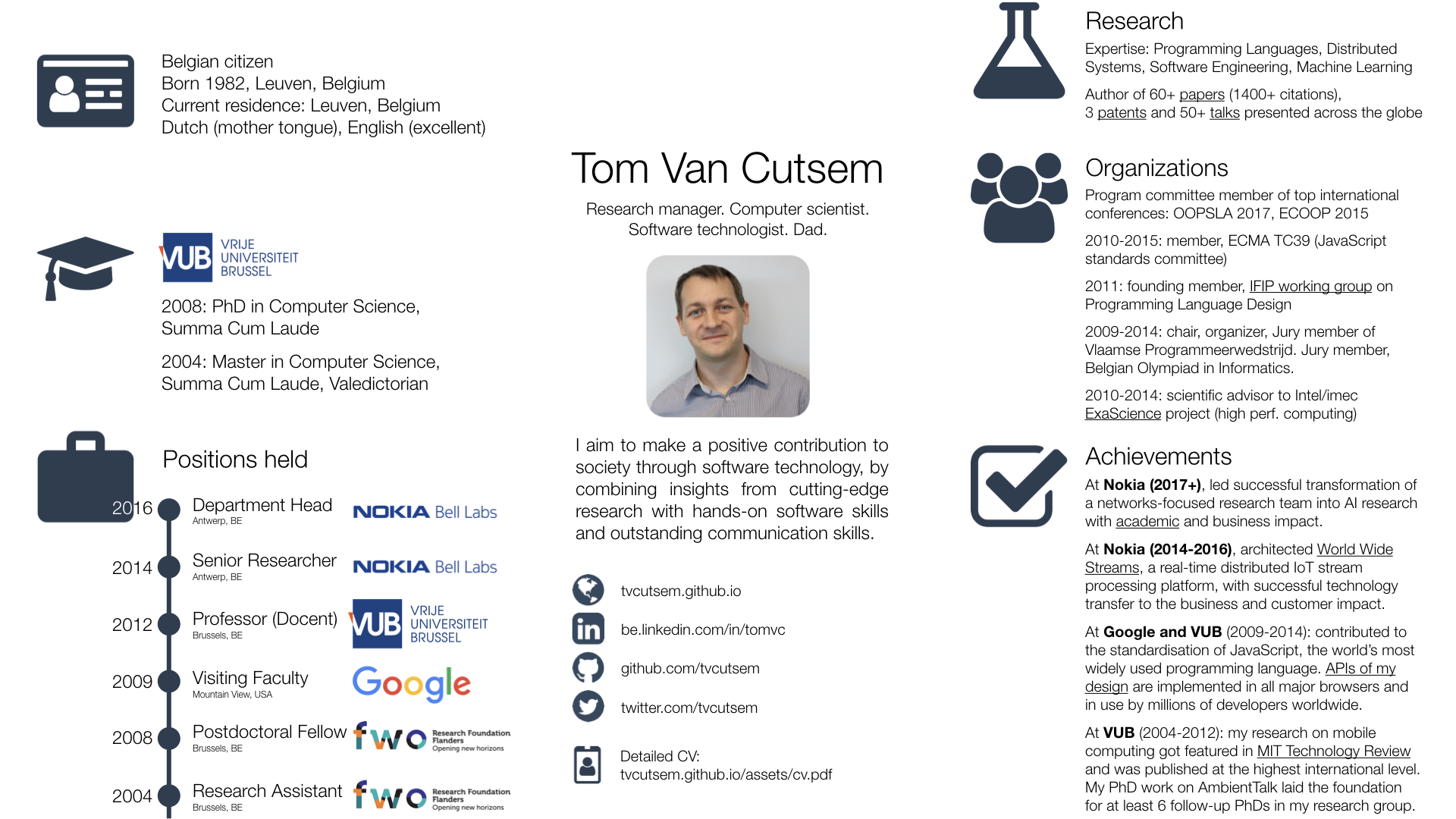
Tom Van Cutsem is an Associate Professor of computer science at KU Leuven in Belgium, where he is affiliated with the Distributed and Secure Software (DistriNet) research group within the Faculty of Engineering Science and Department of Computer Science. He also maintains an affiliation with Nokia Bell Labs, where he previously served as a Research Department Head with research interests in decentralized systems, IoT, stream processing and machine learning for software engineering. His academic career includes a previous position as Assistant Professor at Vrije Universiteit Brussel from 2010 to 2014. Dr. Van Cutsem holds a PhD in Computer Science from Vrije Universiteit Brussel. His educational background has provided the foundation for his expertise in distributed systems, programming languages, and software security. His primary research interests span Distributed Systems , Software Security , Blockchain , and Programming Language Design . With the DistriNet research group, he pursues work on decentralized systems, IoT, stream processing, and machine learning for software engineering. His research focuses on making distributed systems more secure, reliable, and accessible, with particular attention to blockchain technology and Web3 infrastructure. He is a founding member of IFIP WG 2.16 on Programming Language Design. His recent publications demonstrate a strong focus on blockchain security and infrastructure, with numerous papers on Web3, smart contracts, and decentralized systems from 2023-2025. His work addresses critical challenges in blockchain validation, smart contract security, and Web3 infrastructure, reflecting his commitment to making decentralized systems more secure and accessible to low-resource participants. Several of his current projects focus on secure middleware for smart contracts and scalable infrastructure for self-sovereign applications. Dr. Van Cutsem supervises PhD students including Weihong Wang, with whom he has co-authored multiple recent publications. He is currently leading several research projects including SODISA (Scalable Software Development and Infrastructure for Self-sovereign Applications), Secure Sandboxing for WebAssembly-based Smart Contracts, and Programming languages for privacy-preserving and verifiable computing, with funding extending through 2028-2029. He leads research within the Distributed and Secure Software (DistriNet) group at KU Leuven, which focuses on creating secure and dependable distributed systems. His team works on cutting-edge challenges in blockchain infrastructure, smart contract security, and decentralized application development, with connections to both academic and industrial partners including Nokia Bell Labs.
Isabelle Platten is a Professor at the Catholic University of Louvain , affiliated with the Louvain School of Management (LSM) and the Louvain Institute of Data Analysis and Modeling (LIDAM). She is associated with the Louvain Finance (LFIN) unit, focusing on financial economics and quantitative finance. Her research interests span market microstructure , ETF liquidity dynamics , interest rate modeling , credit risk , and banking regulations . Her work explores volatility modeling, payoff replication, and the impact of financial instruments like ETFs on market stability. Her publications highlight trends in financial markets , including liquidity spillovers from ETFs, risk-sharing mechanisms, and regulatory compliance under frameworks like IFRS 9. She has also contributed to understanding market maker behavior and bid-ask spreads on platforms such as NASDAQ Europe. Platten’s affiliations include the Louvain Finance unit and the Louvain Institute of Data Analysis and Modeling , where she engages in interdisciplinary financial research. Her contact details include an email at isabelle.platten@uclouvain.be and an office at LSM, Building B, Mons, Belgium.
Bart Baesens is a full professor at the Faculty of Economics and Business (FEB) at KU Leuven, affiliated with the Information Systems Engineering Research Group (LIRIS). He is a member of Leuven.AI, the university's artificial intelligence institute, and leads the education commission for the Master in Information Management program at FEB. His research focuses on machine learning, fraud detection, credit risk, network analytics, and explainable AI, with applications in finance, insurance, agriculture, and smart systems. Baesens is known for developing frameworks like IML4DQ and GARG-AML, and has contributed to foundational work in sensor data analysis and graph-based learning for AML systems. His recent research emphasizes practical applications of AI, such as improving museum archive accessibility via large language models and enhancing agricultural sustainability through precision irrigation systems. He collaborates with industry partners on projects like predictive maintenance optimization and customer lifetime value modeling, leveraging techniques like temporal fusion transformers and self-supervised anomaly detection. Baesens' work bridges academia and industry, with publications addressing ethical AI, model interpretability, and real-world fraud detection challenges. His contributions span over 150 peer-reviewed articles, including influential studies on credit scoring, social network analytics for insurance fraud, and multi-task learning for environmental monitoring.