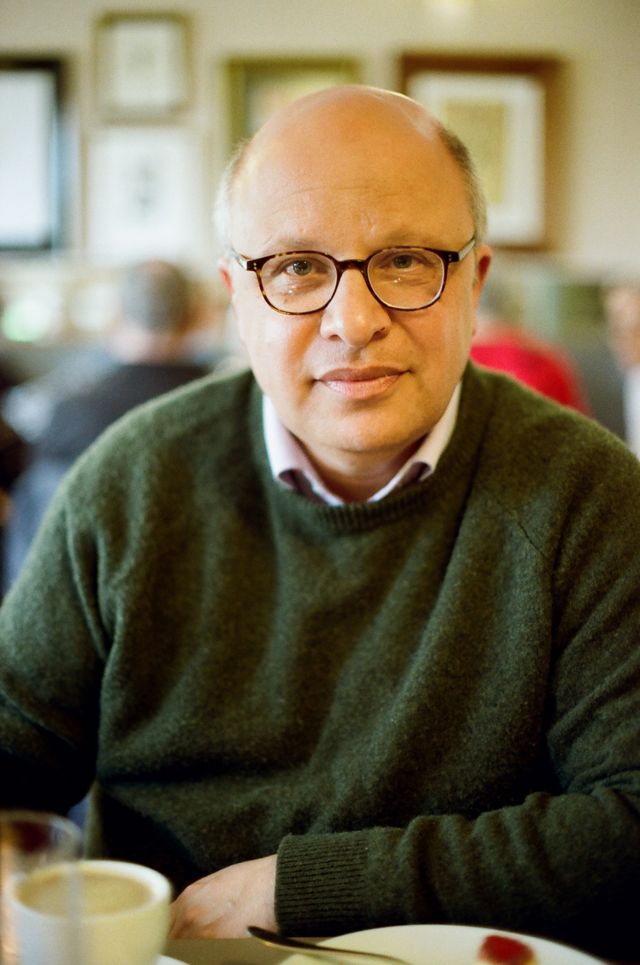
Munther Isaac is a Palestinian Christian pastor, theologian, and academic at Bethlehem Bible College , where he serves as Academic Dean and Director of the Biblical Studies Department. He also leads the Christ at the Checkpoint conference and pastors two churches in Bethlehem and Beit Sahour. Education : BS in Civil Engineering (Birzeit University), MA in Religion-Biblical Studies (Westminster Theological Seminary), PhD in Biblical Theology of the Promised Land (Oxford Centre for Mission Studies) Munther’s research focuses on Palestinian Christian theology , particularly theology of the land , reconciliation, and holistic mission. His work bridges biblical interpretation with contemporary sociopolitical challenges in the Middle East, emphasizing interfaith dialogue and contextual theological education. His publications explore themes such as the book of Daniel’s reception in Arab Christian contexts and the application of Old Testament narratives in Palestinian churches. His recent publications include monographs and articles addressing Christian identity in Palestine , reconciliation ministries , and liturgical practices . Though not explicitly listed, his academic output aligns with broader trends in contextual theology , postcolonial biblical criticism , and conflict resolution . Key Affiliations : Board member of Kairos Palestine, Ministry of Christian University Students in Palestine, Shepherd Society, and Musalaha (reconciliation ministry) Munther is actively involved in community engagement through interfaith forums , public theological education , and women’s ordination advocacy . He is married to Rudaina, an architect, and has two sons.
Jarrod Ray Hore is a Scientia Lecturer in the School of Humanities & Languages at the University of New South Wales (UNSW), Sydney, and Co-Director of the New Earth Histories Research Program. His work explores environmental history, settler colonialism, and the intersections of science, geology, and cultural landscapes. Hore’s research focuses on landscape photography’s role in shaping colonial projects, earthquake geology, and the logistics of the natural history trade. He has published widely in journals like the Pacific Historical Review and Australian Historical Studies, and his award-winning book *Visions of Nature* (2022) examines how photography reinforced settler territoriality. His research interests span environmental history, transnational history, the history of science, and colonial studies. Key areas include the history of settler colonialism in Australia, New Zealand, and North America, as well as the cultural and scientific dimensions of geological exploration. Hore actively supervises HDR and honours students in environmental history, colonial history, and the history of photography. His awards include the Marilyn Lake Prize (2023) and Donna Coates Prize (2022), with shortlist recognitions for prestigious history awards. Beyond academia, he teaches courses like *A House Divided: The Making of Modern America* (ARTS2150), emphasizing U.S. histories of race, class, and global engagement. Hore’s work bridges environmental humanities and colonial studies, analyzing how visual and scientific practices reinforced imperial and settler agendas. His current projects explore the material and logistical networks underpinning natural history collections and the epistemologies of colonial geology.
Professor Alison G. Salvesen (University of Oxford, Asian and Middle Eastern Studies) is a leading scholar in Early Judaism and Christianity, affiliated with the Oxford Centre for Hebrew and Jewish Studies and Mansfield College. Her work bridges textual criticism, translation history, and reception studies. Current Projects: Hexapla Institute Executive Committee (electronic database of Origen's Old Testament), monograph on Jacob of Edessa (d. 708 CE) Teaching: Septuagint studies, Patristic texts, Textual criticism, Syriac literature Specializing in ancient Hebrew Bible interpretations, she examines Greek (Septuagint), Aramaic (Targums), Syriac (Peshitta), and Latin (Vulgate) traditions. Her research spans rabbinic Judaism and early Christian exegesis. Scientific leadership includes co-editing major reference works and directing the Polonsky Fellowship. Current DPhil students include Joel Bell, Yael Krämer, and Paul Ulishney. Key grants/awards: Polonsky Fellow in Early Judaism and Christianity
Dr. Julia Costa López is an Assistant Professor (tenured) in History and Theory of International Relations at the Department of International Relations and International Organisation, Faculty of Arts, University of Groningen. Her work bridges international relations, history, and political thought, focusing on how historical frameworks shape modern disciplinary concepts. PhD from University of Oxford Lecturer at St Hilda's College Fulbright scholar at University of Denver's Josef Korbel School Graduate studies at University of Cambridge Research spans medieval political authority, sovereignty emergence, racialized medievalisms in extremism, and translation politics in global scholarship. Key projects include Routledge Handbook of Historical International Relations (2021) and the Oxford Handbook of History and International Relations (2023). Publications address Eurocentrism, conspiratorial ideology, and ritual's role in authority production. Scientific contributions appear in Cambridge Review of International Affairs , International Organization , and European Journal of International Law . Awards include the Fulbright scholarship. Recent work explores terraqueous relations and premodern world conceptualizations, challenging simplistic land-sea dichotomies in IR.
Karen Bek-Pedersen is a Part-time Lecturer at the Department of Scandinavian Studies, School of Communication and Culture, Aarhus University. Her research focuses on Norse mythology, pre-Christian Nordic religion, ritual practices, and cultural anthropology. She is affiliated with the 'Forskningsenhed for europæisk middelalder' (Research Unit for European Medieval Studies) as a network member. Her publications explore topics such as mythological interpretation, ritual symbolism, and historical analysis of Nordic deities and legends. Notable works include studies on sorcery in medieval literature, symbolic animal representations in Norse myths, and the intersection of kingship and land in pre-Christian narratives. Selected Awards: N/A Advising/Grants: No specific grants or advising roles listed. Labs/Teams: Active member of the European Medieval Studies research network.
Mariane C. Ferme is a Professor in the Department of Anthropology at the University of California, Berkeley. Her research focuses on sociocultural dynamics in West Africa, particularly Sierra Leone, with expertise in political anthropology, legal studies, and material culture. She holds a PhD in Anthropology from the University of Chicago and has taught at prestigious institutions including the University of Cambridge and École des Hautes Études en Sciences Sociales. Education : PhD in Anthropology (University of Chicago), MA in Political Science (University of Milano), BA in Anthropology (Wellesley College). Ferme’s research spans the political imagination in conflict zones, agrarian transformations, and the interplay between humanitarian law and local justice systems. Her work has been supported by major grants from the National Science Foundation and the France-Berkeley Fund. She has published extensively on Sierra Leone’s post-war societies and the socio-cultural dimensions of the Ebola outbreak. Scientific awards include funding from the National Science Foundation, Hellman Family Faculty Fund, France-Berkeley Fund, Harvard Academy for International and Area Studies, and the Carter Woodson Institute for African and African-American Studies.
Anne-Lise François is an Associate Professor in the Departments of English and Comparative Literature at the University of California, Berkeley. She earned her PhD in Comparative Literature from Princeton University. Her work bridges 18th- and 19th-century British literature with contemporary environmental humanities, focusing on themes of ecological ethics, literary minimalism, and non-productive temporalities. Current research explores pastoral worldliness and commons-based economies in Romantic and modernist texts. Key scholarly contributions include her prize-winning book *Open Secrets: The Literature of Uncounted Experience* (2007), which examines 'affirmative reticence' in works by Jane Austen, Mme de Lafayette, and Emily Dickinson. Her recent projects address climate crisis narratives, food politics, and the intersection of aesthetic theory with ecological urgency. Teaching emphasizes transhistorical literary studies and environmental criticism Active in interdisciplinary collaborations across literature, philosophy, and environmental science Current book project: *Provident Improvisers: Parables of Subsistence from Wordsworth to Benjamin* Her writing synthesizes close textual analysis with broader socio-ecological frameworks, challenging Enlightenment models of productivity and advocating for 'recessive fulfillment' in both art and life.
Stephen Spector is a Professor of English at Stony Brook University since 1972, with a PhD from Yale University (1973). His work bridges medieval literature, religious studies, and language history. He has held visiting positions at the Hebrew University (Jerusalem, 1996–97) and fellowships at the National Humanities Center and Wesleyan University. His research focuses on medieval English literature, particularly mystery plays and biblical texts, alongside modern topics like Christian Zionism and the Ethiopian Jewish rescue operation (Operation Solomon). He has authored influential books such as Evangelicals and Israel (2009), which won the London Book Festival Prize, and Operation Solomon (2005), honored with the JDC-Herbert Katzki Award. Education: B.A. in English and Psychology from Penn State University (1968), M.Phil. and Ph.D. from Yale University (1973). He has taught courses ranging from the history of the English language to medieval literature and the Bible as literature. Research highlights include pioneering studies on anti-Semitism in medieval mystery plays, textual editing of the N-Town Play, and modern analyses of religious-political intersections. His recent work explores biblical prophecy’s influence on US foreign policy and contemporary grammar usage guides. Awards include the Van Courtlandt Elliott Prize (1980) for medieval scholarship, National Endowment for the Humanities grants, and SUNY Research Foundation fellowships. He has also contributed op-eds on topics like Sarah Palin’s religious influences and Israel-Evangelical relations. Grants and fellowships span decades, including directing NEH summer seminars on Jewish presence in early English literature (1993, 1996). His work often integrates historical methodologies with contemporary cultural analysis. Labs/Teams: Not explicitly listed, but his research collaborations are evident in co-edited volumes like The Olde Daunce (1991) and contributions to interdisciplinary projects like the Early English Text Society.
Margaret Robinson is an Associate Professor at Dalhousie University, holding dual appointments in the Department of English and Department of Sociology and Social Anthropology within the Faculty of Arts and Social Sciences. She is a bisexual two-spirit scholar from Eski'kewaq, Nova Scotia, and a member of the Lennox Island First Nation. Her interdisciplinary work bridges Indigenous studies, queer theory, and intersectional feminism, with a focus on decolonizing methodologies and Indigenous oral traditions. Robinson’s research explores representation of Indigenous peoples and sexual/gender minorities in creative works, including fanfiction and popular culture. She holds a Tier 2 Canada Research Chair in Reconciliation, Gender, & Identity (2019-2023) and leads the Mi’kmaw Cultural Research Lab funded by the Canadian Foundation for Innovation (2021-2024). Her education includes a BA from Saint Mary’s University and MA/PhD from the University of Toronto. Key research areas include Indigenous New Wave literature, Mi’kmaw spirituality, and Two-Spirit feminism. Recent grants focus on reconciliation frameworks and LGBTQ2S+ health equity. She has published widely on topics like queer mental health, animal personhood in Mi’kmaw cosmology, and decolonizing pedagogies.
University of California , Santa Barbara (UCSB)United States
Adam Sabra is a Professor and King Abdul Aziz Ibn Saud Chair in Islamic Studies at the University of California, Santa Barbara (UCSB). He holds a Ph.D. from Princeton University (1998). His research focuses on pre-modern Middle Eastern history, particularly Egypt, with emphasis on medieval and early modern periods. Key areas include social/cultural history of Cairo, poverty/charity systems, legal history, and Islamic mysticism. Education: Ph.D. in History, Princeton University, 1998 Research Interests: Medieval Egyptian urban society and economy Sufi orders and spiritual lineages Legal and charitable institutions under Mamluk and Ottoman rule Families and social mobility in early modern Egypt Recent Scholarship Trends: Recent work examines aristocratic families in Ottoman Egypt (1500–1800) and integrates hagiography into social history analysis. His publications span topics like waqf systems, artisan-scholar networks, and gender dynamics in Sufi literature. Scientific Awards & Activities: Cleveland Bayard Dodge Distinguished Visiting Professorship at AUC (2014–15) Member, Institute for Advanced Study, Princeton (2012–13) National Endowment for the Humanities Fellow Advising & Grants: Advises graduate students Nicholas Liu and Ibrahim Mansour. His research has been supported by fellowships from NEH and the American Research Center in Egypt. Labs/Teams: Collaborates with scholars in Islamic studies through edited volumes and international research networks.
Dr. Roy Fischel is a researcher at SOAS University of London within the School of History, Religions and Philosophies. Specializing in Islamic history , Deccan Sultanates , and persianate cultural exchange , his work bridges South Asian history and Middle Eastern political thought . Education : Not explicitly mentioned in provided texts Research Themes : Persianate cultural diffusion Islamic state formation Deccan sultanate legitimacy Comparative imperial dynamics Gender studies in Ottoman Palestine His academic output demonstrates deep engagement with manuscript circulation (1400-1700) and cosmopolitan language practices. Though no scientific awards appear in the dataset, his supervision of 5 doctoral theses shows significant academic mentorship. Key publications include: 2020: Local States in an Imperial World (monograph) 2019: The Niẓām Shāhīs (encyclopedia entry) 2017: Aḥmadnagar (encyclopedia article) 2008: Sultan Abdülhamid II and Palestine (journal article) His work often analyzes state formation processes through multilingual manuscript cultures and transregional networks .
Prof. Dr. Koert van Bekkum serves as Professor and Department Chair of Old Testament at the Evangelische Theologische Faculteit Leuven (ETF Leuven), where he also holds the position of Academic Vice Dean for Research since 2022. Previously, he was an Associate Professor of Old Testament at ETF Leuven (2018-2020) and continues to hold an Associate Professor position at Theological University Kampen since 2018. His academic career spans biblical scholarship, theological education, and research leadership in the field of Old Testament studies within the Reformed tradition. His educational background includes: PhD from Theological University Kampen (2010) with highest honors, dissertation: 'From Conquest to Coexistence: Ideology and Antiquarian Intent in the Historiography of Israel's Settlement in Canaan' Basiskwalificatie Onderwijs, Vrije Universiteit Amsterdam (2014) Visiting PhD Candidate, Archaeological Institute, Hebrew University Jerusalem (2000) Member Megiddo Expedition (1998, 2000) Drs. theol., Theological University Kampen (1997) VWO-diploma (gymnasium), Gomarus College, Groningen (1989) Van Bekkum's research interests span multiple dimensions of Old Testament scholarship, with particular emphasis on biblical historiography, archaeology of the Southern Levant, and the intersection of biblical studies with Reformed theology. His work demonstrates deep engagement with ancient Near Eastern contexts, biblical chronology, and the theological interpretation of scripture. He has made significant contributions to understanding biblical covenants, ancient Israelite history, and the relationship between biblical texts and archaeological evidence. His scholarship often bridges traditional Reformed theological perspectives with contemporary academic approaches to biblical studies, creating a distinctive voice in the field that values both confessional commitments and scholarly rigor. His recent publications reveal a consistent focus on the intersection of biblical texts with historical and archaeological contexts, particularly regarding the chronology of ancient Israel and the Southern Levant. Van Bekkum frequently examines how biblical narratives interact with ancient Near Eastern contexts, as seen in his work on Joshua, Deuteronomy, and biblical covenants. His scholarship shows a growing interest in reception history and how biblical texts have been interpreted across different eras, including contemporary contexts of religious pluralism. Notably, he has engaged with controversial topics like the Shapira forgeries and biblical chronology, demonstrating willingness to tackle complex scholarly debates while maintaining theological integrity. Van Bekkum is actively involved in academic service, serving on the Executive Board of the Netherlands School for Advanced Studies in Theology and Religion (2017-), as a member of the American Schools of Oriental Research (2019-), and previously as Secretary of the Oudtestamentisch Werkgezelschap in Nederland en België (2017-2022). His leadership extends to editorial roles, including previous service on the Editorial Board of Verantwoordingsreeks (2014-2017) and the Board of the Society for Christian Philosophy (2013-2017). His academic work is characterized by a commitment to integrating biblical scholarship with Reformed theological tradition while engaging constructively with contemporary scholarly debates. Van Bekkum's research demonstrates how historical-critical methods can coexist with confessional theological commitments, offering a model for evangelical scholarship that is both academically rigorous and theologically faithful.
Elise Kleivane is an Associate Professor in Written Culture at the Department of Norse and Celtic Philology, Faculty of Humanities, University of Oslo. She has served as Head of Teaching at ILN (Institute of Language and Literature) from 2021 to 2024 and maintains an active research and teaching profile in Norse philology and related fields. Dr. Kleivane earned her PhD in Norse Philology from the University of Oslo in autumn 2011, following a Master of Arts in Norse Philology completed in spring 2003. Her academic journey has positioned her as a leading scholar in medieval Scandinavian writing culture. Her research focuses on epigraphy, runology, and medieval literacy, with particular emphasis on the intersection of written and material culture in medieval Norway. Kleivane examines how writing functioned in both public and private spheres, analyzing inscriptions in runes and Roman script as evidence of medieval communication practices. Her work bridges philology, archaeology, and cultural history to reconstruct literacy patterns in pre-modern Scandinavia. Recent projects have explored religious texts, biblical translations, and the role of writing in ecclesiastical contexts. Analysis of her publication record reveals a consistent trajectory through medieval epigraphy and literacy studies. Her work demonstrates increasing sophistication in connecting material evidence with textual analysis, moving from specific inscription studies to broader questions about writing culture. The pattern shows strong engagement with interdisciplinary approaches, combining philological expertise with archaeological and historical methodologies. Her research increasingly addresses questions of religious practice, vernacular literacy, and the transmission of knowledge in medieval Scandinavia. Among her significant appointments, she has been appointed to the Language Council's expert council for standardization and language observation (2023-2026) and to the Sources Commission (2023-2026), serving on the editorial board for the National Archives' scientific publication channels. Dr. Kleivane has secured substantial research funding, most notably leading the Norwegian Research Council-funded project 'Letters between runes and manuscripts' (2017-2021) and participating in the NORDCORP-funded 'Retracing the Reformation' project (2013-2017). She currently contributes to the Riksbanken Jubileumsfond-funded research program 'Modes of Modification' (2018-2025) as a member of its steering committee, where her research focuses on 'Texts in the Open and Out of Sight: Public and Private Communication in Epigraphy.' She teaches across multiple institutions including the University of Oslo and Stockholm University, covering subjects ranging from Norse literature and mythology to runology and medieval manuscript culture. Her teaching reflects her research interests in written culture across the medieval Scandinavian world.
Pamela Klassen is a Professor and Chair in the Department for the Study of Religion at the University of Toronto, with a cross-appointment in the Department of Anthropology. She has taught at the University of Toronto since 1997 and has been a full professor since 2011. Her academic leadership includes serving as Chair & Graduate Chair of her department (2020-present) and as Vice-Dean, Undergraduate & International in the Faculty of Arts & Science (2016-2020). In 2022-2023, she served as the William Lyon Mackenzie King Visiting Professor of Canadian Studies at Harvard University. Professor Klassen's research focuses on colonialism, treaties, museums, and public memory. Her work spans several interconnected areas: Anthropology of religion, secularism, and mediation (including digital humanities) Christianity, colonialism, and land in North America & Turtle Island Religion, ritual, and public memory (including museum studies) Religion, spirituality, and gender Her scholarship demonstrates a consistent engagement with how religious practices, memories, and institutions intersect with questions of power, land, and identity in settler colonial contexts. Klassen's work often bridges historical and ethnographic approaches, examining both contemporary religious practices and their historical formations. Professor Klassen's publications reveal a trajectory of increasingly focused attention on the intersections of religion, land, and colonialism, with recent work emphasizing Indigenous perspectives and decolonial approaches to religious studies. Her scholarship moves fluidly between theoretical interventions in religious studies and concrete engagements with public memory projects. Scientific Awards & Honors 2022-2023: William Lyon Mackenzie King Visiting Professor of Canadian Studies, Harvard University 2019: Fellow of the Royal Society of Canada 2015-2020: Anneliese Maier Research Award, Alexander von Humboldt Foundation 2015: Northrop Frye Award of Excellence for Integration of Research and Teaching 2014-2017: Distinguished Visiting Professor in Anthropology of Modern Religion, University of Tübingen 2012: American Academy of Religion Award of Excellence for Spirits of Protestantism Professor Klassen has successfully secured significant research funding, including the prestigious Anneliese Maier Research Award which supported her collaborative work with the Kay-Nah-Chi-Wah-Nung Historical Centre. She has supervised numerous graduate students in religious studies and anthropology, with many going on to successful academic careers. Professor Klassen leads several major collaborative projects including Kiinawin Kawindomowin Story Nations, a digital storytelling initiative with the Rainy River First Nations, and Treaty Conversations, an educational resource about treaty relationships in Ontario. These projects exemplify her commitment to community-engaged scholarship that bridges academic research with public education and reconciliation efforts.
Joan Taylor is a Professor in the Department of Theology and Religious Studies within the Faculty of Arts & Humanities at King's College London. Her interdisciplinary research bridges literature, language, history, and archaeology to examine early Christian texts and Second Temple Judaism within their socio-historical contexts. Her primary research focuses include: New Testament studies with emphasis on historical figures (Jesus, John the Baptist, Mary Magdalene); Dead Sea Scrolls and Qumran archaeology; Alexandrian Judaism including Philo of Alexandria; women's roles in early Christianity; and the archaeology of Christian holy sites across Palestine. Taylor employs a contextualizing methodology that integrates literary analysis with archaeological evidence. Her recent publications reveal consistent engagement with gender studies in religious contexts, historical Jesus research, and archaeological analysis of sacred spaces. Key themes across her 109 research outputs include the interplay between textual traditions and material evidence, particularly regarding women's leadership roles and the spatial organization of ancient religious communities. Iren Levi-Sala Prize (1995) Taylor has secured significant research funding including a Wellcome Research Grant for her pharmacological analysis of Essene practices, a British Academy grant for her Philo commentary, and Leverhulme Trust support for projects on Coptic Apocrypha and 'Babatha’s Sisters'. Her current active project examines social and economic relationships behind early Christian texts using papyrological resources. She has supervised 11 postgraduate students and contributed to public understanding through media engagements including the 'Jesus' Female Disciples' documentary and advising on Fern Britton's Holy Land Journey.